“The greatest courage is not to be unafraid, but to be afraid and go on anyway.”
— Faustina often imparts wisdom to young Toby.

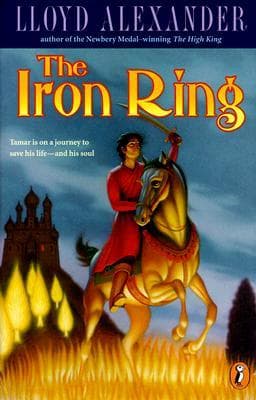
Lloyd Alexander (1997)
Genre
Fantasy / Children's / Young Adult
Reading Time
283 min
Key Themes
See below
Sign in to track this book
Bound by a losing game of chance and the iron ring on his finger, young King Tamar embarks on a perilous, dharma-driven quest through a land of talking animals, cunning kings, and ancient Indian mythology to reclaim his life and discover his destiny.
Young King Tamar of Sundari plays a game of chance, 'Pachisi,' with a mysterious stranger, King Sarva. Tamar loses, and Sarva demands an unusual forfeit: Tamar's life, to be claimed when Sarva chooses. Sarva places an iron ring on Tamar's finger, which cannot be removed. Though Tamar's Royal Counselor, Advis, dismisses it as a dream, the ring and Tamar's sense of dharma compel him to honor the debt. He resolves to journey to Sarva's distant kingdom, Vanara, to face his fate and understand the ring's meaning.
Driven by his dharma, King Tamar leaves his kingdom and begins his solitary journey towards Vanara. He soon meets a large, talkative eagle named Chewak, who is overly concerned with his own safety. Chewak reluctantly agrees to accompany Tamar, offering aerial views. Further on, they meet the eccentric monkey king, Ashva. Ashva, who claims to have once been a human king cursed into a monkey, is a master of riddles but possesses surprising wisdom. He joins Tamar's quest, offering his unique perspective, though his loyalty is often tested by his mischievous nature.
As their journey continues, Tamar, Chewak, and Ashva find a village terrorized by a rakshasa, a man-eating demon. Here, Tamar meets Mirri, a brave milkmaid who initially mistakes him for a common traveler. Mirri shows remarkable courage and resourcefulness. Tamar, upholding his duty as a king, confronts the rakshasa and, with his companions' unexpected help, defeats it. Mirri, impressed by his valor, decides to join their group, adding a vital human element and a practical perspective.
The travelers arrive in a desolate desert kingdom ruled by a cruel and greedy king, who holds his people captive and hoards all resources. This king is a Yaksha, a nature spirit often linked to wealth, but here he is malicious. Tamar is appalled by the suffering and feels compelled by his dharma to intervene. He and his companions plan to subtly undermine the king's authority and redistribute his ill-gotten gains to the starving people. This episode tests Tamar's compassion and leadership, reinforcing his commitment to justice over personal gain, even if it delays his own quest.
During their travels, Ashva slowly reveals more about his past as King Jambu and the curse that changed him into a monkey. He speaks of a powerful sorcerer named Dharma-Raja and a game of dice that led to his downfall. Ashva believes his transformation is linked to a broken promise or an act of deceit, and he deeply wants to return to his human form. His desire to be free from the curse adds another layer of purpose to their journey, as he hopes that confronting King Sarva or finding a solution in Vanara might also offer a path to his own redemption.
The companions enter the perilous Valley of the Naga, a region with intelligent, powerful serpent beings. They meet the formidable Naga King, a wise but cautious ruler wary of humans. To pass through his lands, Tamar must prove his worth and integrity. The Naga King presents a series of riddles and moral tests, challenging Tamar's understanding of duty and honor. Tamar's respectful manner and his clear explanation of his dharma ultimately win the Naga King's trust, allowing the group safe passage, further showing Tamar's growing diplomatic skills and strong moral compass.
Finally, after many trials, Tamar and his companions arrive at Vanara, King Sarva's kingdom. Vanara is not what Tamar expected; it is a desolate, eerie land, filled with a strange silence. King Sarva himself is a much more powerful and ancient being than Tamar had imagined, possibly divine. Sarva's true nature relates to fate and cosmic order, and his intentions become clearer: he tests the resolve and honor of kings. The iron ring on Tamar's finger pulsates with a new, ominous energy.
King Sarva reveals that the initial game was only the beginning. He challenges Tamar to a final, ultimate game of Pachisi, with stakes far greater than Tamar's own life. Sarva explains that he tests the dharma of kings, and that Tamar's journey and actions have been part of this grand design. The lives of Tamar's companions—Mirri, Chewak, and Ashva—are also at stake, along with the fate of Sundari. Tamar must play with absolute focus and integrity, understanding that every decision reflects his deepest character and the strength of his dharma.
During the final game, King Sarva presents Tamar with a series of difficult choices, each designed to test his dharma to its limit. Tamar, remembering the lessons learned and the sacrifices made by his companions, and understanding that true kingship involves putting others first, makes a selfless choice. He offers to forfeit his own life to save his companions and his kingdom, showing an ultimate understanding of dharma as self-sacrifice and responsibility. This act of profound selflessness is the turning point, proving his worth beyond any game.
Upon Tamar's selfless declaration, King Sarva reveals his true purpose: not to destroy, but to affirm. The iron ring, which had bound Tamar to his fate, magically falls from his finger, signifying his release and the completion of his test. As a reward for Tamar's unwavering dharma, Sarva lifts the curse on Ashva, transforming him back into his human form, King Jambu. The companions rejoice, their bonds strengthened by the arduous journey. Tamar has not only survived but has grown into a truly wise and compassionate ruler, having fully embraced the deepest meaning of dharma.
Tamar, Mirri, and the newly human Jambu (formerly Ashva), along with Chewak, prepare to return. Tamar, now a king shaped by adversity and enlightened by experience, understands his responsibilities. He has learned that true power is not in conquest, but in compassion, justice, and self-sacrifice. Mirri, who has proven herself an invaluable companion and a woman of immense courage and wisdom, returns with him, their bond having deepened into love. Tamar is ready to rule Sundari with a wisdom and empathy he could not have had before his dangerous quest, promising a golden age for his kingdom.
The Protagonist
Tamar transforms from an untested, somewhat rigid ruler into a wise, empathetic, and truly selfless king who understands the deeper meaning of dharma.
The Supporting
Mirri's courage and wisdom are recognized and valued, solidifying her role as a partner and eventually a queen.
The Supporting
Ashva seeks and ultimately achieves redemption and transformation back into his human form, King Jambu, through Tamar's selfless act.
The Supporting
Chewak slowly overcomes his cowardice, demonstrating flashes of bravery and developing genuine loyalty to Tamar.
The Antagonist/Catalyst
Sarva remains a mysterious, unchanging force, serving as the ultimate test and arbiter of dharma for Tamar.
The Supporting
Advis's role is largely static, serving as a pillar of traditional wisdom and support for Tamar.
The Mentioned
The Naga King serves as a test of Tamar's diplomatic skills and respect for other cultures.
The Mentioned
Dharma-Raja's actions are part of the backstory, driving Ashva's character arc.
The central theme, 'dharma,' explores its many meanings: duty, honor, cosmic law, and right conduct. Tamar's journey begins with his strict adherence to dharma, compelling him to honor a debt others dismiss. As he progresses, he learns that dharma is not just about rules, but about compassion, self-sacrifice, and putting others' welfare first. His encounter with the cruel Yaksha king, his protection of Mirri, and his willingness to sacrifice himself for his companions all deepen his understanding of true dharma. The iron ring is a constant, physical reminder of this principle.
“A king's dharma is not merely to rule, but to serve.”
The novel examines what makes a good king. Initially, Tamar is king by birth, but his journey forces him to earn his kingship through character trials. He learns that a king must be compassionate (as shown in the Yaksha kingdom), brave (against the rakshasa), wise (in dealing with the Naga King), and ultimately selfless (in his final confrontation with Sarva). His companions, especially Mirri, teach him about common people's lives and practical leadership, while Ashva offers cynical wisdom. By the end, Tamar understands that true leadership means serving his people, not just being served.
“Power is not in the crown, but in the heart that wears it.”
Many characters change significantly. Tamar evolves from a somewhat naive monarch to a truly enlightened ruler. Ashva's entire story involves his desire for redemption and his transformation back into King Jambu, a direct result of Tamar's selfless dharma. Even Chewak, the cautious eagle, shows moments of courage and growing loyalty. These transformations highlight that challenges and self-reflection can lead to deep personal change, and that past mistakes can be atoned for through right action and the help of others.
“To change one's skin is easy; to change one's heart, that is the true magic.”
The story constantly plays with the tension between predetermined fate and individual choices. King Sarva, as a dealer in destiny, seems to orchestrate Tamar's journey, suggesting a fated path. However, Tamar's steady commitment to his dharma, his choices in facing challenges, and his ultimate act of self-sacrifice show the power of free will to shape destiny. The iron ring itself symbolizes this interplay: a fated burden that Tamar chooses to confront with his own moral agency, leading to a resolution that is both fated and earned through his actions.
“Destiny may lay the path, but your feet must walk it.”
A magical, unremovable ring symbolizing a binding debt and Tamar's dharma.
The iron ring is the central plot device, serving as a tangible representation of Tamar's debt to King Sarva and his unwavering commitment to his dharma. It cannot be removed by ordinary means, physically binding Tamar to his quest. Beyond its literal function, the ring acts as a constant, visible reminder of his burden and his honor, driving his actions and reinforcing the theme of duty. Its eventual removal signifies the completion of his spiritual and moral journey, and his ultimate triumph.
A game of chance used by King Sarva to initiate and conclude Tamar's quest.
Pachisi, an ancient Indian board game, is used as a metaphorical and literal device to frame Tamar's journey. It symbolizes the unpredictability of life and the role of chance, but also the importance of strategy and character. Sarva uses the game to set the stakes for Tamar's life, and later, for the lives of his companions and his kingdom. The game becomes a representation of the larger cosmic game of dharma, where one's choices and integrity are the true currency, culminating in a final test of Tamar's moral fiber.
Talking animals who provide comic relief, distinct perspectives, and aid.
Chewak, the cowardly eagle, and Ashva, the wily monkey king, serve as more than just sidekicks. They offer comic relief and lighten the tone, but also provide unique perspectives on Tamar's journey. Chewak's fear often highlights Tamar's courage, while Ashva's cynicism and riddles challenge Tamar's idealism and provide unexpected wisdom. Their animal forms and distinct personalities allow for allegorical commentary on human nature, and their own character arcs (Chewak's gradual bravery, Ashva's redemption) mirror and support Tamar's central journey.
“The greatest courage is not to be unafraid, but to be afraid and go on anyway.”
— Faustina often imparts wisdom to young Toby.
“A sword is not only for striking; it is also for defending, and sometimes, for not striking at all.”
— Toby learns about the true purpose of a weapon.
“There are some things that cannot be taught, only learned through experience.”
— Toby reflects on his journey and the lessons he's gained.
“Hope is a small thing, but it is enough to light the darkest path.”
— When the companions face despair, a glimmer of hope remains.
“The world is full of choices, and each one changes the path you walk.”
— Toby considers the consequences of his decisions.
“Even the mightiest king must sometimes bend his knee.”
— A lesson in humility for those in power.
“True strength is not in how much you can lift, but in how much you can bear.”
— Toby endures hardship and grows stronger emotionally.
“Stories are not just for amusement; they are lessons wrapped in wonder.”
— The importance of tales and their inherent wisdom.
“Sometimes, the greatest battle is fought within oneself.”
— Toby grapples with his inner doubts and fears.
“Loyalty is a bond stronger than any chain of iron.”
— The companions demonstrate unwavering loyalty to each other.
“A true friend will tell you what you need to hear, not just what you want to hear.”
— Faustina offers honest advice to Toby.
“The path to wisdom is often paved with mistakes.”
— Toby learns from his errors throughout his quest.
“To truly see, one must sometimes close their eyes.”
— A paradoxical piece of advice about inner vision and understanding.
“Even the smallest creature can change the course of a king's destiny.”
— Toby, initially underestimated, proves his worth.
Ready to see how well you understood this book? Take our interactive quiz with 10 questions.

Biography coming soon.







