“I believe that the cinema is a total art, and that the director is the true author of the film.”
— The narrator's reflection on art and cinema, early in his stay on the island.

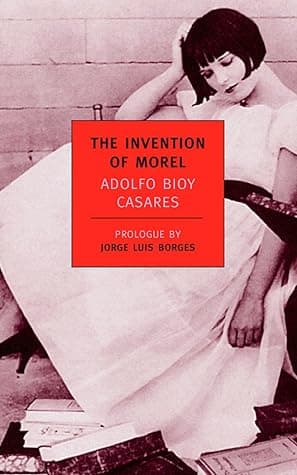
Adolfo Bioy Casares (1964)
Genre
Fantasy / Science Fiction
Reading Time
120 min
Key Themes
See below
Sign in to track this book
On a deserted island, a fugitive finds a perpetually replaying society of holographic projections, falls in love with an illusory woman, and confronts the terrifying implications of a machine that blurs the lines between life, memory, and immortality.
The unnamed narrator, a Venezuelan political fugitive, arrives on a desolate, seemingly abandoned island in the South Pacific. He chose this island because of rumors of a mysterious, incurable disease that once plagued it, believing it would deter pursuers. He settles into a dilapidated museum-like building, noting its strange, oversized furniture and the presence of two lighthouses and a swimming pool. His initial days are spent alone, scavenging for food and exploring the peculiar, overgrown structures, all while documenting his observations in a diary. He enjoys his isolation, convinced he is the sole inhabitant.
One evening, the narrator is shocked to discover a group of elegantly dressed people suddenly appearing near the swimming pool. They seem to be on vacation, sunbathing, swimming, and dancing. Among them is a beautiful woman the narrator calls Faustine, with whom he immediately becomes infatuated. He observes them from a distance, terrified of being discovered but equally captivated. He notes their strange habits, such as repeating the same actions day after day, and their apparent indifference to him, even when he believes he is in plain sight.
The narrator becomes obsessed with Faustine, watching her every move and trying to understand her. He tries to speak to her directly many times, but she never acknowledges him, appearing to look through him or simply not register his existence. He notices other strange things: the visitors never seem to eat or sleep, and their conversations are often fragmented or repeat exactly. The narrator, driven by his growing infatuation and confusion, begins to question his sanity, wondering if he is hallucinating or if the island is cursed.
A new person, a man named Morel, arrives on the island and immediately takes a leadership role among the group. The narrator observes that Faustine seems to have a complex relationship with Morel, showing both respect and subtle defiance. Morel often gives long, rambling speeches to the group, which the narrator overhears but struggles to understand. His arrival intensifies the narrator's unease and deepens the mystery surrounding the islanders. The narrator suspects Morel holds the key to understanding the strange reality he finds himself in.
During a particularly long speech, Morel gathers his guests and reveals the true nature of their existence. He explains that he has invented a machine capable of recording and projecting reality, capturing not just images and sounds, but sensations and even souls. The guests, including Faustine, were persuaded to participate in a week-long recording session, believing it to be a unique vacation. Morel reveals that the machine projects these recordings perpetually, creating an eternal, living replica of that week. The narrator, hidden and eavesdropping, is horrified and awestruck by this revelation.
The narrator finally understands why the islanders never interacted with him: they are not real, but merely projections, eternally replaying the events of that single week. He realizes their repeated actions, their lack of reaction to him, and their strange, disembodied conversations are all consequences of being part of a perfect, yet lifeless, recording. He learns that Morel's machine draws its power from the tides and projects the images from the museum building. The realization brings both deep disappointment and a new, desperate plan to the narrator's mind.
Morel further explains his invention, describing his desire to achieve a form of immortality and to reunite with a deceased loved one. He reveals that the machine, while creating perfect replicas, also drains the life force of those being recorded, effectively killing them. Morel, along with his guests, knowingly sacrificed themselves to become part of this eternal projection. His motivation, particularly his love for Faustine, becomes clear, as he sought to preserve her existence indefinitely through his invention. This dark truth adds a layer of tragedy to the seemingly idyllic scene.
Consumed by his love for the projected Faustine, and understanding the machine's mechanism, the narrator forms a desperate and dangerous plan. He decides to record himself into the same week's projection, hoping to eternally exist alongside Faustine. He carefully studies the movements and conversations of the projections, particularly Faustine's, to integrate himself seamlessly into their recorded reality. He believes that by mimicking their actions and positioning himself correctly, he can become a permanent part of their artificial world, even if it means sacrificing his own life.
The narrator begins his perilous endeavor. He repeatedly positions himself in the exact locations where Faustine's projection appears, mimicking her gestures, and attempting to align his own existence with hers within the recorded loop. He endures extreme physical discomfort and mental strain, as the machine's energy field affects him. He observes the subtle shifts and repetitions of the projections, trying to find the precise moment to activate the recording device on himself to ensure his inclusion in their eternal week. His ultimate goal is to appear to Faustine as if he has always been there, sharing her reality.
In his final diary entry, the narrator describes his successful, though perilous, integration into the projection. He believes he has managed to record himself into the same week as Faustine. He acknowledges the fatal nature of Morel's invention, knowing that he will die in the process. However, he expresses a deep sense of hope and peace, believing that he will eternally exist alongside Faustine in the projected reality, even if their interaction remains a silent, artificial one. He leaves his diary as a record of his love and his sacrifice, hoping that someday, someone will understand his choice.
The narrator's last written words are a plea to a future inventor, someone with the scientific skill to potentially manipulate Morel's machine. He hopes that this future individual might be able to merge the existing projections, specifically his own and Faustine's, allowing them to truly interact within the artificial world. He imagines a future where his silent love for Faustine can finally be returned, even if only within Morel's invention. This poignant request highlights the tragic beauty and enduring loneliness of his chosen fate, transcending the boundaries of life and death.
The Protagonist
Transforms from a cautious, solitary fugitive into a desperate lover willing to sacrifice his life for an eternal, albeit artificial, connection.
The Object of Affection / Supporting
Remains static as a projection, but her perceived reality shifts from a living woman to a recorded image for the narrator.
The Antagonist / Inventor
Revealed as having made the ultimate sacrifice for his invention, becoming a part of his own creation.
The Supporting / Mentioned
Static as a recorded image.
The Supporting / Mentioned
Static as a recorded image.
The novel constantly blurs the lines between what is real and what is perceived. The narrator initially believes the islanders are alive, only to discover they are perfect, yet lifeless, projections. This theme is central to the entire plot, as the narrator's understanding of reality is repeatedly challenged. Morel's invention forces a re-evaluation of what constitutes life, consciousness, and presence, suggesting that a perfect replica can be indistinguishable from the original, yet fundamentally different. The narrator's ultimate choice to join the illusion further complicates this, as he chooses an artificial reality over a solitary, 'real' existence.
“What does it matter if I am a copy? I shall be with Faustine.”
The driving force behind both Morel's invention and the narrator's sacrifice is an intense, obsessive love. Morel creates his machine to eternally preserve the image of Faustine, willing to sacrifice himself and others for this goal. Similarly, the narrator's love for the projected Faustine is so deep that he chooses to die and become a part of her artificial world, accepting a reality where true interaction is impossible. This theme explores the lengths to which individuals will go for love, even if it means embracing an illusion or sacrificing their own life and genuine connection.
“I am in love with a dead woman. Or, rather, with a woman who will be dead, for whom I shall die.”
Morel's invention is a quest for immortality, an attempt to defy death and preserve life eternally. However, this progress comes at a terrible cost: the original subjects are killed in the process of being recorded. The novel questions the ethical implications of scientific advancement when it involves the sacrifice of life and genuine human experience. Morel's desire to conquer death results not in true immortality, but in an endless, repetitive illusion, highlighting the limitations and moral dangers of pushing scientific boundaries without considering the consequences.
“We shall be immortal, not in flesh, but in image. And perhaps that is the truest immortality.”
The narrator begins his journey seeking isolation as a fugitive, but his solitude is paradoxically intensified by the presence of the projections. He is surrounded by people, yet utterly alone, unable to interact with them. Even after understanding their nature, his choice to join the projection is a choice for an eternal, shared solitude with Faustine, where true connection remains unattainable. The island itself, with its deserted appearance and later its illusory inhabitants, is a powerful symbol of deep isolation, both physical and existential.
“I was more alone among them than I had ever been in my life.”
The story is told through the narrator's diary entries, offering a subjective and intimate perspective.
The entire novel is presented as the narrator's diary, providing an immediate and unfiltered account of his experiences and thoughts. This device allows the reader to experience his confusion, fear, and growing obsession firsthand, mirroring his journey of discovery. The subjective nature of the diary entries also creates suspense, as the narrator's initial misinterpretations and gradual understanding of Morel's invention unfold, making the revelations more impactful. It also serves as a testament to his final act and a plea to future generations.
A complex device that records and perpetually projects reality, including living beings.
Morel's invention is the central plot device, driving the entire narrative. It is a machine capable of capturing and replaying a specific week of reality, including the sensations and consciousness of the people involved. This device creates the illusion of life on the island and is the source of all the strange phenomena the narrator observes. It serves as the catalyst for the narrator's transformation and his ultimate sacrifice, allowing for the exploration of themes like immortality, reality, and love at any cost. Its fatal side effect is crucial to the plot's tragic conclusion.
A seemingly deserted island that becomes the stage for a scientific marvel and a tragic love story.
The island itself is more than just a setting; it acts as a character and a crucial plot device. Its initial reputation as a plague-ridden, deserted place attracts the fugitive narrator. Its strange, overgrown structures and the sudden appearance of the elegant vacationers create an atmosphere of surreal mystery. The island isolates the characters from the outside world, making Morel's experiment and the narrator's subsequent obsession possible. It becomes a contained universe where the boundaries of life and illusion are tested and ultimately broken.
The projected characters endlessly repeat the same actions and conversations.
The constant repetition of scenes, gestures, and conversations by the islanders is a key plot device that initially confuses and then enlightens the narrator. This cyclical nature of their existence is a direct consequence of Morel's machine, which perpetually replays a single week. It serves to highlight the artificiality of their 'lives' and the limitations of their projected reality. For the narrator, observing these repetitions is crucial for understanding the invention and for planning his own integration into their loop, as he must perfectly mimic their pre-recorded existence.
“I believe that the cinema is a total art, and that the director is the true author of the film.”
— The narrator's reflection on art and cinema, early in his stay on the island.
“The idea of immortality, which would be a blessing for a truly good man, becomes a grotesque punishment for the rest of us.”
— The narrator's philosophical musings on the implications of eternal life, before fully understanding Morel's invention.
“I understand that the love of an illusion is still love.”
— The narrator coming to terms with his feelings for Faustine, despite her true nature.
“I was an intruder, a spectator, an invisible man in the midst of a perfect illusion.”
— The narrator observing the 'people' on the island, realizing their unreality.
“Perhaps I am mad, but I prefer to be mad with hope than sane with despair.”
— The narrator's internal struggle and decision to pursue his plan to join Faustine.
“The only way to reach them was to become one of them.”
— The narrator's realization about the nature of Morel's invention and his desperate solution.
“My love for Faustine became the center of my existence, the reason for my survival.”
— The narrator's profound emotional attachment driving his actions on the island.
“Morel's invention was a trap, a beautiful, perfect trap.”
— The narrator's understanding of the nature and implications of the machine.
“We are condemned to repeat our lives, over and over, eternally.”
— The narrator's grim interpretation of the existence of the recorded individuals.
“I have created an eternity, but it is an eternity without consciousness, without will.”
— Morel's own explanation of his invention's limitations and unintended consequences.
“The feeling of being alive, truly alive, is what we lose first in this strange existence.”
— The narrator reflecting on the difference between his own living state and that of the recordings.
“To be alone, utterly alone, is a different kind of death.”
— The narrator's profound sense of isolation before he fully understands the island's secret.
“The most terrible thing is not to die, but to be forgotten.”
— A general reflection on human desires for legacy and remembrance, relevant to Morel's goals.
“My existence here is a dream, a beautiful and terrifying dream.”
— The narrator's summary of his experience on the island, oscillating between wonder and horror.
Ready to see how well you understood this book? Take our interactive quiz with 10 questions.
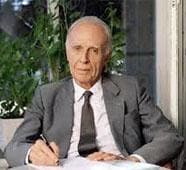
Adolfo Bioy Casares was an Argentine writer, journalist, and translator, best known for his seminal 1940 novel, 'The Invention of Morel.' A close friend and collaborator of Jorge Luis Borges, his work often explored themes of reality, fantasy, and the uncanny. His writing is characterized by its precision, elegance, and subtle philosophical depth.







