“I may be a chump, but I'm not a chump with a capital C.”
— Bertie reflecting on his romantic entanglements and attempts to assert some intelligence.

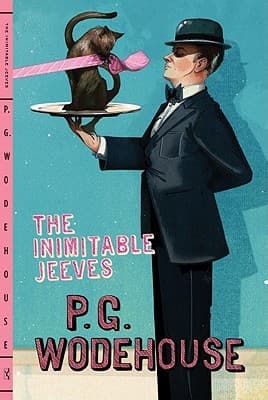
P.G. Wodehouse (1953)
Genre
Historical Fiction
Reading Time
240 min
Key Themes
See below
Sign in to track this book
In a world of misplaced affections, dropped edibles, and upper-class foolishness, only Jeeves's calm and cunning can rescue Bertie Wooster and his friends from their self-made problems.
Bertie Wooster's friend, Bingo Little, loves a waitress named Mabel and needs money to marry her. Bingo's uncle, Lord Bittlesham, is a strict teetotaler, and Bingo fears asking him for funds directly. Bertie, with Jeeves's subtle guidance, tries to help Bingo get a loan from Lord Bittlesham. Their plan involves Bertie inviting Lord Bittlesham to a dinner where Bingo can casually mention his financial needs. However, Lord Bittlesham is a difficult guest, prone to long, dull speeches. Jeeves suggests a more direct approach, but Bertie, in his usual way, fumbles through the situation, making little progress until Jeeves steps in with a more practical solution, securing the money for Bingo.
Bertie's friend, Bicky, a struggling American artist, needs a flat. Bertie, trying to be helpful, suggests Bicky move into his spare room, much to Jeeves's disapproval. Bicky's uncle, a wealthy American meat packer, is visiting London, and Bicky hopes to impress him with an air of prosperity to get financial aid. Bertie and Bicky plan for Bicky to pretend to own Bertie's luxurious flat. However, the uncle, a shrewd and practical man, sees through their charade almost immediately. The situation escalates into a series of misunderstandings and near-disasters, mainly due to Bertie's well-intentioned but flawed interventions. Jeeves, as always, must untangle the mess and restore some order.
Bertie's Aunt Agatha, a formidable woman, insists that Bertie's idle friend, Algernon 'Algy' Wooster (no relation), find work. Bertie, under pressure from his aunt, tries to get Algy a job as a secretary to a reclusive author named Mr. Mulliner. Algy, however, is lazy and unsuited for any work. Bertie's attempts to make Algy seem competent and enthusiastic backfire, leading to humorous mishaps and further infuriating Aunt Agatha. Jeeves, observing the chaos, devises a plan that satisfies Aunt Agatha's demands while allowing Algy to maintain his indolent life, much to Bertie's relief.
Bertie's friend, Biffy Biffen, is engaged but has a terrible memory and keeps forgetting his fiancée's name. The wedding is near, and Biffy is in a panic. Bertie, eager to help, suggests various memory aids, all of which fail. The situation becomes desperate as Biffy's fiancée, Honoria Glossop, grows impatient with his forgetfulness. Bertie's well-meaning but ill-conceived interventions only worsen matters, leading to humorous misunderstandings and near-disasters. Jeeves subtly manipulates events, using his knowledge of human nature and Biffy's habits, to ensure Biffy remembers Honoria's name just in time for the wedding, preventing a disaster.
Bingo Little is again in love, this time with a girl named Mary. His uncle, Lord Bittlesham, disapproves of Bingo's romantic choices and threatens to cut him off financially. Bertie, at Bingo's request, tries to help Bingo impress his uncle. This involves Bertie pretending to be a keen follower of horse racing, a passion of Lord Bittlesham's. Bertie, with his usual lack of sporting sense, struggles to maintain the charade. The plan ends with Bertie, under pressure, making a significant bet on a horse, with disastrous results for his finances. Jeeves, however, turns the tables, recouping Bertie's losses and, through clever maneuvers, bringing Bingo and his uncle to a more amicable understanding.
Bertie's friend, Freddie Bullivant, loves a girl named Elizabeth and needs his uncle, the wealthy and eccentric Mr. Bassington-Bassington, to approve the match and provide financial support. Mr. Bassington-Bassington is a strict vegetarian and dislikes anyone who contradicts him. Bertie, trying to help Freddie, hosts a dinner party where Freddie is supposed to impress his uncle. Bertie's attempts to ensure a smooth evening, however, descend into chaos. Freddie, in his nervousness, makes several blunders, and Bertie's efforts to cover for him only make the situation worse. Jeeves, the master of discreet intervention, steps in to salvage the evening and subtly guide Mr. Bassington-Bassington towards a more favorable view of Freddie and Elizabeth.
Bingo Little, always in love and always needing funds, gets a tutoring position for the son of the wealthy and formidable Mrs. Travers. Bingo, however, is more interested in his latest romantic interest, a governess named Honoria Glossop, than in his tutoring duties. Bertie, pressured by Mrs. Travers to ensure Bingo performs his duties, tries to keep Bingo focused. This leads to comedic misadventures as Bingo tries to juggle his tutoring with his romantic pursuits. Bertie's well-intentioned but clumsy interventions only complicate matters, making Bingo's life more difficult. Jeeves, with his characteristic ingenuity, devises a scheme that allows Bingo to pursue his romantic interests while still satisfying Mrs. Travers, much to Bertie's amazement.
Bingo Little, again in love and short of money, proposes a 'Great Sermon Handicap' – a bet on which of three local vicars will deliver the longest sermon at an upcoming village fete. Bertie, initially reluctant, is drawn into the scheme by Bingo and his friends. The group researches the vicars' past sermon lengths and preaching styles. However, their efforts to influence the outcome, such as trying to distract one of the vicars, lead to humorous and unexpected complications. Bertie's attempts to participate in the 'handicap' highlight his lack of guile. Jeeves, observing the entire farcical endeavor, uses his superior intellect to subtly influence the outcome, ensuring Bertie and his friends emerge relatively unscathed, if not entirely victorious.
Following the 'Great Sermon Handicap', Bingo Little and his friends, still needing funds, devise a new scheme: manipulating the results of the annual village sports day. They plan to bet on various events, including the potato race and the long jump, after assessing the strengths and weaknesses of the local contestants. Bertie, despite his reservations, is drawn into their shenanigans. Their attempts to influence the athletes, through bribery and other dubious means, lead to farcical incidents and unexpected outcomes. The villagers, initially unwitting participants, grow suspicious. Jeeves, once again, unravels the tangled web of their schemes, ensuring that the 'purity of the turf' is restored, albeit after much comedic chaos.
Bingo Little, in another romantic entanglement, needs to win the first prize at a village concert to impress his latest love interest, a young woman named Daphne. Bertie, pressured by Bingo, agrees to help him secure victory. Their plan involves Bertie performing a dramatic recitation, hoping to outshine the local talent. Bertie, however, is a terrible performer, and his attempts to deliver a moving recitation are met with bewilderment and polite applause rather than the desired enthusiasm. The entire concert descends into comedic chaos, with various villagers performing their peculiar talents. Jeeves, observing the entire spectacle, intervenes with a subtle suggestion that allows Bingo to achieve his goal, albeit in a roundabout and unexpected manner, much to Bertie's relief.
Bingo Little, still in love and needing money, decides to launch a new magazine called 'Wee Tots', aimed at parents. Bertie, always a loyal friend, agrees to invest in the venture and help promote it. Bingo's vision for the magazine is eccentric, and his business sense is almost non-existent. Bertie's attempts to assist in the magazine's creation and distribution lead to comical mishaps, including embarrassing encounters with potential advertisers and distributors. The magazine is a spectacular failure, and Bertie's investment is quickly lost. Jeeves, throughout the entire ordeal, offers subtle warnings and advice that Bertie, in his usual way, ignores. Ultimately, Jeeves helps Bertie extricate himself from the financial mess, while Bingo moves on to his next scheme.
Bingo Little, in his latest romantic pursuit, falls for Charlotte Corday Rowbotham, a fervent socialist. To impress her, Bingo adopts socialist ideals and agrees to give a public speech at a workers' rally. Bertie, concerned for Bingo's well-being and reputation, reluctantly attends the rally. Bingo, completely out of his depth, delivers a rambling and unconvincing speech, much to the amusement of the crowd and the dismay of Charlotte. Bertie's attempts to subtly assist Bingo only add to the chaos. The situation devolves into a farcical display of misplaced enthusiasm and political ineptitude. Jeeves, observing the entire spectacle, intervenes with a clever diversion that allows Bingo to escape the embarrassing situation with his dignity somewhat intact, and without further alienating Charlotte.
Bingo Little, after several romantic interests throughout the book, is finally engaged to Honoria Glossop, the formidable daughter of Sir Roderick Glossop. However, his previous romantic entanglements and constant need for funds have strained his relationship with his uncle, Lord Bittlesham. The story ends with a chaotic horse race, similar to the 'Great Sermon Handicap' and 'The Purity of the Turf', where Bertie and Bingo are involved in betting. Bertie, as usual, makes a mess of things, but Jeeves, with his characteristic brilliance, orchestrates events so that Bingo not only wins a substantial sum of money but also secures his uncle's approval for his marriage to Honoria. The book ends with Bingo finally settling down, much to Bertie's relief.
The Protagonist
Bertie remains largely unchanged throughout the book, consistently relying on Jeeves to extricate him from self-made predicaments.
The Supporting
Jeeves consistently demonstrates his unparalleled intellect and resourcefulness, serving as the constant problem-solver.
The Supporting
Bingo's arc involves a series of romantic entanglements, culminating in his eventual marriage to Honoria Glossop.
The Supporting
Aunt Agatha remains a consistent force of nature, perpetually disapproving of Bertie's lifestyle and choices.
The Supporting
Lord Bittlesham's character remains consistent as the disapproving but ultimately generous relative, eventually softened by Jeeves's machinations.
The Supporting
Honoria's arc culminates in her engagement and marriage to Bingo Little, bringing a degree of stability to his life.
The Supporting
Bicky's role is largely static, serving as a catalyst for one of Bertie's early attempts at helpfulness.
The Supporting
Freddie's arc involves overcoming obstacles to secure his inheritance and marry Elizabeth.
Bertie Wooster, despite his good intentions, consistently makes problems worse rather than solving them. His attempts to help his friends, often driven by loyalty or a desire to avoid his Aunt Agatha's anger, are almost always ill-conceived and poorly executed. For example, in 'Jeeves and the Hard-Boiled Egg', Bertie's plan for Bicky to pretend to own his flat leads to chaos when Bicky's uncle arrives. Similarly, in 'Clustering Round Young Bingo', Bertie's efforts to keep Bingo focused on tutoring only complicate Bingo's romantic pursuits. This shows the comedic irony that Bertie's friends would often be better off without his 'help'.
“One of these days, Bertie, you will get into a frightful tangle, and then you will be sorry.”
This theme is clear in the dynamic between Jeeves and Bertie (and his friends). While Bertie and his companions act on impulse, emotion, and often flawed logic, Jeeves consistently shows the power of intellect, foresight, and careful planning. He is the quiet force that untangles every knot, often with Bertie completely unaware of his subtle manipulations. In 'Jeeves and the Unbidden Guest', Jeeves's understanding of human psychology ultimately secures the loan for Bingo, not Bertie's fumbling. In 'The Great Sermon Handicap', Jeeves's superior knowledge allows him to subtly influence the outcome, rescuing Bertie and his friends from their own mistakes. This theme celebrates the quiet genius that can navigate human folly.
“I merely anticipated your requirements, sir.”
Wodehouse often satirizes the idle rich, showing them as largely detached from practical concerns and often focused on trivial pursuits. Bertie and his Drones Club friends are examples, spending their days on elaborate bets ('The Great Sermon Handicap'), romantic problems, and trying to avoid work. The problems they face—how to get money from a disapproving uncle, how to impress a girl, how to avoid a formidable aunt—are often self-created and highlight their privileged but often aimless existence. The contrast between their elaborate schemes and the simple solutions Jeeves provides underscores the comedic absurdity of their world, where a valet often has more common sense than his master.
“The Drones Club, Bertie, is a place where young men gather to discuss their latest romantic entanglements and occasionally, between sips of hock and seltzer, engage in some minor form of betting.”
Throughout the book, the desires for love and money are the main motivators for Bertie's friends, especially Bingo Little. Bingo's endless romantic pursuits are always tied to his need for financial security, often from his disapproving uncle, Lord Bittlesham. These desires lead to elaborate schemes, deceptions, and a constant reliance on Bertie's (and by extension, Jeeves's) resources. Whether it's Bingo trying to impress a girl by winning a competition ('The Metropolitan Touch') or needing funds to marry ('Jeeves and the Unbidden Guest'), the pursuit of romance and the need for financial stability are closely linked, forming the main conflict of many stories and setting the stage for Jeeves's interventions.
“When a fella's in love, Bertie, he needs funds, doesn't he? Capital! The wherewithal!”
Jeeves's timely and ingenious interventions.
While not a literal 'god from the machine,' Jeeves serves as a consistent human deus ex machina. Whenever Bertie and his friends find themselves in an impossible predicament, inevitably due to their own blunders, Jeeves appears with a brilliant, often unexpected, solution. His plans are usually subtle, relying on his deep understanding of human nature and meticulous planning, rather than magical intervention. This device provides comedic relief and a satisfying resolution to seemingly insurmountable problems, highlighting Jeeves's indispensable role.
The humorous contrast between expectation and reality.
Situational irony is a cornerstone of Wodehouse's humor in 'The Inimitable Jeeves'. It frequently arises from Bertie's well-meaning but incompetent attempts to help his friends, which invariably make things worse. The audience expects Bertie to fail, but the specific, often outlandish, ways in which his plans backfire create the comedy. For instance, Bertie's efforts to help Bingo win the 'Great Sermon Handicap' or the village sports day lead to results far different from what was intended, creating a humorous contrast between their ambitious schemes and the chaotic reality.
Repeated humorous elements, particularly Bingo Little's romantic entanglements.
The most prominent running gag in the book is Bingo Little's perpetual state of falling in love with a new woman in almost every story, often leading him to seek Bertie's financial or strategic assistance. This repetition establishes Bingo's character as a hopeless romantic and provides a consistent comedic premise. Other running gags include Bertie's attempts to evade Aunt Agatha and Jeeves's consistent use of obscure literary references, which Bertie never quite understands.
Characters misinterpreting situations or engaging in elaborate hoaxes.
Many of the plots in 'The Inimitable Jeeves' are driven by misunderstandings, either intentional or accidental. Characters frequently misinterpret signals, motives, or events, leading to comedic complications. Additionally, Bertie and his friends often engage in elaborate deceptions, such as Bicky pretending to own Bertie's flat or Bertie feigning interest in horse racing to impress Lord Bittlesham. These deceptions invariably unravel, creating further chaos and requiring Jeeves's intervention to set things straight.
“I may be a chump, but I'm not a chump with a capital C.”
— Bertie reflecting on his romantic entanglements and attempts to assert some intelligence.
“There are moments, Jeeves, when one asks oneself, 'Do I really love this girl?'”
— Bertie contemplating his engagement to Honoria Glossop after a particularly trying incident.
“Jeeves, you are a genius!”
— Bertie's frequent exclamation when Jeeves has extricated him from a difficult situation.
“One of the things I like about you, Bertie, is that you're so infernally easily led.”
— Aunt Agatha's typically blunt assessment of Bertie's character.
“The human heart, they say, is a very complex thing.”
— Bertie musing on the unpredictable nature of affections and decisions.
“I don't know if you've ever experienced it, but there are times when the old brain seems to simply give up the unequal struggle and just lie down and let the waves wash over it.”
— Bertie describing a moment of mental exhaustion and despair.
“The female of the species, Bertie, is more deadly than the male.”
— Jeeves offering a subtle warning about the unpredictable nature of women.
“It is a curious thing, but I have never known a case where a man has been able to keep a secret from his fiancée.”
— Jeeves's observation on the transparency within engaged couples.
“He looked at me with a sort of resigned pity, as if I were a particularly backward child.”
— Bertie's interpretation of Jeeves's expression when he's made a mess of things.
“It is not the part of a gentleman to allow himself to be dictated to by a mere woman.”
— Bertie attempting to assert his independence, usually unsuccessfully.
“One can't go through life being beastly to one's friends, however much they may deserve it.”
— Bertie's moral dilemma when faced with the temptation to take revenge.
“The fact is, Jeeves, that women are rummy.”
— Bertie's general conclusion about the inexplicable behavior of women.
“There are moments, Jeeves, when I don't know which way to turn.”
— Bertie's frequent state of bewilderment before Jeeves provides a solution.
“A man who has been through what I have been through is not to be trifled with.”
— Bertie's attempt to project an air of resilience after overcoming a minor ordeal.
Ready to see how well you understood this book? Take our interactive quiz with 10 questions.

Sir Pelham Grenville Wodehouse, was an English writer and one of the most widely read humorists of the 20th century. His creations include the feather-brained Bertie Wooster and his sagacious valet, Jeeves; the immaculate and loquacious Psmith; Lord Emsworth and the Blandings Castle set; the Oldest Member, with stories about golf; and Mr Mulliner, with tall tales on subjects ranging from bibulous bishops to megalomaniac movie moguls.







