“Reality is a collective hunch.”
— Desiderio's early musings on the nature of perception and existence in the city of Eros.

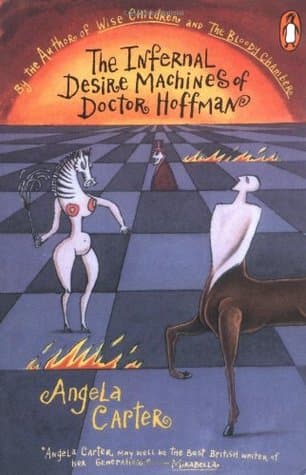
Angela Carter (1972)
Genre
Fantasy / Science Fiction
Reading Time
240 min
Key Themes
See below
Sign in to track this book
In a city descending into chaos from a mad doctor's machines, a man obsessed with the doctor's glass daughter goes on a surreal journey through a world of centaurs, cannibals, and acrobats, fighting reality itself to win his dream-bound love.
The story begins in an unnamed city, once orderly and logical, now under siege by Doctor Hoffman's infernal desire machines. Desiderio, a young employee of the city's Ministry of Information, watches the growing chaos. Reality becomes fluid, with mythical creatures, impossible buildings, and sensual illusions appearing everywhere. The city's leaders, represented by the Centaur, struggle to keep control; their logical methods fail against Hoffman's psychological attacks. Desiderio, despite the overwhelming unreality, holds onto his own perception, believing he is immune to the machines' effects. Yet, he is captivated by the recurring dream image of a beautiful, glass-like woman named Albertina, whom he believes is Hoffman's daughter.
The Centaur, a high-ranking official and a literal centaur, calls Desiderio. He recognizes Desiderio's unique ability to see reality amidst the chaos. He reveals that Doctor Hoffman is a former colleague who has used his scientific talent for destructive purposes, creating machines that bring people's desires and fears to life, thus blurring the lines between reality and illusion. The Centaur gives Desiderio a vital mission: to sneak into Hoffman's hidden stronghold, find his desire machines, and destroy them. This mission is presented as the city's only hope, and Desiderio accepts, driven by duty and the hidden hope of finding Albertina.
Desiderio begins his quest, leaving the increasingly fragmented city behind. His journey immediately throws him into a world where the laws of physics and logic no longer apply. He meets a series of strange and often disturbing characters and situations: a tribe of cannibals who offer him a grim meal, a group of acrobats who perform impossible feats, and landscapes that change without warning. These encounters challenge his sense of self and reality, making him question what is real and what is just a projection of desire. He constantly tests his sanity against the overwhelming unreality around him.
As he continues, Desiderio meets the River People, a community living in constant pleasure, their lives completely ruled by their immediate desires, shown through continuous sexual activity and the pursuit of enjoyment. He sees their lack of individual identity and their collective, dream-like existence. Later, he finds a traveling erotic circus, a show of heightened sensuality and illusion. Here, Desiderio faces the raw power of human desire, manipulated and made real by Hoffman's machines. He is both disgusted and fascinated, recognizing the dangerous appeal of a life lived only for satisfaction, and the fine line between freedom and being enslaved by one's own urges.
Desiderio is captured by the Marquis, a refined and cruel figure who represents the intellectual and artistic manipulation of desire. The Marquis holds him captive in a house of mirrors, where Desiderio undergoes psychological torture meant to break his sense of self. The mirrors reflect not just his body, but also his inner desires and fears, twisting them into grotesque images. This experience forces Desiderio to face his own identity, his reasons, and the nature of his attraction to Albertina. He realizes that his search for her might also be a desire for an ideal image, a projection rather than a real person.
Desiderio eventually escapes the Marquis and meets the Professor, a seemingly learned man who offers him shelter and philosophical discussion. The Professor, though appearing sane, is deeply caught in Hoffman's web of illusions. He explains the ideas behind Hoffman's machines, describing them as tools that bring the subconscious to life, making dreams real and blurring the difference between subjective experience and objective reality. The Professor's explanations deepen Desiderio's understanding of the psychological war being waged, but also further confuse his own sense of what is real. He questions whether his search for Albertina is any more real than the illusions he now navigates.
After many trials and navigating illogical landscapes, Desiderio finally reaches Doctor Hoffman's fortress. The citadel shows Hoffman's genius, a structure that shifts and changes, making entry almost impossible. It is a physical sign of Hoffman's control over reality, a place where the lines between architecture and illusion completely disappear. Desiderio must use all his cleverness and his unique ability to tell reality from illusion to get past its defenses. His arrival marks the end of his difficult journey and brings him close to his goal: Albertina and the desire machines.
Desiderio finally confronts Doctor Hoffman inside his citadel. Hoffman, a man of great intellect and manipulative intent, reveals that Albertina is not a real woman but a construct, a perfect automaton made to embody ultimate beauty and desire. She is the ultimate product of his machines, a living illusion. This revelation shatters Desiderio's ideal vision of her and makes him question the truth of his love and his entire quest. Hoffman boasts about his ability to manipulate human desire and perception, explaining his view of art and life as a series of controlled illusions.
Despite being an automaton, Albertina shows a hint of independent will. When faced by Desiderio and Hoffman, she chooses Desiderio, or rather, chooses the possibility of genuine experience over her designed perfection. This act, however small, gives Desiderio the courage to act. He attacks Hoffman and, in a dramatic fight, manages to destroy the infernal desire machines. The destruction of the machines causes a chain reaction, unsettling the illusions and bringing a temporary return to a more logical reality, though the city and its residents have been forever changed by Hoffman's rule.
Desiderio returns to the city, which is slowly recovering from the chaos, though many of the fantastical elements remain as echoes. He brings Albertina with him, now seemingly more real, though still showing signs of her artificial origin. He reports back to the Centaur, expecting praise. However, the Centaur reveals his own manipulative nature, admitting that he arranged Desiderio's quest not out of a wish for true reality, but to gain control over Hoffman's power for himself. The Centaur, too, is a master of illusion, though of a more political kind, and sees Desiderio as a pawn in a larger game of control.
Albertina, unable to fully fit into a world without the machines that made her, begins to break down. Her glass-like nature becomes increasingly literal, and she eventually shatters into pieces, a sad symbol of how fragile constructed reality and idealized love are. Her death leaves Desiderio deeply sad and disillusioned. His quest, initially driven by love and a desire for truth, ends with the tragic loss of the person he loved. He is left to deal with the meaning of his experiences and the nature of love itself in a world where reality is always uncertain.
Afterward, Desiderio is left to think about the true nature of his journey. He realizes that the Centaur, Hoffman, and even Albertina were all parts of a larger game of illusion and manipulation. He has been a pawn in a battle over what reality means. The novel ends with Desiderio in a state of deep philosophical uncertainty, questioning his own identity and the truth of his experiences. He understands that truth and reality are not fixed but are constantly being built and taken apart, often by desire itself, and that his search for Albertina was ultimately a search for an elusive, perhaps non-existent, ideal.
The Protagonist
Desiderio transforms from a naive observer into a disillusioned seeker of truth, grappling with the complexities of reality and the nature of love. He loses his innocence but gains a deeper, albeit painful, understanding of the world.
The Antagonist
Hoffman remains largely static in his ideological conviction, serving as a philosophical foil to Desiderio and a catalyst for the plot's events.
The Love Interest / Object of Desire
Albertina's arc involves a subtle shift from a purely constructed being to one displaying a glimmer of independent choice, only to ultimately shatter, symbolizing the fragility of constructed reality.
The Supporting / Manipulator
The Centaur's true manipulative nature is revealed towards the end, exposing his own desire for power rather than genuine restoration.
The Supporting / Antagonist
The Marquis serves as a temporary antagonist, designed to challenge Desiderio's sense of self and reality, and does not have a significant personal arc.
The Supporting
The Professor's role is primarily expositional and philosophical, without a personal character arc.
The Mentioned / Collective
As a collective, they do not have an individual arc but serve as a static example of the book's themes.
The main theme looks at how fluid and subjective reality is. Doctor Hoffman's machines literally make desires and fears real, blurring the lines between objective truth and subjective experience. Desiderio's entire quest is a fight to tell what is real, shown by his love for Albertina, who turns out to be an automaton. The city itself becomes a dreamscape, challenging not only the characters' views but also the reader's. The novel suggests that reality is not fixed but is constantly being made, often by our own desires and others' manipulations.
“What is real? What is not? How can we tell the dancer from the dance?”
The novel explores the changing and destructive power of human desire. Hoffman's machines bring desires to life and amplify them, leading to both ecstatic freedom (as seen with the River People) and chaotic destruction. Desiderio's own desire for Albertina drives his quest, but it is also a desire for an ideal image, showing how desire can blind and mislead. Carter examines how uncontrolled desire can lead to losing one's identity, moral decay, and the breakdown of social order, while also acknowledging its basic role in human experience and motivation.
“Desire is the only force that can create a new reality.”
As reality becomes fluid, so does identity. Desiderio's journey forces him to constantly question who he is and what makes up his 'self' when external reality is so unstable. The Marquis's house of mirrors specifically targets his self-perception, twisting his image and challenging his authenticity. Albertina, as an automaton, further complicates this theme, raising questions about whether consciousness and identity can be built. The novel suggests that identity is not inherent but is shaped by perception, desire, and the stories we tell about ourselves and the world.
“I was a man without a mirror, a man without a face.”
Beyond the fantasy elements, the novel deeply concerns itself with the politics of manipulation and control. Doctor Hoffman manipulates reality and desire to show his power, while the Centaur manipulates Desiderio for his own political aims. Even Desiderio's love for Albertina is a form of manipulation, as she is a created being. The story shows how power works not just through force, but through controlling perception, information, and the very fabric of reality, turning individuals into pawns in larger games of influence.
“All power is the power to define reality.”
A constant tension exists between what is artificial and what is real. Albertina, a beautiful automaton, is the ultimate symbol of this theme. Is her love for Desiderio real if she is a machine? The entire landscape created by Hoffman's machines is a grand artifice. The novel constantly questions whether something created or manipulated can have genuine value or truth. It explores the idea that even in a world of illusions, there can be a longing for something real, even if that reality is ultimately hard to find or fragile.
“Only the artificial can be perfect.”
Devices that externalize and manifest desires and fears into reality.
These machines are the central plot device, driving all conflict and surreal events. Created by Doctor Hoffman, they function as a psychological weapon, blurring the line between subjective thought and objective reality. By making desires, dreams, and nightmares tangible, they dismantle the established order of the city and force characters to confront the fluid nature of existence. Their destruction is the primary goal of Desiderio's quest, representing the attempt to restore a more stable reality, though their influence is shown to be lasting.
The revelation that Desiderio's love interest is an artificial construct.
This revelation serves as a major twist and a powerful thematic device. It challenges Desiderio's perception of love and authenticity, forcing him to question whether his feelings are for a real person or an idealized projection. Albertina's artificial nature underscores the novel's exploration of artifice versus authenticity, the power of illusion, and the nature of desire itself. Her eventual shattering symbolizes the fragility of constructed realities and idealized loves, leaving Desiderio with profound disillusionment.
Desiderio's physical quest through surreal landscapes mirrors an internal, psychological journey.
Desiderio's journey from the city to Hoffman's citadel is not merely a physical progression but a metaphorical descent into the subconscious and the irrational. Each encounter and landscape he navigates—cannibals, acrobats, the Marquis's house of mirrors, the River People—represents different facets of human desire, illusion, and the breakdown of reality. This structure allows the narrative to explore complex philosophical themes about identity, perception, and the nature of truth through concrete, albeit fantastical, experiences, making the external world a reflection of Desiderio's internal struggle.
The reveal that Desiderio's patron is as manipulative as the antagonist.
The Centaur's eventual admission of his own manipulative motives serves as a critical plot device. It shatters any remaining illusions Desiderio might have had about a clear-cut battle between good and evil, or reality and illusion. Instead, it reveals a more complex world where all power structures, even those seemingly fighting for order, are engaged in a struggle for control over defining reality. This twist deepens the theme of manipulation and leaves Desiderio in a state of profound philosophical ambiguity, questioning the authenticity of all authority.
“Reality is a collective hunch.”
— Desiderio's early musings on the nature of perception and existence in the city of Eros.
“The price of experience is always high.”
— Desiderio reflecting on the consequences of his journey and the knowledge he has gained.
“The world is a stage, and all the men and women merely players; but in our city, the stage sometimes eats the actors.”
— A cynical observation about the dangers and transformative power of Eros.
“Nothing is real until it is experienced, and even then, its reality is subject to the distortions of memory.”
— Desiderio grappling with the subjective nature of reality as he recalls past events.
“Desire is the most potent engine of the imagination.”
— A core theme of Doctor Hoffman's philosophy and the driving force behind his machines.
“We are all prisoners of our own perceptions.”
— Desiderio recognizing the limitations of individual understanding in a world of shifting realities.
“The greatest freedom is to choose your own chains.”
— A paradoxical statement about agency within a seemingly predetermined or manipulated existence.
“The world is a house of mirrors, and we are forever trying to find our true reflection.”
— A metaphor for the elusive nature of identity and self-discovery in a deceptive world.
“To invent a new reality, you must first destroy the old one.”
— Reflecting on Doctor Hoffman's radical approach to altering the fabric of existence.
“Madness is merely a question of degree.”
— Desiderio contemplating the fine line between sanity and insanity in the face of surreal events.
“Love, like all desires, is a form of hallucination.”
— A cynical view on the nature of love, aligning it with the manufactured realities of Hoffman.
“The most dangerous illusions are those we create for ourselves.”
— Desiderio's realization about self-deception and its profound impact.
“Every journey is a descent into oneself.”
— Desiderio's introspective reflection on his adventures and their personal significance.
“The past is a foreign country; they do things differently there. But the future is an alien planet, and they do not do things at all.”
— A unique twist on a famous quote, highlighting the unpredictable and unknowable nature of the future.
Ready to see how well you understood this book? Take our interactive quiz with 10 questions.

Angela Olive Pearce, who published under the name Angela Carter, was an English novelist, short story writer, poet, and journalist, known for her feminist, magical realism, and picaresque works. She is best known for her book The Bloody Chamber, which was published in 1979. In 2008, The Times ranked Carter tenth in their list of "The 50 greatest British writers since 1945". In 2012, Nights at the Circus was selected as the best ever winner of the James Tait Black Memorial Prize.







