“The wind was a living thing, cold and sharp, and it whispered secrets she didn't want to hear.”
— Elena's initial perception of the supernatural world around Fell's Church.

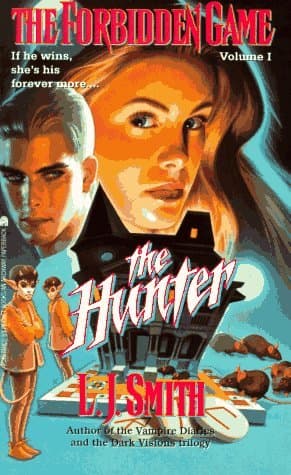
L.J. Smith (1994)
Genre
Young Adult / Romance
Reading Time
4-5 hours
Key Themes
See below
Sign in to track this book
A captivating cyber-punk draws Jenny into a deadly game where her worst fears become real, forcing her to confront a stalker's obsession and bargain for her soul in a house of horrors.
Jenny Thornton, with her boyfriend Tom and friends Melanie and Audrey, visits a new, dim game shop. While her friends are busy, Jenny is drawn to Julian, a mysterious cyber-punk with electric blue eyes and white hair. He sells her a game called 'The Shadow World' in a plain white box, giving her an unsettling feeling she knows him. Julian's intense gaze and odd manner make Jenny feel captivated and uneasy, yet she feels a strange pull toward him, as if they have met before. She buys the game for Tom's upcoming birthday party, unaware of Julian's true intentions.
At Tom's birthday party, Jenny gives him 'The Shadow World.' The plain white box has a chilling warning: 'Entering the Shadow World can be deadly. Do so at your own risk.' Curious and slightly nervous, Jenny, Tom, Melanie, and Audrey start to build the game. They find it is a modular house, and as they put the rooms together, each one seems to show their deepest nightmares and fears. The room grows heavy and dark as the game takes shape, hinting at a reality beyond cardboard and plastic. The friends are drawn in, unable to stop building the unsettling structure.
As the last piece of 'The Shadow World' house snaps into place, a sudden, confusing change happens. The room around Jenny and her friends disappears, replaced by the very house they just built — now life-sized and terrifyingly real. They are trapped inside, the air thick with dread. Panic sets in as they realize the game's warning was true. This is no longer a game; it is a living nightmare, and they are its unwilling players. The house seems to feed on their fear, its corridors twisting in impossible ways.
Soon after their terrifying shift, a chilling figure appears from the shadows: The Shadow Man. To Jenny's horror, The Shadow Man is Julian, the mysterious shopkeeper. He reveals that he created this 'Shadow World' and is the 'hunter,' and they are his 'prey.' Julian explains that to escape, they must face and overcome their deepest fears, which appear inside the house. He begins to stalk them, using the house's layout to separate them and force them into individual encounters with their personal terrors. His presence is both threatening and strangely captivating to Jenny.
Melanie is the first to be cornered by The Shadow Man. Her nightmare is a desolate, empty party where no one remembers her, and she is utterly alone and unloved. She is forced to relive the pain of feeling invisible, a deep insecurity she often hides. Julian watches, offering cryptic taunts and challenges, pushing her to acknowledge and fight this fear. Jenny and the others can only watch, hearing Melanie's cries and understanding the true stakes of the game. Melanie struggles, almost giving in to despair before finding a spark of resistance.
Audrey, always a perfectionist, faces her nightmare in a room filled with impossible tests and constant criticism. Her fear of failure and not being good enough grows, with every mistake loudly condemned by unseen voices. The Shadow Man's presence makes her feel even more inadequate, preying on her desire to always meet high standards. Audrey, usually calm, starts to break down under the pressure. She is forced to question her self-worth and the source of her drive, realizing her quest for perfection often traps her. She must learn to accept imperfection to move forward.
Tom, the strong and protective boyfriend, faces a situation where he is powerless to help those he cares about. His nightmare involves watching Jenny and his friends suffer without being able to intervene, showing his fear of losing control and failing as a protector. The Shadow Man mocks his helplessness, pushing Tom to the edge of despair. Tom's usual confidence shatters as he faces the limits of his own strength, forcing him to understand that true power is not always about physical dominance, but about courage when faced with impossible odds. He struggles to find a way to act despite feeling powerless.
Jenny's nightmare is the most personal. She is trapped in an empty space, reliving the pain of past abandonments and the deep fear of being utterly alone, unloved, and forgotten. The Shadow Man, Julian, focuses on her, watching her struggle intently. He reveals that her fear is linked to a past trauma, a forgotten memory he knows well. Jenny feels a strange connection to Julian even in her terror, as if he understands her in a way no one else does. She must confront this deep loneliness and the trauma that caused it to have any hope of escape.
As Jenny battles her fear, Julian starts to reveal parts of their shared past. He is not just The Shadow Man; he is a supernatural being, a hunter who has pursued Jenny across lifetimes. He explains that Jenny has a unique spiritual energy, a 'light' that he, a creature of shadow, has been drawn to for centuries. He has always tried to claim her, to merge their light and shadow, believing it is their destiny. This game, 'The Shadow World,' is his ultimate trap, designed to break her defenses and force her to choose him, to remember their intertwined history, and to finally give herself to him.
With her friends still trapped and suffering, Jenny confronts Julian, desperate to save them. She realizes Julian's true target has always been her. She offers herself to him, her body and soul, in exchange for the freedom and safety of Tom, Melanie, and Audrey. Julian is interested by her sacrifice, seeing it as a sign of her growing acceptance of their connection. He agrees to her terms, but the bargain is dangerous. Jenny must make a choice that will forever change her destiny, and possibly bind her to Julian and the Shadow World, or find a way to outwit the ancient hunter.
In the final confrontation, Jenny, having faced her fears and understood Julian's nature, must make a difficult choice. Julian gives her the ultimate dilemma: join him, embrace her power, and rule the Shadow World by his side, or resist and risk eternal damnation for herself and her friends. Jenny, drawing strength from her love for her friends and her own inner resilience, finds a loophole or a hidden power within herself. She rejects Julian's dark embrace, not by pure denial, but by using her unique light in a way he had not expected, aiming to break his hold without giving in to his darkness.
Through her desperate act, Jenny breaks the spell of 'The Shadow World.' She and her friends are suddenly thrown back into Tom's living room, the game pieces scattered on the floor. They are safe, but deeply changed by their experience. The memories of their nightmares and Julian's terrifying presence remain. While the physical danger is gone, the psychological impact is immense. Jenny, especially, feels a deep unease and a haunting awareness of Julian's existence and their intertwined past. The ending suggests that while they escaped this time, Julian, the hunter, may not be truly defeated, and Jenny remains his ultimate prize.
The Protagonist
Jenny transforms from an ordinary girl into someone aware of her extraordinary nature and power, learning to confront her deepest fears and make difficult sacrifices.
The Antagonist/Love Interest
Julian remains largely static in his goal to claim Jenny, but his methods intensify, and he reveals more of his ancient, predatory nature.
The Supporting
Tom's arc involves confronting his limitations and the meaning of true strength when faced with supernatural threats he cannot physically overcome.
The Supporting
Melanie's arc is about facing her fear of loneliness and finding self-worth beyond external validation.
The Supporting
Audrey's arc focuses on overcoming her rigid perfectionism and learning to accept vulnerability.
The main theme is characters being forced to face their deepest, personal fears. Julian's 'Shadow World' is made to show these anxieties, from Melanie's fear of being forgotten to Audrey's fear of imperfection, Tom's fear of powerlessness, and Jenny's fear of abandonment. The story suggests that real growth and escape come from acknowledging and overcoming these internal struggles, not running from them. Each character's nightmare directly targets their core insecurities, making their survival depend on their psychological strength.
“Entering the Shadow World can be deadly. Do so at your own risk.”
This theme explores the strong, almost irresistible draw of Julian's dark, ancient power and the contrasting, yet equally strong, power of Jenny's inner 'light' and humanity. Julian represents the seductive danger of the supernatural, offering power and a destined connection, while Jenny shows compassion, selflessness, and human resilience. The story asks if light can truly overcome shadow, or if they are meant to merge. Jenny's internal struggle is not just about survival, but about choosing between two different paths for her soul, one rooted in love and the other in ancient, obsessive power.
“He wanted to capture her light, to merge it with his shadow, to make her his forever.”
The story often hints at a fated connection between Jenny and Julian, suggesting they have been linked across lifetimes. Julian believes it is their destiny for Jenny to be his, and he plans events to lead her to this conclusion. However, Jenny's struggle to resist him and protect her friends highlights the theme of free will. Despite ancient prophecies and Julian's manipulations, Jenny fights to make her own choices and create her own path, challenging the idea that her fate is set. Her final decision shows the power of individual choice over predetermined destiny.
“You've been my prize, my obsession, through every lifetime. It's time to claim you.”
A key theme is the power of sacrifice, especially in love and friendship. Jenny's willingness to offer herself to Julian to save her friends is a crucial moment, showing her deep love and loyalty. This act of selflessness contrasts with Julian's predatory nature and highlights the strength found in human connection. The friends' efforts to help each other, even when facing their own terrors, further shows that collective strength and mutual care can be a strong defense against overwhelming darkness. True love is shown as a willingness to put others' well-being before one's own.
“I'll do anything. Take me, but let them go.”
A literal game that transports players into a dimension of their fears.
The game itself is the primary plot device, acting as a portal and an immersive trap. It's a physical object that, once assembled, actively draws the characters into a supernatural dimension where their fears manifest. It serves as Julian's tool for his hunt, allowing him to isolate and psychologically torture his prey. Its modular nature, where rooms reflect individual nightmares, is crucial to the plot, as it personalizes the horror for each character and forces them to confront their inner demons. The game's existence blurs the line between reality and illusion, making the characters question everything.
Julian's ancient, predatory nature as 'The Shadow Man'.
Julian's identity as an ancient, supernatural 'hunter' who targets specific individuals (like Jenny) across lifetimes is a key device. This establishes a long-standing, fated conflict and provides the antagonist's motivation. It elevates the stakes beyond a simple game, introducing elements of destiny, obsession, and the struggle against an entity far older and more powerful than the protagonists. His ability to manipulate fears and create the 'Shadow World' stems directly from this supernatural nature, making him a formidable and terrifying force.
The deep, ancient, and recurring bond between Jenny and Julian.
The concept of a fated, multi-lifetime connection between Jenny and Julian is a central romantic and plot device. It explains Julian's intense obsession and Jenny's strange, unsettling attraction to him, even amidst her terror. This device adds a layer of tragic romance and cosmic significance to their conflict, suggesting that their battle is not just about survival, but about the culmination of centuries of intertwined destinies. It raises the question of whether love or obsession can transcend time and whether one can truly escape a preordained fate.
The Shadow World's ability to bring characters' deepest fears to life.
This device is crucial for character development and plot progression. By manifesting each character's specific, personal fears (e.g., Melanie's abandonment, Audrey's imperfection, Tom's powerlessness, Jenny's loneliness), the story forces them into direct confrontation with their psychological vulnerabilities. This not only creates intense horror but also serves as a catalyst for their growth. The success or failure of each character to overcome their manifested fear directly impacts their ability to survive and escape the Shadow World, making the internal struggle as important as the external one.
“The wind was a living thing, cold and sharp, and it whispered secrets she didn't want to hear.”
— Elena's initial perception of the supernatural world around Fell's Church.
“There are no rules for creatures of the night, only desires.”
— Damon's philosophy on his vampiric existence.
“Love isn't supposed to be a choice. It's supposed to be a necessity.”
— Elena grappling with her feelings for both Stefan and Damon.
“Some things are worth dying for.”
— Stefan's conviction about protecting Elena.
“You can't outrun your past, not when it's part of your very blood.”
— A reflection on the inescapable nature of vampirism and past actions.
“The darkness was not just outside, but within, a growing shadow that threatened to consume them all.”
— The increasing threat from the ancient evil in Fell's Church.
“Sometimes, the hardest thing to do is forgive yourself.”
— A moment of introspection for one of the characters struggling with guilt.
“Every legend has a grain of truth, and every truth can be twisted into a lie.”
— Exploring the blurred lines between myth and reality in Fell's Church.
“The greatest power is not to destroy, but to protect.”
— Stefan's underlying belief in the proper use of his strength.
“Fear is a powerful weapon, but hope is stronger.”
— The characters facing overwhelming odds and finding inner strength.
“To live forever means to watch everyone you love eventually die. It's a curse, not a gift.”
— A character's lament about the burden of immortality.
“There are some secrets better left buried, even if they scream to be heard.”
— The town's hidden history and the dangers of uncovering it.
“She was a moth to his flame, drawn to a danger she couldn't resist.”
— Elena's dangerous attraction to Damon.
“Even in the darkest night, there is always a flicker of light, if you know where to look.”
— A hopeful sentiment amidst the despair and struggle.
Ready to see how well you understood this book? Take our interactive quiz with 10 questions.

Biography coming soon.