“The wind carried secrets, if you only knew how to listen.”
— Elara often felt the forest had its own language, especially when she was alone.

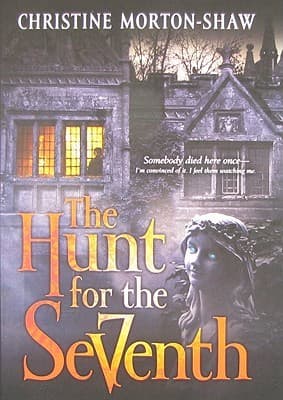
Christine Morton-Shaw (2008)
Genre
Fantasy / Children's / Mystery / Young Adult
Reading Time
300 min
Key Themes
See below
Sign in to track this book
Haunted by six child ghosts in a sinister mansion, Jim and his autistic friend Einstein must solve clues to find a missing 'Seventh' and stop an ancient prophecy from claiming more innocent lives.
Jim, a young boy who sees ghosts, arrives at Minerva Hall, a grand but unsettling estate, to stay with his aunt and uncle. He immediately notices the eerie atmosphere and the well-kept grounds, which have many stone statues. Almost at once, he starts seeing spectral children playing in the garden and house. These six ghostly figures are initially playful but soon talk directly to Jim, telling him to 'find the Seventh.' Jim is confused and disturbed, as no one else sees them, making him question his sanity and what he is experiencing.
Jim meets Einstein, an intelligent, autistic boy who lives at Minerva Hall with his family. Einstein is quiet at first but eventually warms to Jim, showing interest in puzzles and patterns. The ghostly children keep appearing to Jim, leaving him specific, though cryptic, clues. They lead him to various places at the Hall and its grounds, hinting at a hidden history and danger. Einstein, while not seeing the ghosts himself, shows an unusual awareness of the Hall's secrets, often giving Jim information that confirms the ghosts' hints or helps him understand their messages, suggesting he knows more than he lets on.
Through his interactions with the ghosts and Einstein's subtle help, Jim begins to piece together the tragic story of the six children. He learns they were once living inhabitants of Minerva Hall, who died under mysterious circumstances long ago. He also starts to uncover an ancient prophecy tied to the Hall, involving a ritual and a 'Seventh' child, whose fate is important. The prophecy speaks of a dark force to be unleashed, and the six ghosts, trapped between worlds, want Jim to stop it. Their pleas become more urgent as Jim investigates the Hall's past.
The many stone statues in Minerva Hall's gardens become a main focus of Jim's investigation. He first sees them as decorations, but the ghosts' clues and Einstein's knowledge reveal their more sinister purpose. Jim learns that each statue represents one of the six dead children; they are not just memorials but a key part of the ancient ritual. The statues are placed in a specific pattern, forming a symbolic circle vital to the prophecy. Their arrangement directs a powerful, malevolent energy, and Jim realizes they are not just marking the dead, but participating in a dark enchantment.
As Jim continues to solve the mystery, the atmosphere at Minerva Hall grows more threatening. He experiences physical signs of the malevolent force, including cold spots, whispers, and objects moving on their own. The ghosts, while trying to help, also seem bound by the Hall's power, their appearances becoming more frantic. Jim realizes that the ancient entity connected to the prophecy is becoming more active and aware of his interference. The stakes rise, as he understands that failing to solve the clues and stop the ritual could lead to devastating consequences for him and others.
After much prompting and observation, Einstein finally shares all his knowledge and his personal connection to Minerva Hall. He explains that his family has a long history with the estate and the prophecy, and he has known its secrets for some time. He reveals that he is not just a resident but a key figure in the events, with a unique understanding of the ancient texts and astronomical alignments needed for the ritual. Einstein, despite his initial quietness, becomes a more active participant, sharing crucial details about the timing and nature of the 'Seventh' and the coming catastrophe, confirming Jim's fears.
Through the combined efforts of Jim, the ghosts, and Einstein's revelations, Jim discovers the 'Seventh' child's identity. It is not a historical figure, nor an unknown entity, but someone alive and connected to the current inhabitants of Minerva Hall. The 'Seventh' is a young, innocent child, unaware of their role in the ancient prophecy. This discovery adds urgency and moral complexity to Jim's quest, as he realizes he must not only stop the ritual but also protect an innocent life from a terrible fate. The stakes become deeply personal for Jim.
As the celestial alignment nears, the malevolent energy within Minerva Hall peaks. Jim and Einstein realize that the ancient ritual, meant to unleash a powerful, destructive entity, is about to happen. The dark forces, previously subtle, become more open and aggressive in their attempts to secure the 'Seventh' and complete the ceremony. The Hall itself seems to respond to the escalating power, with an oppressive atmosphere and disturbing phenomena. Jim understands he has little time left to act, and the pressure to stop the ritual before it is too late becomes almost unbearable, pushing him to his limits.
With the ritual about to start, Jim and Einstein confront the malevolent force and its human agents, who are determined to complete the sacrifice. They race against time, using clues from the ghosts and Einstein's knowledge to disrupt the ceremony. The confrontation is intense and dangerous, as the dark entity lashes out, trying to stop them. Jim's ability to see and talk with the ghosts is crucial, as they guide him to the exact points of intervention needed to break the ritual's power. The fate of the 'Seventh' and potentially the world hangs in the balance during this desperate struggle.
Through quick thinking, courage, and the combined efforts of Jim, Einstein, and the guiding spirits of the six children, the ritual is stopped. Jim breaks the ancient enchantment, preventing the dark entity from being unleashed and saving the 'Seventh' child. With the ritual undone, the malevolent power over Minerva Hall is broken. The six ghosts, no longer bound by the prophecy or the Hall's curse, find peace and finally move on. Jim watches their departure, a bittersweet moment of relief and closure, knowing he has fulfilled their plea and ended the long-standing horror.
After the ritual is stopped, Minerva Hall is cleansed of its dark influence. The oppressive atmosphere lifts, and the house and grounds feel peaceful for the first time. Jim reflects on his extraordinary experience, the terrifying journey he took, and its impact on him. He has not only saved an innocent life and freed trapped spirits but has also come to terms with his ability to see ghosts. His bond with Einstein, formed in shared danger, remains strong. While the events have been traumatic, Jim emerges with a new understanding of himself and the unseen world, changed by his time at Minerva Hall.
The Protagonist
Jim transforms from a frightened, isolated boy into a brave, self-assured hero who embraces his unique ability to save others.
The Supporting
Einstein moves from a passive observer to an active, crucial participant, sharing his knowledge to avert disaster.
The Supporting/Mentioned
From restless, trapped spirits, they find peace and release through Jim's intervention.
The Supporting
The 'Seventh' is saved from a terrible fate, their innocence preserved by Jim's actions.
The Antagonist
Its attempt to manifest is thwarted, and its power over Minerva Hall is broken.
Jim's ability to see ghosts initially feels like a burden. He questions his sanity and struggles to live in a world where others cannot perceive what he does. This theme explores the loneliness and responsibility that come with a gift that sets one apart. It shows in his initial fear of the ghosts and his internal conflict about sharing his experiences. However, as the story progresses, his unique ability becomes his greatest strength, helping him understand and solve the mystery at Minerva Hall, turning his burden into a powerful tool for good.
“He saw them, clear as day, children playing in the sun-dappled garden, but the others walked right through them, oblivious. Was he mad?”
The story emphasizes how the past, especially tragic events and ancient prophecies, continues to influence and threaten the present. Minerva Hall itself holds history, with its statues and hidden lore. The six ghosts are literal echoes of a past tragedy, their unresolved fates driving the plot. Jim's quest is an investigation of the Hall's dark history, where uncovering the past is the only way to prevent a future catastrophe. The lasting power of ancient rituals and forgotten knowledge shows history's inescapable grip.
“The stones of Minerva Hall remember more than any living person could ever know, and they never forget.”
The friendship between Jim and Einstein is a central emotional part of the story. Jim, isolated by his ghostly visions, finds a unique connection with Einstein, who is also an outsider because of his autism. Their bond builds on mutual respect, shared intelligence, and growing trust. Einstein's acceptance of Jim's experiences, even without seeing the ghosts himself, validates Jim's reality. Their combined strengths—Jim's supernatural sight and courage, and Einstein's intellect and knowledge—are essential to solving the mystery, showing how acceptance and collaboration can overcome individual limitations.
“You see things others don't, Jim. I understand things others don't. Perhaps that is why we are here.”
The narrative presents a clear conflict between good and evil, shown by the malevolent entity seeking to be unleashed and Jim's efforts to stop it. The six ghosts, though unsettling at first, represent a force for good, trying to prevent a greater evil. The ritual itself is a manifestation of ancient, destructive power. The theme explores the idea that evil can lie dormant for centuries, waiting for the right conditions, and that it takes courage, sacrifice, and the protection of innocence to defeat it. Jim's moral choices are always guided by a desire to do what is right and protect the vulnerable.
“Some things, once awakened, cannot be put back to sleep. And some things should never be awakened at all.”
Cryptic messages from the six ghosts guiding Jim's investigation.
The ghostly clues are essential narrative tools that propel the plot forward. The six dead children, unable to directly speak or fully explain, communicate through fragmented visions, symbolic gestures, and leading Jim to specific objects or locations. These clues are often ambiguous at first, forcing Jim and Einstein to interpret them, adding a mystery element to the investigation. They serve to reveal plot points incrementally, build suspense, and create a sense of urgency, as Jim must decipher them before it's too late. They are the primary link between the past tragedy and the present danger.
A centuries-old prediction detailing a ritual and a destructive outcome.
The ancient prophecy is the central driving force of the story, providing the overarching goal and stakes. It outlines a specific event, a ritual involving the 'Seventh' child, and the catastrophic consequences if completed. The prophecy's details are gradually revealed through the ghosts' clues and Einstein's knowledge, building tension and a sense of impending doom. It provides a historical framework for the supernatural events, connecting the Hall's past to its present danger. The race against time to prevent its fulfillment creates the primary conflict and adds a layer of fatalism that Jim must overcome.
The haunted mansion itself acts as a living, oppressive presence.
Minerva Hall is more than just a setting; it functions as a character in its own right, imbued with an oppressive, almost sentient atmosphere. Its ancient stones, hidden passages, and meticulously arranged gardens (especially the statues) all play an active role in the unfolding mystery. The Hall's oppressive aura, its unexplained phenomena, and its deep connection to the prophecy make it a source of both clues and danger. It feels alive, reacting to the escalating supernatural events and becoming a physical manifestation of the dark forces at play, trapping and influencing its inhabitants.
Decorative garden elements with a sinister, ritualistic purpose.
The stone statues in Minerva Hall's garden initially appear as mere ornamentation but are revealed to be crucial plot devices. Each statue represents one of the six dead children and is part of the ancient ritual. Their specific placement forms a symbolic circle, essential for harnessing and directing the malevolent energy. They serve as visual reminders of the past tragedy and active components in the impending magical ceremony. Uncovering their true purpose is a key moment in Jim's investigation, transforming them from passive objects into active elements of the dark enchantment.
“The wind carried secrets, if you only knew how to listen.”
— Elara often felt the forest had its own language, especially when she was alone.
“Sometimes, the greatest mysteries are hidden in plain sight, disguised as ordinary things.”
— A recurring thought Elara had as she examined seemingly mundane objects around her home.
“Courage isn't the absence of fear, but the decision that something else is more important.”
— Said by her grandmother, offering wisdom when Elara was hesitant to embark on a quest.
“The Seventh isn't just a thing to be found; it's a path to be walked.”
— A cryptic clue from an ancient map, hinting at the true nature of their quest.
“Trust is a fragile bridge, easily broken, but strong enough to carry you across the widest chasm if built with care.”
— Elara reflecting on her burgeoning alliance with a new, mysterious companion.
“Even the smallest light can banish the deepest shadow.”
— A comfort Elara found in a moment of despair, holding a glowing magical artifact.
“History isn't just stories; it's the echoes of power that still resonate today.”
— Her history teacher, Mr. Silas, explaining the importance of understanding the past beyond mere dates.
“Sometimes you have to get lost to find what you're truly looking for.”
— A moment of disorientation in the enchanted forest, which ironically led them closer to a clue.
“The true magic isn't in what you can do, but in what you believe you can do.”
— A mentor figure encouraging Elara to overcome her self-doubt and embrace her abilities.
“Every choice, no matter how small, ripples outwards into the future.”
— Contemplating the consequences of a difficult decision they had to make on their adventure.
“A secret shared is a burden halved, and a strength gained.”
— Elara finally confiding in her closest friend about the strange events unfolding around her.
“The world is full of wonders for those who have eyes to see them.”
— Her grandfather's frequent saying, encouraging her to always be observant and curious.
“Not all monsters lurk in the shadows; some wear the most charming smiles.”
— A realization Elara had about a deceptive character they encountered on their quest.
“The greatest treasures are not always gold or jewels, but the stories they tell.”
— Examining an ancient, seemingly worthless artifact that held a vital piece of the puzzle.
Ready to see how well you understood this book? Take our interactive quiz with 10 questions.

Christine Morton-Shaw is a British author known for her children's fiction, particularly "The Hunt for the Seventh." Her work often explores themes of mystery and adventure, captivating young readers with engaging plots and relatable characters. She has established herself as a consistent voice in contemporary children's literature.







