“I am not a beast. I am a human being.”
— Matt asserts his humanity when others treat him as less than human.

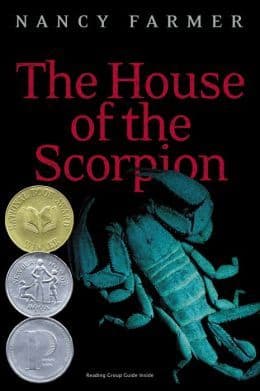
Nancy Farmer (2002)
Genre
Fantasy / Children's / Science Fiction / Young Adult
Reading Time
450 min
Key Themes
See below
Sign in to track this book
In a dystopian future, a clone named Matt, raised as livestock for his ruthless progenitor, must grapple with his identity and fight for survival and personhood in a world that denies his humanity.
Matt is introduced as a young boy living in squalor in a small cottage, cared for by Celia. He is kept hidden from the world, his only companions being a few chickens. One day, three children, Steven, Emilia, and Maria, discover him through a window. Maria, kind-hearted, tries to interact with him, but Steven throws a stone, causing Matt to smash the window and cut his arm. This injury leads to Matt being taken to the Alacrán estate for medical attention. This reveals his existence to the household and ends his secluded life. His unique nature as a clone is immediately apparent to the staff, causing most to treat him with disdain.
After his injury, Matt is initially imprisoned in a room with sawdust, treated like an animal. Celia, his caretaker, fights for his humane treatment. Eventually, El Patrón, the powerful and ancient ruler of Opium, intervenes, revealing Matt is his clone and demanding he be treated with respect. Matt is assigned a bodyguard, Tam Lin, who becomes a father figure. Tam Lin teaches him survival skills and a cynical view of Opium. Matt also develops a deep bond with Maria, despite her initial fear, and struggles with the cruelty of others like Tom, El Patrón's other grandson, and the disdain of most adults.
Under El Patrón's protection, Matt receives an education from a tutor named Teacher and learns to read and write. He lives in luxury, yet remains isolated, never truly accepted by the other children except for Maria, who periodically visits. He learns about the world, but also the harsh realities of Opium, the drug-producing country between the US and what was once Mexico. He discovers that clones are typically created to be organ donors for their originals, and that he is a unique exception because El Patrón wants to live forever, and needs Matt's body for spare parts when his own fail. This knowledge instills a deep fear and understanding of his purpose.
Maria, who had been sent away, returns to Opium. Her renewed presence brings joy to Matt, and their friendship deepens, evolving into a romantic affection. However, their relationship is constantly challenged by the prejudices against Matt as a clone and the manipulations of Tom, who is jealous of Matt's bond with Maria. Tom's cruel nature is revealed through his actions, such as locking Maria in a room with a dead eejit, an act Matt helps her overcome, further solidifying their trust and bond against the hostile environment of the estate.
During a visit to the hospital, Matt witnesses the horrifying reality of other clones: they are purposefully kept brain-dead, their organs harvested as needed. This chilling discovery confirms his fears about his own existence and El Patrón's true intentions. He realizes he is merely a living organ bank. Tam Lin, though bound by loyalty to El Patrón, subtly guides Matt towards understanding his predicament and the need for self-preservation, hinting at a way out, while still upholding his duty to his master.
El Patrón suffers a severe heart attack, accelerating the timeline for Matt's inevitable sacrifice. The urgency of the situation becomes clear, and Matt is kept under even tighter surveillance. Celia, knowing El Patrón will soon need Matt's heart, begins secretly poisoning Matt with arsenic in small doses to make his heart unsuitable for transplant without killing him outright. This act of maternal protection shows Celia's love for Matt and her desperate attempt to save him from his predetermined fate, a secret she keeps from Matt until the critical moment.
When El Patrón's health crisis becomes dire, Celia reveals her plan to Matt: she has been giving him small doses of arsenic to make his heart toxic and unusable for transplant. She also reveals that El Patrón intends to harvest his heart. Tam Lin confirms the danger and secretly gives Matt a survival kit and instructions for escaping Opium, urging him to seek refuge in Aztlán. He explains that Matt must pretend to be an eejit to get through the border, and gives him a route to follow, knowing he is betraying El Patrón but prioritizing Matt's life.
El Patrón eventually dies from his failing heart, having exhausted all his spare organs. His death triggers a chaotic period in Opium. Matt attempts to flee, but is captured by El Patrón's guards and brought back to the funeral. There, Celia reveals the arsenic poisoning, rendering Matt's heart useless to El Patrón. During the funeral, Tam Lin sacrifices himself by choosing to die with El Patrón's other loyal servants in a booby-trapped tunnel, ensuring Matt's path to freedom is clear. He deliberately chooses this fate, hinting at his own past crimes and seeking redemption by saving Matt.
Following Tam Lin's instructions, Matt escapes Opium and crosses the border into Aztlán, a country formed from what was once Mexico. He is immediately apprehended by the 'Keepers,' a group of strict, self-righteous adults who run orphanages for children and teenagers. Matt is sent to a horrifying orphanage, where the children are exploited for labor, malnourished, and subjected to brutal discipline. His privileged upbringing in Opium has not prepared him for this harsh reality, and he struggles to survive among the other boys, particularly the cruel leader, Jorge.
In the orphanage, Matt befriends Fidelito, a timid boy, and Chacho, a tough but loyal companion. He also meets Ton-Ton, another orphan who helps him. Together, they endure the Keepers' cruelty, especially Jorge's sadistic punishments. Matt uses his intelligence and leadership skills, honed by El Patrón's influence, to rally his friends. He discovers that the Keepers are part of a larger, corrupt system and realizes he must escape to expose them and reclaim Opium. He recalls Tam Lin's final instructions to find the people who built Opium and use his unique DNA to unlock the system.
Matt, Chacho, Fidelito, and Ton-Ton manage to escape the orphanage, facing dangers in the desert before finding refuge in a hidden cave. They are pursued by the Keepers, but Matt's resourcefulness and the loyalty of his friends help them survive. They eventually make their way to the Alacrán estate, guided by Matt's memories and Tam Lin's previous lessons. Matt is determined to fulfill Tam Lin's last wish: to dismantle the evil empire of Opium and use his position as El Patrón's clone to bring about change and freedom for the eejits and other oppressed people.
Upon returning to Opium, Matt finds the estate in disarray following El Patrón's death. He discovers that the country has been sealed off by the United States due to its illegal drug production. Matt, as El Patrón's clone, possesses the unique DNA required to activate the security systems and effectively 'unlock' Opium. He is recognized by the remaining loyal staff, including Celia and Maria's family. With his friends by his side and the knowledge gleaned from Tam Lin, Matt prepares to assume leadership, determined to transform Opium from a corrupt drug empire into a land of freedom and justice, breaking the cycle of exploitation and abuse.
The Protagonist
From an isolated, dehumanized clone, Matt develops into a compassionate leader, determined to dismantle the corrupt system he was born into.
The Antagonist
Remains static in his ruthless pursuit of immortality, ultimately succumbing to death despite his efforts.
The Supporting
Her unwavering love for Matt leads her to a courageous act of defiance against El Patrón, saving Matt's life.
The Supporting
From a loyal but disillusioned bodyguard, he finds redemption through his self-sacrifice to save Matt.
The Supporting
Her initial fear of Matt transforms into unwavering love and acceptance, challenging societal prejudices.
The Antagonist
Remains a consistently cruel and manipulative character, never showing remorse or growth.
The Supporting
Develops from a hardened orphan into a loyal and brave companion, finding a sense of family with Matt.
The Supporting
Learns to find courage and loyalty through his friendship with Matt, despite his timid nature.
The Supporting
Reveals hidden intelligence and kindness, evolving from a seemingly simple worker to a vital ally.
The Supporting
His initial cruelty evolves into a more self-serving pragmatism, adapting to shifts in power.
Matt's central struggle is to define his identity beyond being a clone. He grapples with the dehumanizing labels ('beast,' 'property') and the existential crisis of being created solely for another's survival. Through Tam Lin's teachings, Celia's love, and his own experiences in Aztlán, Matt learns to forge his own moral compass and agency, ultimately deciding to use his unique position to reshape Opium. This theme is clear when he questions, 'How old am I?...I know I don't have a birthday like humans, but I was born,' showing his search for personal significance.
“How old am I?...I know I don't have a birthday like humans, but I was born.”
The novel shows the dehumanization of clones and eejits, who are treated as property, organ banks, or mindless laborers. Matt experiences this firsthand, being initially confined to a room with sawdust and later witnessing the brain-dead clones. The eejits, with their computer chips, represent the ultimate form of exploitation, stripped of their free will. This theme is central to understanding the moral corruption of Opium and El Patrón's regime, where human life is valued only for its utility to the powerful, as seen when El Patrón refers to Matt as his 'spare parts'.
“You were harvested...You were grown in that poor cow for nine months and then you were cut out of her.”
El Patrón embodies absolute power and its corrupting influence. His long life and control over Opium have twisted him into a ruthless tyrant who believes he is above all moral laws. The entire society of Opium, from the Alacrán family to the eejits, is structured around serving his will. The Keepers in Aztlán further show this theme, abusing their power over orphans. The novel explores how unchecked power leads to cruelty, exploitation, and a disregard for human life, ultimately showing that such power inevitably crumbles.
“He wanted to live forever, and he couldn't do that without a constant supply of spare parts. That was you.”
Despite the pervasive cruelty, the novel emphasizes the power of friendship and loyalty. Celia's maternal love, Tam Lin's complex protective loyalty, and Maria's belief in Matt's humanity are important to his survival and development. In Aztlán, Matt forms a strong bond with Chacho, Fidelito, and Ton-Ton, showing how these connections provide strength, hope, and the will to survive in the face of oppression. These relationships contrast with the transactional and self-serving 'loyalty' demanded by El Patrón.
“I can't go without you guys... We're a team.”
Several characters seek or achieve redemption through sacrifice. Tam Lin, burdened by a dark past, finds redemption in guiding Matt to freedom and ultimately sacrificing himself to ensure Matt's escape. Celia risks her life and freedom by poisoning Matt to prevent his harvesting. These acts of selflessness highlight the novel's message that true value is not in immortality or power, but in protecting others and acting morally, even at great personal cost. Tam Lin's final act is a poignant example of choosing a noble end to a troubled life.
“I'm not going to let him die... not if I can help it.”
Matt serves as a literal and metaphorical reflection of El Patrón.
The concept of Matt being El Patrón's clone is the central plot device. Literally, Matt is a genetic copy, intended to provide spare organs. Metaphorically, he reflects El Patrón's potential for both good and evil, forcing Matt to actively choose his own path. El Patrón sees Matt as himself, a continuation, which fuels his possessive 'love.' This device allows for an exploration of nature vs. nurture, as Matt, despite his identical DNA, develops a distinct moral compass and rejects the monstrous aspects of his original, ultimately becoming the opposite of El Patrón.
The country of Opium functions as a self-contained, oppressive society.
Opium, the drug-producing country ruled by El Patrón, serves as a dystopian microcosm. It is a closed system built on exploitation, strict hierarchies, and enforced ignorance, reflecting real-world issues of drug cartels, labor exploitation, and totalitarian regimes. The physical isolation of Opium, bordered by the US and Aztlán, reinforces its status as a controlled experiment in tyranny. Its eventual sealing off by the US after El Patrón's death further emphasizes its nature as a corrupt entity that must be dismantled and reformed from within.
Brain-damaged laborers symbolizing extreme dehumanization and control.
The eejits are human beings with computer chips implanted in their brains, rendering them docile, mindless laborers. They are a powerful symbol of extreme dehumanization and the ultimate consequence of the exploitation of the poor and vulnerable. Their existence highlights the moral depravity of Opium and the casual cruelty of its rulers. Matt's horror at their condition and his later determination to free them underscore his developing empathy and commitment to justice, making the eejits a constant reminder of the stakes involved in his journey.
A mentor figure whose complex loyalty and ultimate sacrifice drive Matt's escape and future mission.
Tam Lin serves as a classic mentor figure, imparting crucial knowledge and survival skills to Matt. His character is complex, balancing his loyalty to El Patrón with a growing moral obligation to Matt. His strategic guidance, providing Matt with an escape plan and a destination, is instrumental in the plot. His ultimate sacrifice, choosing to die to ensure Matt's freedom, is a pivotal moment that not only saves Matt's life but also burdens him with the responsibility of fulfilling Tam Lin's implicit wish to reform Opium. This device provides both practical assistance and moral impetus for the protagonist.
“I am not a beast. I am a human being.”
— Matt asserts his humanity when others treat him as less than human.
“The old die. The young inherit.”
— El Patrón reflects on his legacy and the cycle of life in Opium.
“You are my clone. You are me.”
— El Patrón explains Matt's origin and purpose to him.
“I would rather die on my feet than live on my knees.”
— Matt declares his defiance against oppression and control.
“The heart is the only thing that matters.”
— Celia advises Matt about what truly defines a person.
“We are all monsters, but some of us try to be good.”
— Tam Lin reflects on the moral complexities of their world.
“A person isn't a thing you can throw away.”
— Matt argues against the disposable treatment of clones.
“The future is a blank page, but you have to write it yourself.”
— Matt realizes he must shape his own destiny.
“Power is a drug, and I am addicted.”
— El Patrón admits his obsession with control and longevity.
“Sometimes the only way to stay sane is to go a little crazy.”
— Tam Lin offers wisdom on coping in a harsh environment.
“You don't own people. You can't own a soul.”
— Matt challenges the concept of ownership over living beings.
“The truth is like a diamond: it has many facets.”
— A reflection on the complexity of reality and perspective.
“Hope is the thing with feathers that perches in the soul.”
— A poetic line (referencing Emily Dickinson) used to describe resilience.
“In the end, we are defined by our choices, not our origins.”
— Matt comes to understand that his actions matter more than his creation.
Ready to see how well you understood this book? Take our interactive quiz with 10 questions.

Biography coming soon.







