“The past is a foreign country; they do things differently there.”
— A meditation on the nature of memory and change over time.

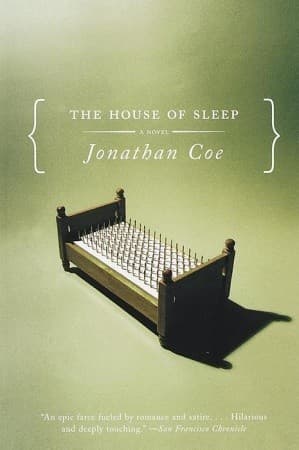
Jonathan Coe (1997)
Genre
Literary Fiction / Psychology / Romance
Reading Time
360 min
Key Themes
See below
Sign in to track this book
Decades after college, a narcoleptic, a film addict, a heartbroken romantic, and an increasingly unstable doctor meet at a gothic sleep clinic, where their past and present collide in a hallucinatory exploration of love, obsession, and reality.
In 1983, Sarah, a young woman with vivid dreams and narcolepsy, arrives at Ashdown House, a university residence. She is assigned room 10. She forms an uneasy friendship with Robert, a shy, introverted student in room 9, secretly infatuated with her. Also present are Terry, a film-obsessed student in room 11, and Gregory, a pre-med student in room 12 with an unusual interest in sleep and its perceived inefficiencies. Their early interactions are marked by youthful awkwardness and growing attractions, setting the stage for misunderstandings that will affect their lives. Sarah's condition immediately impacts Robert, as he struggles to tell her waking reality from her dreams, causing early confusion and a sense of protectiveness.
One night, Sarah, in a narcoleptic state, wanders into Robert's room and kisses him, believing it is part of a dream. Robert, unaware of her condition, sees this as a genuine romantic gesture, filling him with hope and intense emotional attachment. The next morning, Sarah remembers nothing of the event. This incident becomes a turning point for Robert, solidifying his unrequited love and shaping his future perceptions of their relationship. The misunderstanding creates a private tragedy for Robert, as he carries the weight of a moment that, for Sarah, never truly happened in her conscious reality. This early event shows the central conflict from Sarah's narcolepsy.
Terry, driven by his passion for film, spends his nights watching movies and documenting them. He starts an ambitious project to create a film entirely from found footage, compiling clips from various sources. He finds an unexpected confidante in Sarah, who, despite her sleep disorder, appreciates the escapism and narrative possibilities of cinema. Their shared interest offers a brief break from their individual struggles, with Terry using film to understand the world, and Sarah finding a different kind of reality in the moving images. This project symbolizes Terry's desire to control and reorder reality through art.
During his university years, Gregory's interest in sleep turns into a conviction that sleep is a disease, a waste of human potential. He begins to develop theories for its eradication, aiming to optimize human life and productivity. His increasingly extreme ideas alienate him from his peers, who find his intensity disturbing. This early development foreshadows his later professional path and the controversial sleep clinic he will establish. Gregory's intellectual journey shows a growing detachment from conventional medical ethics and a single-minded pursuit of his anti-sleep agenda, rooted in a desire to control natural human processes.
A decade later, in the mid-1990s, the four university friends have lost touch. Sarah, still affected by narcolepsy, struggles to maintain a stable life, often confusing dreams with reality. Robert lives a solitary existence, haunted by the memory of Sarah's kiss and his unrequited love, channeling his emotions into his work as a librarian. Terry pursues a career in film, though perhaps not with the success he once imagined, still deeply involved in his cinematic world. Gregory, now a doctor, has become more radical in his views on sleep, developing experimental treatments. Their paths have diverged, but the unresolved emotional and psychological threads from their time at Ashdown continue to influence their lives.
Desperate for a cure or at least management of her debilitating narcolepsy, Sarah enrolls in a sleep clinic. To her surprise, the clinic is in the same building as her former university residence, Ashdown House, now called the 'House of Sleep.' The familiar corridors and rooms bring back memories, blurring the lines between her past dreams and present reality. This return is both a hopeful step towards recovery and a confrontation with the unresolved aspects of her youth, particularly her complex relationship with Robert and the others. The gothic, cliffside location adds to the unsettling atmosphere, emphasizing the isolation and the strange nature of the treatments.
Upon arriving at the House of Sleep, Sarah slowly realizes she is not alone in her past connections to the building. She meets Robert, who works there as a librarian, drawn back by his lasting attachment to Sarah and the place itself. Terry is also present, ostensibly working on a documentary about the clinic, but still deeply immersed in his film world. Most disturbingly, Sarah discovers that the clinic's director, Dr. Gregory Dudden, is their former acquaintance, Gregory, whose radical theories on sleep have now been put into practice. The reunion is full of unresolved tensions, rekindled emotions, and the unsettling realization of Gregory's extreme methods.
Dr. Gregory Dudden, now fully committed to his anti-sleep crusade, subjects his patients to radical and often cruel treatments designed to minimize or eradicate sleep. These methods include forced wakefulness, sensory deprivation, and psychological manipulation, all justified by his belief that sleep is a detrimental state. His patients, including Sarah, experience distress and further disorientation under his care. Gregory's methods highlight his intellectual arrogance and his detachment from human suffering, as he views his patients more as subjects for experimentation than individuals needing care. The atmosphere in the clinic becomes increasingly oppressive and dystopian, reflecting Gregory's warped vision of human potential.
Witnessing Sarah's increasing distress and confusion under Gregory's treatments, Robert can no longer stay silent about their shared past. He confronts Sarah, revealing the truth about the kiss she gave him in her sleep ten years prior, and how he had interpreted it as a conscious act of affection. This revelation shocks Sarah, who remembers nothing of the event, but it also provides a crucial piece of their intertwined lives. For Robert, it is an act of emotional liberation, but for Sarah, it further blurs the lines between her dreams and reality, adding another layer of complexity to her already fractured perception of the world.
Terry, filming a documentary about the House of Sleep, records the disturbing treatments given by Gregory. His footage captures the patients' suffering and Gregory's alarming disregard for their well-being. Recognizing the ethical violations and the danger to Sarah and others, Terry decides to move from passive observer to active participant. He plans to expose Gregory's practices and arrange an intervention, using his cinematic skills to reveal the truth to the outside world. Terry's role as the documentarian becomes central to the narrative, as his camera becomes a weapon against the clinic's dark secrets.
Realizing the full extent of Gregory's dangerous experiments and the threat they pose, Sarah, Robert, and Terry conspire to escape the House of Sleep. They plan to gather evidence of Gregory's unethical practices, particularly Terry's film footage, and bring it to the authorities. The escape is tense and dangerous, as Gregory maintains tight control over the isolated facility. Their attempt to flee the clinic is a desperate bid for freedom and a chance to expose the truth, leading to a confrontation with Gregory and his staff. The gothic setting of the cliffside manor amplifies the sense of confinement and peril during their escape.
The escape from the House of Sleep has consequences, and the immediate aftermath leaves many questions. While Gregory's methods are exposed, the full extent of his legal repercussions and the fate of the remaining patients are not fully detailed. Sarah's narcolepsy, though now understood by Robert, remains part of her life, and her struggle to distinguish dream from reality continues. Robert's future is intertwined with Sarah's, his devotion unwavering. Terry successfully uses his film to shed light on the abuses, finding a purpose for his cinematic obsession. The novel concludes with lingering uncertainty, emphasizing that some disorders and emotional wounds are not easily cured, but understanding and connection can offer a path forward.
The Protagonist
Sarah's arc involves a gradual realization of the impact of her condition on others and a journey towards accepting her reality, even if it remains complex and dreamlike.
The Protagonist
Robert's arc is about finding the courage to confront the past, reveal his long-held feelings, and finally understand the true nature of Sarah's condition.
The Supporting
Terry's arc sees him transition from a passive, film-fixated observer to an active participant, using his art to expose injustice.
The Antagonist
Gregory's arc is a tragic descent from intellectual curiosity to dangerous scientific hubris and ethical bankruptcy.
The Supporting
Dr. Randall's arc is less defined, primarily serving as a foil to Gregory's extremism and highlighting complicity.
The Mentioned
Veronica's arc is limited, primarily serving to establish Sarah's early life.
The novel constantly blurs the lines between dreams, memories, and waking life, mainly through Sarah's narcolepsy. Her inability to distinguish between what she has dreamed and what has actually happened forces the reader to question the reliability of perception. Robert's interpretation of Sarah's dream-kiss as reality, and his decade-long belief in it, explores how personal perception can shape one's entire life. Gregory's radical views on sleep also challenge conventional understandings of reality, suggesting that sleep is an 'unreal' state to be overcome. The narrative itself often shifts in time and perspective, mirroring the fragmented reality the characters experience.
““The only thing that was real was the film playing in his head.””
Robert's enduring and unrequited love for Sarah forms a powerful emotional core of the novel. His entire adult life is shaped by a single, misunderstood moment, leading to an obsession that prevents him from moving forward. This theme also extends to Terry's obsession with film, which, while less destructive, still dictates much of his existence. Gregory's obsession with eradicating sleep is perhaps the most dangerous manifestation, consuming him and leading to unethical practices. The novel explores how these intense fixations, whether romantic, artistic, or scientific, can both define and distort a character's life, often leading to isolation and pain.
““He had built his entire adult life around a moment that, for her, had never happened.””
The past plays a crucial, almost suffocating, role in the lives of all four main characters. Their shared experiences at Ashdown House in the 1980s continue to haunt and shape their present selves. Sarah's fragmented memories, intertwined with her dreams, make it difficult for her to escape the past. Robert is entirely defined by a past misunderstanding. Terry constantly references past films and cultural moments, living in a cinematic past. Gregory's radical ideas originate from his early academic interests. The return to Ashdown House, transformed into the 'House of Sleep,' physically shows this theme, demonstrating how old places and unresolved issues inevitably resurface, demanding confrontation.
““The past was not a foreign country; it was the room next door, sometimes the same room.””
Gregory's character and the operation of the House of Sleep clinic show scientific arrogance and the dangers of unethical medical experimentation. His conviction that sleep is a disease justifies increasingly cruel and invasive treatments, disregarding patient well-being for the sake of a radical ideology. The novel raises questions about the responsibility of scientists, the line between innovation and abuse, and the moral implications of manipulating fundamental human processes. The isolated setting of the clinic further emphasizes the lack of oversight and the potential for unchecked power in scientific pursuits.
““For Gregory, the human body was merely a flawed machine, ripe for improvement.””
Terry's character embodies the theme of storytelling and art, particularly through film. His constant referencing of movies, his found-footage project, and his eventual documentary about the clinic highlight how narratives, both fictional and real, shape our understanding of the world. Film provides an escape, a way to process reality, and ultimately, a tool for revelation and justice. The novel itself, with its intricate structure and blending of timelines, functions as a complex narrative, demonstrating the power of storytelling to explore psychological depths and critique societal norms. Art, in Terry's hands, becomes a means of truth-telling.
““Life was just a series of cuts, a montage of moments, and the trick was to make sense of the sequence.””
The story jumps between two distinct time periods: 1983-1984 and 1996.
The novel employs a non-linear narrative structure, alternating between the characters' university days in 1983-1984 and their reunion at the House of Sleep in 1996. This device effectively mirrors Sarah's fragmented perception of reality and the way memory functions. It slowly reveals past events and their profound impact on the present, building suspense and allowing the reader to connect the dots between cause and effect over a decade. The shifts in time create a sense of disorientation, similar to Sarah's experience, and highlight how deeply the past influences the present.
A single location that serves as both a university residence and a sleep clinic.
The building itself is a central plot device. Initially Ashdown House, a university residence, it later becomes 'The House of Sleep,' a gothic cliffside manor repurposed as Gregory's sleep clinic. This transformation symbolizes how the past literally informs the present, trapping the characters in a physical space laden with unresolved memories and emotional baggage. The isolated, imposing nature of the house enhances the themes of confinement, psychological distress, and the blurring of reality, making it almost a character in itself, silently bearing witness to both youthful dreams and later nightmares.
A neurological condition that blurs the lines between dreams and reality for the protagonist.
Sarah's severe narcolepsy and cataplexy are not just character traits but a fundamental plot device. Her condition creates the central conflict of the novel, driving misunderstandings (like the kiss with Robert), shaping her perception of reality, and ultimately leading her back to the House of Sleep for treatment. It allows the author to explore themes of perception, memory, and the subjective nature of truth. The narcolepsy is the catalyst for many key events and challenges the reader to question what is real within the narrative.
Terry's ongoing film project, initially a personal obsession, becomes a tool for exposition and justice.
Terry's documentary film, which he works on throughout both timelines, serves multiple purposes. Initially, it's a manifestation of his cinematic obsession and a way for him to process the world. Later, as he films the activities at Gregory's clinic, it becomes an objective record of the abuses taking place. This film acts as a crucial piece of evidence, providing an external, verifiable account of Gregory's unethical practices. It allows Terry to move from passive observer to active participant, using his art as a means of exposure and an instrument of justice, ultimately driving the climax of the story.
“The past is a foreign country; they do things differently there.”
— A meditation on the nature of memory and change over time.
“Sleep is a rehearsal for death.”
— A character's reflection on the unconscious state.
“Perhaps all love affairs, if they are to mean anything, must be conducted under the shadow of some imminent, unavoidable separation.”
— A thought on the intensity and transience of romantic relationships.
“It was one of those moments when the world seems to tilt slightly on its axis, and everything you thought you knew about yourself and your place in it is suddenly called into question.”
— Describing a moment of profound realization or shock.
“The greatest trick the devil ever pulled was convincing the world he didn't exist. The greatest trick the human mind ever pulled was convincing itself it was rational.”
— A cynical observation on human self-deception.
“We are all of us, in our different ways, trying to get back to a time when we felt safe, or loved, or simply understood.”
— A character's musing on nostalgia and the search for belonging.
“There are some truths that are so terrible that the only way to live with them is to pretend they don't exist.”
— Reflecting on coping mechanisms for difficult realities.
“Memory is not a precise instrument. It's more like a landscape that changes with the light.”
— Discussing the unreliability and subjective nature of memory.
“The trouble with dreams is that they sometimes come true, and then you have to live with the consequences.”
— A character's realization about the double-edged sword of ambition or desire.
“Perhaps the real purpose of life is not to find happiness, but to find a way to endure unhappiness with dignity.”
— A philosophical outlook on life's challenges.
“Every secret you keep is a tiny weight you carry.”
— A reflection on the burden of hidden truths.
“We spend our lives constructing narratives, trying to make sense of the chaos, even if the sense we make is entirely fictional.”
— An observation on human storytelling and the search for meaning.
“The most profound experiences are often those we cannot articulate, only feel.”
— Exploring the ineffable nature of certain emotions and events.
Ready to see how well you understood this book? Take our interactive quiz with 10 questions.

Jonathan Coe is an English novelist and writer. His work has an underlying preoccupation with political issues, although this serious engagement is often expressed comically in the form of satire. For example, What a Carve Up! (1994) reworks the plot of an old 1960s spoof horror film of the same name. It is set within the "carve up" of the UK's resources that was carried out by Margaret Thatcher's Conservative governments of the 1980s.







