“The wind was a living thing, a hungry beast howling around the House of Doors, trying to pry its secrets open.”
— Early description of the House and its environment.

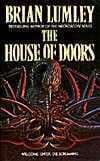
Brian Lumley (1990)
Genre
Fantasy / Science Fiction
Reading Time
Unknown (based on page count, which was not provided)
Key Themes
See below
Sign in to track this book
Trapped in an alien labyrinth that creates their worst fears, a group of humans must conquer their inner demons and otherworldly horrors to escape the House of Doors and save Earth.
The alien Thone, a technologically advanced and ruthless race, arrive on Earth planning conquest. Instead of immediate destruction, they give humanity an ultimatum. They reveal a giant, mysterious structure called the House of Doors, a labyrinth that can create the deepest fears and subconscious realities of those trapped inside. The Thone state that if a chosen group of humans can survive this 'test,' they will leave Earth. Failure means complete subjugation and likely annihilation of humankind. This chilling offer sets the stage for the desperate struggle, as the chosen occupants are forced into the alien device.
A diverse group of individuals, including scientists, military personnel, spies, and civilians, are abducted and find themselves confused within the House of Doors. The environment is immediately hostile and surreal, ignoring normal physics and logic. Initial attempts to communicate and understand are hindered by the strange surroundings and the psychological shock. They quickly realize the House is not static but a dynamic, changing entity that seems to respond to their thoughts and emotions. Panic and confusion are widespread as the group tries to understand the rules of their new prison and the true nature of the Thone's 'test.'
As the group explores, they encounter the House's most dangerous feature: its ability to materialize their subconscious fears. One character might face a childhood monster, another a traumatic memory made real, and another a physical form of their professional failures. These manifestations are not illusions but real threats, capable of causing harm or death. The psychological toll is immense, forcing each person to confront their inner demons. This aspect of the House shows the Thone's deep understanding of human psychology, turning the test into a personal and often agonizing experience for each captive.
The extreme pressure of the House of Doors quickly divides the captive group. Some individuals, driven by training or natural leadership, try to organize and strategize, seeking common ground and safety in numbers. Others, giving in to fear and paranoia, become isolated or hostile, seeing fellow captives as rivals or threats. Scientists try to apply logic to the illogical, while military personnel try to impose order on chaos. These new alliances and factions are constantly tested by the House's psychological attacks and physical dangers, showing how fragile human cooperation is under stress and how different people cope.
Beyond personal fears, the House of Doors also puts its captives in truly alien environments. They might pass through a 'door' and find themselves on a planet with multiple suns, in a gravity-defying city, or among plants and animals unlike anything on Earth. These shifts are disorienting and dangerous, forcing the group to adapt to vastly different physical laws and biological threats. These alien worlds are not just backdrops; they often present unique challenges, puzzles, or new predatory life, pushing the captives' physical and mental limits and showing the vast, unknown power of the Thone.
As the ordeal continues, some of the more analytical minds among the captives, especially the scientists, start to understand the true nature of the Thone's 'test.' They believe the House is not just a torture chamber but a complex psychological and evolutionary crucible. The Thone are testing not just survival skills, but humanity's ability to adapt, endure, discover itself, and perhaps its collective will to overcome internal and external threats. This growing understanding, while terrifying, also provides a sense of purpose and direction, shifting the focus from mere escape to actively 'passing' the Thone's unique examination of the human spirit.
The constant pressures of the House lead to moments of sacrifice and difficult choices. Some characters, initially selfish, find redemption by prioritizing the group's survival over their own. Others, overwhelmed by the horrors, go mad or despair, becoming casualties of the House's psychological warfare. These acts of heroism and tragic losses strengthen bonds among the survivors and highlight individual struggles within the group ordeal. Each sacrifice, intentional or not, contributes to the group's slow, painful progress, showing the depths of human courage and vulnerability.
Through observation, experimentation, and intellect, some captives, often scientists or those with sharp analytical minds, begin to find patterns and 'rules' in the House's seemingly chaotic nature. They realize that fear manifestations are not random but often triggered by specific thoughts, emotions, or environmental cues. They start to experiment with mental discipline, group focus, and even manipulating their own subconscious to influence the House's behavior, hoping to navigate its complexities more effectively. This intellectual breakthrough offers a vital, though precarious, advantage against the House's overwhelming power.
A key realization dawns on the remaining captives: individual survival in the House is tied to a group effort. They understand that beating their 'inner demons' is not just about personal psychological battles, but about building mutual support, empathy, and shared purpose. The House seems to react differently to a united front, sometimes even weakening manifestations when faced with strong solidarity. This shift from individual struggle to a more communal approach marks a significant turning point, showing humanity's capacity for collective resilience and for overcoming internal divisions to face an external threat.
As the group shrinks and their understanding of the House grows, they approach what seems to be the final, most difficult challenge. This might involve a concentrated manifestation of their combined fears, a complex puzzle requiring all their knowledge, or a direct confrontation with a 'core' mechanism of the House itself. This climax tests every lesson learned, every bond formed, and every sacrifice made. It requires not just individual courage, but perfect coordination and unwavering belief in their collective ability to succeed. Earth's fate rests on this ultimate display of humanity's resilience and self-mastery.
After a difficult and terrifying struggle, the surviving captives either succeed or fail in their final challenge. If they succeed, the House of Doors begins to disappear or retract, and the Thone, keeping their word, start to withdraw from Earth, leaving humanity to rebuild and reflect on its ordeal. If they fail, the Thone's promise of withdrawal is broken, and the grim reality of Earth's conquest and likely extinction of humanity becomes real. The ending confirms the ultimate outcome of their journey, whether it is hard-won freedom or the tragic fulfillment of the alien invaders' initial threat.
The Protagonist
Thorne learns to integrate his intellect with empathy and courage, realizing that cold logic alone cannot defeat the House's emotional attacks.
The Supporting
Rostova learns to embrace unconventional tactics and trust in the less tangible aspects of human resilience, beyond purely military strategies.
The Supporting
Miller confronts his hidden vulnerabilities, transforming his physical strength into emotional resilience and finding a new kind of courage.
The Supporting
Petrova discovers her own inner strength and courage, realizing that empathy and psychological insight are as potent as any weapon.
The Antagonist
Their presence remains consistent, serving as the detached, omniscient arbiters of humanity's fate.
The Antagonist
The House reveals its complex mechanisms as the captives learn to navigate and, to some extent, influence its reality.
The Supporting
Chen's quiet wisdom becomes a crucial, often overlooked, resource for understanding the psychological dimensions of the House.
The Supporting
Sharma learns to accept and adapt to the House's non-technical challenges, expanding her problem-solving approach beyond engineering.
The House of Doors makes the deepest, most primal fears of its captives real, turning internal struggle into an external reality. This theme explores how fear can paralyze, change, and eventually be overcome. Characters must confront childhood traumas, professional failures, and existential dread in tangible forms, highlighting the psychological weight of their pasts. The story suggests that true victory is not just physical survival, but mastering one's mind and facing 'inner demons.' For example, a soldier might face a monstrous form of a past battlefield trauma, while a scientist might encounter a manifestation of their greatest intellectual failure, forcing them to accept these parts of themselves. This theme is central to the Thone's 'test,' as they are evaluating humanity's capacity for self-mastery.
“The greatest prison is not the walls that surround you, but the fears you carry within.”
Despite overwhelming odds and an alien environment designed to break them, the human captives show an amazing capacity for resilience. This theme highlights humanity's ability to adapt to impossible situations, both mentally and physically. It shows how people can find strength in unexpected places, learn from mistakes, and innovate under extreme pressure. The diverse skills of the group—scientific, military, psychological—initially seem separate but eventually come together as they learn to collaborate and use each other's strengths. This adaptability is exactly what the Thone are testing, looking for a species capable of evolving beyond its current limits.
“They built a cage of our nightmares, but forgot that a cornered animal fights with the fury of a god.”
Initially, the captives are a diverse group, often driven by individual survival instincts or internal conflicts. However, the constant pressure of the House forces them to realize that their only hope is cooperation and unity. This theme explores how collective action, empathy, and mutual support are essential for overcoming seemingly impossible challenges. Characters must overcome personal biases, distrust, and internal divisions to work together, combining their knowledge and strengths. The House often punishes individualistic behavior, subtly guiding them toward a collective consciousness. This unity becomes a powerful weapon against the House's divisive tactics, showing that humanity's greatest strength is its ability to connect and support one another.
“Alone, we are echoes in a vast, empty hall. Together, we are a choir that can shatter the silence.”
The Thone's 'test' raises deep ethical questions about one species' right to judge and interfere with another's fate. This theme explores the morality of the Thone's actions, their cold, rational assessment of humanity, and whether their methods are justified, regardless of their ultimate goal. It also forces the human characters to reflect on their own species' worth. Are humanity's flaws too great to warrant independent existence, or does its capacity for growth, empathy, and resilience outweigh its destructive tendencies? The Thone represent an alien, utilitarian ethics, forcing humanity to confront its own values and justify its place in the cosmos.
“They judge us, but by what right? By what measure do they deem themselves superior arbiters of life?”
A dynamically changing, reality-bending structure that adapts to its occupants.
The House of Doors is not a static setting but a central plot device. Its ability to shift its layout, manifest fears, and transport occupants to alien realities drives the narrative forward by constantly introducing new challenges and psychological pressures. It functions as a character in itself, an intelligent antagonist that learns and adapts to the captives' strategies, ensuring that no two encounters are ever quite the same. This constant unpredictability prevents complacency and forces characters to remain on edge, highlighting the Thone's advanced understanding of psychology and environmental manipulation.
The literal externalization of characters' inner fears and traumas.
This device is crucial to the plot, turning internal struggles into physical, tangible threats. Instead of merely dealing with abstract fear, characters must battle monstrous embodiments of their personal anxieties, past failures, or deepest regrets. This forces immediate, visceral confrontation with their inner demons, accelerating character development and revealing their hidden strengths and weaknesses. It also serves as the Thone's primary method of 'testing,' as the ability to overcome these manifestations signifies psychological resilience and self-mastery, which are key to their survival and the success of humanity's trial.
A clear, high-stakes challenge with binary outcomes for humanity's survival.
The Thone's ultimatum provides the overarching narrative drive and raises the stakes to an existential level. The entire plot revolves around the success or failure of the captives in the House of Doors, directly tying their individual struggles to the fate of the entire planet. This device creates immense pressure and a constant sense of urgency, ensuring that every decision and every survival attempt carries profound consequences. It also sets up a clear goal for the characters, even amidst the chaos, providing a framework for their efforts and a definitive measure of their progress.
A group of captives with varied backgrounds and expertise.
The deliberate assembly of scientists, military personnel, psychologists, and civilians is a key plot device. It ensures that the group possesses a wide range of skills necessary to tackle the multi-faceted challenges of the House: scientific analysis for understanding its mechanisms, military prowess for direct threats, psychological insight for internal struggles, and even historical knowledge for interpreting archetypal fears. This diversity fosters both conflict and collaboration, demonstrating how different perspectives and abilities are crucial for holistic problem-solving in an alien, unpredictable environment.
“The wind was a living thing, a hungry beast howling around the House of Doors, trying to pry its secrets open.”
— Early description of the House and its environment.
“There are more ways than one to open a door, and some of them don't involve a key.”
— A character's cryptic remark about accessing different realms.
“Fear is a powerful motivator, but it's a poor guide.”
— A moment of reflection on the protagonist's journey.
“The universe is far vaster and stranger than any mortal mind can truly comprehend.”
— A philosophical statement about the cosmic horror elements.
“Some truths are best left undisturbed, for their awakening brings only madness.”
— Warning about the dangers of seeking forbidden knowledge.
“Every door leads somewhere, but not every somewhere is a place you want to be.”
— A cautionary thought about the nature of the House's portals.
“The shadows here were not merely an absence of light; they were a presence, watchful and ancient.”
— Description of the eerie environment within the House.
“What is real, and what is merely a reflection in the mirror of a mad god's dream?”
— A question pondering the nature of reality within the fantastical settings.
“There are echoes of old worlds here, whispering secrets to those who dare to listen.”
— Hinting at the history and lore embedded in the House.
“The very air thrummed with forgotten power, a silent song only the truly sensitive could hear.”
— Describing the latent magical energy present in the House.
“Courage isn't the absence of fear, but the will to act in spite of it.”
— A character's internal monologue about facing overwhelming odds.
“Some paths, once trod, can never be untrod. The footprints remain, for good or ill.”
— Reflecting on the irreversible consequences of certain decisions.
“The House of Doors doesn't merely contain worlds; it *is* a world, a nexus of infinite possibilities and horrors.”
— A deeper understanding of the true nature of the House.
Ready to see how well you understood this book? Take our interactive quiz with 10 questions.

Brian Lumley is a prolific British author celebrated for his contributions to horror and dark fantasy fiction. He is best known for his 'Titus Crow' series and the standalone novel 'The House of Doors.' Lumley's work often explores cosmic horror and the supernatural, drawing inspiration from H.P. Lovecraft while forging his own distinct narrative voice.







