“The house next door had always been empty. Until now.”
— Protagonist Laurie is observing the new neighbors moving into the long-vacant house.

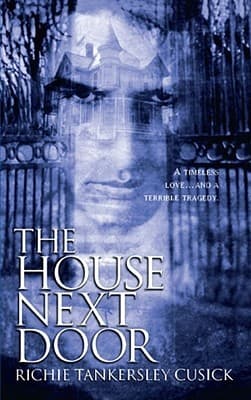
Richie Tankersley Cusick (2001)
Genre
Fantasy / Mystery / Young Adult / Romance
Reading Time
300 min
Key Themes
See below
Sign in to track this book
After spending a night in a haunted house, Emma Donovan is pulled into its tragic past, reliving a romance and a horrific death with a mysterious young man, blurring the lines between dream and a dreadful reality she's destined to repeat.
Seventeen-year-old Emma Donovan, feeling overshadowed by her athletic twin brother, Charlie, accepts his dare to spend a night alone in the Blackwood House next door. The house, empty for decades, has a history of tragedy and suicide, making it a local legend. Despite her fear and the house's immediate unsettling atmosphere—dust, decay, and an unexplainable chill—Emma is determined to prove her bravery. She packs a sleeping bag, a flashlight, and snacks, preparing for a long, lonely night, unaware of the experiences awaiting her.
As Emma settles into the living room of Blackwood House, a strange unease turns into disorientation. Dust motes in the air gather, and the faint smell of old wood becomes the distinct scent of roses. She sees a young man, handsome and dressed in old clothes, standing before her. He speaks to her as if they know each other, and Emma feels an unexplainable connection and affection. These visions are real, not like a dream, and she finds herself responding to him, drawn into a conversation that feels familiar and personal, blurring her reality with his.
Emma's initial visions become a full, immersive experience. She is no longer an observer but an active participant in a past event within Blackwood House. The house is no longer derelict but lived-in. She meets Luke, the handsome young man from her visions, and they share a strong connection. However, tension and foreboding fill their interactions. Emma realizes she is reliving a specific night from the house's history, a night of love, but also growing fear and a sense of coming disaster. She feels a growing dread, knowing this historical re-enactment is leading to a tragic end.
The next morning, Charlie, worried after not hearing from Emma, enters Blackwood House to find her unconscious on the living room floor, her face wet with tears. He brings her home, saying her emotional story of Luke and the past events was a vivid nightmare from the spooky atmosphere. But Emma knows it was more than a dream. The feelings of love, fear, and sorrow are too intense, too real. She feels a phantom ache in her heart and a lingering scent of roses, proof to her that her experience was not just imagination, but a real encounter with the past.
Despite Charlie's doubts, Emma cannot shake the feeling that Luke is still with her. She experiences fleeting sensations—a cool touch, the scent of roses, a whispered name—that confirm her belief. Driven to understand what happened, Emma begins researching Blackwood House. She visits the local library, looking through old newspaper clippings and historical records. She discovers the house was indeed the scene of a tragic event involving a young couple named Luke and Sarah, strengthening her belief that her experiences are linked to their ill-fated love story.
Emma's visions grow stronger, becoming more frequent and consuming. She is repeatedly drawn back into the past, witnessing the romance between Luke and Sarah. She observes their secret meetings, their stolen kisses, and their dreams of a future together, all set in Blackwood House. Emma feels Sarah's joy, her fear, and her love for Luke, as if she is experiencing these emotions herself. She learns that Sarah's father, a controlling man, disapproved of Luke, setting the stage for the tragic events to come.
As Emma looks deeper into the past, she uncovers the controlling nature of Sarah's father, Mr. Blackwood. He is a tyrannical man who forbids Sarah's relationship with Luke. His anger and control cast a dark shadow over the young lovers' lives, creating constant fear and secrecy. Emma witnesses his cruel threats and manipulation, understanding he is the main antagonist in Luke and Sarah's story. The sense of coming disaster she feels grows, realizing that Mr. Blackwood's wrath is the cause of the tragedy she is reliving.
Emma is pulled into the fateful night of the tragedy with terrifying clarity. She is no longer just watching; she is Sarah, experiencing the terror and heartbreak firsthand. Mr. Blackwood confronts Luke and Sarah, his rage growing. In an attempt to protect Sarah, Luke fights back, but Mr. Blackwood, armed with a gun, shoots him. Emma, as Sarah, feels the pain of Luke's death, his blood on her hands, his final words in her mind. The scene is horrific, leaving Emma emotionally shattered and physically drained, deeply affected by the loss.
Following Luke's death, Emma experiences Sarah's grief. The world around her, still in the past, becomes a blur of sorrow and despair. Sarah, broken by the loss of Luke and feeling trapped by her father's cruelty, decides to take her own life within Blackwood House. Emma feels the crushing weight of Sarah's hopelessness, the finality of her decision. This re-enactment is devastating, completing the cycle of tragedy and giving Emma a deep understanding of the house's sorrow and the reason for its haunting.
Emma emerges from the final, most intense re-enactment, emotionally raw but with new clarity. She understands that Luke and Sarah's spirits are trapped in Blackwood House, endlessly replaying their tragic final moments, unable to move on. She realizes that her connection to the house and to Luke is not random but a destined role. Emma feels a responsibility to help them find peace. She is no longer afraid of the house; instead, she is filled with a fierce determination to break the cycle of their haunting and allow their spirits to finally rest.
Emma, convinced she can intervene in the past and change the outcome for Luke and Sarah, begins to make a plan. She believes that by altering a key moment or revealing a truth, she can prevent Luke's death and Sarah's suicide. She tells Charlie, who, despite his initial doubts, is swayed by Emma's conviction and her grief. Together, they research more, looking for any overlooked details or family secrets that might provide a way to break the cycle. Emma prepares for another journey into the past, hoping to bring peace to the tormented lovers.
Emma, armed with her knowledge and resolve, returns to Blackwood House for a final, crucial intervention. She wills herself back into the past, arriving at the moment of confrontation between Luke, Sarah, and Mr. Blackwood. This time, instead of just watching or experiencing as Sarah, Emma actively tries to change the outcome. She attempts to warn Luke, to distract Mr. Blackwood, to prevent the fatal shot. The tension is unbearable as Emma fights against the predetermined course of history, trying to alter the tragic climax she has witnessed many times.
In a climactic moment, Emma's intervention, though not completely changing history, creates a crucial shift. Perhaps she distracts Mr. Blackwood enough, or her presence allows Luke and Sarah a moment of clarity. The exact details are unclear, but the outcome is clear: Luke is not killed. Instead, Mr. Blackwood is disarmed, or the lovers manage to escape. Emma sees Luke and Sarah, together and alive, looking at her with gratitude before fading away, finally free from their tragic loop. Emma feels a sense of relief and peace, knowing she has helped them find their happy ending, even if only in spirit.
Following her final intervention, Emma returns to her own time. Blackwood House, once a source of dread, now feels different. The oppressive atmosphere is gone, replaced by a quiet serenity. The lingering presence of Luke and Sarah is no longer sorrow but peace. Emma feels a sense of closure and a connection to the house and its history. More surprisingly, she finds herself drawn to a new boy in town, who looks like Luke. This new connection hints at reincarnation or a spiritual echo, suggesting that her bond with Luke was not entirely severed and that their love might have a chance to flourish in her own time.
The Protagonist
Emma transforms from an insecure teenager into a brave and compassionate individual, finding her own identity and purpose by helping trapped spirits.
The Supporting
Charlie moves from a teasing, skeptical brother to a concerned and supportive ally for Emma.
The Supporting/Love Interest
Luke's spirit is initially trapped in an eternal loop of tragedy but finds peace through Emma's intervention.
The Supporting
Sarah's spirit is trapped in a cycle of grief and despair but finds peace through Emma's intervention.
The Antagonist
Mr. Blackwood remains a static antagonist, his cruelty driving the initial tragedy and the subsequent haunting.
The Mentioned
Represents a potential new beginning for Emma.
The main theme is the lasting power of love that defies time and death. Emma's connection with Luke, a boy from the past, is so strong that she is pulled into his tragic story. The romance between Luke and Sarah, though ending tragically, leaves a mark on Blackwood House and on Emma. Her experiences show that true love, even when cut short, can leave a powerful spiritual imprint, influencing the present and seeking resolution. Emma's success in bringing peace to Luke and Sarah, and her later meeting with a boy resembling Luke, further shows that love can persist or be reborn.
““Some loves are so strong, they don’t just end. They echo.””
The novel explores how past events, especially traumatic ones, continue to affect the present. Blackwood House is not just an old building; it holds sorrow and unresolved tragedy, actively replaying the final moments of Luke and Sarah's lives. The house's history consumes Emma, forcing her to relive the pain and despair. This theme highlights the idea that unresolved emotional energy can linger, creating a 'haunting' that demands attention and resolution. Emma's journey is about understanding and healing the wounds of the past to free both the spirits and the house itself.
““The house wasn’t just old; it was heavy with memories, like dust motes you could almost see clinging to the air.””
Emma's initial dare comes from a desire to prove her bravery to Charlie and herself. However, her journey into the haunting of Blackwood House forces her to face fears greater than a spooky old building. She must confront intense emotional pain, violence, and despair. Through her empathy for Luke and Sarah, Emma discovers an inner strength and determination she didn't know she had. Her change from an insecure teenager to a courageous individual willing to intervene in a supernatural tragedy is a core part of her character arc, showing that true bravery comes from compassion and a willingness to act.
““She had come to the house to prove she wasn't a coward. She stayed because she couldn't be one.””
A major theme is the struggle between predetermined fate and the possibility of changing it through free will. Emma repeatedly witnesses Luke and Sarah's tragic end, suggesting a fixed destiny. However, her growing determination to intervene, to change the outcome, challenges this idea. Her eventual success, even if subtle, implies that while the past may be powerful, it is not entirely unchangeable. This theme explores whether love and strong will can break cycles of tragedy, suggesting that even in the face of destiny, there is room for hope and intervention.
““Could you truly change what was already written? Or was she just a part of the story, destined to watch it unfold?””
Emma's ability to experience and participate in past events.
This device allows Emma to directly interact with the historical tragedy of Blackwood House. It's more than just visions; she physically and emotionally experiences the past as if she is Sarah, feeling her love, fear, and despair. This immersive quality makes the haunting incredibly vivid and personal, driving Emma's motivation to intervene. It blurs the line between past and present, making the historical events feel immediate and urgent to the protagonist and the reader.
Blackwood House acts as a nexus for unresolved spiritual energy.
The house itself is a central character and plot device. It's not just a setting but a catalyst for the story, actively trapping and replaying the tragic events within its walls. The house's dilapidated state mirrors the decaying, unresolved nature of the past. It serves as a prison for Luke and Sarah's spirits and a portal for Emma, drawing her into its history and transforming her. Its transformation from a place of dread to one of peace signifies the resolution of the haunting.
The appearance of a new character who strongly resembles a past one.
The introduction of the 'new boy' at the end, who looks remarkably like Luke, serves as a subtle but powerful plot device. It suggests a possibility of reincarnation or a spiritual echo, implying that Emma's connection to Luke was not simply historical but potentially fated. This device provides a hopeful resolution to the tragic love story, allowing for the possibility of a second chance at love in Emma's own time, reinforcing the theme of love transcending time.
An initial challenge that sets the entire plot in motion.
The dare from Charlie for Emma to spend a night in Blackwood House is the inciting incident. It's a classic young adult trope that immediately establishes Emma's character (her insecurity, her desire to prove herself) and propels her into the supernatural conflict. Without this initial challenge, Emma would never have entered the house and discovered its haunting, making it a crucial catalyst for the entire narrative.
“The house next door had always been empty. Until now.”
— Protagonist Laurie is observing the new neighbors moving into the long-vacant house.
“There was something about him, a kind of quiet intensity, that made my stomach do flip-flops.”
— Laurie's initial impression of the mysterious new neighbor, Todd.
“It wasn't just old; it felt... alive. As if it had a memory.”
— Laurie's first impressions of the interior of the house next door.
“Some secrets are better left buried, Laurie. Especially when they involve a house like that.”
— Laurie's best friend, Helen, warning her about investigating the house.
“The whispers weren't just in my head anymore. They were coming from the walls.”
— Laurie experiences increasingly vivid supernatural phenomena within the house.
“He looked at me as if I was the only person in the world, and for a moment, I believed him.”
— A romantic moment between Laurie and Todd.
“The past has a way of repeating itself, especially when it's been disturbed.”
— An older character provides a cryptic warning about the house's history.
“I knew then that I wasn't just falling for Todd; I was falling into something much bigger, much scarier.”
— Laurie realizes the depth of the mystery intertwined with her feelings for Todd.
“Every shadow seemed to hold a secret, every creak a story.”
— Laurie's heightened awareness of the eerie atmosphere in the house.
“Sometimes the people you trust the most are the ones with the darkest secrets.”
— Laurie's growing suspicion about the true nature of the new residents.
“It wasn't a dream. It was a memory, bleeding into my own.”
— Laurie experiences a vivid, disturbing vision that feels like a past event.
“Love can be a powerful force, Laurie, but so can obsession.”
— A character reflecting on the destructive aspects of intense emotion connected to the house's history.
“The house wasn't just a place; it was a character, with its own will and desires.”
— Laurie's realization about the sentient, malevolent nature of the house.
“Even in the darkest corners, there's always a flicker of hope, if you're brave enough to find it.”
— Laurie's internal monologue as she confronts the ultimate evil within the house.
Ready to see how well you understood this book? Take our interactive quiz with 10 questions.

Biography coming soon.







