“Mr. Holmes, Mr. Holmes, I am a hunted man. I have been haunted for weeks by a hideous apparition.”
— Dr. Mortimer's dramatic entrance to Baker Street.


Arthur Conan Doyle, Sir Arthur Conan Doyle (2012)
Genre
Thriller / Mystery
Reading Time
240 min
Key Themes
See below
Sign in to track this book
Sherlock Holmes must unravel the chilling legend of a spectral hound and a family curse before the beast on the desolate moors claims its next victim.
Dr. James Mortimer visits Sherlock Holmes and Dr. Watson at 221B Baker Street. He shows them an old manuscript about the Baskerville curse. The legend tells of Hugo Baskerville's evil acts in the 17th century, leading to his death by a monstrous dog, a curse that has followed the family ever since. Mortimer explains that Sir Charles Baskerville, the most recent heir, was found dead on the moor near Baskerville Hall. His face was twisted in terror, and giant footprints were nearby. Though officially ruled heart failure, Mortimer suspects a crime linked to the family curse and asks Holmes for advice about the new heir, Sir Henry Baskerville, who is arriving from Canada.
Sir Henry Baskerville arrives in London and meets Holmes and Watson. Almost at once, he gets an anonymous, crudely cut-and-pasted note warning him to 'stay away from the moor.' This worries Sir Henry, but Holmes is more interested in what the note implies. Later, one of Sir Henry's new boots disappears from his hotel room, only to reappear the next day, while another, older boot goes missing. Holmes concludes that someone is watching Sir Henry closely and may be looking for something specific. He identifies a hansom cab following them and tries to catch the driver, but the man escapes, revealing only a fake beard.
Because of urgent cases in London, Holmes decides to send Dr. Watson to Baskerville Hall with Sir Henry. He tells Watson to observe everyone and report all events. Watson's job is to protect Sir Henry and gather information about the strange happenings on the moor, the local people, and any potential suspects. Before they leave, Holmes strictly warns Watson to be watchful and trust no one. Sir Henry is eager to take his inheritance and dismisses the warnings, but Watson remains cautious, especially after the unsettling events in London.
Watson and Sir Henry arrive at the bleak, old Baskerville Hall, which sits at the edge of the vast, eerie Grimpen Mire. The butler, Barrymore, and his wife, Mrs. Barrymore, greet them. Their somber mood and secretive behavior immediately make Watson suspicious. Soon after, they meet the unusual naturalist Mr. Stapleton, who lives nearby with his beautiful sister, Beryl. Stapleton warns them about the moor's dangers, especially the treacherous mire. Watson notes the hall's isolation and the constant feeling of unease over the estate, which strengthens his resolve to find the truth.
Watson begins his investigation, noticing a series of confusing events. He hears a woman sobbing at night, which Mrs. Barrymore denies. He also sees Barrymore signaling with a candle from a window, seemingly communicating with someone on the moor. Local police tell Watson that Selden, a dangerous escaped convict and Mrs. Barrymore's brother, is hiding on the moor. Watson also grows suspicious of Mr. Stapleton, whose intense interest in Sir Henry seems unsettling, and Beryl Stapleton, who mysteriously warns Sir Henry to leave Baskerville before claiming she was mistaken.
While exploring the moor, Watson repeatedly finds signs of a mysterious lone figure living among the old stone huts on the tor. He discovers discarded food, footprints, and other habitation signs. His initial attempts to see this person fail. This discovery adds another layer of mystery to the already complex situation, making Watson wonder if this unknown person is linked to the Baskerville mystery, the escaped convict, or perhaps an even more sinister plan. The presence of this hidden observer increases the feeling of being watched and manipulated.
Watson finally finds the mysterious figure on the tor and is surprised to see Sherlock Holmes himself. Holmes reveals that he had followed Watson to the moor, believing his presence would be more effective if he remained unseen, allowing the villain to feel secure. He explains that he has been gathering evidence, including watching the Barrymores' signals and Stapleton's movements. Holmes reveals that the person Barrymore was signaling was indeed Selden, the escaped convict. Holmes's hidden presence explains many of the confusing events Watson had reported, and he now has a clearer picture of what is happening.
Holmes explains his theory that the villain is using a real dog, and they set a trap for Selden, the escaped convict, to understand the dog's behavior. Sir Henry, who has grown fond of Beryl Stapleton, offers some of his old clothes to Barrymore for Selden. Later that night, they hear the terrifying cry of the dog and find Selden's body, his neck broken, wearing Sir Henry's tweed suit. The dog, mistaking Selden for Sir Henry because of the clothing, has killed him. This gruesome event proves the physical existence of the monstrous dog and confirms the immediate danger to Sir Henry.
Holmes reveals that Mr. Stapleton is actually Rodger Baskerville, Sir Charles's nephew and the son of Sir Charles's younger brother, who was thought to have died in South America. Rodger is a forgotten heir who faked his death, changed his name, and returned to claim the Baskerville fortune. He has been systematically killing the other heirs, using a trained, phosphorescent dog to mimic the family curse. Beryl Stapleton is not his sister but his abused wife, forced into his plans. Holmes now has enough evidence to expose Stapleton and protect Sir Henry.
Holmes, Watson, and Inspector Lestrade (whom Holmes had called) prepare to ambush Stapleton. They arrange for Sir Henry to walk home alone across the moor after visiting the Stapletons, knowing Stapleton will use the chance to unleash the dog. As Sir Henry crosses the treacherous moor in the fog, the monstrous, glowing dog appears, chasing him. Holmes and Watson shoot, killing the beast just as it is about to attack Sir Henry. The dog is a large, terrifying mastiff-bloodhound cross, painted with phosphorus to give it a hellish glow.
After the dog is killed, Stapleton tries to run across the Grimpen Mire, believing he knows a safe path. However, in the thick fog and under pressure, he makes a mistake and sinks into the bog. His cries are heard, but he cannot be saved. Beryl Stapleton, now free from her husband's control, helps Holmes and Watson navigate the mire to find the dog's lair. There, they discover the remains of Dr. Mortimer's missing spaniel and other evidence of Stapleton's cruel training methods. With Stapleton's death, the Baskerville curse is finally broken, and Sir Henry is safe.
The Protagonist
Holmes maintains his core identity as a rational detective, but his hidden investigation on the moor demonstrates a pragmatic flexibility in his methods.
The Supporting
Watson grows in confidence and investigative skill during his solo mission on the moor, proving his worth as a capable investigator in his own right.
The Protagonist/Victim
Sir Henry starts as a somewhat naive heir but endures a terrifying ordeal, emerging more cautious and appreciative of his life.
The Antagonist
Stapleton's true identity and villainous nature are gradually exposed, leading to his desperate and ultimately fatal attempt to escape justice.
The Supporting
Beryl transitions from a seemingly complicit figure to a key witness who aids Holmes after her husband's demise, finding freedom from his control.
The Supporting
Barrymore's suspicious actions are explained by his familial loyalty, clearing his name as a primary suspect and highlighting the moral complexities of his situation.
The Supporting
Dr. Mortimer's initial fear and superstition give way to relief and understanding as Holmes unravels the rational truth behind the legend.
The Mentioned
Selden's arc is brief and tragic, serving as a plot device to demonstrate the hound's existence and the immediate danger to Sir Henry.
The novel's central conflict pits scientific deduction and rational thought against old legends and supernatural fears. Dr. Mortimer first presents the Baskerville curse as supernatural, and locals fear the 'hellhound.' Holmes, however, always seeks a logical, human explanation, refusing to be swayed by folklore. This theme is clear when Holmes dismisses the idea of a true supernatural beast, focusing instead on physical evidence and human motives. He ultimately reveals the hound is a trained dog, painted with phosphorus to exploit the legend. Holmes's reason overcoming perceived supernatural fear highlights the Enlightenment values in detective fiction.
““It is a case, my dear Watson, where we must be prepared to give battle to the powers of evil, spiritual as well as human. I confess that I am not without my hopes that we may be able to shatter the spiritual, and to pin the human to the wall.””
The novel shows a sharp contrast between London's ordered, rational world and Dartmoor's wild, untamed, dangerous landscape. Baskerville Hall itself is a point of civilization at the edge of a threatening wilderness, the Grimpen Mire. This contrast appears in the characters: Holmes represents urban intellect and order, while Stapleton, though educated, has embraced the moor's wildness to carry out his brutal plans. The moor acts as both a hiding place for villains and a source of ancient, primal fear, always threatening to consume the characters. The treacherous bog, in particular, symbolizes the hidden dangers beneath a seemingly stable surface, ultimately swallowing the villain.
““The longer one stays here the more does the spirit of the moor sink into one’s soul, its vastness, and its endless melancholy, its eerie sounds and sights.””
The antagonist's relentless greed for the Baskerville fortune drives the entire plot. Stapleton, revealed as Rodger Baskerville, systematically kills the rightful heirs to claim the inheritance for himself. The ancient curse, initially a story of lust and violence, is reinterpreted as a cover for a modern, calculated act of greed. Sir Charles's death and the attempts on Sir Henry's life are all direct results of this desire for wealth. The theme explores how inherited riches can corrupt individuals and lead them to commit terrible crimes, showing that human evil, rather than supernatural forces, is the true source of terror.
““It was the money that was at the bottom of it all, Dr. Watson, the money and the family history.””
Many characters and situations in the novel are not as they seem. Stapleton, the seemingly harmless naturalist, is the ruthless murderer. Beryl Stapleton, introduced as his sister, is his abused wife. Holmes himself uses deception, hiding his presence on the moor to observe the villain more effectively. The hound's legend is also a form of deception, used by Stapleton to hide his crimes. This theme highlights the danger of quick judgments and the need to look beyond appearances to find the truth, a core idea in detective fiction. The entire mystery depends on uncovering layers of deceit.
““The world is full of obvious things which nobody by any chance ever observes.””
An ancient family legend used as a cover for modern-day murder.
The curse of the Baskervilles, detailing Hugo Baskerville's demise by a monstrous hound, serves as the primary red herring and the driving force behind the initial fear and mystery. It is a powerful piece of folklore that Stapleton manipulates to make his murders appear supernatural. The legend creates an atmosphere of dread and provides a seemingly unexplainable context for the deaths, diverting attention from human agency and rational motives. Its ultimate debunking highlights the triumph of reason.
A treacherous bog on the moor that symbolizes hidden dangers and ultimately consumes the villain.
The Grimpen Mire is a physically dangerous and symbolically rich location. Its treacherous, shifting ground is a constant threat to anyone crossing the moor, and it becomes a hiding place for Selden. More importantly, it acts as a natural trap, ultimately claiming Stapleton's life. Symbolically, it represents the hidden, lurking dangers and the moral quicksand into which the villain descends. It is an extension of the wild, untamed nature of the moor, indifferent to human life and justice, yet serving as an instrument of fate.
A trained dog painted with phosphorus to appear supernatural and strike terror.
The hound is the central instrument of the villain's plot. Its physical existence, combined with the phosphorus paint, allows Stapleton to exploit the Baskerville legend, making it appear as a supernatural beast. This device grounds the supernatural elements of the story in a horrifyingly real, yet scientifically explicable, threat. It represents the villain's cunning in blending fact and fiction to achieve his goals, and its eventual unmasking as a mere animal is a crucial moment in the triumph of Holmes's rational investigation.
A seemingly trivial detail that provides Holmes with a crucial clue about the villain's intentions.
Sir Henry's missing and then reappearing boot, followed by the disappearance of another, older boot, is a classic Holmesian detail. It seems insignificant but allows Holmes to deduce that someone is trying to obtain an article of Sir Henry's clothing – specifically, an item with his scent. This subtle clue is vital in confirming the use of a trained hound, as a dog would need a scent trail to track its victim. It exemplifies Holmes's ability to extract profound meaning from the most mundane observations.
“Mr. Holmes, Mr. Holmes, I am a hunted man. I have been haunted for weeks by a hideous apparition.”
— Dr. Mortimer's dramatic entrance to Baker Street.
“Data! Data! Data! I can't make bricks without clay.”
— Holmes expressing his need for information to Dr. Watson.
“The world is full of obvious things which nobody by any chance ever observes.”
— Holmes critiquing the lack of observation in others.
“It is an old proverb that 'there is many a slip 'twixt the cup and the lip,' and many a strange thing has happened in this world of ours.”
— Dr. Watson reflecting on the uncertainties of life and the case.
“My dear Watson, you were in my thoughts just now. I was wondering what the devil you are doing in London when you ought to be in Devonshire.”
— Holmes revealing his presence near Baskerville Hall to a surprised Watson.
“Evil, Mr. Holmes, comes to us in many forms. Sometimes it is a man, sometimes a beast.”
— Dr. Mortimer discussing the nature of the evil haunting the Baskervilles.
“There is a light upon the moor now. It is the moon.”
— Watson observing the eerie landscape of Dartmoor at night.
“To a great mind, nothing is little.”
— Holmes emphasizing the importance of even small details in an investigation.
“The one virtue of a man who is a man is to be unafraid.”
— Stapleton's advice to Sir Henry, subtly manipulating him.
“The net is closing in upon him, and he cannot escape.”
— Holmes confidently stating his progress in cornering the villain.
“The world is large enough for us to travel, and the human heart has depths which are not easily sounded.”
— Watson reflecting on the vastness of the world and human complexity.
“What is the meaning of it all, Watson? What object is served by this circle of misery and violence and fear?”
— Watson pondering the motive behind the crimes and suffering.
“Elementary, my dear Watson, elementary.”
— Holmes explaining a simple deduction to Watson (though the exact phrase is not in the book, it's a famous paraphrase).
“The darkest hour, as the old saying has it, is that before the dawn.”
— Watson expressing hope during a tense moment of the investigation.
Ready to see how well you understood this book? Take our interactive quiz with 10 questions.
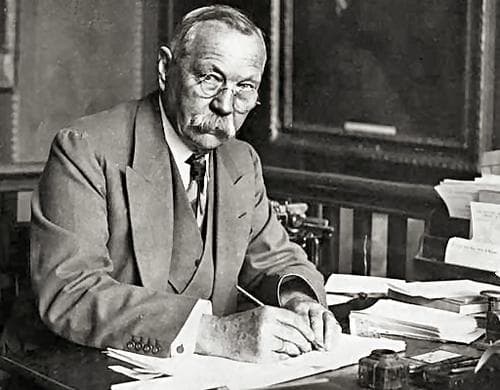
Sir Arthur Ignatius Conan Doyle was a British writer and physician. He created the character Sherlock Holmes in 1887 for A Study in Scarlet, the first of four novels and fifty-six short stories about Holmes and Dr. Watson. The Sherlock Holmes stories are milestones in the field of crime fiction.

Sir Arthur Ignatius Conan Doyle was a British writer and physician. He created the character Sherlock Holmes in 1887 for A Study in Scarlet, the first of four novels and fifty-six short stories about Holmes and Dr. Watson. The Sherlock Holmes stories are milestones in the field of crime fiction.







