BookBrief
The Home and the World cover
Archivist's Choice

The Home and the World

Rabindranath Tagore (2011)

Genre

Historical Fiction

Reading Time

240 min

Key Themes

See below

Track Your Reading

Sign in to track this book

In a Bengal on the cusp of Swadeshi, a sheltered wife's awakening to political fervor and illicit love threatens to shatter the traditional world of her zamindar husband.

Synopsis

In early 20th-century Bengal, the idealist zamindar Nikhil champions his wife Bimala's freedom, encouraging her to leave purdah and engage with the world. Their marriage is disrupted by Sandip, Nikhil's charismatic and nationalistic friend. Sandip, a fervent advocate of the Swadeshi movement, captivates Bimala with his rhetoric and personality, drawing her into politics and away from Nikhil's more measured approach. Bimala becomes enchanted by Sandip, letting her desires and new sense of self intertwine with the nationalistic cause. This leads her to betray Nikhil by secretly taking money from their treasury to fund Sandip's activities. As Sandip's manipulative nature is revealed, and as communal tensions escalate into violence, Bimala confronts the consequences of her choices and uncritical nationalism. Nikhil, a principled idealist, sacrifices himself to quell the riots, leaving Bimala to grapple with loss, guilt, and the harsh realities of a world shaped by both noble ideals and dangerous passions. She finds painful redemption through suffering and self-reflection.
Reading time
240 min
Difficulty
Medium
Pacing
Moderate
Mood
Philosophical, Reflective, Thought-provoking, Tragic
✓ Read this if...
You are interested in a classic of Indian literature exploring themes of nationalism, feminism, and idealism versus pragmatism during a pivotal historical period.
✗ Skip this if...
You prefer fast-paced plots with clear-cut heroes and villains, or find philosophical debates within a narrative to be slow.

Plot Summary

Nikhil's Idealism and Bimala's Seclusion

Nikhil, the enlightened and wealthy zamindar of the Sursagar estate in Bengal, introduces the narrative, reflecting on his modern ideals and his love for his wife, Bimala. He recounts their arranged marriage and his decision to educate Bimala, defying traditional norms that kept women in strict purdah. Nikhil believes in individual freedom and self-discovery. He encourages Bimala to discard her veil and engage with the outside world, setting up a Western-style drawing-room where she can meet his friends and participate in social life. Bimala, initially shy, gradually succumbs to his encouragement, but remains influenced by traditional expectations of wifely devotion, seeing Nikhil as her god.

The Arrival of Sandip

The arrival of Sandip, Nikhil's former school friend and a leader of the Swadeshi movement, changes the tranquil dynamics of the household. Sandip is a charismatic orator and a nationalist who advocates for boycotting foreign goods and promoting indigenous industries. Nikhil, while supportive of Swadeshi ideals, disagrees with Sandip's more aggressive methods, particularly his use of emotional manipulation and coercion. Sandip, invited by Nikhil to stay at Sursagar, quickly becomes a dominant presence. Bimala, initially wary, soon finds herself drawn to Sandip's passionate rhetoric and personality, which sharply contrasts with Nikhil's calm demeanor. Sandip's visits to the drawing-room become central to Bimala's new life.

Bimala's Enchantment with Nationalism

Under Sandip's spell, Bimala's understanding of patriotism and duty changes. Sandip praises her as 'Mother India' and encourages her to support the Swadeshi cause, particularly by collecting funds from the zamindari's tenants. Bimala, flattered by his attention and stirred by his speeches, begins to see Nikhil's gentle idealism as weakness and his tolerance as a lack of fervor. She is captivated by Sandip's vision of a strong India and feels a sense of purpose in contributing to the movement. This new passion, however, creates a rift between her and Nikhil, who observes her growing infatuation with concern, yet maintains his policy of non-interference with her personal growth.

The Theft of the Treasury Money

Driven by her devotion to Sandip and the Swadeshi cause, Bimala betrays Nikhil. Sandip, facing financial difficulties for his movement, subtly pressures Bimala for funds. Convinced that the money is for a noble cause and that Nikhil, with his wealth, would not miss it, Bimala secretly takes 6,000 rupees from her husband's treasury, which she oversees. She rationalizes her actions by believing she serves a higher purpose, but the act causes her internal conflict and guilt. Nikhil, who had left the treasury in her care as a sign of trust, soon realizes the money is missing. Though he suspects Bimala, he chooses not to confront her directly, hoping she will confess and find her own path to redemption.

Nikhil's Confrontation and Bimala's Realization

Nikhil eventually confronts Bimala about the missing money, not with anger, but with a plea for honesty and self-reflection. His gentle yet firm approach, coupled with his unwavering trust, shames Bimala. She confesses her theft and her involvement with Sandip, expressing her regret and guilt. This confession marks a turning point for Bimala. She starts to see Sandip not as the selfless patriot she once admired, but as a manipulative opportunist who exploited her emotions and idealism. The contrast between Nikhil's integrity and Sandip's deceit becomes clear to her, beginning a process of disillusionment with Sandip and a re-evaluation of her husband.

Sandip's Exploitation and Departure

Sandip's exploitative nature becomes evident, particularly in his dealings with local villagers and tradesmen. He coerces them into buying Swadeshi goods at inflated prices and uses strong-arm tactics to enforce the boycott of foreign goods, leading to unrest and economic hardship among the poor. He even attempts to extort money from local Muslim traders, creating communal tension. Nikhil, witnessing Sandip's oppressive methods, repeatedly tries to intervene and protect his tenants, but Sandip dismisses his concerns as weakness. As Bimala's disillusionment grows, she sees Sandip for the selfish, power-hungry individual he is. Eventually, facing opposition and dwindling support, Sandip decides to leave Sursagar, having exhausted his resources and influence.

The Communal Riots

Sandip's aggressive enforcement of the Swadeshi boycott and his targeting of Muslim traders, who traditionally dealt in foreign goods, ignites severe communal tension in the district. His rhetoric, which initially aimed to unite Indians, ironically leads to division and violence. Riots erupt between Hindu and Muslim communities, causing destruction, injury, and loss of life. Nikhil, true to his principles of humanity and justice, works to quell the violence and protect all his tenants, regardless of their religion. He risks his safety to intervene in the clashes, demonstrating his commitment to peace and communal harmony, a stark contrast to Sandip's divisive tactics.

Nikhil's Sacrifice and Bimala's Redemption

During the escalating communal riots, Nikhil, despite Bimala's pleas for him to stay safe, rides out to protect his tenants and restore order. He is gravely injured in the ensuing chaos, struck down while trying to mediate between the warring factions. News of his injury reaches Bimala, filling her with grief, remorse, and a renewed sense of love for her husband. She rushes to his side, realizing the depth of his sacrifice and his selflessness. His injury is a catalyst for her complete moral awakening, solidifying her understanding of genuine patriotism, which lies in compassion and justice, not in fanaticism or manipulation.

The Aftermath and Uncertainty

In the aftermath of the riots, with Nikhil critically wounded, Bimala nurses him. The novel concludes with uncertainty regarding Nikhil's fate, but Bimala's transformation is complete. She has come to appreciate Nikhil's love, his moral compass, and his selfless commitment to his people. Her earlier infatuation with Sandip and the allure of radical nationalism has faded, replaced by a mature understanding of love, duty, and true patriotism. She now sees the 'home' and the 'world' not as conflicting spheres, but as interconnected realms where one's principles must be consistently applied. The future of their relationship and Nikhil's recovery remains open, but Bimala has found her moral bearings.


Principal Figures

Nikhil

The Protagonist

Nikhil maintains his moral integrity throughout, serving as a constant despite the turmoil, and ultimately his sacrifice reaffirms his principles.

Bimala

The Protagonist

Bimala evolves from a sheltered, impressionable woman to a morally awakened individual who understands genuine love and patriotism.

Sandip

The Antagonist

Sandip remains morally static, his true nature revealed through his actions, ultimately leading to his departure and the failure of his divisive tactics.

Miss Gilby

The Supporting

Remains a consistent, minor influence on Bimala's education.

Chandranath Babu

The Supporting

Serves as a consistent moral and intellectual guide for Nikhil and implicitly for Bimala.

Themes & Insights

Nationalism vs. Universalism

The novel explores the dichotomy between narrow, aggressive nationalism and an inclusive, humane universalism. Sandip embodies the former, advocating for a divisive 'us vs. them' mentality, manipulating emotions, and resorting to violence in the name of the Swadeshi movement. His actions lead to communal riots. In contrast, Nikhil represents universalism, believing in the dignity of all individuals regardless of their background. His patriotism extends to all humanity, prioritizing justice, peace, and individual freedom over nationalistic fervor. This theme is portrayed in the communal riots where Nikhil risks his life to protect all his tenants, while Sandip's rhetoric fuels division.

I am willing to serve my country; but my worship I reserve for Right which is far greater than my country. To worship my country as a god is to bring a curse upon it.

Nikhil

Freedom and Responsibility

A central theme is the complex relationship between individual freedom and responsibility. Nikhil champions Bimala's freedom, encouraging her to leave purdah and make her own choices. However, Bimala initially misinterprets this freedom as license, leading her to fall for Sandip's manipulation and even commit theft. Her journey shows that true freedom is not merely the absence of external constraints, but the internal capacity for moral discernment and responsible action. The novel suggests that genuine freedom requires self-awareness, integrity, and a willingness to face the consequences of one's choices, as Bimala learns through her suffering and repentance.

To let our freedom be true, it must be the freedom to choose the right.

Nikhil

The Nature of Love and Marriage

The novel examines different facets of love and marriage. Nikhil's love for Bimala is selfless, patient, and rooted in respect for her individuality. He seeks her growth and happiness, even at the cost of his own pain. Bimala's initial understanding of love is traditional and devotional, but her infatuation with Sandip reveals a superficial, emotionally charged attraction based on charisma and flattery. Through her disillusionment with Sandip and her realization of Nikhil's true character, Bimala learns that genuine love in marriage is built on trust, sacrifice, and a shared moral foundation, rather than fleeting passion or blind adoration. Her devotion to the injured Nikhil signifies her mature understanding of love.

I had thought that my love was greater than my life; but now I see that my life is greater.

Bimala

The Conflict Between Tradition and Modernity

Tagore explores the tensions from the clash between entrenched Indian traditions and modern ideas. Nikhil embodies modernity, challenging purdah and promoting education and individual liberty for women. Bimala's initial struggle to adapt to the drawing-room symbolizes the difficulty of shedding traditional constraints. Sandip, while outwardly modern in his political activism, paradoxically uses traditional symbols and emotional appeals (like 'Mother India') to manipulate. The novel suggests that true progress lies not in blindly adopting Western ideas or clinging rigidly to tradition, but in a thoughtful synthesis that preserves core human values while embracing enlightened thought. The communal riots demonstrate the destructive potential when traditional identities are inflamed by modern political movements.

I am a zamindar, but I am also an Indian; and I have to live in India.

Nikhil

Plot Devices & Literary Techniques

First-Person Narrative (Multiple Perspectives)

The story is told through the alternating viewpoints of Nikhil, Bimala, and Sandip.

Tagore employs a unique narrative structure where the story unfolds through the alternating first-person accounts of the three main characters: Nikhil, Bimala, and Sandip. Each character narrates their experiences, thoughts, and feelings in separate chapters, offering distinct perspectives on the same events and other characters. This device allows the reader to delve deeply into the psychological motivations and moral complexities of each individual, highlighting their subjective interpretations of truth, love, and patriotism. It creates dramatic irony as the reader often knows more than the characters themselves, and it underscores the novel's exploration of conflicting ideologies by presenting them directly from the proponents' minds.

Symbolism of 'The Home and the World'

The title itself represents the central conflict between private life and public duty.

The title 'The Home and the World' serves as a powerful overarching symbol for the novel's central themes. 'The Home' represents the private, domestic sphere, characterized by personal relationships, traditional values, moral integrity, and intimate emotions, epitomized by Nikhil's principled stand and Bimala's initial sheltered life. 'The World' symbolizes the public, political, and social realm, encompassing the Swadeshi movement, communal strife, and the allure of external validation and power, largely represented by Sandip. The novel explores the tension and interpenetration between these two spheres, examining how personal choices impact public life and how public events inevitably intrude upon the home, forcing characters to reconcile their private ethics with their public responsibilities.

The Drawing-Room

A physical space symbolizing the meeting point of tradition and modernity.

The drawing-room in Nikhil's house functions as a significant symbolic space. It is a Western-style room, deliberately set up by Nikhil to encourage Bimala to shed her purdah and engage with the outside world. It becomes the primary setting for Bimala's interactions with Sandip and other guests, representing her initial foray into modernity and public life. The drawing-room is a liminal space where traditional boundaries are blurred, and new ideas are introduced. It symbolizes Nikhil's progressive ideals and his attempt to create a bridge between the 'home' and the 'world,' but it also becomes the site of Bimala's moral testing and the unraveling of her innocence under Sandip's influence.

Critical analysis

Notable Quotes

Patriotism cannot be our final spiritual shelter; my refuge is humanity. I will not buy glass for the price of diamonds, and I will never allow patriotism to triumph over humanity as long as I live.

Nikhil's core philosophy, contrasting with Sandip's fervent nationalism.

The only difference between a man and a beast is that a man can be ashamed.

Bimala reflecting on the moral failings of herself and others.

To be able to love, one must be able to give oneself.

Nikhil's understanding of true love and selflessness.

The truth is, when a man is a man, he is not afraid of anything. But when he is a god, he is afraid of everything.

Sandip's cynical view of power and vulnerability.

Freedom is the right to choose your own chains.

A thought from Sandip, highlighting his manipulative understanding of freedom.

When you want to do good, you must do it yourself. You must not wait for others to do it for you.

Nikhil's advocacy for personal responsibility and action.

It is not for us to create the world, but to serve it.

Nikhil's humble perspective on humanity's role in the world.

The greatest prison where men can live is the fear in their own hearts.

A reflection on the internal struggles that limit individuals.

My love is not a thing of the market-place, to be bought and sold. It is a gift, and it must be given freely.

Bimala's realization about the true nature of love, after being swayed by Sandip.

The current of a man's life is not to be measured by the banks it overflows, but by the depths it covers.

A metaphor about the true measure of a person's impact and character.

The problem is not how to get rid of the darkness, but how to let in the light.

A philosophical insight on overcoming challenges and embracing truth.

There are two kinds of people in the world: those who want to have, and those who want to be.

A fundamental distinction drawn between materialistic and spiritual pursuits.

To conquer the world, you must first conquer yourself.

A timeless wisdom about self-mastery as a prerequisite for external success.

The real tragedy of life is not that men are beasts, but that they are not.

Sandip's cynical view, implying that human pretense of morality is the real issue.

Quiz

Test Your Knowledge

Ready to see how well you understood this book? Take our interactive quiz with 10 questions.

10
Questions
~5
Minutes
?
Best Score

Key Questions (FAQ)

The novel primarily explores the ideological conflict between the traditional values of the home (represented by Bimala and Nikhilesh's arranged marriage and Nikhilesh's progressive but measured patriotism) and the radical, often violent, nationalism of the Swadeshi movement (championed by Sandip). This struggle plays out through the personal relationships and evolving political consciousness of the main characters.

About the author

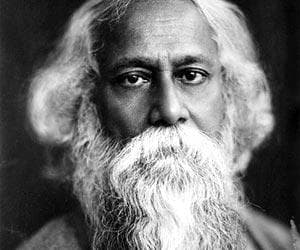
Rabindranath Tagore

Rabindranath Tagore was a Bengali poet, writer, playwright, composer, philosopher, social reformer and painter. He reshaped Bengali literature and music as well as Indian art with Contextual Modernism in the late 19th and early 20th centuries. Author of the "profoundly sensitive, fresh and beautiful" poetry of Gitanjali, he became in 1913 the first non-European and the first lyricist to win the Nobel Prize in Literature. Tagore's poetic songs were viewed as spiritual and mercurial; however, his "elegant prose and magical poetry" remain largely unknown outside Bengal. He was a fellow of the Royal Asiatic Society. Referred to as "the Bard of Bengal", Tagore was known by sobriquets: Gurudeb, Kobiguru, Biswokobi.