BookBrief
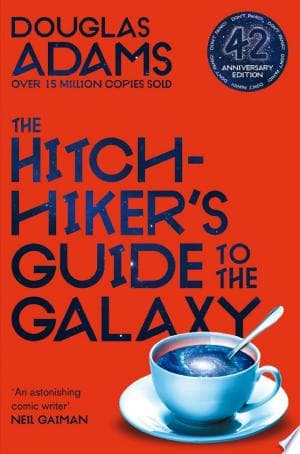
The Hitchhiker's Guide to the Galaxy cover
Archivist's Choice

The Hitchhiker's Guide to the Galaxy

Douglas Adams (2009)

Genre

Fantasy / Science Fiction

Reading Time

233 min

Key Themes

See below

Track Your Reading

Sign in to track this book

Moments after his house is demolished, Arthur Dent, an ordinary Englishman, finds himself launched into a ridiculous interstellar journey, armed only with a towel and a guide that humorously advises 'DON'T PANIC' as Earth is vaporized for a hyperspace bypass.

Synopsis

Arthur Dent's ordinary Thursday takes an extraordinary turn when his house is demolished, followed by Earth itself, to make way for a hyperspace bypass. His best friend, Ford Prefect, reveals he is an alien researcher for The Hitchhiker's Guide to the Galaxy and saves Arthur by hitchhiking onto a Vogon constructor ship. They survive Vogon poetry before being rescued by the Heart of Gold, a spaceship stolen by Arthur's semi-cousin, Galactic President Zaphod Beeblebrox, and his human companion, Trillian, whom Arthur once tried to meet at a party. Their journey leads them to the planet Magrathea, a world once dedicated to building custom planets, where they seek the answer to the Ultimate Question of Life, the Universe, and Everything. On Magrathea, Arthur meets Slartibartfast, a planet designer who explains that Earth was a supercomputer commissioned by hyper-intelligent pan-dimensional beings (disguised as mice) to calculate the Ultimate Question after the answer, 42, was found to be meaningless without knowing the question. The mice then demand to extract the question from Arthur's brain, as he was the last human on Earth before its destruction. A confrontation occurs with two Magrathean police officers, who are actually disguised interdimensional beings attempting to retrieve Zaphod. The group escapes, deciding to go to the Restaurant at the End of the Universe, a new destination for their continuing, absurd adventures across the galaxy.
Reading time
233 min
Difficulty
Easy
Pacing
Fast
Mood
Hilarious, Absurdist, Witty, Philosophical, Lighthearted
✓ Read this if...
You love British humor, absurd situations, philosophical musings wrapped in comedy, and a truly unique take on space opera.
✗ Skip this if...
You prefer serious, hard science fiction, linear plots, or dislike surreal humor and non-sequiturs.

Plot Summary

Demolition and Revelation

The story begins on an ordinary Thursday morning for Arthur Dent, who is trying to stop his house in West Country, England, from being demolished for a bypass. His friend, Ford Prefect, arrives and says he is an alien from near Betelgeuse, and that Earth is about to be demolished for a hyperspace bypass. Ford pulls a protesting Arthur to a local pub, buys them six pints of beer, and then manages to hitch a ride on a Vogon constructor fleet ship moments before Earth is destroyed. Arthur is in shock and disbelief, struggling to understand the sudden end of his world and his best friend's true identity.

Vogon Poetry and Rescue

Aboard the Vogon ship, Arthur and Ford are found by Captain Prostetnic Vogon Jeltz, who makes them listen to his poetry, considered the third-worst in the universe. After this torture, Jeltz orders them thrown into space, thinking they are spies. With only 30 seconds of oxygen left, Arthur and Ford are miraculously saved by the Infinite Improbability Drive of a passing spaceship, the *Heart of Gold*. This sudden rescue, against all odds, introduces them to the universe's absurdities and the unpredictable nature of their new reality, showing the sheer improbability that guides their lives.

Meeting Zaphod and Trillian

Arthur and Ford find themselves aboard the *Heart of Gold*, a revolutionary spaceship powered by the Infinite Improbability Drive. They soon discover the ship's crew includes Zaphod Beeblebrox, Ford's semi-cousin and the President of the Galaxy (who stole the ship), and Trillian, a human woman Arthur had met at a party on Earth. Also aboard is Marvin, a constantly depressed robot. Arthur is especially surprised to see Trillian, as he had tried to meet her unsuccessfully at a party on Earth, only to be outmaneuvered by Zaphod, who arrived in a spaceship. This reunion is awkward and adds another strange coincidence to Arthur's already confusing space journey.

The Quest for Magrathea

Zaphod Beeblebrox reveals his seemingly illogical plan: to travel to the legendary planet Magrathea. Magrathea is a mythical planet, long thought to be a fable, whose inhabitants supposedly built planets for wealthy clients. The coordinates for Magrathea are a closely guarded secret, and Zaphod's wish to find it comes from a mysterious impulse and a desire to uncover its secrets. The crew, including a confused Arthur and a curious Ford, begin this improbable journey, not fully understanding Zaphod's reasons but carried along by the *Heart of Gold*'s improbable power and Zaphod's unpredictable leadership. Their destination holds the key to the universe's greatest secret.

Arrival at Magrathea and Missile Attack

Upon arriving in the Magrathean system, the *Heart of Gold* faces an automated missile defense system, which launches two ancient nuclear missiles at them. Zaphod, in a moment of panic, suggests using the Infinite Improbability Drive to escape, but Marvin, in his usual pessimistic way, notes that the drive is already active. Through sheer improbable luck, the missiles turn into a bowl of petunias and a sperm whale, which then hit the planet's surface. This strange event allows the *Heart of Gold* to land safely on Magrathea, further showing the unpredictable and absurd nature of the universe they inhabit and the power of their unique ship.

Slartibartfast and the Earth's Purpose

On Magrathea, Arthur is separated from the others and meets Slartibartfast, an elderly Magrathean planet designer. Slartibartfast reveals the surprising truth: Earth was not a natural planet but a supercomputer, commissioned by pan-dimensional beings (who appear as white mice) to calculate the Ultimate Question of Life, the Universe, and Everything. The answer to this ultimate question, 42, had already been given by the supercomputer Deep Thought, but the question itself remained unknown. Earth's destruction by the Vogons was an unfortunate interruption, as the computer was minutes from finishing its calculations. Arthur is completely confused by this news, his entire understanding of existence shattered.

The Mice's Demand

Meanwhile, Zaphod, Ford, and Trillian are captured by the pan-dimensional beings, who reveal themselves as the super-intelligent mice Frankie and Benjy. These mice were the true masters behind the Earth project and are desperate to get the Ultimate Question. They believe that since Arthur was the last sentient being on Earth before its destruction, his brain might contain the final piece of the puzzle. They propose to extract Arthur's brain to find the question, much to Arthur's horror. This sinister demand shows the extreme lengths some beings will go to for knowledge and the comical yet terrifying situation Arthur finds himself in.

Confrontation and Escape

As the mice prepare to operate on Arthur, an alarm sounds, indicating the arrival of two intergalactic police officers, who have been tracking Zaphod for stealing the *Heart of Gold*. In the resulting chaos, Marvin, the depressed robot, manages to disable the police officers by talking to their spaceship's computer, causing it to commit suicide from sheer boredom and depression. This unexpected action allows Arthur, Ford, Zaphod, and Trillian to escape the mice and their brain-extraction plans. They quickly return to the *Heart of Gold*, leaving the frustrated mice behind. The escape shows Marvin's unique, though melancholic, abilities.

The Restaurant at the End of the Universe

Having just escaped Magrathea and the mice, the *Heart of Gold* crew decides to find refuge and a meal. Zaphod suggests visiting the legendary Milliways, the Restaurant at the End of the Universe. This restaurant exists within a time bubble at the very end of time, letting patrons see the universe's final moments while enjoying a gourmet meal. The idea of such an extravagant experience appeals to Zaphod's pleasure-seeking nature and offers a temporary break from their dangerous adventures. They set a course for Milliways, ready for another improbable journey and a truly unique dining experience.

The Search for a New Restaurant

The book ends with the crew setting off for the Restaurant at the End of the Universe. However, a slight malfunction with the Infinite Improbability Drive during their journey causes them to land on a different planet than intended. They find themselves on a desolate, ancient world, where they meet a mysterious figure who appears to be a prophet. This unexpected detour puts their immediate culinary plans on hold and sets the stage for further adventures. The ending leaves Arthur and his companions in a new, puzzling situation, hinting at the continuation of their intergalactic misadventures and the unpredictable nature of the universe.

Principal Figures

Arthur Dent

The Protagonist

Arthur transforms from a bewildered, earthbound individual into a reluctant intergalactic traveler, slowly adapting to the universe's illogic while retaining his core English sensibilities.

Ford Prefect

The Supporting

Ford remains largely consistent in his role as the knowledgeable, if slightly irresponsible, guide, continuing his research and navigating galactic perils with seasoned ease.

Zaphod Beeblebrox

The Supporting

Zaphod remains a self-serving, adventurous figure, his underlying motivations for seeking Magrathea slowly revealed as a deeper, implanted purpose.

Trillian (Tricia McMillan)

The Supporting

Trillian adapts quickly to life in space, maintaining her intelligence and wit despite the chaotic company she keeps, becoming a competent member of the *Heart of Gold* crew.

Marvin

The Supporting

Marvin remains consistently and hilariously depressed throughout, his super-intelligence an ironic source of his profound misery, yet he proves surprisingly effective in critical moments.

Slartibartfast

The Supporting

Slartibartfast serves as a wise, if eccentric, expository character, revealing the true nature of Earth and its ultimate purpose, remaining a steadfast, if slightly melancholic, figure.

Prostetnic Vogon Jeltz

The Antagonist

Prostetnic Vogon Jeltz remains a static antagonist, embodying the bureaucratic, unfeeling force that initiates Arthur's journey, consistently cruel and unyielding.

Deep Thought

The Mentioned

Deep Thought's role is primarily historical, a critical plot point that sets the stage for Earth's creation and the subsequent events, its revelation being the catalyst for the entire narrative.

Frankie and Benjy

The Antagonist

Frankie and Benjy emerge as the manipulative masterminds behind Earth's true purpose, their reveal as hyper-intelligent mice adding to the story's absurdity and providing a direct threat to Arthur.

Themes & Insights

The Absurdity of Existence

The novel shows the inherent meaninglessness and randomness of the universe. Events unfold illogically, from Earth's demolition for a bypass to the discovery that a supercomputer calculated '42' as the answer to everything, without knowing the question. Arthur's constant confusion highlights this absurdity, as he deals with the sheer pointlessness of grand galactic plans and the arbitrary nature of fate. The universe is portrayed not as a grand, ordered design, but as a chaotic, often comical, place where reason rarely wins, as seen when missiles turn into a whale and a bowl of petunias.

Space is big. Really big. You just won't believe how vastly, hugely, mind-bogglingly big it is. I mean, you may think it's a long way down the road to the chemist's, but that's just peanuts to space.

The Hitchhiker's Guide to the Galaxy

The Bureaucracy and Its Inhumanity

Adams satirizes bureaucracy as a destructive and illogical force. The Vogons, with their love of paperwork, rules, and terrible poetry, embody this theme. Their demolition of Earth is not an act of malice, but simple adherence to bureaucratic protocol, without any thought for the inhabitants. This shows how rigid systems can lead to immense suffering and destruction, without empathy or common sense. The paperwork for saving Earth was 'mislaid' in an office on Alpha Centauri, perfectly showing the deadly inefficiency of unchecked officialdom and the trivial reasons for monumental disasters.

Bypasses are not built for fun. They are built to facilitate commerce. You cannot stop progress.

Prostetnic Vogon Jeltz

The Search for Meaning

Despite the prevailing absurdity, characters like Arthur and the pan-dimensional beings are driven by a search for understanding and meaning. The entire idea of Earth being a supercomputer designed to find the Ultimate Question after Deep Thought provided the Answer (42) shows humanity's deep need to understand its place in the cosmos. Arthur's persistent desire for a cup of tea and a sensible explanation reflects a longing for order and comfort in a chaotic universe. The ultimate irony is that the search for meaning itself creates more questions and further absurdity, rather than clear answers.

The Answer to the Ultimate Question of Life, the Universe, and Everything is... 42.

Deep Thought

The Nature of Reality and Perception

The novel constantly plays with what is considered 'real' or 'possible.' The Infinite Improbability Drive, which lets the *Heart of Gold* achieve any improbable event, directly challenges traditional understanding of reality. Arthur's struggle to accept that his best friend is an alien, or that Earth was a computer, shows the subjective nature of perception. The idea that reality is built or even programmed (as with Earth) forces characters and readers to question their own assumptions about existence. This theme suggests that reality is far more changeable and strange than commonly believed, often shaped by advanced technology or sheer chance.

The idea was to build a computer that could design an even better computer, and so on, until you had a computer that could design and build a computer that could solve the Ultimate Question.

Slartibartfast

Plot Devices & Literary Techniques

The Hitchhiker's Guide to the Galaxy

An electronic reference book that provides crucial, often sarcastic, information.

The Guide is a versatile, electronic encyclopaedia that serves as a running commentary on the universe. It provides exposition, comic relief, and often foreshadows events. Its entries, frequently quoted by Ford Prefect, offer insights into various alien races, planets, and concepts, often with a dry, humorous tone. The Guide acts as a meta-narrative device, directly addressing the reader and shaping their understanding of the bizarre galactic landscape. It is both a practical tool for survival and a philosophical observer of cosmic absurdity, often concluding its entries with the famous advice: 'Don't Panic!'

The Infinite Improbability Drive

A revolutionary propulsion system that allows a ship to pass through every conceivable point in every conceivable universe simultaneously.

This device powers the *Heart of Gold* and is central to the plot's absurd developments. It works by making the ship pass through 'every conceivable point in every conceivable universe simultaneously,' thus arriving at its destination with 'infinite improbability.' This allows for completely random and often hilarious events to occur, such as missiles turning into a sperm whale and a bowl of petunias. It's a plot device that enables sudden rescues, bizarre transformations, and provides a scientific (albeit nonsensical) explanation for the universe's inherent randomness, driving the narrative through sheer, unpredictable chance.

Pan-Dimensional Beings / Mice

The hyper-intelligent beings who commissioned Earth, appearing as mice.

Initially presented as a concept by Deep Thought, these beings are revealed to be the true masterminds behind Earth's creation. Their true forms are beyond human comprehension, but they appear as white mice in their earthly guise. This reveal is a major twist, subverting expectations and adding to the novel's humor. They serve as a powerful plot device to explain Earth's true purpose and to create a direct threat to Arthur (as they want his brain). Their existence highlights the idea that the seemingly insignificant can hold immense power and intelligence, further emphasizing the absurdity of appearances.

The Answer '42'

The numerical answer to the Ultimate Question of Life, the Universe, and Everything.

The number 42 is the ultimate MacGuffin and a central piece of cosmic irony. Deep Thought, the second greatest computer ever, takes 7.5 million years to calculate this answer, only to discover that no one knows the actual question it answers. This revelation drives the creation of Earth as an even larger computer to find the question. The number itself is meaningless without its corresponding question, symbolizing the futility of seeking answers without understanding the underlying query. It's a running gag that underscores the inherent meaninglessness and absurdity of seeking ultimate truths in a chaotic universe.

Critical analysis

Notable Quotes

Quiz

Test Your Knowledge

Ready to see how well you understood this book? Take our interactive quiz with 10 questions.

10
Questions
~5
Minutes
?
Best Score

Key Questions (FAQ)

Arthur Dent's house is demolished to make way for a bypass, only to be immediately followed by the Earth itself being destroyed by the Vogons to make way for a hyperspace bypass. This sudden, double demolition forces him to flee with his alien best friend, Ford Prefect, just moments before the planet's annihilation.

About the author

Douglas Adams

Douglas Noël Adams was an English author, humorist, and screenwriter, best known for The Hitchhiker's Guide to the Galaxy. Originally a 1978 BBC radio comedy, The Hitchhiker's Guide to the Galaxy developed into a "trilogy" of five books that sold more than 15 million copies in his lifetime. It was further developed into a television series, several stage plays, comics, a video game, and a 2005 feature film. Adams's contribution to UK radio is commemorated in The Radio Academy's Hall of Fame.