“Before I die, I want to be a part of the world.”
— Leo Gursky's lifelong yearning for connection and to be remembered.

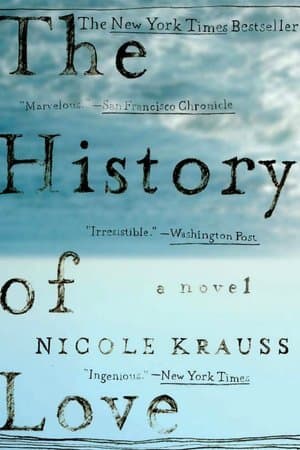
Nicole Krauss (2005)
Genre
Literary Fiction / Historical Fiction / Romance
Reading Time
360 min
Key Themes
See below
Sign in to track this book
A forgotten Yiddish novel intertwines the lives of a lonely Polish émigré still yearning for his lost love and a tenacious teenage girl determined to cure her mother's solitude by finding its elusive author.
Leo Gursky, an eighty-year-old Polish Jewish immigrant in New York, spends his days trying to be noticed, fearing he will die alone. He stages minor accidents or makes inappropriate comments to get a response. His life is defined by the memory of Alma Mereminski, his youth's love in Poland, and the child he believes they had before the war separated them. He wrote a book, 'The History of Love,' for her, a manuscript that seemingly vanished. He believes his son, Isaac, whom he has never met, is a successful writer, and Leo wonders if Isaac knows of his existence or the book. He deals with the realities of old age and deep solitude, carrying the weight of his past.
Fourteen-year-old Alma Singer, named after a character in a book her mother loves, lives in New York with her mother and younger brother, Bird. Since her father died, Alma's mother, Charlotte, has been withdrawn and lonely. Alma believes that finding a new love for her mother will help her sadness. She discovers that her mother is translating a rare, obscure book titled 'The History of Love,' written by someone named Zvi Litvinoff. Interested in the book and its importance to her mother, Alma decides to find the author, hoping this search will bring joy back into her mother's life. She begins by researching Zvi Litvinoff online and through libraries, a journey that will connect with Leo's past.
Alma's younger brother, Bird, is a religious child who believes he is one of the Lamed Vavniks, the 36 righteous men who secretly sustain the world. He documents his 'proof' in a notebook. Meanwhile, their mother, Charlotte, continues her translation work, focused on 'The History of Love.' The book itself is a series of philosophical thoughts, observations, and stories about love, loss, and human connection, attributed to a fictional character named 'Zvi Litvinoff.' Charlotte received the book from a wealthy, dying man named Jacob Marcus, who asked her to translate it from Yiddish, believing it was written by a childhood friend. This translation project is Charlotte's first significant engagement since her husband's death, giving her purpose.
Leo's memories reveal his past in Slonim, Poland. He loved Alma Mereminski deeply. He wrote a book for her, 'The History of Love,' a personal and philosophical work. When the Nazis invaded Poland, Leo convinced Alma and her family to flee to America. He gave his manuscript to his childhood friend, Zvi Litvinoff, asking him to keep it safe. Leo barely survived the war, hiding in forests. He immigrated to America, always believing Alma and their unborn child had made it safely. He never saw Zvi again and assumed the manuscript was lost, unaware of its true fate.
Alma's initial research into Zvi Litvinoff is difficult. She finds little information about him beyond the book. She contacts libraries and archives, eventually discovering that a Zvi Litvinoff did exist and immigrated to America, but he died years ago. Alma continues her search, driven by her desire to help her mother. She follows clues, including an old photograph in the book, leading her to believe that the author might still be alive or that someone connected to him could provide answers. Her quest is a mix of childlike innocence and determined detective work, as she navigates adult lives and hidden histories.
Leo Gursky, still believing his son Isaac is a famous writer, attends a book signing for a new novel. He approaches the author, convinced it is Isaac, and tries to connect, but the encounter is awkward and unfulfilling, leaving Leo feeling more isolated. Later, a letter arrives for Leo, from a woman named Alma Singer, asking if he is the author of 'The History of Love.' This letter, along with an article mentioning the book's re-publication, changes Leo's world. He realizes his book, the one he thought was lost forever, has survived and is now circulating, attributed to Zvi Litvinoff. This revelation sparks anger, confusion, and a new sense of purpose.
The truth about the manuscript's journey slowly appears. Zvi Litvinoff, after receiving the manuscript from Leo in Poland, escaped the Holocaust and eventually went to Chile. There, struggling to make a living and haunted by his past, he published Leo's manuscript under his own name, believing Leo to be dead. The book gained a small following in Chile. Zvi later immigrated to America, where he lived quietly, never revealing the true authorship. The book's reappearance through Charlotte's translation and Alma's investigation forces a confrontation with this long-held secret, showing the interplay of survival, guilt, and intellectual property.
Alma Singer's persistent questions eventually lead her to Leo Gursky. She initially believes him to be Zvi Litvinoff, the author. Their first meeting is hesitant and full of misunderstandings, as Leo resists the idea that his book is being translated and published under another's name, and Alma is still figuring out the true story. Alma, however, is drawn to Leo's connection to the book's themes and his sadness. She sees in him a potential cure for her mother's loneliness, an unexpected link to the past. Their interactions, though awkward at first, begin to lessen their isolations, forming an unlikely bond.
The most important revelation occurs when Alma and Leo discover their shared past. Alma's deceased father, Isaac Moritz, was the son of Alma Mereminski and Leo Gursky. After fleeing Poland, Alma Mereminski gave birth to Isaac in America. She later married a different man, hiding Isaac's true paternity to protect him from her past trauma. Isaac grew up, became a loving husband to Charlotte and father to Alma and Bird, but always carried an unspoken sadness. The book 'The History of Love' was a cherished possession of Isaac's, passed down to Charlotte, explaining her attachment to it. This discovery links the two families, showing the impact of war and the lasting power of love across generations.
With the truth revealed, Leo Gursky finds peace. He understands that his son, Isaac, lived a full life, even if he never knew his true father. He also finds a surrogate family in Alma, Charlotte, and Bird, who welcome him. Alma Singer, having connected her mother to the book's true author and its history, feels she has completed her mission. The book, 'The History of Love,' speaks not just to Leo's lost love, Alma Mereminski, but to the lasting power of stories and human connection. Leo, no longer fearing being unnoticed, finds comfort in knowing that his life, and his love, have left a meaningful legacy.
The Protagonist
From a lonely, attention-seeking old man defined by loss, Leo finds unexpected connection and a sense of legacy through Alma Singer and the rediscovery of his book.
The Protagonist
Alma matures from a girl seeking an external solution for her mother's sadness to understanding the complex, interconnected nature of love and loss across generations, finding her own place within a newly discovered family history.
The Supporting
Initially withdrawn and consumed by grief, Charlotte slowly re-engages with life as the mystery of 'The History of Love' unfolds, leading her to understand her husband's hidden past and embrace a new family connection.
The Supporting
Bird remains largely consistent in his self-proclaimed role as a Lamed Vavnik, but his world subtly expands as his family's history unfolds, offering him new perspectives on human connection and suffering.
The Supporting
Her story is largely revealed through flashbacks and the unfolding mystery, showing her journey from youthful love to a survivor making difficult choices to protect her child.
The Supporting
His character's arc is revealed in retrospect, showing his life as a loving family man despite a hidden past, ultimately becoming the linchpin connecting Leo's past to Alma Singer's present.
The Supporting
His character's arc is presented retrospectively, revealing his journey from a friend entrusted with a manuscript to a survivor who claimed authorship out of desperation, ultimately impacting generations.
The Mentioned
His role is to initiate the central plot device (the translation of the book) before his death, thus acting as a catalyst for the main characters' journeys.
The novel explores love – romantic, familial, and platonic – and the lasting impact of loss. Leo's life is defined by his lost love for Alma Mereminski and the son he never knew, showing how love can last beyond separation and death. Charlotte's grief for Isaac and Alma Singer's desire to mend her mother's heart show the pain of loss and the efforts people make to lessen it. The book 'The History of Love' itself shows love's power to inspire, devastate, and connect people across time and space.
“He was a man who had lost a world, and then had lost the only connection to that world.”
Characters deal with who they are, individually and in relation to their pasts. Leo Gursky struggles with his identity as an 'invisible' old man, seeking validation and acknowledgment of his existence and his authorship. Alma Singer discovers herself through her quest, learning about her family's hidden history and her place in it. The revelation of Isaac's true parentage makes Charlotte, Alma, and Leo rethink their identities, showing how personal history and ancestry shape who we are.
“I will not die. I will not die. I will not die.”
'The History of Love' is a story about the power of stories to preserve memory, connect people, and shape lives. Leo's book, meant as a statement of his love, becomes a central part of the plot, traveling across continents and generations, affecting various characters. Writing, translating, and reading the book is central to the plot, showing how literature can transmit emotions, histories, and identities. The novel itself shows the human need to tell and hear stories, to make sense of life through narrative, and to leave a mark.
“The story of my life is not the story of my life. The story of my life is the story of a book.”
The novel explores how individual and collective memory shapes the present. Leo Gursky's memories of pre-war Poland and Alma Mereminski are vivid, influencing his every action. The Holocaust is a silent but powerful force, scarring characters and shaping their decisions (e.g., Alma Mereminski's decision to hide Isaac's paternity). The fragmented, non-linear narrative structure reflects memory itself, as characters piece together their pasts. The book shows that history is not just grand events but the sum of countless personal stories, often forgotten or hidden, waiting to be rediscovered.
“What is the opposite of a memory? A prophecy.”
Despite the distances and decades separating the characters, their lives are connected by a single book. Alma Singer's innocent quest leads her to her grandfather, Leo. The chain of events, from Zvi Litvinoff publishing the book to Jacob Marcus asking for its translation, shows how seemingly random occurrences can lead to deep connections. The novel suggests that the world is smaller and more intertwined than it appears, and that even the most isolated lives are part of a larger, unseen history.
“Every person is a book, written by life, and every life is a story, waiting to be told.”
The story is told through shifting perspectives and timelines, revealing fragments of a larger truth.
The novel uses a non-linear structure, jumping between the present-day lives of Leo Gursky and Alma Singer, and flashbacks to Leo's youth in Poland. It also employs multiple narrative voices, including Leo's first-person musings, Alma's third-person narration, and excerpts from 'The History of Love' itself. This fractured approach mirrors the fragmented nature of memory and the way history is pieced together. It gradually reveals information, creating suspense and allowing readers to connect the dots alongside the characters, ultimately converging to form a complete picture.
A fictional manuscript acts as the central catalyst and symbolic heart of the novel.
The novel features a fictional book titled 'The History of Love' as a central plot device. This book, written by Leo Gursky but published by Zvi Litvinoff, is the object of Alma Singer's quest and the catalyst for uncovering the intertwined family histories. Excerpts from this internal book are included in the narrative, reflecting Leo's philosophical and emotional state, and serving as a direct link between the past and present. It symbolizes enduring love, stolen authorship, and the power of literature to transcend time and connect lives.
The name 'Alma' connects characters across generations and signifies the soul.
The name 'Alma' is a significant symbolic device. Leo's great love from Poland is Alma Mereminski. Alma Singer is named after a character in 'The History of Love,' implicitly connecting her to Leo's lost love long before their familial relationship is revealed. The name 'Alma' itself means 'soul' in Spanish, reinforcing the profound emotional and spiritual connections between these characters. This recurring name highlights themes of legacy, destiny, and the cyclical nature of love and loss across generations, suggesting a soulful connection that transcends individual lives.
Leo Gursky's fear of dying unnoticed symbolizes the human fear of insignificance.
Leo Gursky's constant efforts to be noticed—staging minor accidents, making inappropriate comments—stem from his deep-seated fear of dying as an 'invisible man.' This motif symbolizes the universal human fear of insignificance and the desire to leave a mark, to be remembered. It highlights the profound loneliness of old age and the psychological impact of surviving immense trauma. His eventual discovery and connection with Alma Singer provide him with the validation and recognition he craves, transforming him from an 'invisible man' to a man with a tangible legacy.
Bird's belief in the hidden righteous men offers a spiritual and hopeful counterpoint to the narrative's sadness.
Bird Singer's conviction that he is one of the Lamed Vavniks, the 36 righteous men who secretly sustain the world, serves as a significant symbolic and thematic device. This Jewish mystical concept provides a hopeful and spiritual counterpoint to the sadness and loss prevalent in the narrative. It suggests that even in the darkest times, there are hidden forces of goodness and purpose. Bird's innocent belief underscores the idea that unnoticed individuals can profoundly impact the world, mirroring Leo's own quest for significance and the unseen connections that bind humanity.
“Before I die, I want to be a part of the world.”
— Leo Gursky's lifelong yearning for connection and to be remembered.
“The greatest love story of all time is contained in a book that was never written.”
— A reflection on the unexpressed and lost stories, particularly 'The History of Love'.
“She was the most beautiful woman I had ever seen. She was the only woman I had ever seen.”
— Leo Gursky describing Alma Mereminski, emphasizing his singular devotion.
“And it was then that I realized that the world was not a map, and that nothing was written in stone.”
— Alma Singer's realization about the fluidity of life and identity.
“What if the most important person in your life is someone you don't even know?”
— A central question of the novel, exploring the interconnectedness of strangers.
“The truth is, I'm just a guy who wants to be seen.”
— Leo Gursky's simple yet profound desire for recognition and to not be invisible.
“When you're a child, you think your parents are giants. Then, one day, they're just people.”
— Bird (Isaac) Singer's evolving perception of his parents.
“To be forgotten is to die twice.”
— Leo Gursky's fear of oblivion and the importance of memory.
“The world is full of books, and yet, there is no history of love.”
— The ironic observation that gives the novel its title, highlighting an absence.
“Maybe the greatest love stories are the ones that are never told.”
— Echoes the theme of unspoken or lost narratives, particularly Leo's.
“Every person has a book inside them. Some people write it, some people don't.”
— A metaphor for the unique stories and experiences within each individual.
“I was alive. I was alive, and I was going to live.”
— Alma Singer's affirmation of her own existence and determination.
“There are people who are meant to be in your life, and there are people who are meant to pass through.”
— A reflection on the different kinds of relationships and their impact.
“Sometimes, the only way to find something is to stop looking.”
— Alma Singer's journey of discovery, often finding answers when she least expects them.
Ready to see how well you understood this book? Take our interactive quiz with 10 questions.

Nicole Krauss is an American author best known for her four novels Man Walks into a Room (2002), The History of Love (2005), Great House (2010) and Forest Dark (2017), which have been translated into 35 languages. Her fiction has been published in The New Yorker, Harper's, Esquire, and Granta's Best American Novelists Under 40, and has been collected in Best American Short Stories 2003, Best American Short Stories 2008 and Best American Short Stories 2019. In 2011, Nicole Krauss won an award from the Anisfield-Wolf Book Awards for Great House. A collection of her short stories, To Be a Man, was published in 2020 and won the Wingate Literary Prize in 2022.







