“The greatest evil is not to be able to make a choice.”
— A reflection on the nature of free will and damnation.

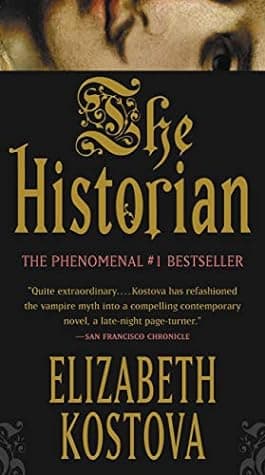
Elizabeth Kostova (2005)
Genre
Thriller / Fantasy / Historical Fiction / Mystery
Reading Time
15-20 hours
Key Themes
See below
Sign in to track this book
A young woman unearths a centuries-old quest for the truth about Vlad the Impaler, plunging into a labyrinth of historical secrets, ancient evils, and her family's perilous legacy.
In 1972, a sixteen-year-old unnamed narrator living in Amsterdam with her diplomat father, Paul, finds an old, leather-bound book in his study—a medieval edition of 'Dracula.' Inside, she finds yellowed letters addressed to 'My dear and unfortunate successor,' signed with only the initial 'H.' These letters describe a chilling academic quest to find the truth about Vlad the Impaler and the legend of Dracula, hinting at a terrifying reality. Her father, usually quiet, becomes visibly upset when he sees her with the book, starting a conversation that reveals his deep involvement in this centuries-old mystery and its impact on his life, especially concerning her mother's disappearance.
The story shifts to Paul's perspective, recounting his experiences as a graduate student in the late 1950s. While studying medieval history at the University of Pennsylvania, Paul meets his mentor, Professor Bartholomew Rossi, who then mysteriously disappears. Before vanishing, Rossi sends Paul a similar old copy of 'Dracula' and a cryptic note. Paul, curious and worried, begins to investigate Rossi's disappearance, following clues that lead him to libraries and archives, where he uncovers strange symbols and references to Vlad the Impaler, suggesting an academic effort to hide information about the historical figure and his mythical counterpart.
Paul's investigation takes him to Istanbul, a city rich in Ottoman history. There, he meets another historian, Professor Anton Stoichev, who was also a student of Rossi. Stoichev reveals more about their quest: the pursuit of Dracula, who, their research suggests, is not just a fictional character but an immortal, vampiric being. They discover historical documents and folklore hinting at Dracula's continued existence and influence over centuries. They learn about the Order of the Dragon, a secret society dedicated to understanding and, if possible, controlling Dracula's power, and the danger faced by anyone who goes too deep into his history.
Paul's girlfriend, Helen, a linguist, becomes more involved in his research. Her skills are useful in deciphering old texts and obscure languages. As they go deeper, Helen also receives a copy of the 'Dracula' book and the 'My dear and unfortunate successor' letters, confirming her place in the dangerous academic lineage. Her involvement strengthens their bond but also exposes her to the same dangers that have affected other historians. Helen's personal link to the mystery, hinted at through her own family history, adds urgency and danger to their shared quest.
The main goal of Paul, Helen, and Stoichev's quest is to find Dracula's tomb, believing it holds the key to his true nature and perhaps his defeat. Their research takes them across Europe, from monastery archives in Romania to hidden libraries in Hungary. They meet other historians and academics, some helpful, some wary, who have also been touched by the Dracula mystery. The pursuit is dangerous, including mysterious disappearances and unsettling encounters, suggesting that Dracula himself knows about their investigation and is trying to stop them, protecting his centuries-old secrets.
During their travels, Helen mysteriously disappears. This event devastates Paul, leaving him heartbroken and needing to understand what happened to her and to confront Dracula. Helen's absence deeply affects Paul's later actions and his commitment to the quest, changing it from an academic pursuit into a personal vendetta. He believes Dracula is responsible for her vanishing, strengthening his resolve to track down the immortal being, not just for historical truth, but for revenge and to save others from a similar fate.
Back in 1972, the narrator, now understanding her father's past, decides to continue the quest. She begins to put together the clues left by Paul, studying the letters and the 'Dracula' book, and researching historical documents. Her journey takes her to various European cities, retracing her father's steps and trying to understand her mother, Helen's, fate. She meets people who knew her parents and were involved in the original search, slowly uncovering more about Dracula's influence and the dangers that still exist. Her pursuit is driven by a desire for truth and a longing to reconnect with her lost mother.
Through their separate but connected investigations, both Paul and the narrator uncover the chilling truth: Dracula is not just a legend but a living, immortal being who has manipulated history and human lives for centuries. He is a master of deception, using his network and influence to prevent anyone from revealing his existence. They learn that his power comes not just from vampirism but from his intellect and ability to weave himself into power and knowledge. The quest becomes less about finding a tomb and more about confronting a living, intelligent evil that spans time.
Paul's journey ends in a confrontation with Dracula, though not as he expected. He realizes that Dracula's power is in his ability to exist in the shadows, influencing events rather than fighting directly. The confrontation is intellectual and psychological, leading to the death or disappearance of many of Paul's colleagues and mentors who dared to challenge Dracula's narrative. Paul himself is left scarred, emotionally and psychologically, changed forever by his encounters and the loss of Helen. He dedicates his life to protecting his daughter from the same fate, while also giving her the tools to understand the truth.
The narrator's quest eventually leads her to Romania, to the heart of the Dracula legend—Poenari Citadel and other historical sites linked to Vlad the Impaler. She experiences the eerie atmosphere of the region, piecing together fragmented histories and local legends. Here, she finds more concrete evidence of Dracula's physical presence and the lasting impact of his rule. Her journey becomes more dangerous as she senses Dracula's watchful presence and the risk of getting too close to the truth, mirroring her father's experiences decades earlier and bringing her closer to understanding Helen's fate.
The narrator finally uncovers the truth about her mother, Helen. She learns that Helen was not killed but was taken by Dracula, possibly turned into one of his undead companions, or otherwise bound to his will. This revelation is shocking, changing her understanding of her parents' story and her own heritage. The possibility that her mother still exists in some form, even a monstrous one, adds a new layer of horror and personal tragedy to the story, making the quest not just about historical truth but about a desperate hope for rescue or understanding.
As the narrator ends her journey, she accepts her role as a 'successor' in the line of historians dedicated to understanding and watching Dracula. She compiles her findings, adding her experiences to the collective knowledge passed down through generations. She understands that Dracula cannot be easily defeated but must be constantly watched and understood. The book ends with her thinking about the burden and importance of this knowledge, preparing to pass it on to future generations, ensuring that the truth, however terrifying, is preserved and that Dracula's influence is never forgotten or underestimated.
The Protagonist
She evolves from an innocent girl discovering a family secret into a brave and dedicated scholar who embraces her role as a 'successor' in the centuries-old fight against Dracula.
The Protagonist/Mentor
From an eager young scholar, he transforms into a cautious and protective father, burdened by his past but resolute in his duty to safeguard his daughter and the truth.
The Supporting/Mysterious Figure
Her arc is largely revealed through flashbacks and the discovery of her past actions; she moves from an enthusiastic scholar to a victim of Dracula, embodying the ultimate sacrifice in the pursuit of knowledge.
The Antagonist
He remains a static, timeless evil, his goal being to maintain his power and secrecy across centuries, adapting his methods to each era.
The Supporting/Mentor
He initiates the quest and then vanishes, leaving behind a legacy of clues and warnings that guide subsequent generations.
The Supporting
He provides essential guidance and historical context to Paul, serving as a knowledgeable ally in the early stages of the quest.
The Mentioned
He serves as a recurring, mysterious guide, providing timely assistance and expanding the narrator's understanding of the hidden world.
The novel shows how history is not a static past but a living, dangerous force that affects the present. The 'successors' inherit not just academic research but a generational quest, burdened by the knowledge of Dracula's continued existence. This theme appears when the narrator discovers the old book and letters, realizing her father's past is her present. Paul's lifelong grief over Helen's disappearance shows how historical events (Dracula's actions) create lasting personal legacies of sorrow and duty. The act of writing and preserving history becomes a dangerous responsibility.
“To you, perceptive reader, I bequeath my history....”
The book redefines Dracula not just as a monster, but as an intelligent, manipulative, and immortal being who uses power through knowledge and fear. His evil is not simply supernatural bloodlust but a calculated, centuries-long plan of self-preservation and influence. This is clear in Dracula's ability to erase or change historical records and to orchestrate the disappearance of those who get too close to the truth, like Professor Rossi and Helen. The novel suggests that true evil can last and adapt across ages, making it a timeless and formidable enemy.
“He is not a monster in the crude sense, but a powerful, ancient intelligence, weaving himself into the fabric of human history.”
Knowledge is both the main weapon against Dracula and the biggest source of danger for the historians. The pursuit of truth about Vlad the Impaler and Dracula leads to understanding but also to personal ruin, madness, or death. Each discovery brings the characters closer to understanding, but also closer to Dracula's watchful eye and vengeful hand. The 'Dracula' book itself symbolizes this dual nature: a key to understanding but also a beacon that attracts danger. The novel highlights that some truths are so profound and dangerous that they require immense sacrifice.
“The knowledge we sought was a double-edged sword: it illuminated the darkness, but also drew us deeper into it.”
The personal tragedies experienced by the characters, especially Paul's grief over Helen's disappearance, drive their obsessive pursuit of Dracula. Loss changes academic curiosity into a personal quest for justice and understanding. Paul's life is defined by Helen's absence, and the narrator's journey is also driven by the mystery of her mother's fate. This theme emphasizes the human cost of their extraordinary effort, showing how deep personal sorrow can become a powerful, though dangerous, motivator, blurring the lines between scholarly pursuit and vengeful obsession.
“Every historian who had followed the trail of Dracula had paid a price, often a terrible one.”
The narrator's journey is a search for her own identity, linked to her parents' secret lives and her mother's mysterious fate. She discovers that her family lineage is tied to a centuries-old struggle, shaping who she is and what her future might hold. The 'My dear and unfortunate successor' letters emphasize this inherited identity and destiny. The novel explores how family secrets, even those spanning generations, deeply influence individual lives and choices, compelling the narrator to embrace a legacy she never knew existed.
“I understood then that my father's history was now my own, and that I, too, was a successor.”
The story is told through layers of letters and first-person accounts, spanning different time periods.
The novel employs a complex narrative structure, primarily using the unnamed narrator's first-person account in 1972, which frames her father Paul's story, told through his own letters and recollections from the 1950s and 60s. Within Paul's narrative, there are often references to older documents and correspondence from previous 'successors.' This multi-layered, epistolary approach allows for a gradual unfolding of the mystery, creating a sense of historical depth and personal connection across generations, while also building suspense as the reader pieces together clues from different eras and perspectives.
An ancient, leather-bound book and accompanying letters act as the catalyst and guiding thread for the quest.
The medieval edition of 'Dracula' and the 'My dear and unfortunate successor' letters serve as the central plot device. The book itself, often appearing mysteriously to those destined to pursue Dracula, is a physical manifestation of the hidden history. The letters provide the initial clues, historical context, and a sense of continuity for the generational quest. They are both a call to action and a warning, guiding the protagonists through their investigations and establishing the lineage of historians who have dared to challenge Dracula. Their discovery by the narrator initiates her own journey and connects her directly to her father's past.
The systematic, scholarly pursuit of historical truth through archives, libraries, and ancient texts.
Unlike a typical horror novel, 'The Historian' grounds its supernatural elements in rigorous academic research. The characters are historians, and their method of confronting Dracula is through diligent investigation of historical documents, folklore, and obscure texts across various European archives. This device lends credibility to the fantastical elements, making the existence of Dracula seem plausible within a historical context. It also highlights the danger of forbidden knowledge and the intellectual bravery required to challenge established narratives, emphasizing the power of scholarship in unraveling deep-seated mysteries.
The landscape and history of Eastern Europe symbolize ancient evils and forgotten truths.
Eastern Europe, particularly Romania, serves as more than just a setting; it is a character in itself, embodying the ancient, mysterious, and often dark history linked to Vlad the Impaler and Dracula. The crumbling monasteries, remote villages, and ancient castles evoke a sense of timelessness and foreboding. The region's complex political history, especially during the Cold War era, adds to the atmosphere of secrecy and paranoia, making it difficult for the historians to access information and move freely. This geographical symbolism reinforces the idea that some evils are deeply rooted in the land and its past.
“The greatest evil is not to be able to make a choice.”
— A reflection on the nature of free will and damnation.
“History, in its broadest sense, is a record of our struggle to understand the past, and to make it meaningful for the present.”
— A philosophical musing on the purpose and challenge of historical study.
“Every secret comes at a price.”
— A general observation about the consequences of hidden knowledge.
“Sometimes the past is a monster. Sometimes it's a guide.”
— Contemplation on how history can both haunt and inform.
“There are some things that even the most dedicated scholar cannot find in books. Some things you must experience for yourself.”
— An argument for direct experience over purely academic knowledge.
“The past is not dead. It is not even past.”
— A classic quote, often attributed to Faulkner, used to emphasize the enduring influence of history.
“Fear is the oldest and strongest emotion of mankind, and the oldest and strongest kind of fear is fear of the unknown.”
— A reflection on the primal nature of fear, particularly in relation to the supernatural.
“The only way to fight a monster is to understand it.”
— A strategy for confronting danger, suggesting knowledge as a weapon.
“To forget the dead is to die a second time.”
— Emphasizing the importance of memory and remembrance for those who have passed.
“Libraries are not just for books. They are for the minds that read them.”
— A statement on the purpose and value of libraries beyond mere storage.
“What is history, after all, but a web of stories woven by those who came before?”
— A perspective on history as a narrative construct.
“The most dangerous lies are the ones we tell ourselves.”
— A psychological insight into self-deception.
“A good historian is like a detective, sifting through clues, trying to reconstruct a crime.”
— An analogy comparing historical research to criminal investigation.
“Sometimes, the only way to save yourself is to lose yourself in the pursuit of something greater.”
— A paradoxical statement about finding purpose through dedication to a larger cause.
Ready to see how well you understood this book? Take our interactive quiz with 10 questions.

Biography coming soon.







