“The wind howled a mournful dirge, a fitting accompaniment to the desolation that had become my life.”
— Early in the story, after the protagonist's life has been upended.

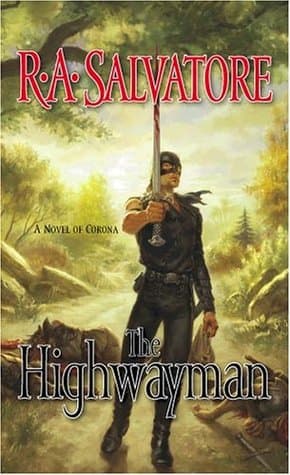
R.A. Salvatore (2004)
Genre
Fantasy
Reading Time
10-12 hours
Key Themes
See below
Sign in to track this book
A young man, caught between two strong heritages and wielding a magic sword, must navigate a world on the edge of collapse while facing his own capacity for good or great evil.
Bransen Garibond, a young man of unknown parents, lives in the Honce-the-Bear region, specifically in the wilderness near Timberline village. He is unusually fast and strong, and skilled with a sword, having taught himself in isolation. His only companion is a large black stallion, Midnight, who seems to share a deep, almost telepathic connection with him. Bransen is troubled by broken memories of a past trauma and the knowledge that he is different, having inherited the blood of two distinct, powerful peoples. He feels like an outsider and longs to belong, often watching the villagers from a distance without approaching.
One night, the quiet village of Timberline is attacked by monstrous creatures known as 'goblins' or 'demons' – agents of the dark sorcerer, Korbil. The villagers, including Captain Kage of the Guard, are overwhelmed. Bransen, watching from the shadows, cannot stand by. He rides into the fight on Midnight, using his sword with supernatural speed and accuracy, killing the creatures easily. His help saves many lives, but also reveals his extraordinary abilities and the unusual nature of his sword, which seems to absorb the essence of his enemies. Though he fights bravely, he remains a mystery to the grateful but cautious villagers.
After the attack, Bransen is sought out by an ancient, mysterious woman named Elbryan, a reclusive sorceress who has been observing him. Elbryan tells Bransen that he is a child of two powerful, magical bloodlines: the Touel'alfar, an ancient elven-like people, and the Abellican, a human order dedicated to justice and magic. She explains that his unique sword is a Touel'alfar relic, capable of absorbing magical energy, and that his speed and strength come from his dual heritage. Elbryan further informs him that Korbil, the dark sorcerer, wants to use Bransen's power for his own evil plans, and that Bransen will play a key role in the coming conflict.
Following Elbryan's advice, Bransen, now calling himself 'The Highwayman' to protect the innocent and punish the wicked, heads towards Callidyrran, a center of Abellican power. On his journey, he meets various people who test his resolve and shape his understanding of the world. He fights bandits and Korbil's agents, further improving his combat skills and control over his growing magical abilities. He also starts to gain the attention of common people, who see him as a symbol of hope against the increasing darkness. His path is dangerous, forcing him to face the moral complexities of his actions.
Upon reaching Callidyrran, Bransen, still an outsider, eventually meets King Amadeus and his daughter, Princess Jilseponie. The King, recognizing Bransen's unique power, offers him a place in the Abellican Order, a group of knights dedicated to justice and using magic for good. Bransen finds an unexpected connection with Jilseponie, who has a sharp mind and a strong sense of duty. This meeting is a turning point for Bransen, as he begins to leave his solitary life and embrace a larger purpose, finding a community that values his abilities and offers him a sense of belonging he has long wanted.
While Bransen finds his place, Korbil's power grows. His dark magic spreads a blight across the land, twisting creatures into grotesque forms and corrupting human hearts. Villages are destroyed, and common people live in constant fear. Korbil's ultimate goal is to completely control Honce-the-Bear, and he sees Bransen's unique bloodline as a way to unlock even greater power. The threat increases, pushing the Abellican Order and King Amadeus to desperate measures, as they realize that Bransen might be their only hope against the coming darkness.
Bransen trains hard with the Abellican knights, learning to improve his swordplay and, more importantly, to control the raw magical energy flowing through him. He struggles with his dual heritage, the wild, untamed power of the Touel'alfar clashing with the disciplined magic of the Abellicans. During this time, he experiences vivid flashbacks and visions, slowly putting together the traumatic events of his past and the true extent of Korbil's cruelty. He learns that his parents were Korbil's victims, and that his existence challenges the dark sorcerer's ambitions.
Korbil, now at his strongest, gathers his monstrous army and launches a destructive siege against Callidyrran. The city's defenses are pushed to their limits, and the Abellican knights, led by King Amadeus, fight bravely but are outnumbered. Bransen, now a key figure in the defense, uses his full power, wielding his sword and magic with a ferocity born of his dual heritage. He faces some of Korbil's most fearsome lieutenants, showing his growth as both a warrior and a leader. The battle is a brutal, desperate fight for survival, with the future of Honce-the-Bear in the balance.
In the middle of the siege, Bransen, guided by a strong sense of purpose, confronts Korbil directly. The battle is a clash of titans, with Korbil using ancient, dark magic and Bransen channeling the combined powers of the Touel'alfar and Abellicans. Bransen's sword, having absorbed countless magical energies throughout his journey, proves to be a vital weapon. He uses his speed and agility to dodge Korbil's spells, while his sword drains the sorcerer's power with each hit. The fate of Honce-the-Bear, and Bransen's own soul, hangs in the balance as the two powerful beings engage in a deadly dance.
Bransen, through his inherent power, his training, and his sword's unique abilities, defeats Korbil. The dark sorcerer is vanquished, and his oppressive magic disappears, bringing a fragile peace back to Honce-the-Bear. However, the victory comes at a cost. Bransen is deeply scarred by the conflict, both physically and emotionally. He has seen immense suffering and made difficult choices, forcing him to accept the darker parts of his power and the responsibilities that come with it. He emerges from the battle a hero, but also a changed man, forever marked by the struggle.
After Korbil's defeat, Bransen is hailed as a hero. He has saved Honce-the-Bear from destruction, and the people look up to him. While he still carries the weight of his past and his power, he no longer feels like an outsider. He has found a home among the Abellicans and a deep connection with Princess Jilseponie. Bransen understands that his journey is far from over, but he now faces it with a clearer purpose and a deeper understanding of who he is. He is no longer just the boy from the woods, but a true protector, ready for whatever challenges lie ahead.
The Protagonist
From a lonely, self-taught warrior, Bransen transforms into a recognized hero, embracing his dual heritage and leadership responsibilities.
The Antagonist
Korbil's power grows throughout the story until his ultimate defeat, showcasing the destructive nature of unchecked ambition.
The Supporting
Jilseponie evolves from a dutiful princess to a resilient leader and a key emotional anchor for Bransen.
The Supporting
Elbryan serves as a catalyst for Bransen's journey, providing the initial push and knowledge he needs to begin his quest.
The Supporting
King Amadeus remains a steadfast leader, symbolizing the resistance against Korbil and providing a foundational structure for Bransen's integration into society.
The Supporting
Midnight remains a constant, unwavering companion, symbolizing loyalty and a connection to Bransen's wilder, untamed side.
The Supporting
Kage's initial suspicion of Bransen evolves into respect and admiration, representing the changing perception of the Highwayman among the common people.
Bransen's journey is about finding out who he is and where he belongs. As a child of two powerful, warring bloodlines (Touel'alfar and Abellican), he feels like an outsider, living alone and haunted by an unknown past. His adoption of 'The Highwayman' identity is an attempt to define himself through his actions. His eventual place in the Abellican Order and his bond with Princess Jilseponie give him the community and purpose he deeply desires, helping him to combine his dual nature. This theme is clear from his solitary life in Timberline to his acceptance in Callidyrran.
“He was neither of the woods nor of the towns, neither human nor elf, but something new, something born of conflict and destined for it.”
The novel explores how power can be used for both good and evil. Bransen has strong physical and magical abilities, an inheritance that could be used for destruction, as Korbil shows. Bransen constantly struggles to control his raw power, fearing its darker impulses, especially the wild Touel'alfar magic. The Abellican Order teaches him discipline and how to use his gifts ethically, which contrasts sharply with Korbil's uncontrolled, corrupting power. The story shows that true power is not just having it, but in the moral choices made when using it.
“The sword drank magic, but it was Bransen who chose what it would drink, and what it would become.”
Bransen is repeatedly told of his 'destiny' by figures like Elbryan, who hint at his key role in the fight against Korbil. However, the story highlights Bransen's active choices and struggles, suggesting that while he may be meant for greatness, the path he takes and the hero he becomes result from his own will and moral decisions. His choice to help in Timberline, to seek out Callidyrran, and to confront Korbil are all acts of free will that shape his destiny, rather than simply fulfilling a prophecy. He chooses to be a protector instead of giving in to darkness.
“Destiny was a road, but it was the traveler who chose the steps he took upon it.”
This is a core theme, seen in the clear conflict between Bransen and the defenders of Honce-the-Bear against Korbil and his demonic army. Korbil embodies pure, destructive evil, wanting to corrupt and control, while Bransen, the Abellicans, and the people of Honce-the-Bear represent the fight for justice, freedom, and light. The novel shows the brutal realities of this conflict, including the sacrifices and suffering endured in the struggle against overwhelming darkness. It is a classic epic fantasy depiction of good versus evil.
“Some battles were fought for land, others for gold, but this one, this was for the very soul of the world.”
Bransen's unique sword that absorbs magical energy.
Bransen's sword is not merely a weapon; it's a magical artifact of Touel'alfar origin. It possesses the unique ability to absorb the magical energy of foes it strikes, making it grow stronger and allowing Bransen to channel that absorbed energy. This device serves multiple functions: it enhances Bransen's combat effectiveness, provides a tangible link to his Touel'alfar heritage, and acts as a plot catalyst by making him a target for Korbil who seeks to control its power. Its evolving capabilities mirror Bransen's own growth in power and understanding.
Bransen's mixed bloodline of Touel'alfar and Abellican.
Bransen's dual heritage is a core plot device that drives his internal and external conflicts. His Touel'alfar blood grants him superhuman speed and raw magical potential, while his Abellican heritage provides a moral compass and a connection to an order of justice. This internal struggle between wild power and disciplined control defines his character arc. It also makes him uniquely powerful – and uniquely vulnerable – as Korbil seeks to exploit this blend of magic. It's the source of his identity crisis and his ultimate strength.
Bransen's fragmented memories of his traumatic origins.
Bransen begins the story with fragmented memories of a traumatic past, his true parentage and the circumstances of his early life shrouded in mystery. This serves as a powerful narrative hook, compelling both Bransen and the reader to uncover the truth. The gradual revelation of his past, particularly through flashbacks and Elbryan's guidance, not only explains his unique abilities but also provides crucial backstory about Korbil's cruelty and the larger conflict. It fuels Bransen's personal motivation and deepens the emotional stakes of his quest.
Elbryan's cryptic pronouncements about Bransen's destiny.
Elbryan's character is largely defined by her role in delivering cryptic prophecies and foreboding warnings about Bransen's destiny and the escalating threat of Korbil. These pronouncements serve as a powerful form of foreshadowing, hinting at future events and the immense challenges Bransen will face. They build suspense and provide a sense of epic scope to the narrative, suggesting that Bransen is part of a larger, ancient struggle, while also motivating him to confront his fears and embrace his role.
“The wind howled a mournful dirge, a fitting accompaniment to the desolation that had become my life.”
— Early in the story, after the protagonist's life has been upended.
“Justice, I have learned, is a fickle mistress, often swayed by the glint of gold or the whisper of power.”
— Reflecting on the corruption and injustice he has witnessed.
“A man without a cause is a ship without a rudder, adrift on an endless sea.”
— Considering his purpose after losing everything.
“The greatest battles are not always fought with steel, but within the confines of one's own heart.”
— Contemplating his internal struggles and moral dilemmas.
“Hope is a fragile thing, easily crushed, yet it is the only light that guides us through the darkest nights.”
— Finding a flicker of hope amidst his bleak circumstances.
“Sometimes, to find your way, you must first get lost.”
— Embracing his new life as an outlaw and the journey it entails.
“The road less traveled is often the one that leads to true freedom.”
— Choosing a path outside of societal norms.
“Revenge is a bitter feast, and those who partake often find themselves consumed by it.”
— Wrestling with the temptation of vengeance.
“True strength lies not in never falling, but in rising every time you fall.”
— After suffering a setback, demonstrating his resolve.
“The whispers of the past can haunt you, but they can also serve as a compass to your future.”
— Reflecting on his past mistakes and how they shape him.
“Loyalty, once earned, is a bond stronger than any chain.”
— Speaking about the bonds he forms with his companions.
“Even in the darkest of shadows, a hero can emerge, if only they dare to believe.”
— A moment of inspiration as he embraces his role.
“The world may try to break you, but it is in the mending that you become truly whole.”
— Overcoming his past traumas and finding a new sense of self.
Ready to see how well you understood this book? Take our interactive quiz with 10 questions.

Biography coming soon.







