“Are you going to marry him, Brigitte? Are you going to go back to France and leave me here?”
— Lucky's fear of abandonment, spoken to Brigitte.

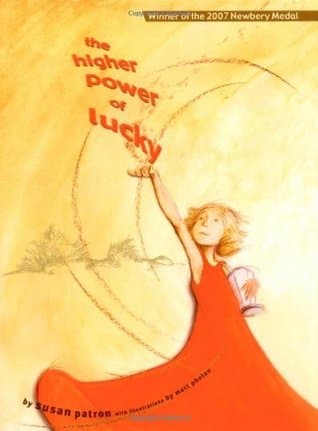
Susan Patron (2006)
Genre
Children's / Young Adult
Reading Time
120 min
Key Themes
See below
Sign in to track this book
Convinced her French guardian is abandoning her, ten-year-old Lucky flees her quirky desert town with her dog and a hefty survival pack, determined to find her own 'Higher Power' amidst the vast, unpredictable Mojave.
Ten-year-old Lucky Trimble lives in Hard Pan, California, a small desert town, with her French guardian, Brigitte. Lucky's mother died when she was young, and her father is often absent, making Brigitte her main caregiver. Lucky often listens to local 12-Step meetings, interested in the idea of a 'Higher Power.' One day, Lucky overhears Brigitte on the phone, speaking French, mentioning 'retourner en France.' Lucky thinks Brigitte plans to abandon her and return to France, leaving Lucky to be sent to an orphanage in Los Angeles. This fear comes from her past abandonment and her strong bond with her dog, HMS Beagle, who she believes won't be allowed in an orphanage.
Afraid, Lucky decides to run away into the Mojave Desert. She plans her escape carefully, believing she must survive alone. She asks her best friend, Miles, who loves food, to help her gather a 'survival kit.' This kit becomes comically large and heavy, filled with canned goods, a flashlight, and a compass. Lucky also tells her other friend, Lincoln, who is in the International Guild of Knot Tyers and wants to be president. Lincoln, practical, worries about her plan but cannot stop her, instead offering her a knotted rope as a 'survival tool.'
With her heavy backpack and HMS Beagle, Lucky slips away from Hard Pan. Her first steps into the desert are hard. The heat is strong, the ground is rough, and her backpack is too heavy. She quickly realizes her romantic idea of desert survival is far from the harsh truth. HMS Beagle, loyal, also struggles with the heat and the long walk. Lucky starts to doubt her decision, feeling the weight of her fears and the physical demands of her escape, but her stubbornness keeps her moving, deeper into the vast, unforgiving land.
As Lucky goes further, a huge dust storm suddenly appears, covering the desert in a blinding, choking cloud of sand. Terrified, Lucky and HMS Beagle look for shelter. She finds a small, run-down shed or abandoned building, offering little protection from the swirling sand. The storm is a powerful and scary force, showing Lucky's vulnerability and nature's immense power. During this experience, Lucky feels truly alone and overwhelmed, realizing the seriousness of her situation and the danger she has put herself and her dog in, far from Hard Pan's safety.
Back in Hard Pan, Miles realizes Lucky is truly gone and worries. He tells Lincoln, who, despite his earlier doubts, feels loyal and responsible for Lucky. Together, the two boys decide to look for her. Miles brings his own 'survival kit' – mostly cookies and snacks – showing his personality. Lincoln uses his knot knowledge and practical thinking to track Lucky, showing his quiet strength and friendship. Their search highlights the strong friendships in Hard Pan and their real concern for Lucky.
Brigitte eventually finds Lucky missing and immediately feels panic and deep concern. She quickly understands Lucky's misunderstanding about her plans. News of Lucky's disappearance spreads through Hard Pan, and the community gathers to help search for the girl. This group effort shows the town's close bond and the care its residents have for each other. Brigitte feels great guilt and worry, realizing she should have been clearer with Lucky about her intentions, and that her perceived secrecy fueled Lucky's fears.
After a tense search, Miles and Lincoln find Lucky and HMS Beagle, huddled in the makeshift shelter in the desert after the dust storm. The reunion is a moment of great relief for all three children. Lucky, tired and humbled by her experience, is happy to see her friends. HMS Beagle is also relieved. This moment strengthens their friendship and Lucky's realization that she is not as alone as she thought. Miles offers Lucky much-needed food, and Lincoln provides comfort, showing their steady support and the comfort of human connection in a desolate place.
The children return to Hard Pan, where Lucky reunites with a worried and relieved Brigitte. Brigitte, speaking English, finally explains her phone conversation. She clarifies that she was discussing a short visit to France to finish adoption paperwork for Lucky, not to abandon her. She reassures Lucky that she loves her and wants to be her permanent guardian. This explanation clears up Lucky's fears, bringing great relief to the ten-year-old. The entire town celebrates Lucky's safe return, strengthening the sense of community and belonging Lucky had feared losing.
Having faced the vastness of the desert and been found by her friends, Lucky starts to understand the 'Higher Power' she heard about at the 12-Step meetings. It is not a single, physical thing, but the connection of people, nature's resilience, and unseen forces that guide and protect. Her hard experience in the desert, with her friends' loyalty and Brigitte's love, helps her understand that a Higher Power can appear in many forms, including love, friendship, and kindness. This new understanding brings her peace and security.
With her fears gone and her understanding of her place in the world deeper, Lucky fully accepts Hard Pan as her home and Brigitte as her family. She no longer feels the need to run away or be constantly on guard. The experience taught her the value of trust, communication, and the people in her life. She realizes that her 'meanness gland,' as she calls it, came from misunderstanding and fear, and that she is truly loved and belongs. Lucky's journey ends with a sense of belonging and a new appreciation for her unconventional, yet loving, family.
The Protagonist
Lucky learns to trust, communicate, and understand that she is loved and belongs, overcoming her deep-seated fear of abandonment.
The Supporting
Brigitte learns the importance of clear communication with Lucky, solidifying their bond through understanding and formalizing their family.
The Supporting
Miles's unwavering friendship and loyalty are tested and confirmed through his actions in helping and searching for Lucky.
The Supporting
Lincoln demonstrates his quiet strength and loyalty through his practical support and active participation in finding Lucky.
The Supporting
HMS Beagle's consistent presence reinforces Lucky's need for companionship and her bond with her current life.
The Mentioned
Not applicable, as he is a peripheral, mentioned character.
The Mentioned
Not applicable, as they are a collective, mentioned presence.
Lucky's interest in the 12-Step meetings and their talk of a 'Higher Power' is key to her journey. At first, she thinks it is a real thing she needs to find or a magical force. Her runaway adventure, especially facing the vast, indifferent desert and the dust storm, makes her rethink this. She begins to understand a 'Higher Power' not as a single, divine being, but as the connection of human love, friendship, community, and nature's powerful forces. The 'Higher Power' becomes the support she receives and the sense of belonging she finds.
“What was her Higher Power? What was she going to do if she couldn't find one?”
Lucky's deep fear of abandonment, from her mother's death and her father's absence, causes her actions. Her misinterpretation of Brigitte's phone call immediately triggers this fear, making her believe she will be sent to an orphanage and separated from HMS Beagle. Her desperate flight into the desert is an attempt to control her perceived fate. Her journey teaches her that she is not alone, and that she has a loving guardian and loyal friends who care for her, meeting her need for belonging and security within her unconventional family.
“She couldn't be abandoned. Not again. Not ever.”
Despite Lucky's belief that she must face her challenges alone, the story emphasizes friendship and community. Miles and Lincoln's steady loyalty and their decision to search for Lucky show their strong bond. The entire town of Hard Pan gathers to find Lucky, showing the desert community's close nature. These relationships are Lucky's true 'Higher Power,' giving her safety, comfort, and the realization that she is loved and supported, ultimately saving her from the desert's dangers and her own fears.
“Hard Pan may have been small, but it was big on looking out for its own.”
The story's main conflict comes from a misunderstanding: Lucky overhears Brigitte speaking French and misinterprets her plans to visit France as a plan to abandon her. This lack of clear communication fuels Lucky's worries and makes her run away. The plot's resolution depends on Brigitte finally explaining her true intentions in English, clarifying that she was preparing for Lucky's adoption. This theme shows the importance of open communication, especially between adults and children, to prevent misunderstandings and build trust.
“If only Brigitte had just said it in English.”
Lucky's initial romantic view of surviving in the desert, fueled by her imagination, quickly meets the harsh reality of the Mojave. Her oversized survival kit, the strong heat, and especially the sudden, scary dust storm, show nature's unforgiving power. This encounter with the raw elements removes her naive ideas and forces her to face her vulnerability. The desert, first seen as a place of escape and independence, becomes a symbol of isolation's dangers and the need for human connection and practical preparation.
“The desert wasn't a place for running away. It was a place for staying put, for hiding.”
A comically heavy backpack filled with impractical items for desert survival.
The survival kit is a significant plot device, symbolizing Lucky's naive understanding of self-sufficiency and the harsh realities of the desert. Its excessive weight and often impractical contents (like numerous cans of food) highlight her youth and her friends' well-meaning but misguided efforts. It physically impedes her progress and serves as a constant reminder of the burden of her decision to run away. It also provides moments of levity and underscores the gap between her imagined adventure and the actual struggle.
Lucky's habit of listening to anonymous recovery meetings, particularly about 'Higher Power.'
Lucky's eavesdropping is a key device for introducing the central theme of a 'Higher Power.' It plants the philosophical seed that she grapples with throughout the story, prompting her to seek her own guiding force. The fragmented and adult conversations she overhears contribute to her misinterpretations and anxieties, as she tries to make sense of complex concepts through a child's lens. It also subtly introduces themes of vulnerability, seeking help, and finding strength beyond oneself.
A sudden, powerful natural event that traps Lucky in the desert.
The dust storm is a critical plot device that acts as a major turning point in Lucky's desert journey. It immediately escalates the stakes, creating a life-threatening situation that she cannot control. It forces her to stop running and seek shelter, confronting her vulnerability and the true dangers of her escape. The storm isolates her, intensifying her fear, but also sets the stage for her rescue, as it makes her more discoverable and highlights the urgency of the search efforts by her friends and the community.
Brigitte's use of French, which Lucky misunderstands, driving the initial conflict.
Brigitte's frequent use of her native French language is the catalyst for the entire plot. Lucky's inability to fully understand French leads her to misinterpret Brigitte's phone conversation about 'retourner en France,' believing it signifies abandonment rather than adoption paperwork. This linguistic barrier highlights the theme of miscommunication and the dangers of assumptions. It's a simple, yet effective, device to create the central conflict and propel Lucky's emotional and physical journey, ultimately resolved by Brigitte's clear explanation in English.
“Are you going to marry him, Brigitte? Are you going to go back to France and leave me here?”
— Lucky's fear of abandonment, spoken to Brigitte.
“The wind howled like a coyote who'd lost his pack.”
— Describing the harsh desert environment.
“Higher Power, are you there? Can you hear me?”
— Lucky's direct address to her 'Higher Power'.
“Sometimes you just had to be brave, even if you were scared to death.”
— Lucky's internal monologue about facing challenges.
“The desert was a place of secrets, and Lucky knew a few.”
— Introducing the mysterious nature of the desert and Lucky.
“It wasn't a real Higher Power, of course. Just a voice in her head that sounded a lot like her dad.”
— Lucky's understanding of her 'Higher Power'.
“You can't catch feelings like you catch a cold, Lucky.”
— Brigitte's practical advice to Lucky.
“A good knot could save your life.”
— Lucky's appreciation for practical skills, like knot-tying.
“The only thing worse than being alone was being alone and scared.”
— Lucky's reflection on her feelings of isolation.
“Every time someone left, it felt like a little piece of her went with them.”
— Lucky's ongoing struggle with loss and separation.
“If you wanted something bad enough, you had to fight for it.”
— Lucky's determination to keep Brigitte with her.
“Even a small town had big stories.”
— Highlighting the richness of life in a seemingly quiet place.
“She wasn't just Lucky. She was Lucky, with a capital L.”
— Lucky's growing sense of self-identity and strength.
Ready to see how well you understood this book? Take our interactive quiz with 10 questions.
Dan Gemeinhart
4.5

Kate O'Hearn
4.4

Jeanne Birdsall
4.4

Jen Wang
4.4
Wendelin Van Draanen
4.3

John Marsden
4.3

Chris Van Allsburg
4.3
Jennifer A. Nielsen
4.2