“I was Apollo. I was a god. I was super hot. And I was going to die.”
— Apollo's initial realization of his predicament and mortality as a mortal teenager.

Rick Riordan (2016)
Genre
Fantasy / Children's / Young Adult
Reading Time
375 min
Key Themes
See below
Sign in to track this book
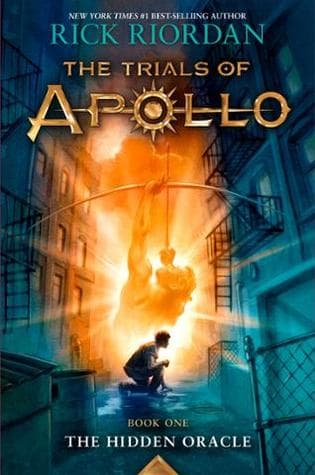
Stripped of his divinity and thrust into the vulnerable body of a teenager, the narcissistic god Apollo must navigate the perils of mortal life, evade ancient enemies, and somehow reclaim his Olympian power, all while trying not to get killed by a toaster.
The story begins with the god Apollo falling from Olympus, without his divine powers and transformed into a gawky, acne-ridden mortal teenager named Lester Papadopoulos. He lands in a dumpster-filled alley in New York City, confused and horrified by his human body. His first encounter is with two thugs who try to mug him, but he is rescued by a young demigod named Meg McCaffrey, who uses celestial bronze swords despite her small size. Apollo, still reeling from his transformation, learns that Meg is a daughter of Demeter. He must accept her as his new master, a condition Zeus imposed for his punishment, and together they seek refuge at Camp Half-Blood, hoping to find answers and assistance.
Upon arriving at Camp Half-Blood, Apollo finds the camp in chaos. Demigods are disappearing, and the Oracle of Delphi, Rachel Dare, is afflicted with prophetic static, unable to give prophecies. Chiron, the camp director, explains that the disappearances and the Oracle's illness are linked to the absence of Apollo's divine influence and the rise of an ancient enemy. Apollo, despite his mortal form, is expected to help restore the Oracle and the camp's safety. He quickly realizes that regaining Zeus's favor will be harder than he first thought, especially without his godly powers and with a seemingly inexperienced demigod as his master.
Chiron assigns Apollo and Meg their first task: to find a missing demigod named Sherman Yang and investigate the source of the camp's problems. Their journey takes them to the woods surrounding Camp Half-Blood, where they encounter germ-obsessed, plague-carrying 'germ-monsters' (Keres). They also discover a hidden entrance to the subterranean labyrinth. During their search, they find a chamber that houses the remnants of the Grove of Dodona, an ancient oracle connected to talking trees. The grove is dying, and its last bits of power manifest as cryptic, often contradictory, whispers, hinting at a greater threat. They rescue Sherman, but the grove's message remains unclear.
Following a clue from the Grove of Dodona, Apollo and Meg venture deeper into the woods, where they are ambushed by Myrmekes, giant ants that collect shiny objects and have a powerful acidic bite. Meg, showing combat skills, helps Apollo fight them off. During the battle, they are rescued by Leo Valdez, riding Festus the bronze dragon, accompanied by Calypso. Leo, who had been presumed dead after the war with Gaea, explains that he and Calypso had been searching for a cure for Calypso's mortality. Their return brings hope to the struggling camp, but also raises questions about their timing and purpose.
With Leo's help, Apollo begins to understand the larger conspiracy. They learn that the disappearances and the Oracle's silence are caused by a mysterious, ancient entity known as 'The Beast,' who operates through a mortal corporation called Triumvirate Holdings. This organization is taking control of all the ancient Oracles, including Delphi, Dodona, and the Sibylline Oracles, to prevent future prophecies and gain power. Apollo realizes that 'The Beast' is a triumvirate of Roman emperors, aiming to restore the Roman Empire and suppress the Greek demigod world. This revelation escalates the stakes, as Apollo now faces a global threat, not just a personal punishment.
As Apollo and Meg investigate further, a truth comes to light. During a fight with a group of Blemyes (headless monsters working for the Triumvirate), Meg's true allegiance is revealed. She is the adopted daughter of Nero, one of the three Roman emperors comprising 'The Beast.' Meg, manipulated and controlled by Nero since childhood, betrays Apollo, leading him into a trap. This betrayal deeply hurts Apollo, who had begun to trust Meg. He is captured and brought before Nero, who reveals his long-standing grudge against Apollo and his plans to eradicate the demigod world and secure his own immortality.
Apollo, imprisoned by Nero, escapes with the help of some unexpected allies. He, Leo, and Calypso, along with some Camp Half-Blood demigods, launch a counterattack on Nero's headquarters, which is located beneath his penthouse in the Triumvirate Tower. Their main goal is to reclaim the Grove of Dodona, which Nero intends to destroy. A fierce battle ensues, with Apollo, despite his mortal weakness, trying to inspire and lead the demigods. He uses his musical talents to distract Nero's forces, showing his innate divine abilities even without his godly powers.
During the climactic battle, Meg, torn between her loyalty to Nero and her growing bond with Apollo, finally chooses to defy her abusive adoptive father. Seeing Nero's cruelty and his willingness to sacrifice anyone for his ambitions, Meg uses her demigod powers to create a growth of plants, turning the tide of the battle against Nero. Apollo, seeing Meg's change of heart, draws upon his last strength and, with Meg's assistance, defeats Nero, temporarily incapacitating him and forcing him to retreat. The immediate threat from Nero is neutralized, but the other two emperors of the Triumvirate remain at large.
With Nero defeated and the immediate danger gone, Apollo focuses on restoring the Grove of Dodona. Using his limited remaining powers and with the help of Meg and the demigods, he revives the ancient talking trees. The Grove, now fully restored, issues its first clear prophecy since Apollo's fall. The prophecy, delivered in ancient Greek, foretells a perilous journey to the American West, the need to seek out other Oracles, and the continued struggle against the remaining two emperors of the Triumvirate. This is a significant step in Apollo's quest, providing a clear path forward and a renewed sense of purpose, despite the challenges ahead.
Having completed his first trial and secured a prophecy, Apollo begins to accept his mortal limitations and responsibilities. He acknowledges Meg's bravery and loyalty, solidifying their partnership. With the Grove of Dodona restored and the Oracle of Delphi still recovering, Apollo understands that his journey is far from over. He and Meg prepare to leave Camp Half-Blood, embarking on a new quest guided by the prophecy to find the other Oracles and confront the remaining emperors. Apollo, though still wanting his godhood, has learned lessons about humility, friendship, and the meaning of heroism, setting him on a path of self-discovery and redemption.
The Protagonist
From an arrogant, helpless god, Apollo learns humility, empathy, and the value of mortal courage, beginning his journey towards redemption.
The Supporting
From a manipulated and conflicted pawn, Meg finds her own agency, loyalty, and courage, breaking free from her abuser's control.
The Supporting
Chiron remains a steadfast mentor, guiding Apollo through his initial mortal struggles and integrating him into the demigod world.
The Supporting
Leo returns from his quest to cure Calypso, rejoining his friends and providing vital support to Apollo's new mission.
The Supporting
Calypso experiences mortality for the first time, adapting to a new life with Leo while offering her unique skills to Apollo's cause.
The Antagonist
Nero is established as a major antagonist, revealing his cruel nature and his powerful reach, but is ultimately defeated in this book, though not permanently.
The Supporting
Rachel is introduced as incapacitated, her condition serving as a primary plot driver for Apollo's quest to restore the Oracles.
The Supporting
Will steps up to lead his cabin and heal the camp in his father's absence, demonstrating his resilience and leadership.
The Supporting
Peaches serves as a loyal, protective companion for Meg, adding a quirky element to the group's dynamic.
Apollo's transformation into a mortal forces him to shed his arrogance and confront his own weaknesses. Without his powers, he must learn to rely on others, experience fear and pain, and understand the value of mortal life. This journey of humility allows him to discover empathy and courage he never knew he possessed, moving beyond his self-centered divine perspective. His struggles show that true strength is not in power, but in character and compassion, a lesson he slowly begins to grasp.
“My life as a god had been one long string of glorious triumphs. My life as a mortal was turning out to be a string of one humiliation after another.”
The novel explores the abuse of power through the actions of Zeus, who punishes Apollo excessively, and especially through Nero, who manipulates and abuses Meg. Apollo's own past arrogance as a god also represents a form of power abuse. His quest for redemption is not just about regaining his godhood, but about atoning for his past mistakes and learning to use influence responsibly. Meg's struggle to break free from Nero's control further shows the destructive nature of unchecked power and the possibility of redemption for those who choose to fight against it.
“I had been a god. I had commanded respect. Now I was a pawn in a game I didn't understand, controlled by a twelve-year-old.”
Apollo's journey redefines what it means to be a hero. As a god, he was powerful and celebrated, but as a mortal, he must learn that heroism is about courage, sacrifice, and protecting others, especially the vulnerable. He sees true heroism in the demigods and Meg, who fight despite their mortality. This theme contrasts the effortless power of a god with the hard-won bravery of mortals, suggesting that the latter is more meaningful. His transformation forces him to embody the qualities he once took for granted in his demigod children.
“Mortals were so fragile. So easily broken. And yet, they kept fighting. They kept hoping. It was a quality I had never truly appreciated.”
The idea of family is central, both biological and chosen. Apollo's strained relationship with Zeus drives the initial conflict, while his interactions with his divine children at Camp Half-Blood show the complexities of his godly parentage. More deeply, the book explores the 'found family' dynamic between Apollo and Meg, who initially resent each other but grow to rely on one another. Meg's tragic past with Nero, her abusive adoptive father, emphasizes the importance of choosing healthy relationships, making her eventual defiance and bond with Apollo a powerful example of the strength of chosen family.
“Nero was my father. He raised me. But he wasn't... he wasn't good to me.”
As the former god of prophecy, Apollo's loss of power directly impacts the Oracles, which become silent or corrupted. The plot is driven by the need to restore these Oracles and obtain new prophecies to guide the demigods. This theme explores the role of fate and predestination versus free will. While prophecies offer guidance, the characters' choices and actions determine their path. The Triumvirate's attempt to control the Oracles shows their desire to manipulate fate and suppress the future, making the restoration of prophecy a key step in resisting their tyranny.
“Without the Oracles, the future was dark. The demigods were blind.”
Apollo's human form, serving as his primary punishment and catalyst for growth.
Apollo's transformation into the mortal teenager Lester Papadopoulos is the central plot device. It strips him of his divine powers, forcing him to experience human vulnerabilities like pain, fear, hunger, and acne. This physical limitation is a constant source of humiliation and frustration for Apollo, but it also compels him to develop empathy, courage, and resourcefulness. His mortal body acts as a symbol of his punishment and a vehicle for his character development, making him relatable and highlighting the contrast between his former godlike arrogance and his newfound human frailty.
Ancient sites of prophecy, now silenced or corrupted, driving Apollo's quest.
The Oracles, particularly the Oracle of Delphi (embodied by Rachel Dare) and the Grove of Dodona, serve as key plot drivers. Their incapacitation is a direct result of Apollo's fall and the Triumvirate's machinations, creating an urgent need for Apollo to restore them. The prophecies they issue, or fail to issue, guide the characters' actions and reveal crucial information about the overarching conflict. They represent the connection between the mortal world and divine foresight, and their restoration symbolizes the hope for the future of the demigod world.
Unusual and powerful weapons, hinting at Meg's hidden abilities and importance.
Meg McCaffrey's twin celestial bronze swords are a significant plot device. Celestial bronze is a rare and powerful metal, typically wielded by experienced demigods. Meg's possession and skillful use of these swords from the very beginning hint at her extraordinary abilities and her mysterious past, setting her apart from other young demigods. They serve as a constant reminder that there is more to Meg than meets the eye, foreshadowing her true parentage and her eventual defiance of Nero. The swords are instruments of both combat and revelation.
A modern corporate front for ancient Roman emperors, symbolizing the blend of old and new threats.
Triumvirate Holdings functions as a modern-day corporate front for the ancient Roman emperors Nero, Commodus, and Caligula, collectively known as 'The Beast.' This plot device effectively blends ancient mythology with contemporary elements, showing how old enemies adapt to the modern world. The corporation's vast resources and seemingly legitimate facade allow the emperors to operate with impunity, manipulate mortals, and systematically target the Oracles. It represents a new, insidious form of threat that Apollo and the demigods must learn to combat, highlighting the challenge of fighting ancient evil in a modern setting.
Apollo's preferred poetic form, used for narration, humor, and emotional expression.
Apollo's frequent use of haiku poetry is a distinctive literary device. While often used for comedic effect, highlighting his self-pity or observations about his mortal predicament, it also serves as a way for him to process his emotions, express his divine nature even in human form, and sometimes even deliver cryptic warnings or insights. The haikus provide a unique narrative voice, reinforcing Apollo's identity as the god of poetry and adding a layer of wit and charm to the narrative, even in dire situations.
“I was Apollo. I was a god. I was super hot. And I was going to die.”
— Apollo's initial realization of his predicament and mortality as a mortal teenager.
“Being a god is great. Everyone loves you. Everyone worships you. You're beautiful and powerful and you never have to do chores. Being a mortal is terrible. Everyone hates you. Everyone wants to kill you. You're ugly and weak and you have to do chores.”
— Apollo's internal monologue comparing his past divine life to his current mortal existence.
“Your name is Lester Papadopoulos. You are a sixteen-year-old mortal. You are no longer a god. You are no longer beautiful. You are no longer powerful. You are no longer immortal. You are just Lester.”
— Apollo's grim acceptance of his new mortal identity after being cast down by Zeus.
“The world was full of monsters. Some of them wore human faces.”
— Apollo's observation about the dangers lurking in the mortal world, both mythical and human.
“Meg was trouble. She was a tiny, angry, green-clad package of trouble. And I was stuck with her.”
— Apollo's initial assessment of Meg McCaffrey, his reluctant young master.
“Sometimes you have to do the right thing, even if it's terrifying.”
— A lesson Apollo begins to learn as he faces challenges and makes difficult choices.
“I missed my godly powers. I missed my godly looks. I missed my godly life. But most of all, I missed my godly self-confidence.”
— Apollo reflecting on the psychological impact of losing his divinity.
“The gods were not always fair. Sometimes, they were downright cruel.”
— Apollo's growing realization about the nature of the Olympian gods, including himself.
“There are worse things than being mortal. Like being a god who can't do anything.”
— Apollo's dawning understanding that his mortal limitations are forcing him to adapt and rely on others.
“You can't just run away from your problems, Lester. Eventually, they catch up to you.”
— Meg McCaffrey's blunt advice to Apollo, highlighting his tendency to avoid responsibility.
“The Oracle of Delphi was silent. Which meant either nothing bad was going to happen, or something *really* bad was going to happen.”
— Apollo's anxiety over the lack of prophecies from the most important oracle.
“It's never too late to try and make things right.”
— A hopeful sentiment Apollo encounters or considers as he tries to atone for past mistakes.
“Even a god can learn new tricks. Or, in my case, old tricks I'd forgotten how to do as a mortal.”
— Apollo's struggle and eventual minor success with a mortal skill.
“Sometimes, the most powerful weapon isn't a sword or a bow. It's a friend.”
— Apollo's realization about the importance of companionship and loyalty in his mortal journey.
Ready to see how well you understood this book? Take our interactive quiz with 10 questions.
Biography coming soon.







