“Living things are all the same in the end. They all want to live, and they all want to be happy.”
— Sprout reflecting on life and the shared desire among all creatures.

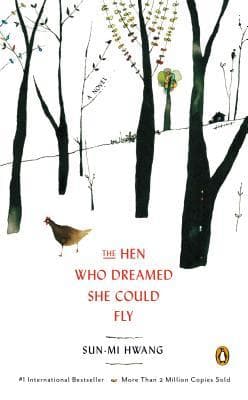
Sun-mi Hwang (2013)
Genre
Fantasy / Children's
Reading Time
120 min
Key Themes
See below
Sign in to track this book
A hen named Sprout leaves her confined life to find freedom, become a mother, and live outside the coop.
Sprout, a white Leghorn hen, lives a boring life in a crowded coop, laying an egg every day only for it to be taken. She wants to hatch her own egg and see the outside world she glimpses through the barn doors. Her attempts to escape are ignored by other hens and met with strictness from the farmer. She dreams of the freedom of the yard animals and the mystery of the wild. One day, she stops laying eggs, which labels her as 'spent' and leads to her being thrown into a pit, where other 'useless' animals are left to die.
Left for dead in the pit, Sprout is saved by Straggler, a mallard duck who is also an outcast, having lost his mate and chicks to a weasel. Straggler helps her out of the pit, and she starts a new life in the barnyard. She is at first overwhelmed by the size and newness of it all but quickly adjusts. She watches the other animals, especially the proud Rooster and his group, and learns about the dangers of the wild. Her main wish remains to hatch an egg, a dream that seems impossible without a mate or an egg.
One day, Sprout finds a single, abandoned duck egg. Even though it is not her species, she decides to hatch it. She works to keep the egg warm and safe, even through bad weather. She faces doubt and teasing from other barnyard animals, especially the Rooster, who thinks a hen cannot hatch a duck egg. Straggler, however, offers quiet support and protection from a distance, watching over her as she tirelessly sits on the egg, determined to prove them wrong and fulfill her strong motherly desire.
After a long time of waiting, the egg hatches, revealing a small, green-headed duckling. Sprout is very happy, naming him Greentop. Her happiness is mixed with the knowledge that Greentop is a duck, not a chick, and therefore different from her. The other animals are surprised by her success but keep pointing out the differences between mother and son. Sprout, however, loves Greentop completely and is determined to raise him, despite the future challenges due to their different natures.
Raising Greentop is hard for Sprout. As a hen, she cannot swim or fly, which are important skills for a duck. Greentop naturally goes toward water and other ducks, making Sprout anxious and afraid for his safety. She tries her best to teach him, even trying to swim herself, but quickly sees her limits. Straggler, Greentop's biological father, continues to watch over them, sometimes stepping in to protect Greentop from dangers or guide him, creating a complex situation as Sprout handles her role as a mother to a different species.
As Greentop grows, his duck instincts get stronger, and he spends more time with other ducks, learning to swim and dive. He eventually joins the wild ducks, flying with them and living his true nature. Sprout, though proud, feels a growing loneliness and the unavoidable separation. She understands that to truly love him, she must let him be free, even if it hurts her. This time is marked by Greentop's increasing distance and Sprout's quiet acceptance of his path.
After Greentop fully joins the wild ducks, Sprout decides to leave the barnyard's safety and live in the wild, near the pond where Greentop often visits. She builds her own nest and learns to find food alone. This new life is full of danger, especially from the weasel, which is a constant threat. Sprout bravely faces these challenges, embracing her new freedom and showing her strength. She sometimes sees Greentop flying overhead, offering silent comfort and a connection to her son.
The weasel is a constant and deadly predator throughout the story. It killed Straggler's mate and chicks, and it constantly hunts for food in the wild. Sprout meets the weasel many times, barely escaping. The weasel shows the harsh realities and dangers of life outside the protected barnyard, forcing Sprout to become brave and clever to survive. Its presence highlights how fragile life is and the strength needed to protect those she cares about.
During a dangerous meeting with the weasel, Straggler, who has been a quiet protector of Sprout and Greentop, steps in. He bravely faces the weasel, drawing its attention away from Greentop. In a heroic act of sacrifice, Straggler lets himself be caught by the weasel, making sure Greentop escapes and survives. His death deeply affects Sprout, who recognizes the deep love and protection he gave, solidifying his role as Greentop's biological father and a true friend to her.
Years pass, and Sprout continues her independent life in the wild. Greentop, now a big adult mallard, returns to the pond with his own mate and ducklings. Sprout watches him from a distance, filled with pride and happiness. She sees her dream fulfilled in his thriving life, understanding that her purpose was to raise him to be free and strong. Her own journey, from a confined layer to a free spirit and a loving mother, ends with this peaceful view of her son's happiness.
Old and weak, Sprout meets the weasel one more time, now with the weasel's hungry babies present. Seeing the cycle of life and death, and seeing the weasel's desperate need to feed its young, Sprout makes a choice. Instead of running, she offers herself to the weasel, becoming its last meal. This final act of sacrifice, like Straggler's, ensures the weasel's babies survive, completing her journey of motherhood and freedom by willingly becoming part of nature.
The Protagonist
Sprout transforms from a confined, dreaming hen into a free, independent, and ultimately self-sacrificing mother, finding fulfillment in both freedom and the nurturing of life.
The Supporting
Straggler, initially a solitary figure, finds a new purpose in protecting Sprout and Greentop, ultimately sacrificing himself for the latter's survival.
The Supporting
Greentop grows from a vulnerable duckling into a self-sufficient, free-flying mallard, embodying the freedom his mother sought for him.
The Antagonist
The Weasel remains a consistent force of nature, embodying the constant threat and the cycle of survival.
The Supporting
The Rooster remains largely static, representing the unchanging, conventional aspects of the barnyard world.
The Mentioned
The Farmer's role remains consistent, a distant figure of control.
The main theme is Sprout's constant search for freedom from the coop and the expectations placed on her. She rejects the set life of an egg-laying hen to make her own way. This theme is clear from her first wish to escape the coop, her choice to live in the wild, and her letting Greentop live as a duck. It shows how important it is to live genuinely, even if it means being an outsider.
“A hen who doesn't lay eggs is not a hen. I am a hen, but I am not just a hen. I am me.”
Sprout's journey is deeply tied to her wish for motherhood and the sacrifices she makes for her adopted son, Greentop. She goes against species barriers to hatch and raise a duckling, enduring ridicule and danger. Her love for Greentop leads her to let him be free, even when it causes her pain. Her final act of sacrifice for the weasel's babies extends her motherly instinct beyond her immediate family, showing the deep and selfless nature of a mother's love.
“Living means to make your own life. And to live, you have to have courage. To be truly free, you have to be willing to die.”
The story clearly shows the natural cycle of life and death, especially through the constant threat of the weasel and the eventual deaths of several characters. From the discarded hens in the pit to Straggler's sacrifice and Sprout's final act, death is shown not as a tragedy, but as a necessary part of existence. Sprout's final decision to give herself to the weasel, ensuring the survival of its babies, sums up her acceptance of this natural order.
“To live outside the coop, you must live with the threat of death. That is the price of freedom.”
Sprout, Straggler, and Greentop are all outsiders in different ways, trying to find acceptance and a place where they belong. Sprout is shunned for not laying eggs and for raising a duckling. Straggler is alone because of his past loss. Greentop, a duckling raised by a hen, at first struggles with his identity. The theme explores how belonging can be found not just by fitting in, but also by creating one's own family and community, and by accepting who one truly is, even if it means being different.
“Even if you're different, if you're with someone you love, you belong.”
Animals exhibit human-like thoughts, emotions, and complex motivations.
The novel uses anthropomorphism to allow readers to empathize with the animal characters and explore complex themes. Sprout's inner thoughts, her dreams of freedom, her maternal longing, and her philosophical reflections are all deeply human in nature. This device makes the story accessible and relatable, enabling the fable to convey universal messages about individuality, sacrifice, and the meaning of life through the experiences of barnyard and wild animals.
The coop represents confinement and tradition, while the wild signifies freedom and danger.
The coop symbolizes a life of predetermined purpose, conformity, and lack of individuality, where hens are valued only for their egg-laying ability. The wild, in contrast, represents freedom, self-determination, and the natural order, but also inherent dangers and the struggle for survival. Sprout's journey from the coop to the wild physically embodies her quest for personal liberation and a life lived on her own terms, highlighting the trade-offs between security and freedom.
The weasel embodies the amoral, inescapable realities of the food chain and survival.
The weasel is not portrayed as inherently evil, but rather as a necessary part of the ecosystem, driven by hunger and the need to feed its young. It serves as a constant antagonist, representing the harsh, unyielding aspects of nature and the inevitability of death in the wild. This device grounds the story in realism, preventing it from becoming overly sentimental and emphasizing that freedom comes with inherent risks and the acceptance of life's brutal cycles.
A catalyst for Sprout's transformation and a symbol of her maternal destiny.
The discovery of the abandoned duck egg is the pivotal moment that allows Sprout to fulfill her deepest desire for motherhood. It is a symbol of hope, new life, and unconventional family. By adopting an egg of a different species, Sprout transcends societal expectations and biological limitations, solidifying her unique path and challenging the traditional definitions of what it means to be a mother. The egg represents the potential for life and love to flourish against all odds.
“Living things are all the same in the end. They all want to live, and they all want to be happy.”
— Sprout reflecting on life and the shared desire among all creatures.
“Why do you keep laying eggs if you don't even hatch them yourself?”
— Sprout's internal question about the purpose of her eggs, leading to her desire for motherhood.
“The world was much bigger and more beautiful than she had ever imagined.”
— Sprout's awe upon seeing the outside world for the first time after escaping the coop.
“A hen's dream is to hatch her own chick, raise it, and watch it fly away.”
— Sprout articulating her fundamental desire and purpose.
“If you don't try, you'll never know if you can do it.”
— Sprout's determination to escape the coop and pursue her dreams.
“The strong eat the weak, that's the law of nature.”
— Weasel explaining the harsh realities of the wild to Sprout.
“To hatch an egg and raise a chick, that's a hen's ultimate dream.”
— Sprout's unwavering belief in her purpose, even when facing adversity.
“Some dreams are not meant to come true, but that doesn't mean they aren't worth having.”
— Sprout reflecting on the challenges of life in the wild and the nature of aspirations.
“Just because you're different doesn't mean you're wrong.”
— Sprout's acceptance of her unusual 'chick' (the duckling).
“Motherhood is not about biology; it's about love and devotion.”
— Sprout's actions towards Straggler demonstrating her maternal love.
“The greatest joy is to watch your child fly away, even if it means letting go.”
— Sprout's ultimate sacrifice and fulfillment as Straggler leaves.
“Freedom is not just about escaping a cage; it's about living your own life.”
— Sprout's journey from the coop to the open fields, defining true freedom.
“A mother’s love is boundless, even across species.”
— The core theme of Sprout raising a duckling as her own.
“Life is a cycle of birth and death, and every creature plays its part.”
— Sprout's final understanding of her place in the natural world.
Ready to see how well you understood this book? Take our interactive quiz with 10 questions.







