“No more than a puzzle, a game, if you will, between the man and the demon. And then, when the puzzle was solved, the game was over, and the prize claimed. Simple, yes?”
— Frank Cotton's early thoughts on the Lament Configuration.

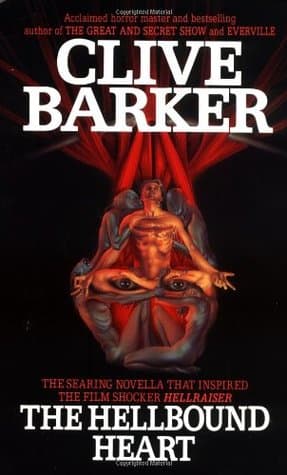
Clive Barker (1991)
Genre
Fantasy
Reading Time
90 min
Key Themes
See below
Sign in to track this book
A hedonist's pursuit of ultimate pleasure through an antique puzzle box unleashes a demonic, S&M-themed netherworld, transforming his lover into a purveyor of human sacrifice to restore his shattered, monstrous form.
Frank Cotton, a man driven by hedonism and a lifelong search for extreme sensual experiences, acquires the Lament Configuration, a puzzle box said to unlock ultimate pleasure. He buys it from a mysterious dealer and takes it to a secluded room in his ancestral home, the Cotton house. Believing the box holds the key to sensation beyond the ordinary, Frank solves it. His expectation of pleasure is met with something terrifying: the Cenobites, extra-dimensional beings who explore the limits of sensation through a mix of pain and pleasure. They take Frank, pulling him into their realm of torture, leaving only a stain on the floor.
Months after Frank's disappearance, his brother Rory Cotton and Rory's wife, Julia, move into the old Cotton house. Julia has a complicated past with the house and with Frank; she had an intense affair with Frank before her marriage to Rory, an affair that made her unhappy with her husband's gentle nature. As they settle in, Julia often goes to the room where Frank disappeared, drawn by a sense of his presence and her unresolved feelings. She feels an emptiness in her life that Frank had briefly filled with his raw intensity.
One day, while Rory and Julia move furniture, Rory cuts his hand on a nail. His blood drips onto the exact spot on the attic floor where Frank had been taken by the Cenobites. The blood brings a grotesque, partially formed version of Frank's body from the floorboards. He is a skinless mass of muscle and bone, trapped between dimensions. Frank talks to Julia telepathically, saying he needs more blood and flesh to fully regenerate and escape the Cenobites.
Julia, still infatuated with Frank and unhappy with her marriage, agrees to help Frank. She begins to lure unsuspecting men back to the Cotton house. Posing as a lonely woman, she picks up strangers at bars, brings them home, and kills them in the attic. Each victim's blood and flesh are absorbed by Frank, who slowly regains his physical form. Julia is horrified by her actions but feels compelled by her desperate desire to bring Frank back, believing he holds the key to her own satisfaction and freedom.
Kirsty Cotton, a young woman who is a long-time friend of Rory and has unrequited feelings for him, becomes suspicious of Julia's behavior and the strange things at the Cotton house. She notices Julia's secret trips out at night, her odd manner, and the unsettling atmosphere of the attic. Kirsty worries about Rory as Julia becomes more withdrawn and cold. She investigates quietly, sensing something wrong in the seemingly quiet family home.
Kirsty confronts Julia, going to the attic where she finds Frank, now almost fully formed but still a horrifying, skinless figure. Frank attacks Kirsty, showing his true nature and Julia's involvement. During the struggle, Kirsty grabs the Lament Configuration, which Frank had hidden. She escapes the house, fleeing with the puzzle box. Frank, angry about her escape and the potential loss of his freedom, pursues her, while Julia stays behind, helping Frank.
Terrified and desperate, Kirsty solves the Lament Configuration, summoning the Cenobites. She tries to bargain for her life, explaining that Frank Cotton, who had escaped them, is the one they seek. The Cenobites, led by Pinhead, are interested but demand proof. Their rules mean they cannot simply take Frank without a valid reason, like his escape from their domain. Kirsty offers to lead them to Frank, promising to deliver him back to their realm in exchange for her freedom.
Kirsty returns to the Cotton house, where Frank and Julia are now openly together. Frank, almost fully restored, tries to kill Kirsty to stop her from exposing him to the Cenobites. Julia, still loyal to Frank, helps him. However, Kirsty outsmarts them, leading Frank into a position where the Cenobites can confirm his identity. Frank, believing he has escaped permanently, is confronted by the Cenobites, who recognize him as their former captive.
The Cenobites, now sure of Frank's identity, say they will reclaim him. Frank, arrogant, tries to fight them, but their power is absolute. They overpower him and subject him to their methods, tearing and mangling his renewed flesh as they drag him back to their dimension of pain. Julia, watching Frank's recapture, is left alone amidst the carnage, her obsession leading to his death and her own despair.
In a cruel turn, Frank, before his final recapture, reveals that he killed Rory and skinned him, wearing his brother's skin to evade the Cenobites. Julia knew about this and was involved. When Kirsty confronts Julia, Julia tries to attack Kirsty. However, the Cenobites intervene, recognizing Julia's part in Frank's escape and her own pursuit of forbidden sensation. They take Julia, dragging her into their dimension to experience their brand of pleasure and pain, leaving Kirsty as the sole survivor of the horrific ordeal.
With Frank and Julia taken by the Cenobites, Kirsty, traumatized but alive, flees the Cotton house. Residual energies from the Cenobites' departure, which appear as grotesque entities, pursue her. She escapes into the night and eventually finds a way to return the Lament Configuration to its original, mysterious vendor. She leaves the puzzle box with the antique dealer, hoping to rid the world and herself of its influence, though forever marked by the horrors she witnessed.
The Antagonist
Frank begins as a thrill-seeker, is transformed into a skinless monster, and ultimately returns to the Cenobites' realm for eternal torment.
The Supporting
Julia transforms from a dissatisfied wife to a cold-blooded murderer, driven by her obsession with Frank, ultimately joining him in the Cenobites' dimension.
The Supporting
Rory begins as a loving husband, becomes an unwitting catalyst for horror, and is ultimately murdered and skinned by his brother.
The Protagonist
Kirsty transforms from an observant friend into a heroic survivor, confronting evil and ultimately returning the Lament Configuration to its source.
The Antagonist
The Lead Cenobite remains largely static, serving as an enforcer of the Cenobite's order and philosophy, reclaiming Frank and Julia.
The Antagonist
The Cenobites serve as the primary external threat, reclaiming Frank and Julia and restoring order to their domain.
The Mentioned
The antique dealer remains a mysterious, static figure, facilitating the beginning and end of the narrative's cycle.
The main theme of 'The Hellbound Heart' explores how pleasure and pain are connected. Frank's search for ultimate sensation leads him to a dimension where these concepts are the same, as he experiences with the Cenobites. Julia's actions, first driven by the 'pleasure' Frank offered, quickly turn into the 'pain' of murder and complicity, yet she stays with him. The Cenobites show this theme, finding ecstasy in extreme sensation, going beyond human understanding of suffering and joy. The novella suggests that humanity's limited view of these concepts can lead to horrifying results when pushed too far.
“''It will tear your soul apart,' came the whisper. 'It will show you sights you cannot imagine, and give you pleasures beyond your wildest dreams.'”
Unfulfilled desire drives many characters, especially Julia and Frank. Julia's unhappiness with her marriage to Rory comes from the intense, short passion she shared with Frank. This emptiness fuels her obsession with Frank, leading her to commit terrible acts to bring him back, believing he holds the key to her ultimate satisfaction. Frank's entire life is defined by an insatiable desire for new sensations, which leads him to the Cenobites. This theme shows how uncontrolled longing can turn people destructive, blurring moral lines and causing horrific consequences for themselves and others.
“'He had exhausted the possibilities of the five senses. He needed new stimuli, new experiences, new pain, new pleasure, new ways to be. The box promised all these things.'”
The novella explores how love and family relationships can become twisted. Julia's 'love' for Frank is a destructive obsession, making her betray and murder her kind husband, Rory, for Frank. Frank, in turn, manipulates Julia and brutally murders his own brother, even wearing his skin. The idea of family breaks down, replaced by a predatory dynamic where intimacy becomes a tool for selfish desires. The Cenobites, in their own way, are a distorted community, bound by a shared, extreme philosophy of sensation, without human empathy or compassion, creating a terrifying 'family' of tormentors.
“'You're not Rory,' she said, her voice a flat whisper. 'You're Frank.' And then, 'Oh, Frank. My Frank.'”
The Lament Configuration represents forbidden knowledge and the dangers of seeking it. Frank's acquiring and solving the puzzle box is a deliberate act of going into realms beyond human understanding, driven by a proud desire for ultimate experience. The Cenobites are this forbidden knowledge, guardians of a dimension of sensation that humans were not meant to access. Kirsty's interaction with the box, though out of necessity, still brings her into contact with unspeakable horrors. The story warns against tampering with forces beyond mortal understanding, suggesting some secrets are best left alone.
“'The box. You opened it. We came.'”
A mystical puzzle box that serves as a gateway to the Cenobites' dimension.
The Lament Configuration is the central plot device of the story. It is a seemingly innocuous, intricate puzzle box that, when solved, acts as a key to another dimension, summoning the Cenobites. It represents the allure of forbidden knowledge and ultimate sensation. Its solving is the inciting incident for Frank's initial capture and later for Kirsty's desperate bargain. The box is not merely a key but also a symbolic representation of the human desire to transcend limits, even if those limits guard against unimaginable horror. Its return to the antique dealer signifies a temporary closing of the gateway, but never its destruction.
The grotesque process of Frank's return to the physical world, fueled by human sacrifice.
This device is crucial for driving the middle acts of the story. Frank's partial resurrection from a drop of Rory's blood establishes his horrifying state and his need for more human material to fully reconstitute. This necessity forces Julia into her role as a murderer, directly implicating her in the escalating horror. The visual of Frank's skinless, evolving form is a powerful and repulsive image, constantly reminding the reader of the unnaturalness of his existence and the depths of depravity required to sustain it. It serves as a literal manifestation of Frank's monstrous nature.
The strict rules governing the Cenobites' actions and interactions with humans.
The Cenobites are not chaotic demons but follow a strict, albeit alien, code. They are summoned by the box and can only claim those who either solve it or are explicitly offered to them as a means of returning an escapee. This 'code' is a crucial plot device because it allows Kirsty to bargain with them and temporarily align their goals. It provides a framework for their terrifying power, making them formidable but not omnipotent, and adds an element of perverse logic to their actions, preventing them from being mere mindless monsters. This structure allows for the narrative's resolution by providing a means for Frank's recapture.
The narrative occasionally delves into Julia's skewed and self-serving perspective.
While the overall narrative is third-person omniscient, there are significant sections that delve deeply into Julia's thoughts and motivations, particularly regarding her affair with Frank and her dissatisfaction with Rory. This provides insight into her twisted psychology, allowing the reader to understand (though not condone) her choices. Her perspective often rationalizes her horrific actions, making her complicity more chilling. This device enhances the psychological horror by showing how a seemingly ordinary woman can be drawn into extreme depravity through desire and obsession, making her character arc deeply unsettling.
“No more than a puzzle, a game, if you will, between the man and the demon. And then, when the puzzle was solved, the game was over, and the prize claimed. Simple, yes?”
— Frank Cotton's early thoughts on the Lament Configuration.
“The box. You opened it. We came.”
— Pinhead's iconic line to Kirsty Cotton.
“What you think of as pain is a wholly inadequate concept. For us, pain is a pleasure beyond measure. A sensation that defines us, elevates us, makes us divine.”
— A Cenobite explaining their nature to Frank.
“It was a labyrinth, he knew, a maze of pathways and chambers, of locks and keys, of shifting walls and whispering doors.”
— Describing the nature of the Lament Configuration.
“He had tasted the edge of the world and found it sweet.”
— Frank's reflection on his pursuit of extreme experiences.
“Oh, no tears, please. It's a waste of good suffering.”
— Pinhead's sardonic comment.
“The flesh is a map, brother. A map of all our desires, all our pains, all our ecstasies. And we are its cartographers.”
— A Cenobite explaining their philosophy of the body.
“Some things have to be believed to be seen.”
— Kirsty considering the impossible events unfolding around her.
“There were pleasures, Frank knew, that transcended the body, pleasures that tore at the soul and remade it.”
— Frank's understanding of the ultimate pleasures he sought.
“We have such sights to show you!”
— Pinhead's chilling promise to Frank.
“The world was a raw, aching wound, and he was its surgeon, ready to probe its depths for the most exquisite agonies.”
— Frank's perspective on the world and his desires after his return.
“It was a geometry of hell, a mechanism designed to unlock dimensions of suffering and sensation.”
— Further description of the Lament Configuration's purpose.
“He was a connoisseur of the forbidden, a gourmet of the taboo.”
— Describing Frank Cotton's character and pursuits.
Ready to see how well you understood this book? Take our interactive quiz with 10 questions.

Clive Barker is a celebrated British author and filmmaker renowned for his unique brand of imaginative horror and dark fantasy. He gained international recognition for his novella "The Hellbound Heart," adapted into the cult classic film "Hellraiser." Barker's other notable works include the epic fantasy novel "Imajica" and the acclaimed "Books of Blood" short story collections, solidifying his status as a master of visceral and boundary-pushing storytelling.







