“The Heart is a a lonely hunter my friend, no matter what you may say.”
— Spoken by Jake Blount to John Singer, lamenting the isolation of individuals.

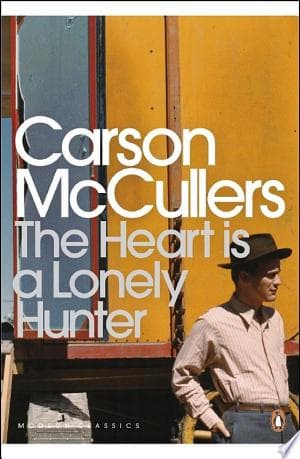
Carson McCullers (2012)
Genre
Literary Fiction / Historical Fiction
Reading Time
9 hours 45 min
Key Themes
See below
Sign in to track this book
In a sleepy 1930s Southern town, a silent, all-observing deaf man becomes the unexpected confidant for a range of lonely, lost, and longing people, each projecting their deepest desires onto his quiet empathy.
John Singer, a deaf engraver, lives in a small Southern mill town with his only companion, Spiros Antonapoulos, another deaf man. Spiros, large and gluttonous, is Singer's anchor, and they share a simple, comfortable routine. However, Spiros begins to act erratically, including public urination and theft. Despite Singer's attempts to protect him, Spiros's cousins decide he needs professional care and commit him to a state asylum. This separation devastates Singer, leaving him lonely and adrift. He moves into a boarding house and becomes a silent, passive observer, attracting the confidences of the town's outcasts and dreamers.
Mick Kelly, a tomboyish adolescent, lives with her large, struggling family in the same boarding house as John Singer. Mick is independent and obsessed with classical music, which she secretly listens to on the radio and tries to compose. She dreams of buying a piano and escaping her poverty. Her family's financial struggles are constant, and Mick often feels misunderstood and isolated, despite being surrounded by her siblings. She finds a strange pull to Singer, drawn to his quiet presence and the peace she feels in his company, though she doesn't fully understand why.
Jake Blount, a drunk and passionate socialist, arrives in town. He is a wanderer, driven by anger at social injustice and a need to state his complex, often rambling, political theories. Blount often gets into trouble, usually in bars, where his drunken rants about capitalism and the working class are met with confusion or hostility. He desperately searches for someone who will truly listen and understand his message. He is drawn to John Singer, seeing him as a kindred spirit due to his quiet intensity and apparent attentiveness, believing Singer uniquely grasps his concerns.
Dr. Benedict Mady Copeland, an elderly Black physician, is educated and dedicated to his community, but also burdened by isolation and disappointment. He has contempt for the ignorance and superstition he sees among his fellow Black townspeople, and he is estranged from his own children, whom he feels have failed to meet his expectations. He often lectures them on racial uplift and socialist ideals, but his words often go unheard. Like the others, he feels a strong, inexplicable pull towards John Singer, finding comfort in the deaf man's silent, uncritical presence.
Biff Brannon, owner of the New York Cafe, is a quiet, observant man who watches the townspeople from behind his counter. He is a widower, having recently lost his wife, Alice, and he struggles with his own loneliness and a hidden desire to care for others, especially Mick Kelly, whom he observes with a paternal, yet complex, affection. Biff is practical, but also philosophical, often thinking about humanity and life's mysteries. He becomes a silent confidant to many, including John Singer, who regularly eats at his cafe and to whom Biff feels a deep connection.
John Singer's apartment becomes a silent place for Mick Kelly, Jake Blount, and Dr. Copeland. Each character, in their deep loneliness, projects their desires, frustrations, and philosophies onto Singer, believing he uniquely understands and sympathizes with their struggles. Mick shares her musical goals, Jake rants about political injustice, and Dr. Copeland states his dreams for racial equality and his disappointment in his children. Singer, unable to hear or speak, simply listens with an unwavering gaze, offering no advice or judgment, which makes him the perfect confidant for these isolated individuals. They find a temporary, fragile peace in his presence.
The Kelly family's financial situation worsens, forcing Mick to take a job at the local five-and-dime store. This entry into the working world, with its long hours and low pay, crushes her spirit and limits her time and energy for music. Her dreams of buying a piano and composing begin to fade as poverty weighs her down. The job also exposes her to the cruelties and banalities of adult life, deepening her disillusionment and isolation. She still visits Singer, but the visits become tinged with growing despair.
Dr. Copeland's health declines, made worse by his constant struggles and frustrations. He continues to clash with his family, especially his daughter Portia and son Willie, over their perceived lack of ambition and understanding. His efforts to organize his community for change are met with apathy, and he feels isolated within his own race. He also faces a personal tragedy when his son Willie is unjustly imprisoned and mutilated. Copeland's visits to Singer become more desperate, as he seeks comfort and validation in the face of his disappointments and his illness.
Jake Blount's drunken political rants become more frequent and aggressive. He sees the town as a microcosm of the societal decay he despises and feels an urgent, yet increasingly useless, need to awaken the people. His frustration at their indifference often turns into public disturbances and confrontations. He clings to Singer as his only true audience, believing Singer is the only one who truly understands his despair and the urgency of his message. Blount's behavior becomes more unstable, showing a man on the verge of a complete breakdown, his idealism turning into dangerous rage.
Driven by his deep longing, John Singer finally travels to the state asylum to visit Spiros Antonapoulos. His reunion with his former companion is anticlimactic. Spiros is unresponsive, detached, and clearly suffering from mental decline. He barely recognizes Singer and shows no signs of their former bond. This visit shatters Singer's last hope for connection and companionship. He realizes that the Spiros he knew is gone, leaving him with an even deeper sense of isolation and the crushing weight of his loneliness. The journey confirms his understanding that his primary source of comfort and connection is lost.
As the summer progresses, the individual struggles of Mick, Jake, and Dr. Copeland intensify. Mick feels her musical dreams slipping away, replaced by work and family demands. Jake Blount's political rants grow more desperate and violent, ending in a public brawl. Dr. Copeland's health worsens, and his efforts to change his community are met with continued apathy, deepening his despair. Each character, despite their visits to Singer, finds their personal battles overwhelming, and their projected hopes onto him begin to feel hollow as their own lives become harsher.
After his devastating visit to Spiros Antonapoulos and the realization that his only true companion is lost to him forever, John Singer succumbs to the crushing weight of his profound loneliness. He returns to his room, cleans his revolver, and shoots himself. Biff Brannon discovers his death, deeply shaken. Singer's suicide leaves a void in the lives of Mick Kelly, Jake Blount, and Dr. Copeland, who must face their own isolation without their silent confidant. His death shows the main theme of the novel: the insurmountable nature of human loneliness.
Singer's death affects the remaining characters, though none fully grasp the depth of his despair or their role in projecting their own needs onto him. Mick continues her difficult life, her musical dreams dimmed but not gone. Jake Blount, after a final, violent outburst, leaves town, still driven by his anger and search for meaning. Dr. Copeland, gravely ill, is forced to leave for his family's farm, his life's work seemingly unfulfilled. Biff Brannon stays at his cafe, thinking about Singer's life and death, and the universal human need for connection and understanding, continuing his quiet observation of the world.
The Protagonist
Singer begins as a passive observer, beloved by those around him, but his profound loneliness and inability to connect authentically ultimately lead to his tragic suicide.
The Protagonist
Mick's initial youthful idealism and musical dreams are gradually crushed by the pressures of poverty and the demands of adulthood, leading to a more resigned, yet still internally striving, existence.
The Protagonist
Blount's initial passionate idealism descends into increasingly desperate and violent outbursts, culminating in his departure from town, still searching for meaning but having achieved little.
The Protagonist
Copeland's unwavering idealism for racial uplift and social justice slowly erodes into bitter disappointment and physical decline, forcing him to confront the limitations of his influence.
The Supporting
Biff remains largely static in his role as an observer, but his internal reflections deepen as he witnesses the tragedies and struggles of those around him, particularly Singer's death.
The Mentioned
Spiros's arc is one of mental decline, serving primarily as the catalyst and symbol of Singer's ultimate isolation.
The Supporting
Portia's arc is one of quiet resilience, navigating her difficult family dynamics and societal constraints without fully succumbing to despair.
The Supporting
Willie's arc is one of victimhood, his personal tragedy serving as a powerful symbol of racial injustice and further fueling his father's disillusionment.
The Supporting
They remain largely static, representing the unyielding pressure of poverty and the ordinary struggles of a working-class family.
The main theme of the novel is the deep and often insurmountable loneliness experienced by each character. Despite living close and interacting daily, the characters are deeply isolated, unable to truly connect or understand one another. Each projects their desires and needs onto John Singer, who, as a deaf man, cannot truly reciprocate, showing the futility of their attempts at connection. Singer's suicide shows the devastating power of this isolation when his only true bond (with Spiros) is broken. Mick's musical dreams, Jake's political rants, and Dr. Copeland's social ambitions all come from a deep sense of being alone and misunderstood.
““The one who is doing the most hating is the one who is going to be the most lonely.””
Each main character desperately searches for someone or something to give their life meaning and to truly understand them. Jake Blount seeks an audience for his political ideas, believing he can awaken people. Dr. Copeland strives to uplift his race and finds meaning in his socialist ideals, but feels misunderstood by his own family and community. Mick Kelly searches for meaning in music, hoping to rise above her poor life. John Singer himself searches for understanding in his distant friend, Spiros Antonapoulos. The tragic irony is that they all project this need onto Singer, a man unable to truly understand them as they desire, leading to disappointment.
““There was no reason for him to be lonely. But he was. He was the loneliest boy in the world.””
The novel shows the social injustices common in the American South during the 1930s, especially racial discrimination and economic hardship. Dr. Copeland's experiences highlight the racism faced by the Black community, seen in his son Willie's brutal treatment in prison and the general apathy towards racial uplift. The poverty of the Kelly family, forcing Mick to give up her dreams for work, illustrates economic inequality. Jake Blount's character acts as a constant, though often unclear, voice against these societal problems, though his efforts are mostly useless. The setting, a small mill town, shows the limited opportunities and oppressive atmosphere.
““The most important thing to do in the world is to see that no man is ever hungry or cold or sick or unhappy.””
Many characters have grand dreams and ideals that are crushed by the harsh realities of their lives. Mick Kelly dreams of becoming a great musician, but poverty forces her into menial labor, slowly extinguishing her artistic spirit. Dr. Copeland's noble goals for his race and family are met with disappointment and apathy, leading to deep disillusionment. Jake Blount's fervent socialist vision clashes violently with the indifference of the world, driving him to despair. John Singer's simple dream of companionship with Spiros is tragically unfulfilled. The novel suggests that while dreams provide comfort, their clash with reality often leads to pain and resignation.
““It was like she was trying to sing a song and she didn't know the words.””
Central to the novel is the exploration of how people communicate and, more often, fail to communicate. John Singer's deafness and muteness act as a literal barrier, yet he becomes the most sought-after confidant because he cannot respond, allowing others to project their own meanings onto him. The other characters, despite being able to speak and hear, often misunderstand each other, their words failing to bridge the gap of their individual experiences and perspectives. Jake Blount's lengthy rants are met with incomprehension, Dr. Copeland's lectures alienate his children, and Mick often feels unheard. The novel highlights the difficulty of true interpersonal understanding.
““Always there was a certain sound that only he could hear, a silent sound that might be a chord or a note that he could not catch.””
John Singer's deafness and muteness make him a passive receiver of others' confessions.
John Singer's inability to speak or hear positions him as the ultimate silent confidant. This device allows the other characters—Mick, Jake, and Dr. Copeland—to project their deepest hopes, fears, and philosophies onto him without fear of judgment or interruption. They interpret his attentive gaze and quiet presence as profound understanding, fostering a false sense of connection. This device effectively highlights their individual loneliness and the universal human need to be heard, while simultaneously emphasizing the impossibility of true, reciprocal understanding in their isolated lives. Singer becomes a blank canvas onto which their desperate desires are painted.
Mick Kelly's passion for music represents her aspirations, individuality, and escape from poverty.
Music, particularly classical music, serves as a powerful symbol for Mick Kelly's inner life, her dreams of beauty, order, and escape from her impoverished reality. It represents her longing for a world beyond her reach and her unique individuality. Her attempts to compose and her yearning for a piano are metaphors for her aspirations and her struggle against the crushing weight of her circumstances. As her dreams are slowly eroded by the demands of work and family, the fading of her musical ambitions symbolizes the loss of her innocence and the harsh realities of life in the segregated South.
The small, economically depressed Southern town creates an atmosphere of stagnation and limited opportunity.
The setting of a small, unnamed Southern mill town in the 1930s is more than just a backdrop; it functions as a critical plot device. It emphasizes the economic hardship, racial segregation, and limited opportunities that shape the characters' lives. The town's insularity and lack of intellectual stimulation exacerbate the characters' feelings of isolation and prevent them from finding genuine outlets for their ambitions. The oppressive heat of summer further contributes to the sense of stagnation and simmering frustration, creating an environment where dreams are easily stifled and social injustices are deeply entrenched.
Characters project their own needs and interpretations onto John Singer, rather than engaging in true communication.
The device of projection is central to the novel's exploration of loneliness and misunderstanding. Each of the main characters—Mick, Jake, and Dr. Copeland—projects their own specific desires, ideologies, and interpretations onto John Singer. They see in his silent, attentive presence exactly what they need to see: a kindred spirit, an understanding intellect, a sympathetic listener. This projection prevents genuine communication and understanding, as they are not engaging with Singer as an individual but rather as a mirror for their own internal worlds. This highlights their profound isolation and the human tendency to seek validation externally, even from those who cannot provide it authentically.
“The Heart is a a lonely hunter my friend, no matter what you may say.”
— Spoken by Jake Blount to John Singer, lamenting the isolation of individuals.
“He was a man who had come to think of himself as a sort of public utility, a silent receptacle for the world's confidences.”
— Describing John Singer's role in the lives of the townspeople, who project their hopes and fears onto him.
“How can you be lonely when you're with people?”
— Mick Kelly's internal question, reflecting her youthful struggle to understand deeper forms of isolation.
“A person can be in a big crowd and still be lonely.”
— Dr. Copeland's observation, highlighting the pervasive nature of loneliness even in populated areas.
“She wanted to be a musician, and she wanted to be beautiful, and she wanted to be loved.”
— Mick Kelly's aspirations and desires, typical of an adolescent yearning for a fulfilling life.
“It was like she had a secret, important, beautiful, and she didn't know what it was, or how to tell it.”
— Mick Kelly's feelings about her internal world and her struggle to express her artistic inclinations.
“The most terrible thing about it was that there was no one to tell.”
— Jake Blount's despair over the lack of understanding or genuine connection with others.
“There was a world of things to be done. He did not know how to begin.”
— Dr. Copeland's frustration with the enormity of social injustice and his personal inability to enact change.
“Maybe it was the feeling of not belonging anywhere, of being a stranger everywhere.”
— Biff Brannon's internal reflection on his own sense of displacement and otherness.
“He knew that in some strange way the two of them were alike. They were both alone.”
— Biff Brannon's observation about John Singer and himself, recognizing a shared solitude.
“It was not a question of love, or hate, or good, or bad. It was a question of knowing.”
— Reflecting on the deeper need for understanding and recognition between people, beyond simple judgments.
“There were too many people, and too much noise, and too many things going on that had nothing to do with him.”
— Jake Blount's feeling of being overwhelmed and disconnected in a bustling environment.
“All people are lonely, she thought. All people are in the world to themselves, and they can't get out.”
— Mick Kelly's somber realization about the fundamental isolation of human existence.
“He had wanted to explain to them that the real trouble with the world was that people were always wanting something for nothing.”
— Jake Blount's cynical view on human nature and the motivations behind societal problems.
Ready to see how well you understood this book? Take our interactive quiz with 10 questions.

Carson McCullers was an American novelist, short-story writer, playwright, essayist, and poet. Her first novel, The Heart Is a Lonely Hunter (1940), explores the spiritual isolation of misfits and outcasts in a small town of the Southern United States. Her other novels have similar themes and most are set in the Deep South.







