“There are two kinds of people in this world: those who divide the world into two kinds of people, and those who don't.”
— Roger Mifflin's philosophical musings on human nature.

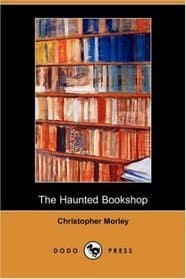
Christopher Morley (1919)
Genre
Historical Fiction / Mystery / Romance
Reading Time
180 min
Key Themes
See below
Sign in to track this book
In a cozy Brooklyn bookshop, a young woman stumbles into a charming yet perilous world of espionage and literary intrigue when she uncovers a plot to assassinate a prominent politician, all while navigating her own romantic entanglements.
Titania Twigg, a bright and observant young woman from the advertising firm of Messrs. Gissing & Gissing, is sent to Brooklyn to meet Roger Mifflin, the owner of 'The Haunted Bookshop'. Her assignment is vaguely defined as creating an advertising campaign, but she senses a mystery. Upon arrival, she finds the shop charmingly chaotic and filled with the scent of old books. Roger Mifflin, a passionate but eccentric bookseller, greets her with an air of distraction, hinting at a larger concern than advertising. Titania immediately notices his intense absorption in a particular manuscript and a general unease in the shop.
Roger Mifflin confides in Titania, revealing that his true reason for hiring an advertising agent is to have an extra pair of eyes and ears. He believes a conspiracy is brewing, targeting the esteemed peace advocate and lecturer, Dr. Gilbert Emery. Mifflin suspects the plot is connected to a specific rare book – a first edition of Robert Louis Stevenson's 'New Arabian Nights' – which has been manipulated to carry a hidden message or device. He explains his theory about secret societies and coded messages in books. Titania, initially skeptical, is drawn into his conviction and agrees to help, intrigued by the unusual nature of the 'advertising' job.
As Titania settles into her role, she observes Roger Mifflin closely. She notices his preoccupation with a manuscript titled 'The Fourth Dimension,' written by a mysterious individual named 'A. B. C.' Mifflin believes this manuscript is central to the conspiracy. At the same time, the specific first edition of Stevenson's 'New Arabian Nights,' which Mifflin had been guarding, goes missing from the shop. This disappearance confirms Mifflin's fears and increases the urgency of their investigation. Titania, using her keen observational skills, starts noticing subtle inconsistencies and suspicious occurrences within the bookshop.
A new character, Aubrey Gilbert, arrives at the bookshop, supposedly to help Mifflin with cataloging and other tasks. Gilbert is introduced as a former employee or acquaintance of Mifflin, but Titania immediately finds him unsettling. His manners are overly polite, almost fawning, and he seems overly interested in Mifflin's activities and the general goings-on in the shop. Titania's instincts tell her that Gilbert is not who he claims to be, or at least that his intentions are not pure. She begins to subtly monitor his movements and conversations, becoming increasingly convinced that he is connected to the conspiracy against Dr. Emery.
Titania and Roger Mifflin work to decipher the manuscript 'The Fourth Dimension.' They discover it contains a complex cipher, which, once partially cracked, reveals fragmented but alarming information. The manuscript seems to outline a philosophical justification for a radical act, hinting at a 'higher cause' that could involve violence. The content reinforces Mifflin's belief that Dr. Gilbert Emery is in grave danger. The puzzle of the cipher becomes a race against time, as they fear the conspirators are moving closer to their objective. Their collaborative effort strengthens the bond between the pragmatic Titania and the idealistic Mifflin.
Dr. Gilbert Emery is scheduled to deliver a highly anticipated lecture on peace and international relations. The event is a significant public appearance, making him particularly vulnerable. Titania and Roger Mifflin realize that the lecture is the most likely target for the conspirators. They feel immense pressure to understand the full scope of the plot and warn Dr. Emery before it's too late. Their attempts to reach Emery directly meet with bureaucratic hurdles, adding to their frustration. The clock is ticking, and the 'haunted' atmosphere of the bookshop seems to amplify their sense of impending doom.
Titania, through her observations and deductions, gathers enough evidence to confront Aubrey Gilbert directly. She realizes he is not merely an assistant but a key player in the conspiracy, likely a member of the radical group. During a tense confrontation within the bookshop, Titania skillfully corners Gilbert, forcing him to drop his facade. He reveals that the group, driven by a misguided ideology of 'creative destruction,' plans to disrupt Dr. Emery's lecture, though the exact method remains somewhat unclear. Gilbert, under pressure, also confirms the significance of the missing Stevenson book and the 'Fourth Dimension' manuscript as tools in their scheme.
With Aubrey Gilbert's partial confession, Titania and Roger Mifflin understand the urgency of the situation. They know the conspirators intend to act during Dr. Emery's lecture. Leaving Gilbert under watch, they rush to the lecture hall, hoping to arrive before any harm can be done. Their journey is filled with anxiety as they try to anticipate the conspirators' methods and identify potential threats in the large crowd. The chaotic rush emphasizes the blend of intellectual mystery and real-world danger that has characterized their adventure.
At the lecture hall, Titania and Roger Mifflin identify the key conspirators, including a woman named Miss Finch, who had been covertly observing the bookshop. They intervene, creating enough of a diversion and raising alarms to prevent the full execution of the plot. While there is a minor disruption, Dr. Emery is unharmed, and the conspirators' plans are stopped. The 'weapon,' which turns out to be a psychological manipulation rather than a physical one, is neutralized. The police are called, and the conspirators are apprehended, ending the immediate threat. The bookshop's 'haunting' is revealed to be the lingering presence of intrigue rather than a supernatural one.
Afterward, the 'Haunted Bookshop' returns to its quirky charm, but with a new sense of quiet triumph. Titania Twigg's initial 'advertising' assignment has evolved into a deep experience. She and Roger Mifflin reflect on the events, recognizing the unusual bond they've formed through shared danger and intellectual pursuit. The experience leaves Titania with a deeper appreciation for the world of books and the unexpected adventures they can hold. Their professional relationship has grown into something more personal, hinting at a romantic future. The bookshop, no longer haunted by conspiracy, now holds the promise of shared stories and companionship.
The Protagonist
Titania transforms from a professional outsider to an integral part of the bookshop's world, embracing adventure and finding unexpected love.
The Protagonist
Roger's anxieties about the conspiracy are validated, and he finds a capable partner and companion in Titania.
The Antagonist
Gilbert's deceptive facade is peeled away, revealing him as a conspirator whose plans are ultimately thwarted.
The Supporting
Emery remains largely unaware of the specific threat against him but is ultimately saved by the protagonists' intervention.
The Supporting
Miss Finch's role as a conspirator is exposed, leading to her capture.
The Mentioned
N/A
The novel celebrates the deep influence of books, not just as objects but as carriers of ideas, both good and bad. Roger Mifflin values books as sources of wisdom and comfort, while the conspirators use them as tools for their radical ideology. The 'Haunted Bookshop' itself shows the lasting power of literature, and the central mystery involves a rare book and a manuscript used to convey secret messages and philosophical reasons for violence. The book suggests that ideas, once released, can 'haunt' the world, for good or ill.
““There is no such thing as an innocent book. Books are either good or bad, and their badness is a very positive thing.””
This theme is shown by the dynamic between Roger Mifflin and Titania Twigg. Mifflin is an idealist, driven by his love for books and a belief in noble causes, sometimes to the point of being impractical. Titania, on the other hand, is practical, approaching problems with logic and common sense. Their different approaches are crucial to solving the mystery; Mifflin's idealism identifies the threat, while Titania's practicality helps navigate real-world complexities. The novel suggests that a balance of both is necessary for effective action and a fulfilling life.
““Life is an adventure, and if you don’t live it as one, you’re missing the point.””
The plot explores the workings and reasons of a secret society driven by a radical philosophy. The conspirators believe in 'creative destruction' and intellectual superiority, using a complex cipher and philosophical manuscript to justify their actions. The novel explores how seemingly intellectual or abstract ideas can be twisted into reasons for violence and disruption. It highlights how such plots can be insidious, often hidden in plain sight or within intellectual discussions, making them difficult to detect and counter.
““The greatest crimes are not committed by criminals, but by idealists.””
From Titania's initial vague assignment to the final confrontation, the novel embraces the joy and excitement of solving a mystery. The 'haunted' aspect of the bookshop is not supernatural but metaphorical, representing the intrigue and hidden depths within the seemingly ordinary. Titania, initially seeking a straightforward advertising job, finds herself drawn into a thrilling adventure that challenges her intellect and expands her worldview. The book celebrates the idea that adventure can be found in unexpected places, especially within books and ideas.
““There is a romance about a bookshop that no other shop can claim.””
A rare book that serves as the catalyst and focal point for the conspiracy.
The first edition of Robert Louis Stevenson's 'New Arabian Nights' functions as a classic MacGuffin. It is the object that the conspirators seek and that Roger Mifflin is trying to protect, driving much of the initial plot. Its significance lies not in its intrinsic value as a rare book, but in its role as a container for a hidden message or device, making it central to the conspirators' plan against Dr. Emery. Its disappearance further intensifies the stakes and pushes the protagonists into action.
A coded document that reveals the conspirators' ideology and plans.
The manuscript titled 'The Fourth Dimension,' written by 'A. B. C.,' and the cipher within it, serve as a crucial plot device for revealing the nature and extent of the conspiracy. The process of deciphering it engages both Titania and Mifflin's intellect and provides critical clues about the radical group's philosophy and their target. It's a classic element of mystery, where intellectual puzzle-solving directly impacts the unfolding action and understanding of the antagonist's motives.
The atmospheric setting that provides an evocative backdrop for the mystery.
The bookshop itself, described as 'haunted,' functions as more than just a location; it's a character in its own right and a significant plot device. The 'haunting' is not supernatural but metaphorical, representing the lingering presence of ideas, both good and bad, within its walls. It creates an atmosphere of mystery and intrigue, suggesting that hidden stories and secrets reside among the dusty shelves. This setting allows for close quarters investigation and emphasizes the intellectual nature of the conspiracy.
A deceptive premise that allows the protagonist to enter the world of the mystery.
Titania's initial 'advertising assignment' for the bookshop is a clever plot device that serves as a plausible, mundane entry point for her into Roger Mifflin's world and the unfolding mystery. It provides a reason for her presence and her close observation of the bookshop and its proprietor, without immediately revealing the deeper, more dangerous plot. This allows the mystery to unfold gradually, drawing Titania (and the reader) in organically, as the true nature of her 'job' is slowly unveiled.
“There are two kinds of people in this world: those who divide the world into two kinds of people, and those who don't.”
— Roger Mifflin's philosophical musings on human nature.
“When you sell a man a book you don't sell him just twelve ounces of paper and ink and glue – you sell him a whole new life.”
— Roger Mifflin explaining the profound impact of books to Helen.
“It is a good rule, after reading a new book, never to allow yourself another new one till you have read an old one in between.”
— Roger Mifflin's advice on balancing new and classic literature.
“The world is full of books, and the books are full of the world.”
— A general reflection on the interconnectedness of literature and reality.
“No man is lonely while he is reading.”
— Roger Mifflin's comforting thought about the companionship of books.
“To be truly happy, one must be able to enjoy the company of oneself.”
— A reflection on self-sufficiency and contentment.
“There is a certain dignity in being a book, even an old and forgotten one.”
— A thought on the inherent value of every book.
“The true joy of a bookshop is not in what you buy, but in what you discover.”
— Roger Mifflin's perspective on the browsing experience in a bookstore.
“Every book has a soul, and every soul has a story.”
— A poetic statement about the essence of books and human experience.
“The greatest mysteries are not always found in the darkest alleys, but sometimes in the quietest corners of a bookshop.”
— A hint at the subtle mysteries unfolding within the bookshop.
“A good book is a companion, a confidant, a teacher, and a friend.”
— Describing the multifaceted roles of a beloved book.
“Life is a mystery, and a good book is a clue.”
— A metaphorical statement about how books help understand life.
“The only way to escape the world is to dive deeper into it, through the pages of a book.”
— A paradox illustrating the immersive power of reading.
“Sometimes the most extraordinary things happen in the most ordinary places, if you only look closely enough.”
— A reflection on the hidden wonders within everyday settings, like a bookshop.
Ready to see how well you understood this book? Take our interactive quiz with 10 questions.

Christopher Morley was an American journalist, novelist, and poet, best known for his charming novels about books and bookshops. His most famous works include 'The Haunted Bookshop' (1919) and 'Parnassus on Wheels' (1917), which celebrate the love of literature and the quiet magic of bookstores. Morley's writing often blended humor, warmth, and a deep appreciation for the written word.