“Don't let the bastards grind you down.”
— Offred finds this phrase scratched into her cupboard by a previous Handmaid.

Margaret Atwood (2016)
Genre
Fantasy / Science Fiction
Reading Time
540 min
Key Themes
See below
Sign in to track this book
In a future where women lose their rights and become reproductive tools, Offred navigates a frightening world, holding onto memories and forbidden desires in a fight for her identity.
Offred, once named June, is a Handmaid in the Republic of Gilead, a religious state. She lives in the home of Commander Fred Waterford and his wife, Serena Joy. Her main job is to have children, since pollution caused many people to be infertile. The story begins with Offred describing her plain room and the strict rules of her new life. She remembers her time at the Red Centre, where Aunts like Aunt Lydia taught Handmaids their new roles, removed their old identities, and made them accept their forced sexual service. She recalls parts of her past life with her husband Luke and daughter Hannah, a life now gone.
Offred's daily routine is carefully managed. She goes on supervised shopping trips to the market with her partner, Ofglen, and takes part in the monthly Ceremony with the Commander. During their walks, Handmaids talk in code, careful of the Eyes, Gilead's secret police. Offred often thinks about her past, remembering her feminist mother, her friend Moira, and her family. These memories help her keep her sense of self against the state's efforts to erase her. She sees public executions, the 'Particicution' of supposed criminals, and bodies hanging on the Wall, reminders of Gilead's power.
The Ceremony is a cold, ritual act to try and get pregnant. The Commander has sex with Offred while she lies between Serena Joy's legs, a distorted version of a biblical fertility ritual. Offred wants human connection. The Commander starts calling her to his study at night to play Scrabble. These secret meetings break Gilead's rules and give Offred forbidden mental stimulation, plus a look into the Commander's loneliness and hypocrisy. He also gives her old magazines, showing Gilead's inconsistencies.
Serena Joy, upset by the Commander's possible infertility and her own wish for a child, suggests Offred sleep with Nick, the driver, hoping to get pregnant. This is risky, as any unauthorized sexual activity is forbidden. Offred already feels a pull to Nick, sensing something hidden about him. She agrees to Serena Joy's plan, driven by a wish for physical touch and a small hope of having a baby, which would improve her status and possibly her survival.
The Commander continues his secret meetings and takes Offred to Jezebel's, a hidden brothel approved by the government for high-ranking officials and visitors. This place, which contradicts Gilead's strict religious appearance, employs women called 'unwomen' or those who chose this path over the Colonies. To Offred's surprise, she finds Moira, her best friend from before Gilead, working there. Moira tells her about trying to escape the Red Centre and being caught, giving a harsh account of life for those who resist.
Offred begins a sexual relationship with Nick, finding real connection and enjoyment in their forbidden meetings. She thinks she might be pregnant, which brings both hope and fear. At the same time, the first Ofglen (Offred's shopping partner) reveals she is part of Mayday, an underground resistance group. She tries to get Offred to join, asking her to get information from the Commander. But soon after this, the first Ofglen disappears. A new, more eager Handmaid takes her place and says the original Ofglen killed herself to avoid being caught by the Eyes, leaving Offred alone and scared.
Offred attends a 'Salvaging,' a public execution where Handmaids must take part in a 'Particicution,' a mob killing of a supposed rapist. The event shows Gilead's control and the Handmaids' forced involvement in its violence. The new Ofglen, however, says the accused man was a Mayday member trying to confess, and she gives him a final, merciful blow to end his pain. This act shows Gilead's hypocrisy and brutality, while also showing the quiet resistance under the surface.
Serena Joy reveals that a picture she has of Offred's daughter, Hannah, was given to her by the Van Arsdale's, a family who adopted her. She tells Offred that Hannah looks happy and does not remember her. This news devastates Offred, who had hoped to be reunited with her child. She becomes very depressed, questioning why she continues to live and feeling without hope. Her relationship with Nick becomes her only comfort, offering a brief escape from her difficult life in Gilead.
One day, a black van, belonging to the Eyes, arrives at the Commander's house. Nick appears and tells Offred the men are from Mayday and are there to rescue her, but he cannot promise her safety. He tells her to trust them. Offred is led to the van, unsure if she is being rescued or captured. She gets into the van, her future completely unknown. This is a sudden and unclear end to her story.
The novel ends with 'Historical Notes,' set in 2195, many centuries after Offred's time. Professor James Darcy Pieixoto, an expert in Gileadian Studies, gives a lecture. He talks about finding Offred's story, recorded on cassette tapes, and the difficulty of confirming and understanding them. He says 'Offred' was a name from her master, meaning 'Of Fred,' and that the tapes were found in a locker during the 'Gilead Archaeological Salvaging.' The academics, distant and often dismissive of women, analyze Offred's story focusing on historical accuracy rather than human suffering. This suggests that even after Gilead fell, some of its underlying social problems remained or were reinterpreted.
The Protagonist
Offred transforms from a woman initially overwhelmed by Gilead's oppression into someone who finds small, personal ways to resist and assert her individuality, ultimately making a dangerous choice for potential freedom.
The Antagonist
The Commander's character does not undergo significant change; he remains a hypocritical and self-serving figure, embodying the moral decay of Gilead's elite.
The Antagonist
Serena Joy remains a static character, consumed by her bitterness and inability to have a child, her actions consistently driven by self-interest and resentment.
The Supporting
Nick's arc involves a gradual revelation of his true nature and his role in the resistance, culminating in his efforts to help Offred escape.
The Supporting
Moira's arc showcases her initial strong resistance, followed by her survival in a deeply compromised position, demonstrating the varied forms of survival under oppression.
The Supporting
Aunt Lydia remains a static character, embodying the oppressive force of Gilead's re-education system.
The Supporting
Ofglen's arc is brief but impactful, moving from a seemingly compliant Handmaid to a revealed resistance fighter who makes the ultimate sacrifice.
The Mentioned
Luke's character does not have an arc within the narrative, serving primarily as a memory and symbol of Offred's past.
The Mentioned
Hannah's character does not have an arc; she serves as a powerful symbol of Offred's lost life and a motivator for her actions.
The Mentioned
Pieixoto's character is static, serving as a framing device to comment on the nature of history and interpretation.
The Handmaid's Tale explores male control, especially over women. Gilead takes away women's rights, identities, and control over their bodies, making them reproductive tools, house servants, or sexual objects. Handmaids, Wives, Marthas, and Econowives all suffer under a system designed by men, enforced by women (Aunts), and justified by twisted religious texts. The novel criticizes the historical and ongoing suppression of women's voices, education, and freedom. It shows how even women can help in their own oppression or that of others. Offred, Moira, and Serena Joy's experiences show different aspects of women's suffering and resistance.
“We were a society dying of too much choice. I was a part of that, and I remember it. I remember the days when we were able to choose.”
Gilead systematically takes away its citizens' identities, especially women's. Handmaids are renamed, their pasts removed, and their personalities suppressed. Offred's constant inner thoughts and memories of June, Luke, and Hannah are her main ways of keeping her sense of self. The struggle to remember who she was and to create a small space for her own thoughts becomes a central act of rebellion. This theme explores how identity is shaped by memory, relationships, and personal freedom, and what happens when these are taken away. Offred's slow realization of her ability to do small acts of defiance is part of her finding herself again.
“I try to remember what I used to look like. I try to remember what I used to wear. I try to remember what I used to feel.”
The novel's main idea is about controlling female fertility because many people are infertile. Women are defined only by their ability to have children, and their bodies become state property. Handmaids are forced into sexual acts to get pregnant, while Wives are shamed for being infertile. This theme directly addresses political and social control over women's bodies. It criticizes the idea that a woman's worth is only tied to her ability to bear children. The fear of infertility drives Gilead's entire social structure, turning women into tools instead of individuals. It shows the terrible results when control over one's body is removed.
“We are for breeding purposes. We are two-legged wombs, that's all: sacred vessels, ambulatory chalices.”
Language is a tool for both control and resistance in Gilead. The regime renames everything—women, places, ideas—to support its beliefs and erase the past. Bible verses are selectively used to justify oppression. Handmaids cannot read or write, as reading is seen as dangerous. But Offred's inner thoughts, her memories, and her search for forbidden words become acts of defiance. The Commander's secret Scrabble games show the power of language as a form of mental freedom and connection. The 'Historical Notes' also show how language can be used to understand, misunderstand, or distance oneself from past suffering.
“A word after a word after a word is power.”
Offred's story moves between deep sadness and brief moments of hope. The constant threat of the Eyes, the Wall, and the Colonies often makes her feel hopeless. Yet, small acts of kindness (like Nick's touch), forbidden pleasures (Scrabble), and Mayday offer fragile hope for change or escape. Her longing for her daughter and the memory of her past life fuel her desire to survive. The unclear ending leaves the reader with a mix of both hope and uncertainty, suggesting that hope is possible but not guaranteed, and often comes with great personal risk.
“Nolite te bastardes carborundorum. Don't let the bastards grind you down.”
Gilead is a totalitarian state where surveillance is everywhere. The Eyes, the secret police, are always present, creating an atmosphere of fear and distrust. Handmaids are constantly watched by Marthas, Wives, and even each other. Public executions and punishments serve as constant reminders of the state's power. This theme explores the psychological effect of living under constant surveillance, where privacy is gone and disagreement leads to brutal force. It shows how fear and control keep order and suppress individual thought and action.
“There are always two of us. Lying in bed, watching the window, watching the door. There is always someone watching.”
Offred's story told solely from her limited, internal perspective.
The entire novel is narrated by Offred in the first person, giving readers direct access to her thoughts, memories, and emotional state. This subjective viewpoint emphasizes her isolation, as she can only communicate freely in her mind. It creates a sense of immediacy and intimacy, allowing the reader to experience the horrors of Gilead through her internal struggle. The unreliability of her memory, especially regarding pre-Gilead events, also highlights the psychological toll of her environment. The 'Historical Notes' at the end then frame her narrative as a found document, adding another layer to its subjectivity.
Offred's frequent shifts between present and past, revealing her former life.
Offred's narrative is constantly interspersed with flashbacks to her life before Gilead, her separation from Luke and Hannah, and her experiences at the Red Centre. These memories serve several functions: they provide crucial backstory, highlight the stark contrast between her past freedom and present oppression, and are a vital mechanism for Offred to maintain her sanity and sense of self. They also demonstrate the power of memory as a form of resistance against a regime that seeks to erase individual histories. The fragmented nature of these memories reflects her trauma and the difficulty of recalling a life that feels increasingly distant.
A future academic conference providing a detached, post-Gileadean analysis.
The novel concludes with an epilogue set in 2195, presented as a transcript from a symposium on Gileadean Studies. This device serves to contextualize Offred's narrative, suggesting that Gilead eventually fell and that her story was a historical document. However, the academic tone of Professor Pieixoto, his subtle sexism, and his focus on historical accuracy over human suffering, create a chilling effect. It implies that while the specific regime of Gilead may have ended, the underlying issues of misogyny and the objectification of women might persist, subtly critiquing the way history is often interpreted and the potential for a lack of empathy in future societies.
Specific colors denoting social roles and restrictions in Gilead.
Colors play a crucial symbolic role in Gilead, immediately identifying a person's social status and function. Handmaids wear 'red,' symbolizing fertility, blood, and passion, but also danger. Wives wear 'blue,' representing purity and domesticity (often associated with the Virgin Mary). Marthas wear 'green,' for their domestic service. The 'Eyes' wear 'black,' signifying authority and menace. These color codes serve as a constant visual reminder of the rigid social hierarchy and the loss of individual choice, reinforcing the oppressive nature of the regime and stripping individuals of their personal expression through clothing.
The use and manipulation of biblical scripture to justify Gilead's ideology.
Gilead's entire social structure and moral code are ostensibly based on a fundamentalist interpretation of the Old Testament, particularly the story of Rachel and Bilhah (Genesis 30:1-3), which justifies the Handmaid system. However, the regime selectively quotes and distorts scripture to support its oppressive agenda, ignoring other biblical tenets. This device highlights the dangers of religious extremism and how sacred texts can be manipulated to control populations. Offred often reflects on these distortions, recognizing the hypocrisy and perversion of faith for political power.
“Don't let the bastards grind you down.”
— Offred finds this phrase scratched into her cupboard by a previous Handmaid.
“Nolite te bastardes carborundorum.”
— The Latin version of the above quote, which Offred learns from the Commander.
“We were the people who were not in the papers. We lived in the blank white spaces at the edges of print. It gave us more freedom.”
— Offred reflects on life before Gilead.
“Better never means better for everyone... It always means worse, for some.”
— Offred comments on the regime's promises of improvement.
“A rat in a maze is free to go anywhere, as long as it stays inside the maze.”
— Offred describes the limited freedoms in Gilead.
“I wait. I compose myself. My self is a thing I must now compose, as one composes a speech. What I must present is a made thing, not something born.”
— Offred prepares for her role as a Handmaid.
“There is more than one kind of freedom... Freedom to and freedom from. In the days of anarchy, it was freedom to. Now you are being given freedom from. Don't underrate it.”
— Aunt Lydia lectures the Handmaids on Gilead's ideology.
“We thought we had such problems. How were we to know we were happy?”
— Offred reminisces about her past life with her husband Luke.
“Ignoring isn't the same as ignorance, you have to work at it.”
— Offred reflects on how people ignored warning signs before Gilead.
“But who can remember pain, once it's over? All that remains of it is a shadow, not in the mind even, in the flesh. Pain marks you, but too deep to see. Out of sight, out of mind.”
— Offred muses on the nature of suffering and memory.
“The night is mine, my own time, to do with as I will, as long as I am quiet. As long as I don't move.”
— Offred describes the small freedoms she finds in her room.
“We are for breeding purposes: we aren't concubines, geisha girls, courtesans. On the contrary: everything possible has been done to remove us from that category.”
— Offred explains the role of Handmaids in Gilead.
“I would like to believe this is a story I'm telling. I need to believe it. I must believe it. Those who can believe that such stories are only stories have a better chance.”
— Offred reflects on the nature of her narrative and survival.
“Ordinary, said Aunt Lydia, is what you are used to. This may not seem ordinary to you now, but after a time it will. It will become ordinary.”
— Aunt Lydia indoctrinates the Handmaids into accepting their new reality.
Ready to see how well you understood this book? Take our interactive quiz with 10 questions.
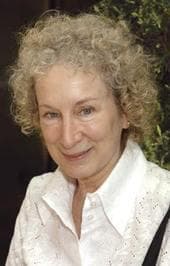
Margaret Eleanor Atwood is a Canadian poet, novelist, literary critic, essayist, teacher, environmental activist, and inventor. Since 1961, she has published eighteen books of poetry, eighteen novels, eleven books of non-fiction, nine collections of short fiction, eight children's books, two graphic novels, and a number of small press editions of both poetry and fiction. Atwood has won numerous awards and honors for her writing, including two Booker Prizes, the Arthur C. Clarke Award, the Governor General's Award, the Franz Kafka Prize, Princess of Asturias Awards, and the National Book Critics and PEN Center USA Lifetime Achievement Awards. A number of her works have been adapted for film and television.







