“A mouse took a stroll through the deep dark wood.”
— Opening line introducing the mouse's journey.

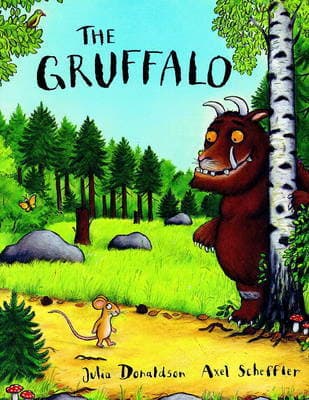
Julia Donaldson (1999)
Genre
Fantasy / Children's
Reading Time
5 min
Key Themes
See below
Sign in to track this book
A clever mouse outwits a parade of predators and a mythical monster by spinning tales of a terrifying Gruffalo, only to discover the beast is real.
A small, brave mouse decides to walk through a 'deep, dark wood.' A hungry fox quickly confronts him and invites him to his 'cosy underground house' for lunch. The mouse, knowing he is in danger, says no. To scare the fox, he invents a creature called a Gruffalo, saying they are meeting for lunch. He describes the Gruffalo with 'terrible tusks, and terrible claws, and terrible teeth in his terrible jaws,' and says its favorite food is roasted fox. The fox, scared by this description, runs away, leaving the mouse to continue his walk.
Continuing his journey, the mouse soon sees an owl, perched high in a tree, who also tries to invite him to its 'tree-top house' for tea. Knowing the owl wants to eat him, the mouse again uses his clever tactic. He tells the owl that he is meeting a Gruffalo for tea, describing its 'knobbly knees, and turned-out toes, and a poisonous wart at the end of its nose.' He adds that the Gruffalo's favorite food is owl ice cream. The owl, hearing this description and the threat, immediately flies away in a panic, leaving the mouse unharmed.
As the mouse goes deeper into the wood, he meets a slithery snake who invites him to its 'log-pile house' for a feast. The mouse, always quick-witted, says no to the snake's offer, knowing he would become the feast. He tells the snake that he is on his way to have 'Gruffalo crumble' with a Gruffalo, describing this creature with 'purple prickles all over his back.' He further says that the Gruffalo's favorite food is scrambled snake. The snake, hearing about this creature and its food choice, quickly goes back into its log-pile house, leaving the mouse to think about his success.
Feeling good after scaring away the fox, owl, and snake with his made-up creature, the mouse walks on, thinking, 'A Gruffalo? What's a Gruffalo? A Gruffalo! Why, didn't you know?' He believes his invention is just imaginary. However, to his surprise and fear, he suddenly sees a creature that perfectly matches every detail of the Gruffalo he had just described: 'terrible tusks, and terrible claws, and terrible teeth in his terrible jaws,' with 'knobbly knees, and turned-out toes, and a poisonous wart at the end of his nose,' and 'purple prickles all over his back.' The Gruffalo is real!
The real Gruffalo, happy to find the small mouse, says, 'Oh, a Gruffalo! Hello, little mouse. You're just the food I like best of all – roasted mouse!' The mouse, at first scared, quickly calms down and, again, uses his intelligence. He tells the Gruffalo that he is the scariest creature in the wood and asks the Gruffalo to follow him to prove it. The Gruffalo, curious and perhaps a little easily fooled, agrees to follow the mouse, wanting to see this 'scary' creature for himself, not knowing the mouse's plan.
As the mouse leads the Gruffalo through the wood, they first meet the fox, who is still hiding, shaking. The mouse greets the fox, who sees the big, scary Gruffalo behind the mouse and immediately cries out, 'Oh dear, oh dear, oh dear!' and runs into his underground house, convinced the Gruffalo is after him. The mouse then says to the Gruffalo, 'See? I told you so! Didn't I tell you, Gruffalo, that everyone is scared of me?' The Gruffalo, a bit confused but impressed, replies, 'Yes, but why?'
The mouse continues to lead the Gruffalo, and they soon come across the owl, still in its tree-top house. The mouse greets the owl, who immediately sees the tall Gruffalo behind the tiny mouse. The owl, remembering the 'owl ice cream' threat and seeing the creature, shrieks, 'Oh dear, oh dear, oh dear!' and flies away fast, vanishing into the sky. The mouse again turns to the Gruffalo and says, 'See? I told you so! Didn't I tell you, Gruffalo, that everyone is scared of me?' The Gruffalo, becoming more puzzled, says, 'Yes, you did, little mouse, yes you did.'
The mouse and the Gruffalo continue their walk, and soon they meet the snake, who is still hiding in its log-pile house. The mouse greets the snake, who, seeing the huge Gruffalo behind the mouse, exclaims, 'Oh dear, oh dear, oh dear!' and quickly slides back into its house, disappearing. The mouse, now fully in control, turns to the Gruffalo and says, 'See? I told you so! Didn't I tell you, Gruffalo, that everyone is scared of me?' The Gruffalo, convinced by the other animals' reactions, finally believes the mouse's claim.
After the snake runs away, the mouse turns to the Gruffalo and, with confidence, says, 'Now, my favorite food is Gruffalo crumble!' The Gruffalo, who has seen the scared reactions of the fox, owl, and snake, and has just heard the mouse claim Gruffalo crumble as his favorite food, is completely convinced that the tiny mouse is indeed the most fearsome creature in the entire wood. Overwhelmed with fear, the Gruffalo lets out a 'terrible roar' and runs away as fast as he can, disappearing into the deep, dark wood.
With the Gruffalo gone, the deep, dark wood is finally safe for the little mouse. He is no longer threatened by the fox, the owl, the snake, or the Gruffalo. The clever mouse finds a nut and sits down to eat it in peace, enjoying his meal. His intelligence and quick thinking have not only saved him from becoming lunch for various predators but have also cleared the wood of the most fearsome creature, letting him enjoy his walk without trouble.
The Protagonist
The Mouse begins as vulnerable prey but develops into a confident manipulator, ultimately achieving safety through his cleverness.
The Antagonist
The Gruffalo emerges as a terrifying threat but ends up fleeing in fear, having been outsmarted by a much smaller creature.
The Supporting
The Fox attempts to be a predator but quickly becomes a terrified victim of the Gruffalo's perceived threat.
The Supporting
The Owl's predatory attempt is thwarted, and he becomes a terrified bystander in the Mouse's plan.
The Supporting
The Snake's predatory attempt is foiled, and he becomes a terrified witness to the Mouse's perceived power.
This theme is central to 'The Gruffalo,' showing that wit can win over strength and size. The tiny Mouse, physically weak, repeatedly outsmarts much larger predators (Fox, Owl, Snake, and even the Gruffalo itself) through his quick thinking and storytelling. His ability to invent a creature and then use the real creature's presence to his advantage shows how a sharp mind can be a stronger tool than physical strength when facing danger. The Mouse's success comes from his intelligence, not his muscles.
“A Gruffalo? What's a Gruffalo? A Gruffalo! Why, didn't you know?”
The book shows how imagination and storytelling are tools for survival. The Mouse first invents the Gruffalo and its traits to scare away predators. His detailed descriptions are so believable that they scare away the Fox, Owl, and Snake. This theme continues when the invented creature becomes real, and the Mouse must then create a new story to trick the Gruffalo. His ability to tell tales and manage how others see things is his main defense, showing how stories can change reality and affect behavior, even in dangerous situations.
“He has terrible tusks, and terrible claws, and terrible teeth in his terrible jaws.”
The story explores how fear is often about perception and can be controlled. The predators are scared by the Mouse's made-up Gruffalo, and later, the Gruffalo itself is scared by the Mouse, not because the Mouse is physically strong, but because the Gruffalo believes him to be. The Mouse cleverly sets up situations where the Gruffalo sees the other animals running, leading the Gruffalo to think they are running from the Mouse. This shows how appearances can be misleading and how a well-managed idea of power can be more effective than actual power in causing fear.
“My favourite food is Gruffalo crumble!”
While often connected with 'survival of the fittest,' The Gruffalo offers a charming take on 'survival of the wittiest.' The forest is a dangerous place where bigger, stronger animals hunt smaller ones. The Mouse, being at the bottom of the food chain, must rely entirely on his mental quickness to survive. His ability to quickly judge threats, invent solutions, and change his plan when faced with the real Gruffalo shows that intelligence and quick thinking are needed for survival in a tough environment. The story celebrates the underdog's win through pure cleverness.
“A mouse took a stroll through the deep, dark wood.”
A recurring pattern of encounters and dialogue for emphasis and rhythm.
The story employs a highly repetitive structure, particularly in the encounters between the Mouse and the three predators (Fox, Owl, Snake), and later, when the Mouse leads the Gruffalo past them. Each predator invites the Mouse for a meal, the Mouse invents a new Gruffalo detail and its favorite food (which is the predator), and the predator flees. This repetition creates a strong rhythmic quality, making the story memorable and predictable for young readers, while also building suspense and highlighting the Mouse's consistent cleverness. It reinforces the pattern of the Mouse's successful deception.
An invented threat becomes real, subverting expectation.
The story uses a unique form of foreshadowing, or rather, an inverted expectation. The Mouse 'foreshadows' the Gruffalo's existence and characteristics through his fabricated descriptions. The audience, like the Mouse, believes this creature is purely imaginary. The shock comes when the 'foreshadowed' creature actually appears, turning the Mouse's clever lie into a terrifying reality. This device brilliantly sets up the central conflict and the subsequent need for the Mouse to adapt his strategy, creating a powerful twist in the narrative.
The audience knows the Gruffalo is fake before the Mouse meets the real one.
Dramatic irony is present initially as the audience is privy to the fact that the Gruffalo is a made-up creature, while the predators believe it to be real. This creates humor and highlights the Mouse's cleverness. The irony then shifts when the real Gruffalo appears, and both the Mouse and the audience are surprised. Finally, a new layer of dramatic irony emerges as the Gruffalo believes the Mouse to be the scariest creature, while the audience knows the Mouse is simply orchestrating the situation, adding to the tension and comedic effect.
The entire narrative is told through a consistent AABB rhyming scheme.
The book is written entirely in rhyming couplets (AABB rhyme scheme) with a consistent rhythm. This poetic structure makes the story highly engaging, easy to read aloud, and memorable for children. It enhances the flow of the narrative and adds a playful, musical quality to the text, which is characteristic of Julia Donaldson's style. The rhyming scheme also helps to structure the narrative and reinforce key plot points and character descriptions, making the Gruffalo's features and the Mouse's cunning memorable.
“A mouse took a stroll through the deep dark wood.”
— Opening line introducing the mouse's journey.
“A fox saw the mouse and the mouse looked good.”
— Mouse encounters the first predator.
“Where are you going to, little brown mouse? Come and have lunch in my underground house.”
— Fox's deceptive invitation to the mouse.
“It's terribly kind of you, Fox, but no – I'm going to have lunch with a gruffalo.”
— Mouse invents the Gruffalo to scare off the fox.
“A gruffalo? What's a gruffalo?”
— Fox's confused reaction to the mouse's invention.
“A gruffalo! Why, didn't you know? He has terrible tusks, and terrible claws, and terrible teeth in his terrible jaws.”
— Mouse describes the Gruffalo's fearsome features.
“Silly old Fox! Doesn't he know, there's no such thing as a gruffalo?”
— Mouse's triumphant thought after scaring off the fox.
“You'll taste good on a slice of bread!”
— Owl's threatening remark to the mouse.
“But who is this creature with terrible claws and terrible teeth in his terrible jaws?”
— Snake's fearful question upon seeing the Gruffalo.
“My favourite food! the Gruffalo said. You'll taste good on a slice of bread!”
— Gruffalo threatens to eat the mouse.
“All was quiet in the deep dark wood. The mouse found a nut and the nut was good.”
— Closing lines showing the mouse's peaceful victory.
“He has knobbly knees and turned-out toes, and a poisonous wart at the end of his nose.”
— Mouse adds more details to the Gruffalo's description.
“Oh help! Oh no! It's a gruffalo!”
— Animals' fearful exclamation upon seeing the Gruffalo.
“The Gruffalo's favourite food is roasted fox!”
— Mouse tricks the Gruffalo by claiming the fox is its favorite food.
Ready to see how well you understood this book? Take our interactive quiz with 10 questions.

Biography coming soon.







