BookBrief
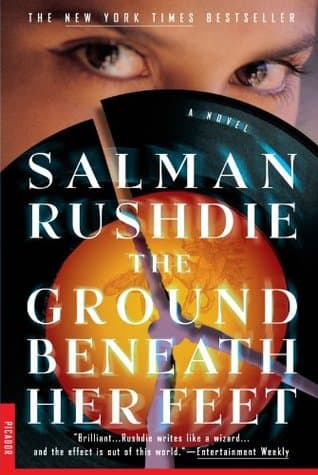
The Ground Beneath Her Feet cover
Archivist's Choice

The Ground Beneath Her Feet

Salman Rushdie (1999)

Genre

Literary Fiction / Fantasy / Romance

Reading Time

15-20 hours

Key Themes

See below

Track Your Reading

Sign in to track this book

When reality breaks apart, a photographer tells the grand love story of a vanished rock star and her musical partner, a love like the Orpheus legend set against East-meets-West conflicts and a world literally coming undone.

Synopsis

Rai, a photographer and occasional lover to rock star Vina Apsara, tells the decades-long love story between Vina and Ormus Cama, a musical genius and fellow rock star. Born in Bombay, Vina and Ormus meet as children and are instantly drawn to each other, their lives tied together by music and a love that goes beyond normal limits. Rai, their mutual friend, follows their rise from Bombay's cultural scene to international rock stardom, often in a world that is subtly, yet increasingly, breaking and shifting. Their romance is a modern retelling of the Orpheus myth. Ormus often 'loses' Vina to her ambition, her recklessness, and eventually, a devastating earthquake that seems to kill her. But Ormus's love and music have the power to find her again, even across parallel dimensions and other realities, as existence itself begins to crack and show other possible worlds. Rai's story combines their passionate, difficult journey with his own thoughts on love, loss, myth, and reality, ending with a look at lasting love and the power of storytelling in a constantly changing world.
Reading time
15-20 hours
Difficulty
Hard
Pacing
Variable
Mood
Epic, Mythic, Romantic, Reflective, Grand
✓ Read this if...
You enjoy sprawling, ambitious literary fiction that blends myth, music, and magical realism with a passionate love story.
✗ Skip this if...
You prefer straightforward narratives without extensive digressions, complex prose, or a philosophical bent.

Plot Summary

Bombay Childhoods and Fateful Encounters

The novel begins with Rai telling the story of Ormus Cama and Vina Apsara's childhoods in Bombay. Ormus, from a wealthy Parsi family with a deep connection to music, sees a vision of a parallel Earth during a childhood fever. Vina, with mixed Indian and American heritage, is a free spirit, already restless. Rai, a photographer, becomes a part of their lives, watching and documenting their growing talents and complicated relationships. Ormus, a music prodigy, is drawn to Vina's raw appeal, and their connection is instant and strong, despite their different personalities. Their early years are set against India's rich culture, preparing them for their future as rock stars.

The First Departure and Musical Genesis

Vina, in an act of rebellion, leaves Bombay for England, abandoning Ormus and Rai. Ormus, heartbroken but sure they will reunite, follows her, convinced she is his musical muse and destined partner. Rai, the loyal friend, also goes to London. There, Ormus and Vina meet again by chance and form the band VTO (Vina and the Ormus). Their music, a mix of Eastern influences and Western rock, quickly gains a following. This period marks the start of their legendary collaboration and their difficult romantic relationship, often overshadowed by Vina's independence and Ormus's possessiveness.

Rise to Stardom and Shifting Realities

VTO becomes internationally famous, one of the most influential bands of their time. Their music crosses genres and borders, and their iconic love story, though often full of conflict and cheating (including Vina's affair with Rai), captivates millions. As their fame grows, so do the subtle, strange signs that reality is starting to break. News reports become stranger, historical events seem to change, and differences in common knowledge appear. Ormus, especially, notices these 'quake-shifts,' remembering other versions of events and sensing a parallel world, a concept he first encountered as a child.

The Orpheus Myth Reimagined

The story clearly connects to the myth of Orpheus and Eurydice. Vina, during a concert in Mexico, dies in a devastating earthquake, seemingly swallowed by the earth. This event shatters Ormus and the band. Ormus, consumed by grief and a desperate need to find Vina, goes on a metaphorical journey into the underworld. He withdraws from public life, creating a groundbreaking album, an operatic rock masterpiece called 'The Ground Beneath Her Feet,' which he believes can somehow bring Vina back or connect him to her across the shifting realities. His musical search becomes an act of mourning and artistic creation.

The Parallel Earth and Alternate Selves

Ormus's new music, and Rai's ongoing narration, explore the increasingly clear breaking apart of reality. Characters meet their doubles from a parallel Earth, where history happened differently. Rai, through his photographs and observations, sees these 'quake-shifts,' documenting the subtle and not-so-subtle changes in the world. Ormus's album, a musical bridge, connects to this other world, reflecting his belief that Vina might still exist there. The novel suggests that every choice creates a branching reality, and the lines between these realities are becoming dangerously thin, leading to widespread confusion and existential unease among people.

Vina's Return and the Impossible Reunion

In a miraculous turn of events, Vina reappears, seemingly brought back from the parallel Earth. She is the same Vina, but subtly different, carrying the experiences of a life lived in another reality. Her return throws Ormus into joy, confusion, and renewed obsession. Their reunion is passionate but complicated by the knowledge of the fractured worlds and the different paths their lives have taken. Rai, the observer, captures these moments, dealing with what Vina's return means for their intertwined fates and the stability of their world. The story shows the deep emotional and philosophical challenges of such an impossible reunion.

The Final Tour and Imminent Collapse

With Vina's return, VTO reforms and goes on a triumphant, yet unsettling, final world tour. Their concerts become huge, almost religious gatherings, full of urgency reflecting the world's increasingly unstable state. The 'quake-shifts' get worse, causing widespread panic and societal breakdown. Entire cities vanish, historical figures reappear or disappear, and the laws of physics seem to waver. Ormus and Vina, despite their personal difficulties, continue to make music, their art serving as both a comment on and a temporary comfort for the crumbling reality. Rai documents this final, desperate act of artistic defiance against the approaching chaos.

The Ultimate Sacrifice and Enduring Love

As the world falls into complete fragmentation, with multiple realities collapsing into each other, Ormus makes a deep and tragic choice. Realizing that the world cannot hold both versions of Vina (the one who died and the one who returned), he decides that for one Vina to exist, he must stop existing. In a final act of love, Ormus sacrifices himself, offering his own life to anchor Vina in a single reality, or at least preserve her memory. Rai, the sole survivor and narrator, sees this ultimate act of selflessness, left to tell the story of their epic love against the backdrop of a broken world.

Rai, The Chronicler of a Broken World

After Ormus's sacrifice and the final collapse of a coherent reality, Rai is left as the main teller of the events. He wanders a world where memories are fluid, histories contradict, and people struggle to make sense of their pasts with the changing present. His photographs, once objective records, now act as reminders of what was, or what might have been. Rai, who loved Vina and was Ormus's closest friend, is tasked with telling a story that defies logic and linear progression. His voice, full of sorrow and a strong will to remember, becomes the anchor in the story's end, trying to put together meaning from the fragments.

The Enduring Power of Story and Myth

After the world's fragmentation, Rai thinks about the lasting power of stories, myths, and art. Even with the physical collapse of reality, the legend of Ormus and Vina, their music, and their love story continue, remembered in various forms across the splintered realities. The novel suggests that even if the physical world crumbles, the stories we create, the songs we sing, and the love we share can go beyond the limits of existence. Rai's final act is to finish his story, making sure the epic tale of Ormus and Vina lives on, showing human endurance, creativity, and the search for meaning in a changing universe.

Principal Figures

Rai

The Narrator/Supporting

Rai evolves from a privileged observer to the burdened chronicler, finding his purpose in preserving the story of Ormus and Vina and the truth of a lost world.

Ormus Cama

The Protagonist

Ormus transforms from a prodigious musician into a mythical figure, sacrificing himself in a desperate attempt to preserve love and reality.

Vina Apsara

The Protagonist

Vina's journey is one of constant movement and redefinition, becoming an iconic figure whose existence transcends a single reality.

Sir Darius Cama

The Supporting

Sir Darius eventually comes to terms with and even takes pride in Ormus's extraordinary success, despite his initial reservations.

Lady Cama

The Supporting

Lady Cama remains a steadfast source of love and support for Ormus throughout his life, accepting his choices.

Ima and Feroza

The Supporting

They serve primarily as the origin points for Vina's dual heritage, their own story intertwined with the broader themes of cultural fusion and divergence.

The Band Members (VTO)

The Supporting

They rise to fame and experience the highs and lows of the music industry alongside Ormus and Vina, eventually disbanding after Vina's 'death'.

The Narrator's Parents

The Mentioned

They serve as background figures, their role primarily to ground Rai's personal history within the larger narrative.

Themes & Insights

The Instability of Reality and Parallel Universes

A main theme is that reality is not fixed but fluid, with 'quake-shifts' causing historical events to change and parallel universes to blend. This shows up in Ormus's childhood vision, the increasingly strange news reports, and Vina's eventual return from another world. The novel suggests that every choice creates a branching reality, making memory and truth subjective. This theme is important for Vina's return and Ormus's sacrifice, as existence itself is at risk.

''The ground beneath her feet' began to crack and heave, and not only for her, but for all of us, the ground beneath our feet began to crack and heave, and the world we knew began to come apart.

Narrator Rai

Love, Loss, and Obsession

The epic love story between Ormus and Vina is the emotional center of the novel, exploring deep passion, jealousy, and lasting devotion. Ormus's obsession with Vina, even after her death, drives his art and his ultimate sacrifice. Their relationship is difficult, marked by cheating and separation, yet always drawing them back together. Rai's unrequited love for Vina adds another layer, showing different sides of love and its power to both inspire and destroy. The Orpheus myth directly supports this theme.

He would find her. He would always find her. It was his destiny, his curse, his song.

Narrator Rai

Art as Redemption and Meaning-Making

Music, photography, and storytelling are shown as strong forces that can go beyond reality and give meaning to a chaotic world. Ormus's music, especially his opera 'The Ground Beneath Her Feet,' is his attempt to bring Vina back and understand the world's fragmentation. Rai's photography captures truth and beauty amid the chaos, and his narration is an act of making meaning. Art becomes a way for people to deal with reality falling apart and to preserve memory and love.

Maybe the only way to hold onto anything was to sing it, to photograph it, to tell its story.

Narrator Rai

The East-West Divide and Cultural Hybridity

The novel is full of the interaction between Eastern and Western cultures, especially through the characters' backgrounds and the band's music. Vina's mixed heritage, Ormus's Parsi background, and Rai's Indian upbringing, all set against a global rock-and-roll stage, show this theme. VTO's music itself combines Indian classical influences and Western rock, creating a unique sound that bridges cultural divides. The story explores the challenges and richness of living in a culturally mixed world, often reflecting the complexities of post-colonial identity.

We were the children of two worlds, or maybe no world at all, just a space in between.

Narrator Rai

Myth and Modernity

Rushdie skillfully weaves ancient myths, especially the Orpheus and Eurydice story, into a modern rock-and-roll narrative. Ormus is the modern Orpheus, Vina his Eurydice, and Rai their chronicler. This weaving elevates the personal story to an epic, universal scale, suggesting that basic human experiences of love, loss, and the search for immortality are timeless. The novel uses myth not just as a parallel but as a structure to explore questions about fate, destiny, and the lasting power of archetypal stories.

Every myth is a true story, told in the language of the imagination.

Narrator Rai

Plot Devices & Literary Techniques

Unreliable Narrator

Rai's subjective perspective, shaped by his personal biases and the fragmented reality, colors the entire narrative.

Rai, as the first-person narrator, is explicitly unreliable. His deep love for Vina and his complex friendship with Ormus influence his portrayal of events and characters. Furthermore, the very nature of the 'quake-shifts' means that his memories and observations are constantly being challenged by shifting realities. This unreliability forces the reader to question the 'truth' of the story, mirroring the novel's central theme of a fractured reality. Rai's personal failings and immortal longings are central to his narrative voice.

Magic Realism / Metafiction

The blending of fantastical elements into a realistic setting, often with self-referential commentary on storytelling itself.

The novel employs magic realism through the 'quake-shifts' and the concept of parallel Earths, presenting these fantastical elements as if they are ordinary occurrences within the narrative world. It also uses metafiction, as Rai often comments on the act of storytelling, his own role as narrator, and the nature of truth and memory. This self-awareness highlights the constructed nature of reality and narrative, inviting the reader to engage with the story on multiple intellectual and emotional levels.

The Orpheus Myth

An explicit and pervasive mythological parallel that structures the central love story and its tragic trajectory.

The myth of Orpheus and Eurydice is not merely referenced but acts as a foundational framework for the relationship between Ormus and Vina. Ormus is the musician who descends into a metaphorical underworld (his grief and artistic quest) to retrieve his lost love, Vina. Her death in an earthquake and subsequent return from a parallel world directly echo Eurydice's fate. This device adds a layer of tragic inevitability and archetypal significance to their modern rock-and-roll saga, elevating their personal story to a timeless myth.

Quake-shifts / Parallel Earths

The central fantastical mechanism by which reality becomes unstable, leading to historical changes and alternate versions of existence.

This is the primary plot device driving the novel's fantastical elements. 'Quake-shifts' are subtle or overt alterations in reality, where historical events or well-known facts change, and characters encounter versions of themselves or others from parallel Earths. This device allows for Vina's 'resurrection' and provides the context for Ormus's ultimate sacrifice. It challenges notions of objective truth and memory, making the world itself a dynamic, unreliable entity, mirroring the subjective experiences of the characters.

Critical analysis

Notable Quotes

What is the opposite of faith? Not disbelief. Too easy. Too shallow. Disbelief is, for most men, only an inverse kind of faith, a clinging to the not-God, a passionate belief in the non-existence of God, no less a faith than any other. No, the opposite of faith is the quest.

Examining the nature of belief and doubt in the context of religion and personal conviction.

The only people who see the whole picture are the ones who stand outside the frame.

Reflecting on perspective and the limitations of being immersed in a situation.

We are all storytellers. We all live in a network of stories. There isn't a stronger connection between people than storytelling.

Highlighting the fundamental human need for narrative and its role in human connection.

Love is a kind of faith, too, a belief in something you can't prove.

Comparing love to faith, emphasizing its unquantifiable and deeply felt nature.

History is not what happened. History is what is told.

Exploring the subjective and constructed nature of historical accounts.

To be born again, you must first die. Not a physical death, but a spiritual one, a death of the old self.

Discussing personal transformation and the shedding of past identities.

Memory is a crazy woman that hoards all sorts of odds and ends and then decides to show them off, in the least opportune moments.

Describing the unpredictable and often inconvenient nature of human memory.

The greatest enemy of truth is often not the lie, but the myth.

Distinguishing between deliberate falsehoods and deeply ingrained, often unquestioned beliefs.

Life is a series of disappearances, a constant letting go of what we thought we had.

Reflecting on the transient nature of existence and the inevitability of loss.

We dream of journeys we will never take, of lives we will never live, of people we will never be.

Exploring the human capacity for imagination and the allure of alternate realities.

Every act of creation is first an act of destruction.

Discussing the transformative process of creating something new, often requiring the dismantling of the old.

Music is the language of the inexpressible.

Emphasizing the unique power of music to convey emotions and ideas beyond words.

The world is a palimpsest, overwritten with new stories, but the old ones are still there, underneath.

Using the metaphor of a palimpsest to describe how past narratives and histories persist beneath present realities.

We are all foreigners, everywhere, even in our own homes.

Exploring themes of displacement, alienation, and the feeling of not quite belonging.

Reality is a consensus hallucination.

Challenging the objective nature of reality, suggesting it is a shared, agreed-upon construct.

Quiz

Test Your Knowledge

Ready to see how well you understood this book? Take our interactive quiz with 10 questions.

10
Questions
~5
Minutes
?
Best Score

Key Questions (FAQ)

The novel primarily follows the epic, cyclical romance between two rock stars, Vina Apsara and Ormus Cama, whose lives are intertwined with music, fame, and a constantly shifting reality. Their story is narrated by Rai, a photographer and their mutual friend/lover, who chronicles their journey across different worlds and timelines.

About the author

Salman Rushdie

Sir Ahmed Salman Rushdie is an Indian-born British-American novelist. His work often combines magic realism with historical fiction and primarily deals with connections, disruptions, and migrations between Eastern and Western civilizations, typically set on the Indian subcontinent. Rushdie's second novel, Midnight's Children (1981), won the Booker Prize in 1981 and was deemed to be "the best novel of all winners" on two occasions, marking the 25th and the 40th anniversary of the prize.