“The Grimm Collection was housed in a long, narrow room on the fifth floor of the New-York Circulating Material Repository.”
— Introduction to the main setting.

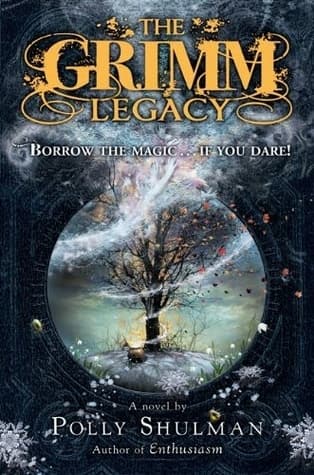
Polly Shulman (2010)
Genre
Fantasy / Children's / Mystery / Young Adult / Romance
Reading Time
240 min
Key Themes
See below
Sign in to track this book
An ordinary teen's after-school job at a peculiar lending library thrusts her into a magical mystery when fairy tale artifacts from the Brothers Grimm collection begin to vanish, forcing her to catch the thief before she becomes the prime suspect.
Elizabeth, a high school student living with her aunt and uncle in New York City, needs an after-school job to help pay for an expensive school trip. She applies to the New-York Circulating Material Repository, a strange library that lends out objects instead of books. During her interview, she learns the library has a hidden 'Grimm Collection' containing magical items from fairy tales. Despite her skepticism, she is hired as a page, tasked with shelving mundane objects, and given strict instructions to never enter the forbidden fourth floor.
On her first day, Elizabeth is introduced to the library's unique system, including its pneumatic tube network. She quickly befriends Aaron, a fellow page who knows about the library's secrets. Aaron eventually takes Elizabeth to the restricted Grimm Collection in the basement, a vast, dimly lit room filled with enchanted objects. She sees the Seven-League Boots, a talking mirror, a table that produces food, and other items. The librarians treat these objects with reverence and extreme caution, emphasizing their power and the need for secrecy.
The first major incident occurs when the Seven-League Boots are reported missing from the Grimm Collection. Elizabeth, having been one of the last people to see them, feels uneasy. Mr. Mauskopf is furious, and the librarians begin a tense, internal investigation. Elizabeth and Aaron, intrigued and a little fearful, start their own unofficial inquiry, piecing together clues and observing the suspicious behavior of their colleagues. The disappearance begins a series of thefts that threaten the library's security and the balance of its magic.
After the boots, the Table-Be-Set and the Purse-of-Fortunatus also disappear from the Grimm Collection. The librarians, particularly Mr. Mauskopf, grow increasingly suspicious of Elizabeth, as she seems to be present or involved in some way during each incident. Elizabeth feels the pressure and realizes she needs to find the real thief to clear her name. She and Aaron look deeper into the library's history and the specific properties of the stolen items, realizing the thief must have a sophisticated understanding of the collection and its magical workings.
Elizabeth and Aaron start to investigate the librarians. They learn about Mr. Mauskopf's past as a former page, Mr. Zabriskie's deep connection to the library, and Annelise's mysterious presence. They discover that the talking mirror, a powerful artifact, only speaks in riddles and is unhelpful in directly identifying the thief. Their investigation leads them to question the motives of everyone involved, realizing that the thief isn't just stealing for personal gain but possibly for a more complex, magical purpose.
Determined to understand the thefts, Elizabeth uses the library's extensive archives to research the history of the Grimm Collection and the magical objects themselves. She uncovers old records and journals that hint at previous incidents and the dangers associated with controlling such powerful magic. This research reveals that the objects are not merely tools but have a will of their own, and their misuse can have dire consequences. She begins to suspect that the thief might be someone with a historical grievance or a desire to restore a perceived imbalance.
Through research, observation, and a tense confrontation, Elizabeth uncovers the true culprit: Silas Black, a former librarian who was supposedly banished for attempting to steal the objects years ago. However, Silas is not directly involved; he is manipulating Annelise, one of the current librarians, who is secretly his daughter. Annelise, driven by her father's twisted ideals of 'freeing' the magic, has been stealing the items and using a magical cloak to remain unseen and unheard, making her the perfect accomplice.
The climax unfolds in the Grimm Collection. Elizabeth, armed with her knowledge and a growing understanding of the magical items, confronts Annelise. Silas Black, who has been communicating with Annelise through the talking mirror, reveals himself as a disembodied voice, still powerful and manipulative. Annelise, under her father's influence, attempts to use the stolen items to achieve his goal of unleashing their magic. A struggle ensues, with Elizabeth, Aaron, and the other librarians fighting to regain control of the artifacts and prevent a magical catastrophe.
During the confrontation, the Seven-League Boots, Table-Be-Set, and Purse-of-Fortunatus are activated, causing chaos within the library. Elizabeth, thinking quickly, manages to outsmart Annelise and disable the magical cloak, revealing her. With the help of Aaron and the other librarians, they manage to subdue Annelise and recover the stolen items. Silas Black's plan to unleash the Grimm magic is foiled, and his influence over Annelise is broken, albeit with significant magical repercussions for the library and its inhabitants.
In the aftermath, Annelise is taken away, her fate uncertain, but her connection to Silas Black is severed. The library begins repairing the damage and re-securing the Grimm Collection. Elizabeth, having proven her bravery and intelligence, gains the respect of Mr. Mauskopf and Mr. Zabriskie. She decides to continue working at the library, now with a deeper understanding of its magic and a newfound sense of belonging. Her relationship with Aaron also deepens, hinting at future adventures and a continued exploration of the magical world she has discovered.
The Protagonist
Elizabeth transforms from an ordinary girl seeking a job into a brave and resourceful detective who saves a magical library and finds her place within it.
The Supporting
Aaron evolves from a quirky colleague into Elizabeth's trusted confidant and romantic interest, growing in courage and leadership alongside her.
The Supporting
Mr. Mauskopf softens his rigid stance, learning to trust and rely on the resourcefulness of his young pages.
The Supporting
Mr. Zabriskie remains a steady, guiding presence, his subtle wisdom proving crucial in resolving the magical crisis.
The Antagonist
Annelise is revealed as the complicit thief, acting under her father's spell, and is ultimately freed from his influence.
The Antagonist
Silas Black's long-held plan to unleash the Grimm magic is finally thwarted, and his influence is broken.
The Supporting
The Mirror remains a constant, enigmatic presence, its riddles eventually aiding in the resolution of the mystery.
The Mentioned
The Boots are stolen and then recovered, symbolizing the restoration of order to the Grimm Collection.
The novel explores magic as a power that requires careful stewardship, not an inherently good or evil force. The Grimm Collection's existence highlights the responsibility of containing and managing potent artifacts. Silas Black's desire to 'free' the magic and Annelise's subsequent actions demonstrate the chaos that can ensue when magic is unleashed without proper understanding or respect for its consequences. Elizabeth's journey teaches her that true power lies not in possession, but in responsible guardianship.
“Magic is not a toy, Miss Rew. It is a force, and it demands respect. And containment.”
Elizabeth, an outsider living with her aunt and uncle, initially feels displaced. Her job at the Repository, especially her involvement with the Grimm Collection, gradually gives her purpose and a community. She finds friendship with Aaron and earns the respect of the eccentric librarians. This theme is evident as she looks deeper into the library's secrets, realizing she is uniquely suited to understand and protect its magic, ultimately choosing to remain a part of this extraordinary world rather than returning to her mundane life.
“Some places just feel right, don't they? Like they're waiting for you.”
Elizabeth's greatest assets are not magical abilities but her sharp mind, curiosity, and keen observational skills. She meticulously pieces together clues, researches the library's history, and pays attention to details that others overlook. This theme is central to her success in solving the mystery. For example, her ability to deduce Annelise's involvement by noticing subtle inconsistencies in her behavior and her understanding of the magical items' properties are key to apprehending the thief, proving that intellect can be as powerful as magic.
“Sometimes, the most important things are hidden in plain sight, if you only know how to look.”
The novel touches on the idea of family legacies, both benevolent and destructive. The Grimm Collection is a legacy, passed down through generations of librarians. More significantly, Annelise's actions are driven by her loyalty to her father, Silas Black, and his twisted interpretation of the Grimm legacy. This highlights how family ties, even dysfunctional ones, can shape an individual's choices and motivations, and how breaking free from a harmful legacy can be an act of self-discovery.
“My father believed this magic should be free. Not locked away like some dusty book.”
A secret library of magical objects from fairy tales.
The Grimm Collection is the central plot device, serving as the setting for much of the mystery and the source of all conflict. It is a hidden, secure room within the New-York Circulating Material Repository that houses enchanted artifacts from Brothers Grimm fairy tales. The collection's existence drives the plot by introducing magic into Elizabeth's ordinary life and by providing the items that are stolen, thus initiating the mystery. Its inherent power and the danger of its misuse are the core elements of the narrative.
A magical mirror that provides cryptic clues in riddles.
The Talking Mirror functions as a source of exposition and mystery. It is one of the magical objects in the Grimm Collection, known for its ability to speak, but only in riddles. This device allows the author to provide crucial information to Elizabeth and Aaron in a challenging, engaging way, forcing them (and the reader) to interpret and deduce. It also serves as a communication channel for the antagonist, Silas Black, demonstrating its unique connection to the magical world and enhancing the sense of intrigue.
An enchanted garment that grants invisibility and silence.
The magical cloak is a key plot device used by the antagonist, Annelise, to execute the thefts. It grants the wearer invisibility and silence, making her undetectable and allowing her to move freely within the secure Grimm Collection without being seen or heard. This device creates significant tension and mystery, as the librarians are baffled by how the thefts are occurring without any signs of forced entry. Its eventual discovery and neutralization are critical to solving the mystery and apprehending the thief.
A quirky, old-fashioned communication and delivery system.
The pneumatic tube system, though not magical itself, is a significant world-building and plot device. It is an intricate network of tubes used to deliver messages and small items throughout the vast library. This system adds to the unique, anachronistic charm of the Repository and serves to highlight its peculiar nature. It also plays a minor role in the plot by being a means of communication and sometimes misdirection, further emphasizing the library's eccentricities and Elizabeth's immersion into its strange world.
“The Grimm Collection was housed in a long, narrow room on the fifth floor of the New-York Circulating Material Repository.”
— Introduction to the main setting.
“There were magic items, of course. But they weren't for everyone. Only for people who knew how to use them, and who were trusted.”
— Elizabeth learns about the rules and nature of the collection.
“Some stories, she realized, were not just stories. They were maps.”
— Elizabeth's growing understanding of the magical nature of the items.
“The problem with magic, as Elizabeth was quickly learning, was that it rarely did exactly what you wanted it to.”
— Elizabeth's early struggles with controlling magical items.
“Every object had a story, and every story had a secret.”
— A recurring theme about the items in the collection.
“Sometimes the most ordinary things could be the most dangerous.”
— Elizabeth reflects on the deceptive nature of some magical items.
“Being a page was more than just shelving books. It was protecting secrets, guarding power, and keeping the balance.”
— Elizabeth's evolving understanding of her role.
“The library wasn't just a place to keep books; it was a living, breathing entity, full of its own history and secrets.”
— Elizabeth's deeper appreciation for the repository itself.
“You can't just take things because you want them. There are rules. And if you break them, there are consequences.”
— An adult character explains the importance of rules to the pages.
“Curiosity was a powerful thing, sometimes helpful, sometimes dangerous.”
— Elizabeth considers the double-edged sword of her own inquisitive nature.
“Even the smallest item could hold immense power, if you knew how to unlock it.”
— Elizabeth discovers the potential within seemingly insignificant objects.
“Trust was a fragile thing, easily broken, hard to mend.”
— Elizabeth deals with betrayals and forming alliances.
“The real magic wasn't just in the objects, but in the stories they told, and the people who believed in them.”
— Elizabeth's ultimate realization about the nature of the Grimm Legacy.
“Sometimes, the best way to find something lost was to look for something else entirely.”
— A clever strategy used during the mystery.
Ready to see how well you understood this book? Take our interactive quiz with 10 questions.







