“The world is a series of gluttonous meals, and most of the time you have to eat what's offered to you, even if it's not what you want.”
— Fiona explaining the unfortunate circumstances they find themselves in.

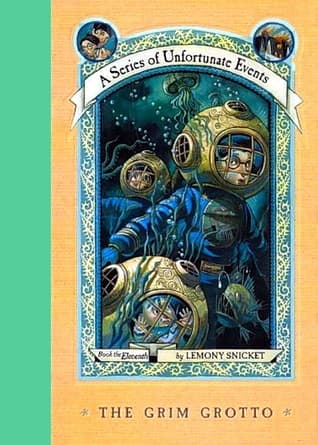
Lemony Snicket (2004)
Genre
Fantasy / Children's / Mystery / Young Adult
Reading Time
240 min
Key Themes
See below
Sign in to track this book
The Baudelaire orphans confront a submarine mystery, battling mechanical monsters, a deadly fungus, and their own despair while searching for a lost friend in a perpetually damp world.
After escaping the Caligari Carnival, Violet, Klaus, and Sunny Baudelaire find themselves at the bottom of the Stricken Stream. They discover a rusty diving helmet, their only refuge from Mr. Poe and the authorities. Hoping it will help them find the V.F.D. sugar bowl and their friends, they climb inside. The helmet is swept away by the current, carrying them into the vast, dark, and cold waters of Briny Beach. They realize they are at the ocean's mercy, with no control over their path, and their air supply is shrinking.
Just as their air runs out, a submarine called the Queequeg snags the Baudelaire's helmet. They are brought aboard and meet Captain Widdershins, a one-eyed man who says 'Aye!' often, and his stepdaughter, Fiona, a mycologist. The Queequeg is a V.F.D. submarine, and Captain Widdershins reveals he knew their parents and is also looking for the sugar bowl, believing it holds important information. He offers the Baudelaires a temporary safe place and a new lead.
The Queequeg's main goal is to find and study the Medusoid Mycelium, a rare and deadly fungus that can kill within an hour. Fiona, a mycologist, focuses on this, hoping to find a cure or understand it. Captain Widdershins explains the fungus is spreading and threatens all life. The Baudelaires learn the Medusoid Mycelium is linked to V.F.D. and the sugar bowl, as the organization has tried to contain or weaponize it. Their journey on the Queequeg becomes tied to this urgent mystery.
While exploring a grotto, the Baudelaires meet Fernald, the Hook-Handed Man, one of Count Olaf's henchmen. To their surprise, Fernald says he is Captain Widdershins's former first mate and Fiona's lost brother. He explains he left V.F.D. after a split and now believes Olaf's side is the only way to get justice. Fernald tries to persuade Fiona and the Baudelaires to join him, appealing to Fiona's wish to be with her brother. This reunion is tense, showing the deep divisions within V.F.D. and forcing the Baudelaires to question who is an ally.
The Queequeg is attacked by a large, octopus-shaped submarine, which the Baudelaires recognize as Count Olaf's. The machine, with grappling arms and a harpoon, badly damages the Queequeg. Captain Widdershins and his crew abandon ship, but not before the Baudelaires send a coded message to the missing Quagmire triplets in a bottle. In the chaos, Fiona is torn between her stepfather and her brother, Fernald, who demands she join Olaf's crew for her safety. The Baudelaires, separated from the Captain, are left to face Olaf.
With the Queequeg destroyed and Captain Widdershins gone, the Baudelaires and Fiona are captured by Olaf's crew and taken to the Grim Grotto, a dark underwater cave system. This grotto is where the Medusoid Mycelium comes from, and its air is full of deadly spores. Olaf plans to use the fungus as a weapon, threatening to infect the world if his demands are not met. The Baudelaires and Fiona must navigate the dangerous grotto, avoid the fungus and Olaf's henchmen, and find a way to escape and stop Olaf. They realize the sugar bowl might be hidden in this grotto.
While in the Grim Grotto, Klaus and Sunny accidentally breathe in Medusoid Mycelium spores. They quickly show symptoms: purple skin and difficulty breathing. Fiona, using her knowledge of fungi, realizes they need horseradish as an antidote. The Baudelaires and Fiona begin a desperate search for horseradish, knowing time is short for Klaus and Sunny. They must navigate the dangerous grotto, avoid Olaf's watch, and find the rare ingredient before the fungus harms the two younger Baudelaires. Violet, an inventor, tries to find a way to protect them from more exposure.
Fiona, still struggling with her brother Fernald being with Olaf, faces a hard choice. When they find the horseradish and are about to escape, Fernald convinces Fiona she must choose her family over the Baudelaires and V.F.D. He promises her safety with him if she betrays the orphans. In a sad moment, Fiona helps the Baudelaires get the horseradish but then allows Olaf's crew to recapture them, choosing to stay with her brother. This betrayal leaves the Baudelaires feeling abandoned, questioning whom they can trust.
Despite Fiona's betrayal, the Baudelaires, with the horseradish antidote, outsmart Olaf's henchmen and escape the Grim Grotto. They use their skills to build a raft and navigate the underwater currents. As they head to the surface, they find a message in a bottle. It contains a coded message from the Quagmire triplets, revealing their location and that they are in danger at V.F.D. headquarters. This message gives them hope but also shows the urgency of their mission, as their friends still need rescue.
After escaping the Grim Grotto, the Baudelaires are again in the open ocean, without a clear path. They see Count Olaf's submarine surface nearby. Realizing that following Olaf is the only way to continue their search, find the sugar bowl, and possibly rescue the Quagmires, they secretly board his submarine. They hide inside, ready for the next part of their journey. The book ends with the Baudelaires hidden on Olaf's submarine, heading into an unknown future, still seeking answers and hoping to reunite with their friends and solve the V.F.D. mysteries.
The Protagonist
Violet continues to hone her inventive skills under extreme pressure, demonstrating leadership and resilience in the face of betrayal.
The Protagonist
Klaus's research skills become critical for survival, particularly in identifying the Medusoid Mycelium and its antidote.
The Protagonist
Sunny's communication skills continue to develop, and her keen sense of smell proves vital in a life-or-death situation.
The Antagonist
Count Olaf continues his relentless pursuit, demonstrating increased cunning and a willingness to use biological weapons.
The Supporting
Captain Widdershins introduces the Baudelaires to the V.F.D.'s underwater operations and the threat of the Medusoid Mycelium, before his fate becomes uncertain.
The Supporting
Fiona grapples with conflicting loyalties between her family and the V.F.D., ultimately choosing her brother but feeling immense guilt.
The Supporting
Fernald's past connection to the V.F.D. and his family is revealed, complicating the narrative of good versus evil.
The Mentioned
Mr. Poe remains oblivious to the true dangers the Baudelaires face, serving as a reminder of their isolation.
This theme explores the difficult choices people make when faced with competing loyalties to family or a larger cause. Fiona's painful decision to side with her brother Fernald over the Baudelaires and her stepfather, Captain Widdershins, is a main example. Her choice, while betraying the orphans, comes from a deep desire to reunite with her lost sibling, showing the strong pull of family, even when family members are allied with evil. The Baudelaires' loyalty to each other, in contrast, serves as a steady force amid changing allegiances, highlighting the strength in their chosen family.
“'Family is a word that means something different to everybody,' Fiona said, her voice barely a whisper.”
The story consistently blurs the lines between good and evil, introducing characters who defy easy labels. Fernald's past as Captain Widdershins's first mate and his current alliance with Olaf, along with his appeal to Fiona, shows that individuals can change sides based on their view of 'justice.' V.F.D. itself is shown as a divided organization, with factions often at war. This ambiguity makes the Baudelaires constantly question whom to trust and highlights the moral complexities of the world, where even good people can make questionable choices, and seemingly bad people might have understandable, though misguided, reasons.
“'The world is a place of confusing and contradictory signals, and it is often difficult to tell which side of the argument is which.'”
Knowledge is shown as having both benefits and risks. Klaus's reading helps him identify the Medusoid Mycelium and its antidote, showing how information can save lives. Fiona's knowledge of fungi is also vital. However, the Medusoid Mycelium itself is a dangerous form of knowledge, a biological weapon that can be misused. Conversely, the ignorance of adults like Mr. Poe, who does not see Olaf's true nature, often puts the children in danger. The theme explores how knowledge, used responsibly, can save lives, but when misused or misunderstood, can cause destruction, and how a lack of understanding can be just as harmful.
“'There is a great deal of information in the world, and there is a great deal of misinformation, and it is very difficult to tell the difference.'”
Despite the constant misfortunes and betrayals they face, the Baudelaire orphans show great resilience. They are thrown into the ocean, lose their temporary safe place, are infected with a deadly fungus, and are betrayed by a friend, yet they never give up. Their ability to work together, using their individual talents, and their hope to find the sugar bowl and their friends, keeps them going. This theme highlights the human ability to endure and adapt in the worst situations, finding strength in their bond and their determination to find the truth, even when surrounded by despair and seemingly impossible problems.
“'Even in the most dire of circumstances, there is always the possibility of a solution, if one is clever enough to find it.'”
A deadly, fast-acting fungus that serves as a central threat and plot driver.
The Medusoid Mycelium is a rare, highly poisonous fungus that, upon inhalation, causes death within an hour. It serves as the primary macguffin and immediate threat in 'The Grim Grotto,' driving the plot as the V.F.D. (and later Olaf) seeks it, and the Baudelaires must find its cure. Its existence highlights the V.F.D.'s dangerous research and Olaf's willingness to use biological weapons. The race against time to find horseradish as an antidote creates intense suspense and forces the Baudelaires to rely on Klaus's research and Fiona's mycological expertise, directly impacting their immediate survival.
A mysterious, highly sought-after object central to the V.F.D. mystery.
The sugar bowl is a recurring, enigmatic object that the Baudelaires, Captain Widdershins, and Count Olaf are all searching for. Its contents and significance remain largely unknown, but it is implied to hold vital information or a crucial item related to the V.F.D. and its schism. In 'The Grim Grotto,' the search for the sugar bowl motivates much of the action, as it's believed to be hidden somewhere in the Grim Grotto. It functions as a powerful, yet undefined, symbol of the overarching mystery and the key to understanding the V.F.D.'s secrets, propelling the Baudelaires' journey forward.
The internal division within the V.F.D. that blurs the lines between good and evil.
The V.F.D. schism is a fundamental plot device that explains why the organization, once a unified force for good, is now fractured. It reveals that some members, like Fernald, have joined Count Olaf's side, believing it to be the 'fire-starting' side, while others, like Captain Widdershins, represent the 'fire-fighting' side. This division complicates the Baudelaires' understanding of good and evil, forcing them to question who is truly an ally. The schism creates moral ambiguity, as characters like Fiona are torn between these opposing factions, adding depth and complexity to the narrative beyond simple villainy.
Methods of communication and deception used by both the Baudelaires and their enemies.
Coded messages and disguises are recurring plot devices throughout the series, and they continue to play a crucial role in 'The Grim Grotto.' The Baudelaires use a coded message in a bottle to communicate with the Quagmire triplets, demonstrating their ingenuity and the importance of secret communication within the V.F.D. Count Olaf, as always, employs disguises (though less prominently in this book, as his identity is known) and deceptive tactics. These devices emphasize the secretive nature of the V.F.D. world and the constant need for the Baudelaires to decipher hidden meanings and see through falsehoods to survive and progress in their quest.
“The world is a series of gluttonous meals, and most of the time you have to eat what's offered to you, even if it's not what you want.”
— Fiona explaining the unfortunate circumstances they find themselves in.
“It is a curious thing, the death of a loved one. We all know that our time in this world is limited, and that eventually all of us will perish. It is a truth we live with every day, and yet we are always surprised when it comes.”
— The narrator reflecting on the nature of loss.
“There are some things that cannot be fixed, but can only be endured.”
— Violet pondering the seemingly insurmountable challenges they face.
“The future, like a murky body of water, holds many secrets.”
— A metaphor used to describe the uncertainty of what lies ahead.
“Just because something is true doesn't mean it's the whole truth.”
— Klaus considering the deceptive nature of information they receive.
“It is a rare and beautiful thing when the truth is simple.”
— The narrator remarking on the complexity of the Baudelaire's situation.
“Even the most ordinary object can be extraordinary if you look at it in the right way.”
— Violet observing the potential uses for seemingly mundane items.
“No matter how much you want to, you can't always save everyone.”
— A harsh lesson learned by the Baudelaires in their pursuit of safety.
“The greatest weapon against fear is knowledge.”
— Klaus often relying on research to understand and overcome obstacles.
“Sometimes the only way to get through a terrible situation is to pretend it's not happening.”
— A coping mechanism described by the narrator, often employed by characters.
“A secret is not something you keep, it's something that keeps you.”
— The narrator discussing the pervasive influence of secrets in the story.
“The world is an oyster, but sometimes it’s a rotten one.”
— A pessimistic take on a common idiom, reflecting the Baudelaires' experiences.
“It is often the small choices that make the biggest difference.”
— The Baudelaires making crucial decisions under pressure.
“Hope is like a very fragile, very small, very easily extinguished candle.”
— The narrator describing the precarious nature of hope in the Baudelaires' lives.
Ready to see how well you understood this book? Take our interactive quiz with 10 questions.
Biography coming soon.







