“The greatest pleasures of life are not so much in the possession of a thing as in the pursuit of it.”
— Reflecting on Pierce's motivations and the thrill of the heist.

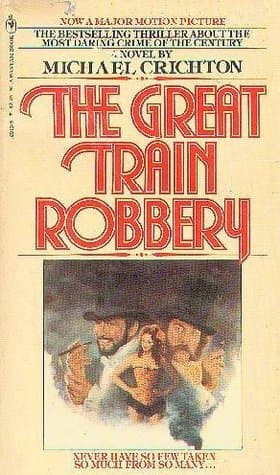
Michael Crichton (1975)
Genre
Thriller / Historical Fiction / Mystery
Reading Time
300 min
Key Themes
See below
Sign in to track this book
A charming master thief plans to steal gold from a moving train in Victorian London, risking everything to navigate social divides and the precision of steam and steel.
In Victorian London, the master criminal Edward Pierce plans to steal gold bullion transported by train, meant for British troops in the Crimean War. He carefully watches the gold's security, noting it is in a special safe, locked by four keys, each held by a different official. Pierce, charming and clever, knows a successful robbery needs precise timing and knowledge of the railway system, plus help from skilled, disreputable people. His first step is to learn about the transport logistics and the safe's weaknesses.
Pierce starts building his team with Robert Agar, a skilled safecracker. Agar, currently in prison, is key to Pierce's plan. Pierce arranges Agar's escape from Newgate Prison, a task needing detailed planning and bribes. Once Agar is free, Pierce tells him about the gold robbery. He also brings in Clean Willy, a young, agile person who can move through tight spaces, and Miss Miriam, Pierce's beautiful and clever mistress, who will distract targets and gather information. The team's varied skills are important for the complex operation.
The first key to the gold safe is held by Mr. Henry Fowler, the bank director. Pierce uses a complex plan to get an impression of Fowler's key. He uses his social connections to enter Fowler's circle, watching his habits. Miriam helps with distractions, while Agar, disguised as a servant, enters Fowler's home. Through a planned series of events, including a staged accident and a temporary key swap, Agar gets a wax impression of Fowler's key. This first success confirms Pierce's careful planning and his team's skill.
The second key belongs to Mr. Edgar Trent, the railway company's general manager. Pierce creates an even more detailed plan, involving a staged dog fight and a timed interruption, to get an impression of Trent's key. During this attempt, Clean Willy, under pressure, makes a mistake: a witness sees him and later identifies him. This error brings an unexpected risk, as authorities now have a lead, endangering the operation. Pierce must take strong action to silence Willy and keep the operation secure, showing the dangerous stakes.
The third key is held by Mr. John Simms, the railway station master, a man who likes young girls. Pierce uses Simms's weakness, with Miriam luring him into a compromising situation. While Simms is distracted, Agar gets the key impression. However, pressure grows as Inspector Bridger, a determined Scotland Yard detective, starts to suspect a large scheme. Clean Willy, fearing for his life after his earlier mistake, tries to betray Pierce to the police for protection. Pierce, expecting this, arranges Willy's death, making it look like an accident, removing a weak link and securing the operation, though brutally.
The fourth and final key is held by Mr. Bradford, the railway company's treasurer. Pierce and Agar target Bradford during a public event, a boxing match. The plan involves a choreographed series of distractions and sleight of hand to get the impression. However, Inspector Bridger, now actively investigating the missing keys, is at the same event and becomes suspicious of Pierce. A tense chase follows, with Pierce barely escaping detection while still getting the final key impression. Getting all four keys is a big step, but also means a higher risk of being discovered soon.
With all four keys copied, Pierce and Agar prepare for the robbery. They plan to do it during the train's journey from London to Folkestone. Pierce, disguised as a wealthy gentleman, boards the first-class carriage, while Agar, as a humble passenger, sits in a lower class. The gold is in a special luggage van, guarded by two railway employees. The train leaves, and tension rises as Pierce knows every minute brings them closer to either wealth or ruin. The complex plan depends on precise timing and clear access to the gold carriage.
Under cover of darkness and the train's rhythmic noise, Pierce and Agar begin their task. Agar, using his 'snake' skills, moves along the outside of the moving train to the luggage van. He then uses the copied keys to unlock the safe with the gold. Pierce, meanwhile, creates distractions in the passenger carriages to draw attention from the back of the train. Moving the heavy gold bars from the safe to their prepared hiding places on the train is hard and dangerous, needing great strength and stealth, all while the train moves quickly.
As the train nears a pre-arranged remote siding, Pierce and Agar prepare to unload the gold. They activate a mechanism that drops the gold bars from the moving train onto a waiting carriage below, driven by other accomplices. Timing is critical to avoid being seen. Once the gold is transferred, Pierce and Agar escape from the train, blending back into the crowd. They leave no immediate evidence of the robbery, intending to make it seem as if the gold simply disappeared during transit. The time after is tense, hoping their plan holds up.
The next morning, the gold's disappearance is found, causing shock in London and the British establishment. Inspector Bridger, already suspicious of Pierce, leads the investigation. Authorities are puzzled by how such a secure shipment could be breached without forced entry. Bridger, however, connects the clues, recognizing the crime's sophisticated nature and suspecting Pierce. Pressure builds on Pierce and his accomplices as police close in, carefully following every lead and witness. The robbery's initial success is overshadowed by the threat of capture.
Inspector Bridger, determined, focuses his investigation on Edward Pierce, convinced he is guilty. He questions suspects and follows every lead. Agar, after the gold is offloaded, is caught due to a mistake and his known criminal record. Under pressure, Agar eventually names Pierce. Bridger sets a trap, using Agar's confession to lure Pierce into a compromising situation. The chase becomes a high-stakes game of intellect and endurance between the detective and the criminal, ending in a dramatic confrontation.
Despite Pierce's attempts to escape, Inspector Bridger's chase eventually corners him. Pierce is arrested, along with Miriam, and tried in a case that fascinates Victorian society. The evidence, gathered by Bridger, is strong, including Agar's testimony and details of the key impressions. Although Pierce maintains his innocence, the proof leads to his conviction. He is sentenced to penal servitude, a harsh punishment for such a crime. The Great Train Robbery, while a feat of criminal ingenuity, ends with the law winning, after a significant challenge.
The Protagonist
Pierce evolves from a seemingly untouchable criminal mastermind to a man facing the consequences of his ambition, ultimately brought down by the very system he sought to defy.
The Supporting
Agar is initially a loyal and indispensable partner, but his vulnerability and eventual capture lead to his cooperation with the police, indirectly contributing to Pierce's downfall.
The Supporting
Miriam remains steadfastly loyal to Pierce throughout the ordeal, sharing his fate and demonstrating her unwavering commitment to him.
The Antagonist
Bridger's relentless investigation leads him from initial suspicion to the successful apprehension and conviction of a formidable criminal mastermind.
The Supporting
Willy's brief involvement highlights the dangers of the criminal underworld, as his mistake and subsequent betrayal lead to his violent end.
The Mentioned
Fowler's role is static, serving as an unwitting pawn in Pierce's grand scheme.
The Mentioned
Trent's role is static, serving as an unwitting pawn in Pierce's grand scheme.
The Mentioned
Simms's role is static, serving as an unwitting pawn in Pierce's grand scheme.
The novel shows the class divisions in Victorian London, where great wealth and poverty exist together. Edward Pierce, a gentleman criminal, moves easily between both worlds, using his upper-class charm to trick the elite while relying on his underworld connections for the crime's execution. This theme is clear in how Pierce targets the wealthy, using their complacency and trust in the system. The difference between Pierce's rich life and the poor lives of his working-class accomplices like Agar and Clean Willy highlights the social inequalities that provided both reason and chance for such a crime.
“In London, the rich lived by the rich, and the poor by the poor, and only a very few, like Edward Pierce, moved easily through both worlds.”
A main theme is the appeal of trying and doing the seemingly impossible. The Great Train Robbery is not just about gold; it is about the intellectual challenge and the excitement of doing a crime that defies all security. Pierce is driven by the plan's boldness and the desire to prove his intelligence and cunning. This is clear in his careful planning and his enjoyment of the steps needed to get the keys. The 'impossible' aspect makes the crime more than just theft, turning it into a grand, intellectual game for characters and readers.
“The greatest joy of all was simply to succeed, to accomplish the impossible.”
The story emphasizes Pierce's detailed planning, contrasting it with unexpected events and human error. Every step of the robbery, from getting key impressions to the train journey, is carefully planned. However, events like Clean Willy being seen, or Agar's eventual capture, show that even the most perfect plan can be risked by reality and human mistakes. This theme creates tension, as the reader wonders if Pierce's elaborate plans can withstand all outside pressures.
“No plan, however perfect, could account for every variable, every human failing.”
The novel explores justice and law in Victorian society. While Pierce sees himself as a clever person challenging a complacent system, Inspector Bridger represents the relentless pursuit of justice. The story questions whether the law, with its strict rules, can truly handle a criminal as clever as Pierce. Pierce's eventual capture and conviction, despite his brilliance, affirms the law's lasting power, even if it is a hard-won victory. It also subtly questions the morality of a system that allows such wealth inequality, which might fuel such crimes.
“The law was a slow, ponderous beast, but it was relentless.”
A criminal endeavor designed to be utterly unachievable.
This device sets up the central conflict: the challenge of stealing gold from a supposedly impregnable safe on a moving train. The 'impossible' nature of the heist immediately hooks the reader, creating high stakes and a sense of wonder at how the protagonist could possibly succeed. It drives the intricate plotting and requires Pierce to overcome numerous seemingly insurmountable obstacles, pushing the boundaries of what is considered feasible within the criminal world.
A protagonist of exceptional intellect and cunning who orchestrates complex schemes.
Edward Pierce embodies the mastermind criminal archetype. He is not merely a thief but an intellectual who views the crime as a grand challenge. This device allows for intricate, multi-layered plotting, extensive research, and clever misdirection. Pierce's intelligence and foresight are central to the narrative, making him a formidable opponent for the authorities and a fascinating character for the reader, who is drawn into the workings of his brilliant, albeit criminal, mind.
An object that serves primarily to drive the plot forward.
The gold bullion itself acts as a classic MacGuffin. While its value is immense and provides the initial motivation, the true focus of the story is not the gold per se, but the elaborate process of stealing it. The gold is the catalyst for Pierce's intricate planning, his recruitment of accomplices, and the subsequent cat-and-mouse game with Inspector Bridger. Its presence is essential, but the narrative's true interest lies in the 'how' rather than the 'what' of the theft.
A dynamic between a clever criminal and a relentless investigator.
This device is central to the novel's thriller aspect, establishing a compelling rivalry between Edward Pierce and Inspector Bridger. Their intellectual sparring and constant one-upmanship create suspense and tension throughout the story. The reader is kept on edge as Bridger slowly closes in on Pierce, and Pierce devises new ways to evade capture, highlighting the brilliance of both characters and making the eventual confrontation all the more impactful.
“The greatest pleasures of life are not so much in the possession of a thing as in the pursuit of it.”
— Reflecting on Pierce's motivations and the thrill of the heist.
“The secret of success is to know nothing, and then to be very clever about it.”
— A cynical observation on the nature of certain successful individuals.
“There are only two kinds of people in the world, the Irish and those who wish they were.”
— Clean Willy's jovial, if biased, proclamation about his heritage.
“Every man has his price, but some men's prices are higher than others.”
— The underlying philosophy behind bribing officials and accomplices.
“The only difference between a madman and a genius is success.”
— Considering the fine line between daring ambition and outright folly.
“It is a peculiar sensation, this living in a world of illusion, and being aware of it.”
— Pierce's internal reflection on the elaborate deception required for the robbery.
“Crime, like disease, is a symptom. It is a symptom of social malaise.”
— A more philosophical take on the societal context of the robbery.
“The best way to rob a bank is to own one.”
— A sardonic remark about the larger scale of legal financial manipulation vs. outright theft.
“Fear is a powerful motivator, but it can also be a paralyzing one.”
— Observing the reactions of various characters under pressure.
“In London, it is said, there is a clock in every house, and a thief in every family.”
— A popular, somewhat cynical, saying about the city's inhabitants.
“The advantage of being a criminal is that you can always find work.”
— A dark humorous observation on the constant demand for illicit activities.
“Luck is what happens when preparation meets opportunity.”
— Pierce's belief in meticulous planning rather than mere chance.
“The most dangerous animal in the world is a man with nothing to lose.”
— Considering the desperation of some characters involved in the plot.
“Every man has a weakness, and it is the job of the clever man to find it.”
— Pierce's strategic approach to manipulating others for his scheme.
Ready to see how well you understood this book? Take our interactive quiz with 10 questions.

Biography coming soon.







