“There are some things that are so important, you just have to do them. Even if they're dangerous. Even if they're scary. Even if you don't know how they'll turn out.”
— The Narrator reflects on the nature of important decisions and courage.

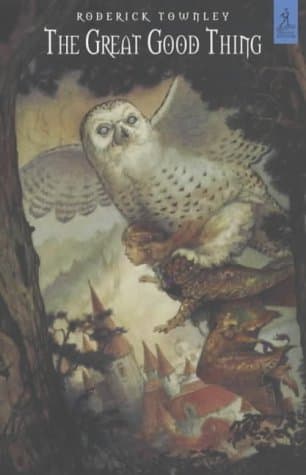
Roderick Townley (2001)
Genre
Fantasy / Children's / Young Adult
Reading Time
180 min
Key Themes
See below
Sign in to track this book
Trapped as an eternally twelve-year-old princess in her story, Sylvie breaks the fourth wall, leaving her book to write her own destiny.
Princess Sylvie, a twelve-year-old heroine, has lived the same adventure for eighty years within her storybook. Each day, she wakes up, faces the evil witch, escapes the troll, and is rescued by Prince Periwinkle. Her world is detailed, from the talking animals in the Whispering Woods to the shimmering gowns in her castle, but it never changes. Sylvie feels bored and frustrated, wanting the freedom to choose her own path and experience new things. She has grown tired of her predetermined fate and predictable dialogue, often adding her own thoughts, confusing the other characters who are bound by the script.
Driven by her desire for change, Sylvie does the unthinkable for a storybook character: she looks up and speaks directly to the Reader. This act shatters her world's illusion, causing the narrative to falter and other characters to become confused and frozen. The Reader, initially startled, is a young girl named Meg who is reading Sylvie's book. Sylvie asks Meg for help, explaining her problem and her wish to escape the endless cycle. This interaction creates a bond between character and reader, setting off events that defy their realities.
Meg, curious and sympathetic, tries to understand Sylvie's situation. Through their connection, Sylvie gets glimpses of Meg's world, a place of bright colors, different sounds, and unpredictable events. This exposure strengthens Sylvie's resolve to leave her book. Meanwhile, her act of looking up affects the storybook world. Other characters, like the cynical dragon Fathom, begin to feel the disruption, sensing a fundamental shift. They notice pauses in their dialogue and inconsistencies in their actions, suggesting Sylvie's rebellion is a catalyst for widespread awakening.
Encouraged by her connection with Meg and the growing awareness among her fellow characters, Sylvie organizes a secret meeting. She gathers Fathom, the wise but grumpy dragon, and the bumbling but kind Prince Periwinkle, among others. Sylvie explains her theory: they are just characters in a book, and their lives are dictated by the Reader. This news is met with disbelief, fear, and cautious hope. Sylvie proposes a radical idea: to collectively find a way out of their stories and into the 'Great Good Thing' – the real world. This meeting begins their rebellion against predetermined destinies.
As the characters explore their predicament, Fathom, with his knowledge of the book's margins, finds hidden 'Author's Notes.' These notes provide a meta-narrative, explaining their story's purpose, the author's intentions, and how they exist within the narrative. They learn their world is a specific adventure, and any deviation is a 'glitch.' This discovery is both freeing and terrifying, confirming their status as fictional beings but also hinting at a different kind of existence beyond the written word. It gives them a clear goal: to understand and manipulate their world's rules.
Realizing their only hope of escape is to reach the 'End' of their story, Sylvie, Fathom, and Periwinkle journey through their book's pages. They must navigate various chapters, each presenting familiar but now subtly altered challenges. The narrative itself seems to resist them, trying to pull them back into their assigned roles. They meet other characters who are either unaware of their situation or actively try to stop them, believing they are causing chaos. Their quest becomes a race against their existence's structure, pushing them to defy every narrative rule.
During their journey, Sylvie and her companions find characters from other books shelved alongside theirs. They meet a brave knight from an epic saga, a mischievous fairy from a collection of fables, and a wise old wizard from a spellbook. These 'outside' characters, also aware of their fictional nature, want freedom or have found ways to subtly influence their narratives. They share knowledge and strategies for navigating the 'space between stories,' forming a temporary alliance. This encounter broadens Sylvie's understanding of the vastness of the book world and strengthens her resolve.
As they near the 'End,' Sylvie realizes something profound. The 'Great Good Thing' is not just about escaping her book and becoming 'real.' It is about the freedom to choose, to have control over her own life, whether in her story or outside it. She understands that true happiness comes from making decisions and experiencing genuine newness, not just following a script. This change in perspective empowers her, giving her a clearer vision of what she truly desires and strengthening her resolve to achieve it, for herself and all characters trapped in repetitive narratives.
Reaching the final page, Sylvie and her companions face the ultimate barrier between their fictional world and Meg's reality. The 'End' is not a simple door, but a liminal space, a swirling vortex of words and images that threatens to unravel them. They must use their combined wits and courage to cross this threshold. The Author's Notes provide a clue, suggesting that belief and collective will are key to traversing this boundary. It is a moment of great risk, where their existence hangs in the balance, and they must decide if the unknown freedom is worth the potential dissolution of their being.
Through a collective act of will and Meg's subtle guidance, Sylvie and her companions cross the threshold. They do not become fully 'real' as a human is, but they achieve a new state of being. They exist in the 'space between stories,' a meta-narrative realm where they can visit other books, interact with Readers, and, most importantly, influence their own narratives. Sylvie realizes that true freedom is not about escaping stories, but about having the power to shape them. She, Fathom, and Periwinkle, along with their new allies, begin a new kind of adventure, one where they author their own destinies, bringing joy and change to other characters and readers alike.
The Protagonist
Sylvie transforms from a passive, albeit discontent, character into an active agent of change, ultimately becoming the architect of her own and others' stories.
The Supporting
Fathom evolves from a solitary, cynical observer to an active participant in the quest for freedom, finding renewed purpose and companionship.
The Supporting
Periwinkle grows from a scripted hero into a character with independent thought and agency, choosing his own path and friendships.
The Supporting
Meg learns about the sentience of fictional characters, expanding her understanding of stories and her own role as a reader, becoming a silent ally.
The Mentioned
The Narrator's absolute control is challenged and ultimately circumvented by the characters' collective will, signifying their gaining of agency.
This is the main theme, seen through Sylvie's desire to escape her predetermined life. It shows in her defiance of looking up at the Reader, her rallying of other characters, and their journey to break free from the narrative. The story argues that true happiness comes from choosing one's own path, even if the destination is uncertain. This is clear when Sylvie realizes the 'Great Good Thing' is not just escaping, but the freedom to write her own story, challenging the nature of fictional existence.
“What good is an adventure if you know every twist and turn before it happens?”
The book blurs the lines between the real and fictional worlds, making characters and readers question what 'real' means. Sylvie's awareness of her fictionality and her interaction with Meg highlight this. The 'Author's Notes' and the 'space between stories' deepen this idea, suggesting that even fictional lives have value and the potential for self-determination. It asks the reader to consider characters' lives beyond the page and how stories shape perception.
“Just because your life is written down doesn't mean it isn't real. It's just a different kind of real.”
The novel celebrates and examines storytelling. It shows how stories can trap characters in endless loops, but also how they can inspire change and connection. Meg's role as the Reader is important, showing a reader's influence on a book's life. The characters' eventual ability to 'write' their own narratives emphasizes that stories are dynamic and can evolve, moving beyond the initial author's intent. It suggests that reading creates a unique bond and responsibility between the reader and the characters within.
“A story isn't just words on a page. It's a life waiting to be lived, and sometimes, those lives want to be lived differently.”
While Sylvie's initial desire is personal, her success depends on her ability to inspire and unite other characters. The alliance with Fathom, Periwinkle, and characters from other books shows that collective action is necessary to overcome obstacles. Their shared desire for freedom creates community and mutual support, proving that even in a world dictated by a single narrative, solidarity can lead to change. This theme highlights the strength found in shared purpose and cooperation.
“One character alone might be a glitch. Many characters, together, are a revolution.”
Characters directly acknowledge and interact with the reader.
This device is central to the entire narrative. Sylvie's act of looking up and speaking to Meg directly shatters the illusion of her fictional world. It immediately establishes the meta-fictional nature of the story, allowing for a unique relationship between character and reader. This device serves to propel the plot, as it's the catalyst for Sylvie's quest for freedom, and also enhances the theme of the nature of reality and fiction by explicitly bridging the gap between the two.
The story comments on its own construction and the rules of its fictional world.
The discovery of 'Author's Notes' within the book itself provides exposition about the mechanics of the characters' existence. This device allows the author to explain the 'rules' of the storybook world without breaking character or resorting to overly complex internal monologues. It reinforces the meta-fictional aspect, giving the characters (and the reader) a deeper understanding of their predicament and the potential avenues for escape, functioning as both a plot catalyst and a thematic exploration of storytelling.
Characters are forced to repeat the same story indefinitely.
This is the initial conflict and the primary motivator for Sylvie's actions. The concept of characters living the same adventure repeatedly creates a sense of existential dread and highlights the theme of agency. It establishes the stakes for Sylvie's rebellion, as breaking the loop means challenging the fundamental nature of her existence. The repetition also allows the reader to understand Sylvie's frustration and empathize with her desire for change, making her quest more compelling.
A liminal realm existing between different books and potentially reality.
This device provides a physical and conceptual destination for the characters' quest. It is the realm they strive to reach, representing a transitional state between rigid narrative and true freedom. It allows for the introduction of characters from other books, expanding the scope of the fictional universe. The 'Space Between Stories' acts as a metaphor for independent thought and choice, a place where narratives can converge and diverge, and characters can forge their own destinies outside the confines of their original texts.
“There are some things that are so important, you just have to do them. Even if they're dangerous. Even if they're scary. Even if you don't know how they'll turn out.”
— The Narrator reflects on the nature of important decisions and courage.
“Sometimes, the things we imagine are more real than the things we see.”
— A philosophical observation about the power of imagination.
“Every story needs a hero, and every hero needs a quest.”
— The Narrator's foundational understanding of narrative structure.
“A good story, you see, is like a good friend. It stays with you.”
— The Narrator emphasizes the lasting impact of a well-told story.
“The world is full of magic, if only you know where to look.”
— A hopeful statement about finding wonder in the ordinary.
“It's not about being brave all the time. It's about being brave when it counts.”
— A nuanced definition of bravery.
“Even the smallest of us can change the biggest of things.”
— A message of empowerment for those who feel insignificant.
“To truly live, you must step outside the pages.”
— The central theme of the book, about breaking free from predetermined roles.
“Fear is a funny thing. It can make you run, or it can make you fight.”
— An observation on the dual nature of fear.
“Sometimes, the best way to find your way is to get a little lost.”
— A paradox about discovery and exploration.
“The greatest good thing, perhaps, is simply to be.”
— A profound reflection on existence and being.
“A world without stories would be a world without dreams.”
— Highlighting the essential role of stories in human experience.
“Adventure doesn't always come looking for you. Sometimes, you have to go looking for it.”
— An encouragement to seek out new experiences.
“The most important words are often the ones left unsaid.”
— A thought on unspoken truths and understanding.
Ready to see how well you understood this book? Take our interactive quiz with 10 questions.







