“It was a wonderful thing, I thought, to have a big brother who knew all about things.”
— Tom's younger brother J.D. often looks up to Tom's intelligence and schemes.

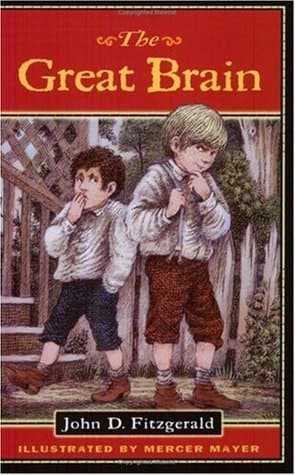
John D. Fitzgerald (1967)
Genre
Children's / Historical Fiction / Young Adult
Reading Time
150 min
Key Themes
See below
Sign in to track this book
In a small Utah town, a clever ten-year-old boy, known as the Great Brain, creates schemes to outsmart his friends, solve local problems, and always make money.
The story introduces Tom D. Fitzgerald, known as the 'Great Brain,' a ten-year-old boy in the Mormon town of Adenville, Utah, in the late 1800s. His younger brother, J.D., narrates the book, detailing Tom's intelligence and his knack for creating plans that make him money while often solving community problems. J.D. explains how Tom often outsmarts adults and children, always finding a way to benefit himself. The first few chapters establish Tom's reputation and J.D.'s impressed, if sometimes annoyed, admiration for his brother's cleverness, setting the scene for the adventures that follow.
When several boys' bicycles go missing in Adenville, including J.D.'s friend Frankie's, the town is upset. The adults are confused, but Tom, the Great Brain, sees a chance to act. He announces he will solve the mystery for a fee. After gathering clues and watching the town's children, Tom figures out that older boys, jealous of the younger kids' bikes, hid them. He sets a trap, causing the culprits to show themselves, and recovers the bikes. Tom collects his reward, showing his detective skills and his constant desire for profit.
The Jenkins boys, two mischievous brothers, get lost and trapped in Skeleton Cave, a dangerous local place. A search party is formed, but their efforts fail. Panic spreads through Adenville. Tom, the Great Brain, steps forward with a plan. He uses his knowledge of the cave's layout, along with ropes and signals, to guide the rescue team. He charges a large fee for his help, but his plan works, and the boys are brought out safely, confirming Tom's reputation as a problem-solver, even in dangerous situations.
One boy, Wendell, has his new Sunday pants stolen from the school cloakroom, upsetting him greatly. The principal cannot find the thief. Tom, the Great Brain, takes on the case, again for a fee. He announces he knows who stole the pants and will give the thief a chance to return them anonymously. He places a large, empty box in the classroom and says the pants will appear inside. Using this psychological tactic, the guilty party, a bully named Sammy, is pressured into returning the pants, showing Tom's insight into human behavior.
Peg-leg Andy, an old prospector known for his rough manner and wooden leg, tells Tom he forgot where he buried his life savings. The old man is desperate. Tom agrees to help, but only if Andy signs a contract promising him a large part of the recovered money. Through careful questions and watching Andy's habits, Tom figures out the likely spot for the treasure. He finds the buried money, ensuring Andy's financial security while, of course, collecting his agreed-upon share, to Andy's initial annoyance but eventual relief.
A new boy named Basil arrives in Adenville. He is quiet, well-dressed, and at first struggles to make friends, becoming a target for bullies. Tom sees a chance. He 'hires' Basil to be his assistant, paying him a small wage to help with his plans, such as organizing games or collecting fees. This arrangement gives Basil a purpose and a connection, helping him gain confidence and acceptance among the other children. While Tom profits from his plans, Basil benefits from fitting in and feeling better about himself, showing a rare, though still self-serving, act of kindness from Tom.
As Christmas nears, the children of Adenville regret their lack of money for presents. Tom, always thinking of business, proposes a solution. He starts a 'Christmas savings' plan, where children can bring him small amounts of money they earn from chores, and he promises to invest it for them, returning it with interest just before Christmas. Many children join, trusting Tom's business sense. He uses the pooled money for small, quick investments or trades, returning a profit to the children (and himself), ensuring everyone has money for gifts.
During a school election for class president, Tom gets involved in a plan to fix the results. He supports a less popular candidate, but through a series of clever manipulations, including convincing voters their votes are secret despite an open ballot system, he manages to change the outcome. While the specific details of his methods are not fully revealed, the episode shows Tom's understanding of human psychology and his willingness to use it. He ultimately exposes the unfairness of the original voting system and how easily it could be manipulated, even if through his own actions.
A new, bigger boy named Butch, known for bullying, arrives in Adenville and challenges Tom to a fight. Tom, who avoids physical fights, accepts the challenge but makes a plan. He uses psychological tactics and some tricks, convincing Butch he has a secret, unbeatable move. On the day of the fight, Tom's reputation and confident manner, combined with a few well-placed feints, make Butch back down without a punch. Tom again proves that intelligence can win over strength, further cementing his untouchable status.
Seeing the growing popularity of bicycles and the limited number in Adenville, Tom, the Great Brain, decides to profit from the trend. He convinces his father to help him get a few bicycles, which he then rents out to other children for an hourly fee. He also offers repair services for a price. His business quickly grows, as he is the only one offering such a service. This venture shows Tom's business spirit and his ability to find and fill a market need, consistently making a profit through his cleverness.
The Protagonist
Tom's character remains largely consistent throughout the stories, always using his intellect for personal gain, but occasionally showing glimpses of underlying good intentions.
The Narrator/Supporting
J.D. mostly serves as a lens through which to view Tom, but he grows in his understanding of Tom's complexities.
The Supporting
Papa remains a consistent figure of authority and morality, offering resistance to Tom's schemes.
The Supporting
Mama's role is consistent, serving as the moral center of the family.
The Supporting
Basil transforms from an insecure outsider to a more confident and integrated member of the community, thanks to Tom's influence.
The Supporting
Andy's situation is resolved by Tom, bringing him peace of mind about his savings.
The Antagonist/Mentioned
Butch is quickly defeated by Tom's cleverness and retreats.
The Supporting/Antagonist
Sammy is exposed and shamed by Tom's scheme, presumably learning a lesson.
The main theme is Tom's intelligence and his ability to create clever solutions for many problems, from lost children in a cave to stolen bicycles. Each chapter shows a different challenge the community or an individual faces, and Tom always steps forward with an unusual, but effective, plan. For instance, his rescue of the Jenkins boys from Skeleton Cave and his recovery of Peg-leg Andy's hidden savings show how his unique thinking allows him to solve problems that confuse adults. His methods are often complex and unexpected, showing the power of a sharp mind.
“My brother Tom was a Great Brain. He was always thinking, and he always knew how to make a profit.”
This theme looks at the tension between Tom's often self-serving reasons and the good results of his actions. While Tom almost always charges a fee or finds a way to profit from his solutions, his plans always help others. The book subtly asks if the 'ends justify the means.' Characters like Mama often worry about Tom's ethics, urging him to be less focused on money. However, Tom's actions, such as helping Basil fit into the community or recovering stolen items, often lead to good results for those involved, even if his main goal is personal gain. This unclear nature is a key part of his character.
“Mama always said that Tom should use his Great Brain for good, not just for making money.”
The book clearly shows Tom's natural business sense and his understanding of basic capitalist ideas within a childhood setting. He identifies needs in his community (e.g., bicycle rentals, problem-solving services) and starts businesses to meet them, always aiming for a profit. His 'Christmas savings' plan and his bicycle rental business are good examples. This theme explores how being resourceful and having a keen eye for opportunity can lead to success, even at a young age, and how a small economy can work in a small town through one clever person's initiative.
“Tom knew that if people wanted something bad enough, they'd pay for it.”
Tom's success relies heavily on his sharp observations and his understanding of human psychology. He can read people's motivations, fears, and desires, and he uses this insight to control situations to his advantage. His method for recovering Wendell's stolen pants, by creating a 'miracle box' to pressure the thief, is a perfect example. Similarly, his ability to outsmart the bully Butch without a physical fight shows his skill in psychological tactics. This theme highlights how understanding the human mind can be a more powerful tool than brute force or common problem-solving.
“Tom didn't need to fight with his fists; he fought with his brain.”
The younger brother's perspective provides an admiring, yet sometimes critical, view of Tom.
The entire story is narrated by J.D., Tom's younger brother. This device allows for an intimate and often humorous portrayal of Tom's schemes, filtered through the eyes of someone who both idolizes and is occasionally exasperated by him. J.D.'s naive yet observant perspective makes Tom's extraordinary intellect seem even more remarkable and allows the reader to experience the awe and occasional frustration of living with a 'Great Brain.' It also lends a nostalgic, childlike charm to the historical setting of Adenville.
A recurring epithet that defines Tom's character and sets expectations.
The constant reference to Tom as 'The Great Brain' serves as both a character descriptor and a narrative device. It immediately establishes Tom's core identity and sets the reader's expectations for his intelligence and cunning. This moniker acts as a shorthand for his extraordinary abilities, reinforcing his reputation with each new anecdote. It also contributes to the book's slightly exaggerated, almost legendary, tone, fitting for a collection of tales about a remarkable childhood figure.
Tom's habit of formalizing his problem-solving services with written agreements.
Tom frequently requires those seeking his help to enter into formal, often written, contracts that stipulate his payment or share of the profits. This device highlights his business acumen and his insistence on fair compensation for his intellectual labor. It also adds a layer of humor and irony, as a ten-year-old boy is seen negotiating and enforcing legally binding agreements, often with adults. This reinforces the theme of entrepreneurship and his unique, often mercenary, approach to helping others.
The story is told through a series of self-contained adventures or 'cases.'
The book is structured as a collection of distinct, self-contained episodes or chapters, each detailing a specific problem that Tom solves. While there is a consistent setting and cast of characters, each 'case' presents a new challenge, allowing for a fresh demonstration of Tom's ingenuity. This episodic nature makes the book highly accessible and engaging, as each chapter offers a complete narrative arc of problem, solution, and resolution, showcasing the versatility of the 'Great Brain.'
“It was a wonderful thing, I thought, to have a big brother who knew all about things.”
— Tom's younger brother J.D. often looks up to Tom's intelligence and schemes.
“My father always said that there were two kinds of people in the world: those who did the work and those who took the credit.”
— A recurring theme about fairness and observation of adult behavior.
“The Great Brain always had a plan. He never just did things without thinking them out first.”
— J.D.'s description of Tom's meticulous and often self-serving planning.
“Sometimes it seemed to me that grown-ups were a lot dumber than kids.”
— J.D.'s youthful perspective on the sometimes illogical actions of adults.
“It was amazing how much money The Great Brain could make if he really put his mind to it.”
— Reflecting on Tom's entrepreneurial spirit and ability to earn money.
“Tom was always coming up with new ways to make money, and they were always legal, though sometimes barely.”
— Highlighting Tom's cleverness in business, often pushing ethical boundaries.
“The Great Brain was a genius, there was no doubt about it. But he was a genius who always looked out for himself first.”
— A candid assessment of Tom's intelligence coupled with his self-interest.
“Most of the time, I didn't mind being fooled by The Great Brain, because he always made it interesting.”
— J.D.'s acceptance of Tom's schemes, often finding entertainment in them.
“In our town, everyone knew everyone else's business, and mostly, they didn't mind.”
— Describing the close-knit, gossipy nature of the small town in the late 19th century.
“The Great Brain could talk anyone into anything, if he tried hard enough.”
— Highlighting Tom's persuasive abilities and rhetorical skills.
“It was funny how much trouble a little kid could get into without even trying.”
— J.D.'s observation about the inherent mischief of childhood.
“My father said that a man's word was his bond, and he always kept his word.”
— Reflecting on the strong moral code and integrity of their father.
“The Great Brain taught me a lot of things, even if I didn't always realize it at the time.”
— J.D.'s retrospective appreciation for the lessons learned from his older brother.
Ready to see how well you understood this book? Take our interactive quiz with 10 questions.

Dan Gemeinhart
4.5

Kate O'Hearn
4.4

Jeanne Birdsall
4.4

Jen Wang
4.4

Wendelin Van Draanen
4.3

John Marsden
4.3

Chris Van Allsburg
4.3
Jennifer A. Nielsen
4.2