“The point is that as a woman I can't afford to be a feminist. I live in a world where men have the power, and I have to live with that.”
— Anna Wulf reflecting on her position as a woman in society.

Doris Lessing (2012)
Genre
Literary Fiction
Reading Time
1200 min
Key Themes
See below
Sign in to track this book
Through fragmented notebooks, a writer dissects her fractured psyche and the disillusionment of post-war communism, striving to unify her identity amidst personal betrayals and societal shifts.
Anna Wulf, a divorced writer living in a London flat with her daughter Janet, introduces her system of notebooks. The Black Notebook details her experiences in colonial Southern Rhodesia (Zambia) as a member of the Communist Party, focusing on a group of young intellectuals and their disillusionment. The Red Notebook covers her time as a Communist in England, documenting her political activities, meetings, and eventual break with the party. The Yellow Notebook is a semi-autobiographical novel she is writing, exploring the character of Ella and her struggles with love, psychoanalysis, and finding meaning. The Blue Notebook is her personal diary, recording daily events, dreams, and her sessions with a psychoanalyst, Mrs. Marks. Anna feels increasingly fragmented and overwhelmed by the separation of these aspects of her life, struggling with writer's block and a deep sense of despair.
The Black Notebook describes Anna's past in Southern Rhodesia during the 1940s. She recalls her involvement with a small group of aspiring writers and communists, including Paul, George, Jimmy, and Mary. Their youthful idealism is shown against the backdrop of colonial society and racial tensions. Anna describes the passionate, often complicated, relationships within the group, particularly her affair with Paul. This notebook captures the intense intellectual discussions, the shared hopes for a better world, and the gradual disillusionment that sets in as political realities and personal betrayals become apparent. The group's attempt to make a film together is a metaphor for their collective aspirations and eventual failures, highlighting the challenges of maintaining political purity and personal integrity.
The Red Notebook describes Anna's life as an active member of the Communist Party in England during the 1950s. She records meetings, debates, and internal struggles within the party. Her initial strong belief in the cause slowly erodes as she sees hypocrisy, dogmatism, and the crushing of individual thought. The notebook details her relationships with fellow communists, the demanding nature of political activism, and its emotional toll. The Hungarian Uprising of 1956 and Khrushchev's 'secret speech' are events that lead to her profound disillusionment and eventual decision to leave the party. This period marks a significant shift in Anna's understanding of collective action and personal responsibility, leaving her feeling politically homeless.
The Yellow Notebook presents the novel Anna is attempting to write, featuring a protagonist named Ella. Ella's experiences closely mirror Anna's own, particularly her struggles with romantic relationships, mental health, and the search for identity. The notebook explores Ella's affair with Michael, a married man, and the emotional complexities of such a relationship. It details Ella's psychoanalysis sessions, where she deals with her past, her dreams, and her sense of self. Through Ella, Anna examines female sexuality, independence, and the societal pressures placed upon women. The fragmented nature of Ella's narrative, mirroring Anna's own state, reflects the difficulty of creating a cohesive story from a fractured inner world.
The Blue Notebook is Anna's most intimate personal diary, recording her daily thoughts, dreams, and interactions with her daughter Janet, her friend Molly, and various lovers. It provides a raw account of her emotional state, her anxieties, and her moments of despair. This notebook captures her ongoing therapy sessions with Mrs. Marks, where she attempts to find the root causes of her fragmentation and writer's block. Anna reflects on the challenges of motherhood, her often unsatisfying relationships with men, and her deep longing for connection and wholeness. The Blue Notebook shows her struggle to maintain sanity and coherence amidst internal chaos and external pressures.
Anna's closest friend is Molly Jacobs, a divorced actress and a socialist who often acts as a sounding board for Anna's political and personal dilemmas. Molly is more grounded and practical than Anna, though equally disillusioned with traditional politics. Their conversations often revolve around the challenges of being independent women, raising children, and navigating relationships. Molly's relationship with her successful but emotionally distant ex-husband, Richard, and her son, Tommy, provides a different perspective to Anna's own family dynamics. Molly's blunt honesty often challenges Anna, forcing her to confront uncomfortable truths about herself and her choices, making their friendship a vital anchor in Anna's fragmented world.
The Blue Notebook details Anna's series of relationships with various men, most notably the American writers Saul Green and Paul. Her affair with Saul Green is particularly intense and destructive, pushing Anna to the brink of a mental breakdown. Saul, also a writer, is deeply troubled, cynical, and emotionally manipulative. Their relationship is characterized by power struggles, intellectual sparring, and a shared sense of despair, ultimately mirroring and worsening Anna's own fragmentation. Paul, another American, is a more stable presence, but his inability to fully connect or understand Anna's complexities ultimately leads to another dead end, highlighting Anna's continuous struggle to find fulfilling relationships.
Molly's son, Tommy, a young man dealing with his own identity and the legacy of his parents' political idealism, experiences a significant mental and emotional crisis. He feels disconnected from the world and struggles to find meaning or purpose in a society he sees as corrupt and hypocritical. Tommy's breakdown, ending in a suicide attempt, deeply affects Anna and Molly. His struggles symbolize the disillusionment of a younger generation inheriting a world shaped by the failures of their elders. Tommy's vulnerability and despair are a reminder of the widespread psychological and social malaise that permeates the novel's world, further highlighting Anna's own internal struggles.
As Anna's internal fragmentation intensifies, fueled by her unsatisfying relationships, political disillusionment, and writer's block, she experiences a profound mental breakdown. Her separate notebooks become increasingly chaotic and indistinguishable, reflecting her disintegrating sense of self. During this period of intense psychological distress, she begins to hallucinate and lose touch with reality. It is during this breakdown, ironically, that she and Saul Green collaborate on a final, unifying 'Golden Notebook.' This notebook is not a conventional narrative but a collection of fragments, lists, dreams, and observations, attempting to synthesize all the disparate aspects of Anna's life into a single, cohesive (though still unconventional) whole. It represents a symbolic attempt at integration and healing.
The Golden Notebook, co-created with Saul Green during Anna's mental breakdown, is the culmination of her journey towards integration. It contains a series of instructions for Saul (and implicitly for Anna herself) on how to live, along with fragmented narratives, dreams, and insights that transcend the categories of the previous notebooks. It represents Anna's struggle to break free from the self-imposed divisions of her past and to find a new way of being, one that acknowledges the complexity and contradictions of life without succumbing to fragmentation. While not offering a conventional 'happy ending,' the Golden Notebook signifies a crucial step towards psychological wholeness and the possibility of a new beginning for Anna, implying she might finally write again, but differently.
The Protagonist
Anna moves from a state of severe psychological fragmentation and despair, documented through her separate notebooks, towards a symbolic integration of her self through the creation of the Golden Notebook, signaling a potential for healing and new beginnings.
The Supporting
Molly remains a relatively stable and supportive figure, experiencing her own challenges but providing a consistent anchor for Anna.
The Supporting
Saul's relationship with Anna pushes both to a breaking point, ultimately contributing to Anna's mental breakdown but also her symbolic integration.
The Supporting
Janet remains a consistent presence, representing the future and Anna's maternal responsibilities.
The Supporting
Tommy's arc tragically culminates in a mental breakdown and suicide attempt, symbolizing the despair of a younger generation.
The Supporting
Richard remains a consistent, if somewhat distant, figure, embodying a conventional success that clashes with the ideals of Molly and Anna.
The Supporting
Mrs. Marks facilitates Anna's therapeutic journey, remaining a consistent professional presence.
The Supporting
Paul is primarily seen through Anna's past recollections, representing a formative, yet ultimately failed, relationship and political ideal.
The main theme is Anna Wulf's psychological fragmentation, shown by her four distinct notebooks (Black, Red, Yellow, Blue). Each notebook tries to compartmentalize different aspects of her life—political, personal, creative—yet this separation leads to a deep sense of disunity and despair. Anna constantly longs for 'wholeness' or integration, believing that her inability to reconcile these facets prevents her from living authentically or writing effectively. The novel suggests that modern life, with its complex political, social, and personal demands, fragments the individual, making the search for a unified self a monumental, perhaps impossible, task. The eventual creation of the Golden Notebook symbolizes a symbolic, if not complete, integration, suggesting a new way of embracing complexity rather than fighting it.
“The point is that I am a writer, and I am not writing. I don't know why. I don't want to know why. But I know that if I did, it would be the beginning of my sanity.”
The novel is a seminal feminist text, exploring the challenges faced by intelligent, independent women in the mid-20th century. Anna and Molly deal with societal expectations regarding marriage, motherhood, careers, and sexuality. They navigate complex relationships with men, often finding them unsatisfying or oppressive. The novel critiques the limitations placed on women, highlighting their struggles to define themselves outside of patriarchal structures. Anna's journey is a quest for a female identity that is both autonomous and integrated, free from the confines of traditional roles. The discussions between Anna and Molly, and Anna's experiences in the Yellow Notebook (through Ella), address issues of sexual liberation, emotional vulnerability, and the search for authentic female experience.
“What do women want? They want to be taken seriously. They want to be loved for themselves, not for their roles.”
A significant theme is the disillusionment with political ideologies, particularly Communism. Anna's experiences in the Black and Red Notebooks detail her initial strong belief in the Communist Party, followed by her gradual and painful disengagement. The novel critiques the dogmatism, hypocrisy, and intellectual rigidity that can permeate political movements, showing how idealism can curdle into cynicism. The Hungarian Uprising and Khrushchev's 'secret speech' are events that shatter Anna's faith, leaving her feeling politically homeless. This disillusionment extends to a broader critique of collective action, suggesting that grand political narratives often fail to address individual human suffering and complexity, leading to a sense of despair among those who once believed.
“The great dream was over. The great dream of the brotherhood of man had turned into a nightmare of lies and betrayals.”
The novel is deeply meta-fictional, constantly questioning the nature of writing itself. Anna's writer's block and her fragmented notebooks reflect her struggle to find a coherent narrative form that can capture the complexity of her experience. She deals with the ethics of fictionalizing her own life (Yellow Notebook) and the limitations of objective political reporting (Black, Red Notebooks) versus subjective personal accounts (Blue Notebook). The novel suggests that traditional narrative forms are insufficient to convey the fragmentation of modern consciousness. The ultimate creation of the Golden Notebook, a highly unconventional and fragmented text, signifies a breakthrough in finding a new, more honest way of storytelling that embraces rather than denies internal chaos. It conveys the idea that form must follow content, especially when the content is a fractured self.
“I can't write because I can't think of a form. I can't think of a way of cutting up my experience so that it makes sense.”
Mental health, particularly Anna's severe fragmentation and eventual breakdown, is a core theme. Her regular sessions with Mrs. Marks, detailed in the Blue Notebook, highlight the then-contemporary understanding of psychoanalysis as a tool for self-discovery and integration. The novel portrays Anna's mental distress not as a weakness, but as a response to the pressures of her life—political disillusionment, challenging relationships, and the search for identity as a woman. The breakdown is depicted as both destructive and paradoxically generative, leading to the creation of the Golden Notebook. It suggests that confronting one's deepest psychological divisions, even if painful, is necessary for achieving a degree of wholeness.
“The point is that I am a writer, and I am not writing. I don't know why. I don't want to know why. But I know that if I did, it would be the beginning of my sanity.”
Four colored notebooks representing different facets of Anna's fragmented life, plus the unifying Golden Notebook.
The notebooks are the primary structural and thematic device. The Black, Red, Yellow, and Blue notebooks each contain a distinct aspect of Anna's life: her past in Africa, her political involvement, her fictionalized alter ego, and her daily diary/psychoanalysis. This fragmentation mirrors Anna's own psychological state. The eventual creation of the 'Golden Notebook' serves as a meta-device, symbolizing Anna's attempt to integrate her fractured self and find a holistic narrative. They allow Lessing to explore multiple perspectives and timelines simultaneously, emphasizing the complexity of human experience and the artificiality of neat categories.
The novel self-consciously comments on its own construction and the act of writing.
Lessing employs metafiction by having Anna Wulf, a writer, struggle with writer's block and the very form of her own story. The Yellow Notebook, a novel-within-a-novel, explicitly addresses the challenges of creating fiction from life. Anna's constant questioning of her own narrative choices and the 'truth' of her experiences draws attention to the constructed nature of storytelling. This device allows Lessing to explore the relationship between art and life, the limitations of language, and the difficulty of representing a complex, fragmented reality without imposing artificial order.
Extensive use of Anna's inner thoughts and unfiltered perceptions.
Particularly evident in the Blue Notebook, Lessing uses interior monologue to directly present Anna's unfiltered thoughts, anxieties, dreams, and reflections. This technique provides deep insight into Anna's psychological state, allowing the reader to experience her fragmentation firsthand. It blurs the line between objective reality and subjective perception, emphasizing the internal chaos she experiences. The stream of consciousness captures the non-linear, associative nature of thought, reflecting Anna's struggle to impose order on her mental landscape and contributing to the novel's raw, authentic feel.
Each notebook's color represents a specific aspect of Anna's identity and experience.
The colors of the notebooks are highly symbolic. Black represents the painful, often dark, memories of colonial Africa and racial tensions. Red signifies the passion and eventual disillusionment of Communism. Yellow embodies the creative, fictionalized self, often associated with the mind and intellect, but also with instability. Blue represents the personal, daily, and often melancholic aspects of her emotional life. The 'Golden' Notebook, created during her breakdown, symbolizes a quest for synthesis, wholeness, and a precious, integrated truth, suggesting a new, unified (though unconventional) way of seeing and being.
“The point is that as a woman I can't afford to be a feminist. I live in a world where men have the power, and I have to live with that.”
— Anna Wulf reflecting on her position as a woman in society.
“There are some books one reads and thinks, 'This is me, this is my life, this is my experience.'”
— Anna Wulf discussing the impact of literature on her personal understanding.
“The way to a man's heart is through his stomach. The way to a woman's heart is through her mind.”
— A generalized statement about gendered approaches to relationships.
“The novel is a way of saying: this is life as I see it, this is what it's like to be me, this is what it's like to be us.”
— Anna Wulf on the purpose and nature of writing fiction.
“I was not a feminist. I was a woman. I was a human being.”
— Anna Wulf clarifying her self-identification beyond political labels.
“The personal is political.”
— A foundational feminist concept explored through Anna's experiences.
“If I am mad, then it is because I have been driven mad by the world.”
— Anna Wulf contemplating her mental state and its external causes.
“The novel is not a novel, it is a statement.”
— A meta-commentary on the form and intent of 'The Golden Notebook' itself.
“We are all of us, in our own way, searching for something to believe in.”
— A general reflection on the human search for meaning.
“The world is divided into two kinds of people: those who divide the world into two kinds of people, and those who don't.”
— A humorous and insightful observation on human categorization.
“Love is not a feeling, it is an act.”
— Anna Wulf's pragmatic view on the nature of love.
“Sanity, I suppose, is the ability to maintain a consistent self. But what if one's self is inconsistent?”
— Anna Wulf questioning the definition of sanity in a fragmented existence.
“The only way to be a free woman is to be a single woman.”
— A perspective on female independence and the constraints of traditional relationships.
“There is no such thing as a unified self. We are all fragments.”
— A central theme of the novel, reflecting Anna's psychological state and the structure of the book.
Ready to see how well you understood this book? Take our interactive quiz with 10 questions.
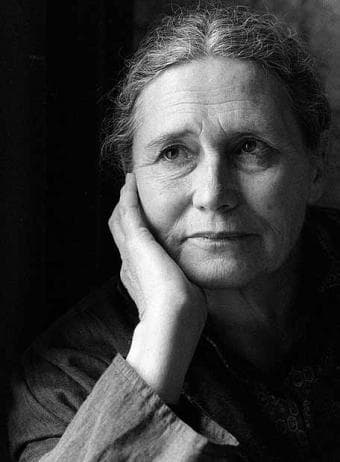
Doris May Lessing was a British-Zimbabwean novelist. She was born to British parents in Iran, where she lived until 1925. Her family then moved to Southern Rhodesia, where she remained until moving in 1949 to London, England. Her novels include The Grass Is Singing (1950), the sequence of five novels collectively called Children of Violence (1952–1969), The Golden Notebook (1962), The Good Terrorist (1985), and five novels collectively known as Canopus in Argos: Archives (1979–1983).