“The true artist is not one who is gifted, but one who is driven.”
— A reflection on the nature of artistic creation and perseverance.

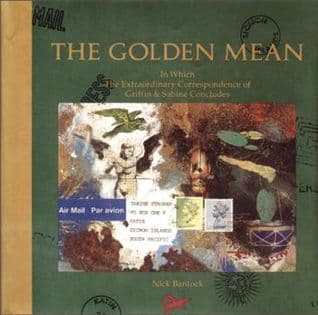
Nick Bantock (1993)
Genre
Fantasy / Creativity / Mystery / Romance
Reading Time
30 min
Key Themes
See below
Sign in to track this book
Two artists, Griffin and Sabine, are drawn together by an unseen force but kept apart by a mysterious barrier. They exchange illustrated letters, racing against a looming threat to find the 'golden mean' that will unite them.
Griffin returns to his London home, expecting Sabine to be there, as her previous letters from *Sabine's Notebook* suggested. Instead, he finds no sign of her. This is a shock and source of confusion for Griffin, especially after their long journey toward meeting. He writes to Sabine, expressing his bewilderment, stating he was sure he understood their plan, but her absence contradicts everything he believed. This mysterious non-encounter sets the stage for the increasing strangeness of their relationship.
Sabine's reply reveals an equally confusing experience. She writes from the Seychelles, confirming she *was* in Griffin's London house for three days after his return, seeing his art and feeling his presence, yet she never saw him. She describes her vivid experience, almost as if she was haunting his home, observing his life through his sketches and objects. This reciprocal, non-overlapping presence deepens the mystery of their separation, suggesting a basic disconnect in their shared reality beyond simple timing.
As their letters continue, a new, unsettling element appears. Sabine starts seeing a recurring, threatening figure in her visions – a shadowy man with a distinct scar. This figure is not just imagined; he begins to appear in her waking life, watching her from a distance. The man seems to be following her, his presence growing more ominous. This introduces a real external threat, adding danger and urgency to their quest to meet, suggesting their separation might be planned by an outside force.
Griffin, though initially doubtful of Sabine's more fantastical claims, finds himself increasingly involved in their inexplicable situation. He struggles with the idea that they can exist in the same space at different times, or sense each other without meeting. His letters show growing frustration and a desperate need for a logical explanation, even as the evidence points to something beyond ordinary understanding. He tries to make sense of Sabine's vivid descriptions of his art and home with his own experience of her absence, highlighting the stress this paradox puts on his rational mind.
A critical development is the gradual fading of Sabine's unique artistic visions. These visions, which allowed her to see and illustrate Griffin's artwork from afar, have been the foundation of their connection. Now, she reports the images are becoming cloudy, unclear, and harder to grasp. This weakening of her psychic link suggests time is running out, implying their chance to bridge the gap between them is closing. It also adds to her anxiety and desperation, as her main way of understanding Griffin and his world is diminishing.
In his search for answers, Griffin studies ancient texts and esoteric knowledge. He finds references to the 'Golden Mean' – a concept of perfect balance and harmony, often used in art, architecture, and nature. This discovery deeply connects with their problem, suggesting their separation might be an imbalance needing correction by finding a precise, harmonious point of connection. The Golden Mean becomes a symbolic and possibly literal key to understanding the forces at play and finding a way to unite.
The threatening figure becomes more aggressive in his pursuit of Sabine. His appearances are no longer distant observations; he actively tries to stop her. Fearing for her safety and sensing the man is trying to prevent her from reaching Griffin, Sabine is forced to leave her location and flee. Her letters become more frantic, describing her evasion tactics and growing fear, showing their separation is not just a cosmic joke but an active, malicious interference.
Inspired by his research into the Golden Mean, Griffin applies its principles to his own artwork, specifically in a series of geometric designs. He believes that by creating a perfectly balanced and harmonically resonant piece, he might create a focal point or even a literal gateway through which Sabine can finally pass. His art becomes less about expression and more about a desperate, magical attempt to manipulate reality and bring his beloved to him, turning his studio into a place of experimentation.
With their visions fading and the threat growing, Griffin and Sabine agree on a precise time and location for a final attempt to meet. They choose a specific spot, carefully coordinating their movements and expectations, hoping the exactness of their plan, combined with Griffin's Golden Mean artwork, will finally allow them to break through the mysterious barrier. The tension is clear as they both prepare for this ultimate confrontation with the forces keeping them apart, knowing this might be their last chance.
The book ends with a powerful, ambiguous moment. While the full outcome of their meeting is open to interpretation, there is a strong sense that Griffin and Sabine achieve a brief, undeniable moment of shared reality. Whether it is a true physical meeting, a merging of their psychic spaces, or a symbolic union, the final images and words suggest they have, for an instant, transcended the barriers. The threatening figure is repelled, and the sense of longing is momentarily satisfied, leaving the reader with hope for their ultimate unity, even if not fully shown on the page.
The Protagonist
Griffin transforms from a rational skeptic into someone willing to embrace the magical and paradoxical, using his art as a tool to bridge impossible divides.
The Protagonist
Sabine evolves from a visionary artist to a hunted individual, forced to use her intuition and courage to evade danger and pursue her destiny.
The Antagonist
Remains an enigmatic, persistent barrier, his presence intensifying the urgency of Griffin and Sabine's quest.
The book constantly blurs the lines between what is real, what is imagined, and what is perceived through unusual means. Griffin and Sabine experience the same spaces at different times, or feel each other's presence without physical contact. Sabine's visions of Griffin's art, and her 'being' in his house without being seen, challenge the very definition of existence and interaction. This theme is central to the mystery, forcing both characters and readers to question the limits of their understanding, as seen when Griffin struggles to reconcile Sabine's detailed accounts with his own experience of her absence.
“I was sure I understood. Yet you were not here when I returned and there was no sign that you ever had been here...”
Griffin and Sabine are drawn together by an undeniable force, seemingly meant to be united, yet they are constantly stopped by an equally powerful, mysterious barrier. The story explores whether their separation is a cruel twist of fate, a test, or an active malicious act. Their persistent efforts to overcome these obstacles suggest a belief in their own ability to act, even against seemingly impossible odds. The appearance of the threatening figure further complicates this, implying their destiny is being actively manipulated or prevented, forcing them to fight for their union rather than simply arrive at it.
“It seems that each cannot exist in the presence of the other. Yet neither can continue without the presence of the other.”
Art is not just a hobby or job for Griffin and Sabine; it is their main way of communicating, connecting, and a potential key to their union. Sabine's visions of Griffin's art form the initial basis of their bond, and Griffin later uses the principles of the Golden Mean in his own work as a magical attempt to bridge their separation. Their shared artistic sensibilities allow them to understand each other on a deeper level than words alone. The fading of Sabine's visions signifies the weakening of their connection, highlighting art's vital role in their relationship and their quest.
“My visions... become cloudy and dim.”
The concept of the 'Golden Mean' is throughout the book, both as a literal clue and a metaphorical goal. It represents the perfect balance and harmony that Griffin and Sabine seek in their relationship and in their fragmented reality. Their inability to exist in each other's presence means a deep imbalance that needs correction. Griffin's research and artistic application of the Golden Mean principle are direct attempts to restore this harmony, hoping to create a 'mean' where they can finally intersect and achieve a stable, unified existence. Their entire journey is a quest for this elusive balance.
“The golden mean—the harmony of perfect balance—is what they seek...”
The entire story is told through letters and postcards exchanged between Griffin and Sabine.
This device is fundamental to the trilogy. It creates a sense of intimacy and immediacy, allowing readers to directly experience the characters' thoughts, feelings, and the unfolding mystery. The physical act of opening envelopes and unfolding letters enhances the immersive experience. It also inherently emphasizes the separation between the characters, as their only contact is through written word, highlighting the longing and the barrier that keeps them apart. The illustrations on the letters and postcards provide visual clues and deepen the narrative.
Both Griffin and Sabine's accounts of events are partially true but don't fully align, creating narrative ambiguity.
While neither character is intentionally deceptive, their individual perceptions of shared events (like Sabine being in Griffin's house) are contradictory. Griffin's experience of Sabine's absence directly conflicts with Sabine's vivid memories of being present. This mutual unreliability is not a flaw but a core element of the mystery, suggesting that reality itself is fractured or that they exist on different planes. It forces the reader to piece together a larger, more complex truth that neither character fully grasps, enhancing the sense of bewilderment and the fantastical nature of their predicament.
Sabine's ability to 'see' Griffin's artwork from afar.
This unique ability is the catalyst for their initial correspondence and their primary means of connection. It allows for a level of intimacy and shared experience that transcends physical distance. The fading of these visions in *The Golden Mean* serves as a critical ticking clock, raising the stakes and creating urgency for their physical reunion. It also firmly establishes the story within a magical realism or fantasy genre, as this power defies conventional explanation and pushes the boundaries of perception.
A concept or object that drives the plot forward.
The 'Golden Mean' itself functions as a MacGuffin. While it's a real mathematical and artistic concept, within the story, it becomes the ultimate goal and the symbolic key to resolving their separation. Griffin's discovery and application of its principles in his art become his desperate attempt to create the conditions for their union. Its presence gives a tangible focus to their otherwise abstract struggle against unseen forces, providing a direction for their final, climactic effort to meet.
“The true artist is not one who is gifted, but one who is driven.”
— A reflection on the nature of artistic creation and perseverance.
“Every line, every curve, every dot holds a whisper of the universe.”
— Describing the intricate detail and cosmic significance within the illustrations.
“To find the extraordinary, you must first embrace the ordinary.”
— A philosophical observation about perspective and discovery.
“Love is not a destination, but a journey taken with another soul.”
— A romantic musing on the nature of enduring affection.
“The greatest mysteries are often hidden in plain sight, waiting for the right eyes to see them.”
— Hinting at the subtle clues and hidden meanings throughout the narrative.
“Imagination is the brush with which we paint our reality.”
— Emphasizing the power of the mind in shaping one's world.
“The silence between the notes is as important as the music itself.”
— A metaphor for the significance of absence or unspoken elements in art and life.
“Sometimes, the only way forward is to look back with new understanding.”
— Reflecting on the importance of revisiting the past to gain clarity.
“The heart has its own geometry, and it rarely follows straight lines.”
— A poetic description of the unpredictable nature of emotions and relationships.
“Every ending is merely a new beginning, disguised as a farewell.”
— Offering a hopeful perspective on change and transitions.
“To create is to breathe life into the unseen.”
— A concise definition of the act of creation and its magical quality.
“The threads of destiny are woven not by fate alone, but by the choices we make.”
— Highlighting the interplay between free will and predetermined paths.
“In the dance of life, sometimes the most profound steps are taken in stillness.”
— Suggesting that quiet contemplation can lead to significant breakthroughs.
“Truth is not found in grand pronouncements, but in the subtle echoes of the heart.”
— Emphasizing the personal and intuitive nature of discovering truth.
Ready to see how well you understood this book? Take our interactive quiz with 10 questions.







