“You cannot change what you are, only what you do.”
— Iorek Byrnison to Lyra Belacqua about accepting one's nature while choosing actions.

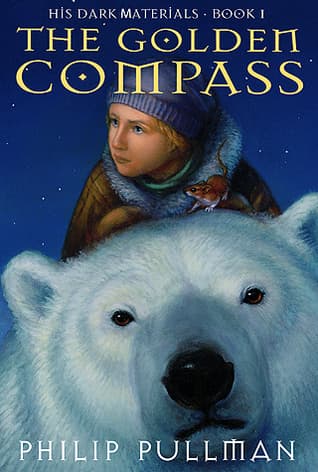
Philip Pullman (1995)
Genre
Fantasy / Children's / Science Fiction / Young Adult
Reading Time
8 hr 30 min
Key Themes
See below
Sign in to track this book
In a world where souls appear as animal daemons, an orphan named Lyra races to the frozen North to rescue her abducted friend and uncover a conspiracy that links stolen children, parallel worlds, and existence itself.
Lyra Belacqua, an adventurous orphan, lives with her daemon, Pantalaimon, at Jordan College, Oxford. She spends her days playing with other children and avoiding her studies. One evening, hidden in the Retiring Room with Pantalaimon, she listens to a meeting of the Master and Scholars. Her uncle, Lord Asriel, shows evidence of a mysterious particle called Dust, only seen in photos of the Aurora Borealis. He thinks it comes from a parallel world. He asks for money for an expedition to the North to investigate. This request is given with hesitation and secrecy. Lyra is curious, and Dust becomes an unsettling mystery.
After Lord Asriel leaves, children start disappearing from Oxford. This includes Lyra's friend, Roger Parslow, a kitchen boy from Jordan College. People say the 'Gobblers,' or the General Oblation Board, are the kidnappers. Lyra is very upset about Roger's disappearance. During this time, Mrs. Coulter comes to Jordan College. She offers to take Lyra to London as her assistant. The Master has some doubts, but Lyra, wanting adventure and a break from college, accepts. Before she leaves, the Master secretly gives her a truth-telling device called an alethiometer, telling her to keep it hidden.
In London, Lyra's life with Mrs. Coulter is exciting at first. She gets new clothes, goes to social events, and experiences a sophisticated life. But Mrs. Coulter's charm soon turns into a cold, controlling, and manipulative nature. Lyra feels more and more uneasy and alone. Mrs. Coulter's golden monkey daemon seems especially threatening. Lyra overhears talks and finds papers that show Mrs. Coulter is the head of the General Oblation Board, the group kidnapping children for experiments in the North. Horrified, Lyra realizes Mrs. Coulter plans to take her to the North for the same reason.
Scared by Mrs. Coulter's true identity, Lyra escapes from her apartment. Mrs. Coulter's agents chase her, but a group of Gyptians rescues her. These river-faring people have strong ties to Jordan College. The Gyptians, led by Ma Costa, Farder Coram, and John Faa, are also looking for their children, who the Gobblers abducted. They welcome Lyra, seeing her connection to Jordan College and her knowledge of Mrs. Coulter. Lyra tells them what she knows about Mrs. Coulter and the Gobblers, which strengthens their shared goal to go north.
As the Gyptians get ready for their journey north, Lyra focuses on learning the alethiometer. To everyone's surprise, she shows a natural ability to read the complex device without the need for its books. This skill usually takes years to develop. Farder Coram, a wise Gyptian, helps her practice. During this time, the Gyptian elders, especially Farder Coram and John Faa, talk about an old prophecy about Lyra. They believe she will play a part in a coming conflict about Dust, which they see as a form of original sin or knowledge. Her fate is tied to the balance of the worlds.
The Gyptian fleet, with Lyra, goes north towards the Arctic. They meet Serafina Pekkala, the queen of the Lake Enara witch clan. She confirms the Gobblers' experimental station, Bolvangar, exists and warns of its dangers. In the port town of Trollesund, they meet Iorek Byrnison, a disgraced armored bear (panserbjørne) who lost his armor and is forced to serve others. Lyra, using her alethiometer and cleverness, helps Iorek get his armor back. He becomes fiercely loyal to her. Iorek agrees to join their expedition, making him a strong ally in their quest to rescue the children.
Iorek and the alethiometer lead the Gyptians and Lyra to Bolvangar, the research station where the Gobblers do their experiments. Lyra, disguised and with Iorek's help, gets into the facility. Inside, she finds that the Gobblers are separating children from their daemons using a procedure called 'intercision.' This leaves both child and daemon traumatized and often dead. She is happy to find Roger among the captive children. Before her own intercision, Lyra sets off the fire alarm, causing chaos and letting her lead the children in a mass escape.
As the children run from Bolvangar, the waiting Gyptian forces, Iorek Byrnison, and Serafina Pekkala's witches meet them. A battle starts between the Gyptians and their allies against the Tartar guards and Mrs. Coulter's agents. Iorek is very helpful; his strength changes the battle. Lyra briefly confronts Mrs. Coulter before the facility starts to fall apart from the battle. The children are safely taken out, but Lyra knows her journey is not over. She learns that her uncle, Lord Asriel, is held prisoner further north, and Roger is still in danger.
After escaping Bolvangar, Lyra, Roger, and Iorek Byrnison go to Svalbard, the kingdom of the armored bears. Lord Asriel is supposedly held there. On their way, bears loyal to Iofur Raknison, the bear king who took Iorek's throne, attack them. Lyra, quick and clever, tricks Iofur into thinking she is a daemon. She says she will make him a true king if he beats Iorek in a fight. Her trick leads to a fight between Iorek and Iofur, allowing Iorek to become king again.
Lyra, Roger, and Iorek finally reach Lord Asriel's research station in Svalbard. Lyra is happy to see her uncle, but he is cold and distant. He tells them his plan: to use a lot of energy, made by separating a child from their daemon, to make a hole between their world and the parallel world he found through Dust. Lyra is horrified. She realizes the real, terrible reason for his research. Lord Asriel sees Roger, a child with potential and a strong daemon, as the right sacrifice. He takes Roger. Lyra has to choose: save Roger or stop her uncle from bringing an unknown force into the worlds.
Lyra begs and tries to stop him, but Lord Asriel continues his experiment. He separates Roger from his daemon, Salmakia, in a violent intercision. This releases a huge amount of energy. Roger dies instantly; his daemon disappears into Dust. The energy tears a hole in the sky, creating a bridge to a parallel world, just as Asriel wanted. Without a word, Lord Asriel walks through the portal, leaving Lyra devastated by Roger's death. Lyra knows she must understand what Asriel has done and get justice for Roger. She decides to follow him into the unknown world, with Pantalaimon.
The Protagonist
Lyra transforms from a carefree, ignorant child into a determined hero burdened by tragic choices, embracing her destiny to confront cosmic forces.
The Supporting
Pan remains Lyra's constant companion, adapting to her experiences and eventually settling into the form of a pine marten as she matures.
The Antagonist/Supporting
Asriel's single-minded pursuit of knowledge leads him to commit a horrific act, crossing into another world to continue his cosmic war.
The Antagonist
Coulter's manipulative facade crumbles as Lyra uncovers her horrific experiments, revealing her as a key antagonist driven by dark ambition.
The Supporting
Roger's abduction and eventual sacrifice serve as the tragic catalyst for Lyra's quest and her ultimate commitment to a greater cause.
The Supporting
Iorek regains his honor and throne through Lyra's help, becoming a steadfast ally and a symbol of strength and loyalty.
The Supporting
Farder Coram acts as a crucial mentor for Lyra, guiding her understanding of the alethiometer and the greater forces at play.
The Supporting
John Faa leads his people on a perilous journey, demonstrating unwavering leadership and commitment to family and justice.
The Supporting
Serafina acts as a mystical guide and powerful protector for Lyra, using her ancient wisdom and magic to aid the cause.
Daemons are central to identity. A daemon is the physical form of a human's soul, always an animal. Until puberty, a child's daemon can change, showing their growing personality. When adult, it takes a fixed form. The 'intercision' at Bolvangar, which separates children from their daemons, is a tearing apart of the soul. It leaves both human and daemon empty and hurt. This theme shows the strong link between inner self and outer form, and the bad results of breaking that bond. It highlights the importance of the individual soul.
“For Lyra, this was the most important rule of all: you could not be parted from your daemon.”
Lyra's journey is a story about growing up. She starts as a carefree child, unaware of the bad parts of her world. Her adventures make her face betrayal, cruelty, and death. Losing her friend, Roger, because of her uncle's ambition, ends her innocence. It forces her to make hard, moral choices. Daemons also show this: as Lyra faces more adult problems, Pantalaimon changes forms less often, showing he will soon settle into his final, adult shape.
“She was going to miss Roger. She was going to miss him for the rest of her life.”
The book looks at good and evil, especially through Lord Asriel and Mrs. Coulter. They do bad things for what they think are good reasons. Lord Asriel thinks he is fighting a corrupt Authority by seeking knowledge of Dust, even if it means sacrificing children. Mrs. Coulter, though cruel, also shows some motherly care for Lyra. The 'Magisterium' (the Church) is shown as a controlling force that stops knowledge. This theme questions simple ideas of good and bad. It suggests that good intentions can lead to bad results, and vice versa.
“He was a man who knew what he wanted and went for it, and what he wanted was not ignoble.”
The search for and control of knowledge are key to the story. Lord Asriel wants to understand Dust and parallel worlds, challenging the Magisterium's beliefs. The Magisterium, fearing Dust (which they call Original Sin), tries to control information and stop scientific study. This is seen in the intercision experiments, which try to prevent Dust's 'corrupting' effect. Lyra's ability to read the alethiometer, a device of pure truth, goes against this control. This makes her important in the fight for open knowledge and understanding.
“The Church, for its part, has always suppressed the study of Dust.”
Lyra is said to be a child of prophecy. She is meant to play a part in a big conflict. The alethiometer, which tells truths, often points to her path. But Lyra often acts on instinct, emotion, and her own cleverness. She makes choices that are not always expected. Her decision to follow Lord Asriel into the new world at the end, because of sadness and wanting answers, feels like her own choice, even if it fits a larger destiny. The book explores the balance between a foretold fate and a person's ability to choose their own way.
“This child is destined to betray.”
External manifestations of human souls, reflecting identity and emotional state.
Daemons are animal companions that are the physical embodiment of a person's soul. They are inseparable from their human, and their form reflects the human's personality. Children's daemons can change shape, symbolizing their unformed identities, while adults' daemons settle into a fixed form. Daemons allow for visible representations of inner turmoil, emotional bonds, and the devastating impact of 'intercision' (soul separation). They are a unique and fundamental aspect of the world-building, making the abstract concept of a soul tangible and vulnerable.
A truth-telling device that reveals answers to any question, guided by symbolic meanings.
The alethiometer is a golden compass-like device with 36 symbols around its face, each with multiple layers of meaning. By setting three hands to specific symbols, a skilled reader can ask a question, and a fourth, oscillating hand will point to the answer. Lyra possesses an innate, intuitive ability to read it without needing the complex interpretive books, a skill that usually takes years to master. It serves as a crucial plot device, guiding Lyra's journey, revealing hidden truths, and providing exposition about Dust, prophecies, and the intentions of others.
A mysterious cosmic particle linked to consciousness, knowledge, and parallel worlds.
Dust is a fundamental, mysterious particle that Lord Asriel discovers through photographs of the Aurora. It is drawn to consciousness and is associated with knowledge, adulthood, and potentially 'Original Sin' by the Magisterium. Its existence implies parallel worlds and challenges established religious doctrines. Dust is the central scientific and theological mystery of the story, driving Asriel's research and the Magisterium's efforts to suppress it through intercision. Its nature and implications are the core conflict that propels the entire trilogy.
The existence of multiple universes, connected through phenomena like Dust and the Aurora.
The concept of parallel worlds is introduced early on by Lord Asriel, who theorizes that Dust originates from a different universe visible through the Aurora Borealis. This device expands the scope of the narrative beyond Lyra's initial world, setting the stage for a multi-world conflict. The eventual tearing open of a gateway to another world at the end of the book is a literal manifestation of this device, directly opening the narrative to the larger cosmological stakes and future adventures across different realities.
Foretold events that guide characters' actions and hint at a larger destiny.
Various prophecies, particularly those concerning Lyra, are mentioned by characters like the Gyptian elders and Serafina Pekkala. These prophecies suggest Lyra is destined to play a crucial role in a looming cosmic struggle, particularly one involving 'betrayal.' This device adds a layer of epic fantasy to the story, giving Lyra's personal journey a greater, preordained significance. It creates dramatic tension around her choices and hints at the grander scale of the unfolding events, shaping the expectations of both characters and readers.
“You cannot change what you are, only what you do.”
— Iorek Byrnison to Lyra Belacqua about accepting one's nature while choosing actions.
“Tell them stories. They need the truth. You must tell them true stories, and everything will be well, just tell them stories.”
— The alethiometer advises Lyra on the power of storytelling and truth.
“Without stories, we wouldn't be human beings at all.”
— Lyra reflects on the importance of narratives in human experience.
“That's the duty of the old, to be anxious on behalf of the young. And the duty of the young is to scorn the anxiety of the old.”
— Mrs. Coulter explains generational dynamics to Lyra.
“I am a bear, you see. I am not a human, and I have no daemon.”
— Iorek Byrnison asserts his identity as an armored bear.
“All the history of human life has been a struggle between wisdom and stupidity.”
— The scholar discussing the alethiometer's revelations.
“The intentions of a tool are what it does. A hammer intends to strike, a vise intends to hold.”
— Iorek Byrnison explains purpose and function to Lyra.
“We are all subject to the fates. But we must all act as if we are not, or die of despair.”
— A gyptian elder discussing destiny and free will.
“There are some places we need to go, and we don't know why until we get there.”
— Lyra contemplating her journey and the alethiometer's guidance.
“A quick death is not always the best death. A slow death can be a better one.”
— Iorek Byrnison on the nature of death and honor.
“Evil is not a thing, it's a quality of action.”
— A discussion among scholars about morality and the alethiometer.
“The world is full of things that don't make sense, and we have to make sense of them.”
— Lyra trying to understand the complexities of her world.
“To be a child is to be curious, and to be curious is to be alive.”
— Reflection on Lyra's innate curiosity driving the plot.
“We have to build the Republic of Heaven where we are, because for us there is no elsewhere.”
— A philosophical idea introduced about creating meaning in one's own world.
Ready to see how well you understood this book? Take our interactive quiz with 10 questions.

Sir Philip Nicholas Outram Pullman is an English writer. His books include the fantasy trilogy His Dark Materials and The Good Man Jesus and the Scoundrel Christ, a fictionalised biography of Jesus. In 2008, The Times named Pullman one of the "50 greatest British writers since 1945". In a 2004 BBC poll, he was named the eleventh most influential person in British culture. He was knighted in the 2019 New Year Honours for services to literature.







