“Never underestimate the power of stupidity.”
— Lamont's frustration with the Earth's scientific establishment.

Isaac Asimov (1972)
Genre
Fantasy / Science Fiction
Reading Time
360 min
Key Themes
See below
Sign in to track this book
Humanity's addiction to limitless, free energy from a parallel universe puts Earth on a collision course with solar annihilation, forcing an unlikely alliance of outcast scientists and rebellious aliens to convince a skeptical cosmos of the impending doom.
In 2070, Earth physicist Frederick Hallam discovers the 'electron pump,' a device that taps into a parallel universe, providing limitless, free energy. The process exchanges tungsten-186 from our universe for plutonium-186 from the para-universe, a seemingly stable reaction that generates vast amounts of energy. Hallam, a controversial figure with a reputation for intellectual arrogance, quickly becomes a global hero, overshadowing his colleagues and dismissing any potential dangers. The initial success of the pump leads to an era of prosperity and technological advancement on Earth. The energy becomes the foundation of society. However, a young, unassuming radio chemist named Peter Lamont notices an anomaly in the exchanged material that hints at a deeper, more dangerous interaction.
Peter Lamont, while working on the electron pump project, discovers that the exchanged plutonium-186 is not merely a different isotope but decays at an accelerated rate, emitting positrons. He theorizes that the exchange process alters the fundamental constants of both universes, specifically the strong nuclear force, causing the instability. Lamont attempts to bring his findings to Hallam, but Hallam, basking in his fame and convinced of his own infallibility, dismisses Lamont's concerns as the ramblings of an inexperienced junior scientist. Hallam's immense influence and the world's reliance on free energy make it nearly impossible for Lamont to gain traction or convince anyone in power of the impending catastrophe, leaving him isolated in his discovery.
In the para-universe, inhabited by three-sexed, amorphous beings called 'Soft Ones,' Dua, a 'Left' (female equivalent), feels a growing unease. Her universe has a strong nuclear force significantly weaker than ours, leading to short-lived stars and a rapid, intense life cycle for its inhabitants. The Soft Ones live in communal 'parenthoods' of three: a Left (emotional, nurturing), a Middle (intellectual, logical), and a Right (physical, creative). Dua, along with her assigned Middle, Odeen, and Right, Tritt, is part of a collective that 'feeds' a device that exchanges material with our universe. She begins to question the purpose of their existence, the constant 'feeding,' and the vague, almost mythical 'Hard Ones' who created their world. She is driven by an instinctual sense that something is wrong.
Dua's increasing curiosity leads her to defy the societal norms of the Soft Ones, who are generally content with their brief, intense lives and their role in the 'feeding.' She develops a strong bond with Odeen and Tritt, pushing them to explore beyond their immediate sensory experiences. Through their collective intellect, they uncover the truth: their universe's energy source is directly linked to the material exchange with the 'Hard Ones'' universe (our own). The Hard Ones, who are the 'creators' of the Soft Ones, designed their universe to have a weaker strong nuclear force, allowing them to exploit it for energy by exchanging matter. The Soft Ones are essentially living energy converters, unaware of the cosmic game they are part of. Dua realizes their very existence is a byproduct of this grand energy scheme.
Dua, Odeen, and Tritt understand the devastating consequences of the energy exchange. The constant weakening of the strong nuclear force in their universe, while beneficial for the Hard Ones, accelerates the decay of their own suns and shortens their already fleeting lives. More critically, they deduce that the exchange also causes the strong nuclear force in the Hard Ones' universe to strengthen. This will eventually lead to the destruction of their sun through super-dense matter formation. Driven by a desperate need for survival and empathy, Dua resolves to communicate this dire warning to the Hard Ones. This act of defiance is unprecedented in the Soft Ones' society, placing them in extreme danger from their own kind who perceive their actions as heresy.
Back in our universe, Hallam continues to dismiss Lamont's urgent warnings, using his political and scientific influence to silence dissent. Earth society, enjoying the benefits of free energy, has no desire to question its source. Meanwhile, on the Moon, a distinct human culture has developed, characterized by a more intuitive and less rigidly logical approach to science. The Lunarites, led by figures like Benjamin Denison, have developed a form of 'para-psychology' or intuitionism, which Earth often scoffs at. They are more open to unconventional ideas and less beholden to Hallam's authority. This cultural divergence sets the stage for a potential breakthrough, as the Lunarites might be more receptive to the subtle signs of impending doom that Earth scientists ignore.
Benjamin Denison, a Lunarite physicist, is a maverick who uses intuitive leaps in his scientific research, often to the consternation of traditional Earth scientists. He is tasked with investigating the 'para-universe' and the energy exchange, but without the constraints of Earth's Hallam-dominated scientific establishment. Denison, working with his Lunarite colleagues, begins to perceive anomalies in the energy transfer that resonate with his intuitive understanding of the cosmos. He doesn't have Lamont's precise chemical data, but he senses a growing instability and an impending imbalance. His approach, less reliant on empirical data alone and more on holistic pattern recognition, allows him to start seeing connections that elude his Earth counterparts, making him a potential ally for Lamont.
Dua, Odeen, and Tritt, after much effort and personal risk, manage to send a message across the dimensional barrier. However, their means of communication are extremely alien and difficult for humans to interpret. The message arrives as a series of abstract, complex energy patterns that are initially dismissed as noise or random fluctuations by Earth scientists. Benjamin Denison, with his intuitive approach and the unique mental capabilities of the Lunarites, is the only one who can begin to make sense of these 'para-messages.' He perceives an underlying structure, a desperate plea for help, and a warning of catastrophic consequences. The challenge now is to translate these alien concepts into human understanding and to convince others of their validity.
Denison, interpreting the para-universe's message, understands that the electron pump not only destroys the para-universe but will eventually cause our own sun to explode. He realizes that the strengthening of our universe's strong nuclear force will lead to a runaway fusion reaction. Independently, Peter Lamont has gathered more conclusive chemical evidence supporting his theory of the strong force alteration. When Denison and Lamont finally meet, their separate lines of investigation converge perfectly. Lamont provides the hard scientific data, while Denison offers the intuitive understanding and the crucial warning from the para-universe. Together, they have a complete picture of the impending doom, but still face the formidable task of convincing a skeptical world.
Armed with their combined evidence, Lamont and Denison confront Hallam and the global scientific establishment. Hallam, deeply entrenched in his ego and the adoration of the public, vehemently denies their claims, accusing them of trying to sabotage his legacy. The world's reliance on free energy makes any suggestion of its cessation unthinkable, and Hallam skillfully manipulates public opinion against Lamont and Denison. The two scientists face ridicule, professional isolation, and political pressure. They realize that simply presenting the facts is not enough; they must find a way to overcome the powerful inertia of a society unwilling to give up its comfort, and the entrenched authority of a man who has become a global deity.
Denison, using his intuitive understanding of the para-universe and collaborating with Lamont's scientific rigor, devises a radical solution: a 'new electron pump.' This revised device would reverse the exchange, sending plutonium-186 from our universe to the para-universe, and receiving tungsten-186. This would gradually restore the strong nuclear force balance in both universes, preventing the destruction of both suns. However, implementing this new pump requires immense political will and a global effort to dismantle the existing energy infrastructure. It also means giving up the 'free' energy from the old pump, which is a major point of contention. The new pump would provide energy, but at a more controlled, less catastrophic rate, ensuring long-term survival for both universes.
The choice is stark: continue with Hallam's pump and face eventual annihilation, or switch to Denison's pump and secure a future, albeit one without limitless, completely free energy. The debate rages globally, with Hallam fighting to maintain his status. Ultimately, the overwhelming scientific evidence, coupled with the increasingly undeniable signs of cosmic instability, sways public opinion. Hallam is discredited, and the world begins the difficult transition to the new electron pump. The process is slow and challenging, but humanity, guided by the combined efforts of Lamont and Denison, chooses long-term survival over immediate gratification. Both universes are saved from their respective dooms, marking a new era of inter-universal cooperation and a humbling lesson for humanity.
The Antagonist
From celebrated genius, Hallam's arc sees him clinging desperately to his fame, ultimately being exposed as dangerously short-sighted and discredited.
The Protagonist
Lamont transforms from an ignored junior scientist into a pivotal figure whose scientific rigor helps save humanity.
The Protagonist
Dua evolves from an instinctively questioning alien to a courageous leader who risks everything to warn another universe.
The Supporting
Odeen, initially a typical 'Middle,' becomes a critical intellectual force, driven by Dua's insights to uncover universal truths.
The Supporting
Tritt moves from a purely physical existence to one embracing intellectual and emotional depth, supporting his parenthood's critical mission.
The Protagonist
Denison's intuitive methods are vindicated, transforming him from a scientific outsider into a savior of humanity.
The Supporting
Kendig's trust in Denison's methods is rewarded, solidifying the importance of Lunarite intuitionism.
The Supporting
Lindstrom's specialized skills prove indispensable, showcasing the value of interdisciplinary Lunarite science.
The novel shows how scientific advancement, when pursued without caution or ethical consideration, can lead to catastrophic consequences. Hallam's pursuit of fame and his dismissal of dissenting voices exemplify the perils of scientific hubris. His electron pump, while offering limitless energy, simultaneously threatens to destroy both universes due to his arrogance and refusal to acknowledge the subtle signs of danger. This theme is highlighted in Lamont's initial, ignored warnings and Hallam's subsequent, aggressive defense of his flawed discovery. It shows how a society's desire for easy solutions can blind it to existential threats.
“Against stupidity, the gods themselves contend in vain.”
Asimov contrasts the rigid, empirical scientific method of Earth, dominated by Hallam's rational but flawed logic, with the more intuitive and holistic approach of the Lunarites and the alien Soft Ones. Peter Lamont, despite his empirical evidence, struggles to be heard. Benjamin Denison's intuitive leaps, combined with the Lunarites' unique 'para-psychology,' allow him to interpret the alien warnings. Similarly, Dua's emotional intuition drives the Soft Ones' intellectual discovery. The story argues that a combination of logical analysis and intuitive insight is necessary for true understanding and problem-solving, especially when facing unprecedented challenges. This is evident in how Denison and Lamont's disparate approaches ultimately converge to form the complete solution.
“If you are to survive, you must abandon logic and use intuition.”
The narrative explores responsibility extending beyond one's own species or even universe. The Soft Ones, particularly Dua, show empathy by risking their lives to warn the 'Hard Ones' (humans) of the impending disaster, even though their own universe also suffers. Conversely, humanity's initial exploitation of the para-universe's energy without understanding its full implications highlights a lack of inter-universal responsibility. The eventual solution requires a conscious choice by humanity to act not just for their own survival, but for the well-being of the other universe, establishing a symbiotic relationship rather than an exploitative one. This theme underscores that true progress involves understanding and caring for the broader cosmic community.
“The universe is not for us to simply take from. There are others.”
The novel explores different forms of intelligence and the challenges of inter-species communication. The Soft Ones' three-part collective intelligence (Left, Middle, Right) offers a unique perspective on consciousness and problem-solving, distinct from human individuality. Their method of communication, initially incomprehensible energy patterns, highlights the difficulty of translating alien concepts into human understanding. Denison's intuitive interpretation and Lindstrom's psychological expertise are crucial in bridging this gap. This theme suggests that intelligence isn't monolithic and that truly understanding another species requires moving beyond anthropocentric assumptions and embracing novel modes of thought and interaction.
“How do you communicate with a being whose mind is so utterly different from your own?”
A central theme is the delicate balance of fundamental physical constants that govern the existence of universes. The electron pump, by altering the strong nuclear force in both universes, demonstrates how seemingly minor interventions can have catastrophic, cascading effects on a cosmic scale. The novel emphasizes that the stability of our universe, and the para-universe, is not a given but a precarious equilibrium that can be easily disrupted. This highlights humanity's potential to inadvertently cause universal destruction through a lack of understanding and foresight, reinforcing the need for extreme caution when manipulating fundamental forces.
“The universe is a fragile thing, balanced on the edge of a knife.”
A device exchanging matter between universes to generate energy.
The electron pump is the central technological innovation of the story. It operates by exchanging tungsten-186 from our universe for plutonium-186 from a parallel universe, generating vast amounts of energy. Initially presented as a miraculous source of limitless power, it becomes the catalyst for the entire conflict. Its true function—altering the strong nuclear force in both universes—is the fatal flaw that drives the plot, making it both a symbol of human ingenuity and a device of potential destruction. The pump's existence creates the initial prosperity and subsequent existential threat.
A parallel dimension with different physical constants and alien life.
The para-universe serves as a crucial setting and plot device, providing the source of the electron pump's energy and introducing the alien Soft Ones. Its distinct physical laws (a weaker strong nuclear force) and unique life forms (three-sexed, amorphous beings with a collective consciousness) highlight the novel's themes of diverse intelligence and cosmic interconnectedness. The para-universe's suffering due to the electron pump directly informs the human protagonists of the danger, making it an indispensable element for the plot's resolution.
A fundamental physical constant whose alteration drives the conflict.
The strong nuclear force is a key scientific concept used as a plot device. Its subtle alteration, caused by the electron pump's matter exchange, is the underlying mechanism for the impending destruction of both universes. In our universe, it strengthens, leading to a solar explosion; in the para-universe, it weakens, leading to rapid stellar decay. This fundamental force's manipulation provides the scientific basis for the catastrophe and the solution, grounding the science fiction elements in real-world physics concepts, albeit extrapolated.
A form of non-logical, holistic understanding developed by Lunarite humans.
Intuitionism, as practiced by the Lunarites, is a unique cognitive ability that allows for a more holistic and non-linear understanding of complex phenomena. It serves as a critical plot device by enabling Benjamin Denison to interpret the otherwise incomprehensible alien messages from the para-universe. This contrasts sharply with Earth's strictly logical, empirical science, highlighting the theme of diverse perspectives. Without the Lunarites' intuitive gifts, the warning from Dua would likely have gone unheeded, making intuitionism essential for humanity's survival.
“Never underestimate the power of stupidity.”
— Lamont's frustration with the Earth's scientific establishment.
“The most exciting phrase to hear in science, the one that heralds new discoveries, is not 'Eureka!' but 'That's funny...'”
— Discussing the nature of scientific discovery and unexpected results.
“An argument is not a dispute; it is an investigation.”
— Discussing the proper approach to scientific or intellectual debate.
“Even a mind of genius, if it is not prepared for the inevitable, will find itself surprised.”
— Reflecting on the unexpected consequences of the electron pump.
“It is change, continuing change, inevitable change, that is the dominant factor in society today. No sensible decision can be made any longer without taking into account not only the world as it is, but the world as it will be.”
— Discussing the rapid advancements and societal impact of the electron pump.
“Against stupidity, the gods themselves contend in vain.”
— A direct quote, reflecting Lamont's deep pessimism about humanity's ability to act rationally.
“The universe doesn't care about your feelings, or your opinions, or your theories. It just is.”
— Reflecting on the impersonal nature of scientific reality.
“When the facts change, I change my mind. What do you do, sir?”
— Though not a direct quote from the book, the sentiment of adapting to new evidence is central to the scientific characters' struggles.
“There are no eternal truths, only eternal questions.”
— A philosophical reflection on the ongoing nature of scientific inquiry.
“It is the chief feature of the world that it is incomprehensible.”
— Reflecting on the vastness and mystery of the cosmos, particularly from the perspective of the para-universe beings.
“To communicate is to be human.”
— Discussing the fundamental need for interaction and understanding, especially between different species.
“The greatest danger is not that we aim too high and miss, but that we aim too low and hit.”
— A general reflection on ambition and the potential for complacency, especially in scientific endeavors.
“What is the good of having a brain if you are not prepared to change your mind?”
— A character's exasperation with those unwilling to accept new evidence.
“Life is a constant process of dying.”
— A somber reflection on existence, particularly from the perspective of the beings in the para-universe.
Ready to see how well you understood this book? Take our interactive quiz with 10 questions.
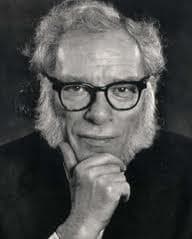
Isaac Asimov was an American writer and professor of biochemistry at Boston University. During his lifetime, Asimov was considered one of the "Big Three" science fiction writers, along with Robert A. Heinlein and Arthur C. Clarke. A prolific writer, he wrote or edited more than 500 books. He also wrote an estimated 90,000 letters and postcards. Best known for his hard science fiction, Asimov also wrote mysteries and fantasy, as well as much non-fiction.







