“They all made the same mistake. They decided that they would never do what they had been told they must do.”
— Refers to Ammu and Velutha's defiance of caste rules.

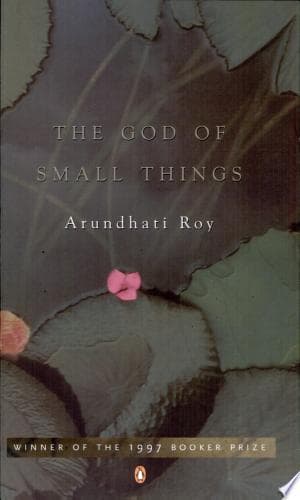
Arundhati Roy (2002)
Genre
Literary Fiction / Historical Fiction
Reading Time
7-8 hours
Key Themes
See below
Sign in to track this book
Through the eyes of fraternal twins Rahel and Estha, Roy writes a moving and rich story exploring forbidden love, the caste system, and the shattering impact of one fateful decision in 1960s Kerala.
The novel begins in 1993, with Rahel returning to Ayemenem, Kerala, after a long time away, mostly spent in America. She finds the once lively Ipe family home, now called the History House, run down and overgrown. Her twin brother, Estha, has become quiet and withdrawn, a state called 'Esthapanized,' and has recently returned from Australia. Their reunion is silent, marked by a shared, unspoken sadness that fills the air. The story immediately shows how past tragedies still affect the adult twins, hinting at the devastating events that shaped their lives and separated them. The oppressive heat and the decaying beauty of Ayemenem reflect the emotional state of its residents.
The story moves back to 1969, describing the anticipated arrival of Sophie Mol, the nine-year-old daughter of Chacko, Rahel and Estha's uncle, and his English ex-wife, Margaret Kochamma. Sophie's arrival from England is a big event for the Ipe family. Ammu, Rahel and Estha's mother, sees it with a mix of hope and worry, knowing it will be a temporary change. For the seven-year-old twins, Sophie's presence is a source of great excitement and novelty. They are fascinated by her Englishness and the gifts she brings. This time represents a brief moment of childhood innocence and happiness, contrasting sharply with the somber present-day story and hinting at the tragedy to come.
Ammu, feeling trapped and unloved after her divorce, finds comfort and passion in a secret affair with Velutha, a skilled carpenter working for the Ipe family's pickle factory. Velutha is a Paravan, an 'Untouchable' in Kerala's deeply rooted caste system. Their relationship breaks the 'Love Laws' – unwritten rules that dictate 'who should be loved, and how. And how much.' The twins, Rahel and Estha, like Velutha, who treats them kindly and with respect. This forbidden love is a central conflict, showing the oppressive social structures and the severe consequences for those who defy them, especially women and lower-caste individuals. The affair is kept very secret, but its discovery is unavoidable and disastrous.
Baby Kochamma, Ammu's grand-aunt, driven by her own hidden desires and a deep prejudice against Velutha because of his caste, discovers Ammu and Velutha's forbidden relationship. Her discovery comes from a mix of moral outrage and a desire to keep the family's social standing. She manipulates events and people, especially Mammachi, to make sure the relationship is exposed and punished. This revelation shatters the fragile peace in the Ipe household and sparks a furious reaction from Chacko, Ammu's brother. The family's anger is not just about the affair itself, but the serious violation of the caste system, which they, as Syrian Christians, strictly follow. Baby Kochamma's actions are central, directly leading to Velutha's tragic downfall and the ruin of Ammu and her children.
After the discovery, Chacko locks Ammu in her room, forbidding her from seeing her children. The family, especially Baby Kochamma, fearing the social fallout of the affair, decides to frame Velutha for the attempted rape of Ammu and the kidnapping of the children. They invent a false story, using the local police's deep-seated prejudices against 'Untouchables.' Inspector Thomas Mathew, a corrupt and caste-biased officer, readily accepts their made-up account. Velutha, unaware of the family's plans, is brutally beaten by the police, despite his innocence. This act of grave injustice shows the systemic oppression and how easily power is abused against the vulnerable in society.
Amidst the chaos and tension after Ammu's punishment, the twins, Rahel and Estha, along with Sophie Mol, decide to run away in their uncle's country boat. They are trying to escape the unhappiness at home and perhaps find Velutha, whom they believe is innocent. During their journey across the river, their boat capsizes in a storm. Sophie Mol, who cannot swim, drowns. This accidental death is a devastating blow, not only to Margaret Kochamma and Chacko but to the entire family. It starts a series of horrific events, becoming the tragic point around which the children's lives are broken and the family's secrets are further hidden. The storm itself can be seen as mirroring the internal turmoil and impending disaster.
After Sophie Mol's drowning, the traumatized children are found and brought back. Baby Kochamma, seeing a chance to get rid of Velutha for good and protect their reputation, manipulates Rahel and Estha. She forces them to lie to the police, making them testify that Velutha was responsible for Sophie Mol's death and that he tried to harm them. The children, scared and confused, and under great pressure, confirm her made-up story. This forced betrayal by the children seals Velutha's fate and is a serious violation of their innocence. It leaves them with a heavy burden of guilt and complicity, scarring them for life and contributing to their later silence and emotional withdrawal.
Based on the children's forced testimony and the family's false accusations, police brutally beat Velutha in the lockup. Despite his innocence and the complete lack of evidence, the police, driven by caste prejudice and a desire to please the influential Ipe family, inflict a merciless beating. Velutha dies from his injuries, a tragic victim of a corrupt justice system and deep social discrimination. The truth of his innocence is never publicly acknowledged, and his death remains a dark secret within the Ipe family.
Following Sophie Mol's death and Velutha's murder, the Ipe family completely falls apart. Ammu is unfairly blamed for everything. Chacko, using his authority, banishes her from the house, denying her access to her children and leaving her with nothing. Estha, due to a complicated reason involving his father's new wife and his perceived 'unsuitability,' is 'Returned' to his estranged father, Baba, in Calcutta, effectively separating him from Rahel and Ammu. This forced separation is a deep trauma for the twins, breaking their strong bond and leaving them isolated. Ammu eventually dies alone, years later, a broken woman. The family house becomes a tomb of unspoken grief and faded memories.
After the terrible events of 1969, Rahel lives a fragmented and unsettled life. She is eventually expelled from school for various minor misbehaviors, reflecting her deep trauma and inability to fit in. She drifts through different cities and countries, including Delhi and New York, pursuing various artistic and architectural projects, but never truly settling. Her relationships are brief and unfulfilling, marked by a pervasive sense of detachment and an inability to form deep connections. She carries the weight of the past, the guilt of her childhood lie, and the deep loss of her mother, brother, and Velutha. Her return to Ayemenem in 1993 shows a desperate attempt to confront her past and perhaps find some resolution or understanding.
Estha, after being 'Returned' to his father in Calcutta, lives a life defined by his deep silence. The trauma of Sophie Mol's death, Velutha's murder, the forced lie, and his separation from Ammu and Rahel make him almost completely mute. He is withdrawn, obsessive, and carries a clear sense of grief and guilt. He returns to Ayemenem after his father's death, living with Mammachi and Baby Kochamma, who largely ignore his emotional state. His 'Esthapanized' condition is a direct result of the psychological wounds from his childhood, showing the devastating impact of the 'Love Laws' and the family's betrayal. His silence is a powerful symbol of the unaddressed pain and injustice that fills the Ipe family's history.
In 1993, Rahel and Estha reunite in Ayemenem. Their reunion is not joyous but one of a shared, unspoken burden. They communicate through glances, gestures, and a deep understanding born of shared trauma. Estha's silence is not a barrier but a language they both understand. They revisit the places of their childhood, the river, the History House, the pickle factory, each location heavy with memories. Their connection is the only remaining thread from their shattered past. They are two halves of a whole, forever bound by the tragedy that consumed their family. Their reunion shows the lasting power of their twinship and the lingering shadow of the past.
The novel ends with Rahel and Estha, now adults, having an incestuous encounter. This deeply forbidden act is presented not as one of passion, but of deep comfort, a desperate attempt to reclaim what was lost and to find connection in their isolated lives. It is another violation of the 'Love Laws,' reflecting and intensifying the forbidden love between Ammu and Velutha. Their intimacy is a tragic consequence of their shared trauma and their inability to form healthy relationships in the outside world. It signifies the cyclical nature of the 'Love Laws' – those who break them are doomed, and those who suffer under them are driven to further transgression, continuing a cycle of pain and forbidden desire.
The Protagonist
From a rebellious young woman seeking love, she is broken and destroyed by societal judgment and the tragic loss of her children and lover.
The Protagonist
From an innocent, imaginative child, she becomes a detached, wandering adult, carrying the weight of unspoken trauma, eventually seeking solace in her brother.
The Protagonist
From a sensitive, imaginative child, he is traumatized into a lifelong silence, returning to his childhood home as a broken man seeking unspoken solace.
The Supporting/Tragic Hero
A kind and skilled man who dares to love across caste lines, leading to his unjust persecution and brutal death.
The Antagonist
Her character remains static, consistently driven by malice, prejudice, and manipulation, ultimately living a lonely and bitter old age.
The Supporting
Initially a somewhat distant figure, he becomes a grieving father and a harsh patriarch, ultimately banishing Ammu and failing to protect his family.
The Supporting
A kind but ultimately passive figure, she slowly declines, burdened by unspoken grief and the family's secrets.
The Supporting
Her brief appearance brings a fleeting joy, and her accidental death irrevocably shatters the Ipe family.
The Mentioned/Supporting
His character is established through memory as a consistently cruel and abusive figure, whose influence lingers even after his death.
The Supporting
A static character, he remains a corrupt and prejudiced figure, acting as an instrument of the oppressive social system.
The main theme is the 'Love Laws,' unspoken rules dictating 'who should be loved, and how. And how much.' The novel carefully details the devastating consequences of breaking these laws, especially through the forbidden love between Ammu, an upper-caste woman, and Velutha, an 'Untouchable' Paravan. Their relationship challenges the rigid caste system and the deep social hierarchy of Kerala in the 1960s. The severe punishment they receive – Velutha's brutal murder and Ammu's exclusion – illustrates how brutally these societal norms are enforced. The 'Love Laws' go beyond caste to gender roles and family expectations, affecting Ammu's divorce and the twins' later separation.
“It was just a way of knowing what should and shouldn't be. And what should and shouldn't be loved. The Love Laws. The laws that lay down who should be loved, and how. And how much.”
The novel clearly shows the irreversible loss of innocence experienced by Rahel and Estha. The catastrophic events of 1969 – the discovery of Ammu and Velutha's affair, Sophie Mol's drowning, Velutha's murder, and the children's coerced lie – shatter their childhood. This trauma shows up in their adult lives: Estha's deep silence and Rahel's unsettled, detached existence. The story constantly shifts between the lively, innocent past and the desolate, grief-stricken present, emphasizing how these childhood traumas permanently scar the twins, preventing them from forming healthy relationships or finding peace. Their inability to speak about the past shows the depth of their psychological wounds.
“They had learned that the world had to be kept outside. That inside, things were different.”
The oppressive and discriminatory nature of the Indian caste system is a constant theme. Velutha, as a Paravan (formerly 'Untouchable'), faces systemic prejudice and violence. His love for Ammu, an upper-caste Syrian Christian, is seen as an unforgivable offense. The novel shows how easily the powerful Ipe family can manipulate the police and the justice system to frame and murder Velutha, simply because of his caste. The caste system dictates not only social interactions but also determines one's worth and right to exist, leading to great injustices and the brutal suppression of those who dare to defy its boundaries. The 'Love Laws' are closely tied to the caste system.
“Small things, God of Small Things. The things that are too small to be seen, to be heard, to be felt. The things that don't matter. But they do.”
The narrative structure itself highlights memory and time. The story unfolds in a non-linear way, constantly shifting between 1969 and 1993. This mirrors the fractured and cyclical nature of memory. The past is not distant but a living presence that constantly shapes the present. The dilapidated 'History House' physically shows this. The characters are haunted by their memories, unable to escape the past's influence. The novel suggests that history, both personal and collective, is not a straight line but a complex web of interconnected events, where 'things can change in a day,' but their effects last a lifetime. The twins' shared memories are their only true connection.
“The past was like a an old house, full of cobwebs and dust, but also full of the echoes of lives lived.”
The novel explores how stories are told, hidden, and manipulated. Baby Kochamma's false story against Velutha is a prime example of how powerful individuals can twist truth for their own ends. Conversely, Estha's deep silence shows the unspeakable trauma he carries. The narrative itself weaves a complex, fragmented story, suggesting that some truths can only be conveyed indirectly, through the 'God of Small Things.' The novel gives voice to those who were silenced by society – Ammu, Velutha, and the children – allowing their untold stories to finally emerge. This highlights the importance of acknowledging forgotten histories and injustices.
“She had told him that he was the most beautiful man she had ever seen. And that she loved him. He had told her that he loved her too. And that he would always love her. And that was all they had said to each other. Everything else was unspoken.”
The story jumps back and forth between 1969 and 1993.
The novel employs a non-linear narrative, constantly shifting between the pivotal year of 1969, when the tragic events unfold, and 1993, when the adult twins, Rahel and Estha, reunite. This device creates a sense of suspense and foreshadowing, gradually revealing the full scope of the tragedy and its lasting impact. It mirrors the fragmented nature of memory and trauma, showing how the past is not a distinct entity but a living presence that continues to shape the present. The reader pieces together the story alongside the characters, experiencing their grief and confusion.
Hints and clues throughout the narrative allude to future tragedies.
Roy masterfully uses foreshadowing to build tension and deepen the sense of impending doom. Early descriptions of the dilapidated Ayemenem house in 1993, Estha's profound silence, and Rahel's detachment all hint at a devastating past. Phrases like 'the day Sophie Mol died' are introduced early, making the reader aware of a future tragedy before its details are revealed. This technique creates a pervasive atmosphere of melancholy and inevitability, emphasizing that the characters are already living with the consequences of events yet to be fully disclosed.
Objects, places, and characters represent deeper meanings.
The novel is rich in symbolism. The 'History House' symbolizes the decaying grandeur of the Ipe family and the weight of their past. The river represents both life and death, connection and separation. The pickle factory, initially a source of family income, becomes a symbol of their decline. The 'Love Laws' themselves are a powerful symbol of societal oppression. Even the 'God of Small Things' represents the overlooked details and the marginalized individuals whose lives are profoundly affected by larger forces. These symbols enrich the narrative, adding layers of meaning and emotional resonance to the story.
Narrative technique that captures the flow of characters' thoughts and feelings.
While not exclusively a stream of consciousness novel, Roy frequently employs elements of this technique, particularly when delving into the minds of Rahel and Estha as children. The narrative often blurs the lines between observation, memory, and internal thought, reflecting the twins' unique, often non-verbal way of perceiving the world. This allows the reader to experience their emotional states and fragmented understanding of events, deepening the empathy for their trauma and illustrating how their childhood innocence is gradually eroded by the overwhelming circumstances around them.
“They all made the same mistake. They decided that they would never do what they had been told they must do.”
— Refers to Ammu and Velutha's defiance of caste rules.
“It was a time when the world was changing, but not in Kottayam. In Kottayam, the world was still fixed.”
— Describes the unchanging nature of their small town despite global shifts.
“And the God of Small Things. He knew what Love was (God's Love, a parent's, a lover's, a friend's), but He didn't know what Small Things were. He only knew what God's things were.”
— Explores the idea of a deity concerned with grander matters, overlooking the mundane yet significant.
“Each of them knew that what had happened could not be undone. And that the world would never be the same.”
— After the tragic events involving Velutha and Sophie Mol's death.
“That's how it was with now. It was always there. It was always coming. It was always on its way.”
— A reflection on the persistent and ever-present nature of the 'now'.
“She was a woman who had grown up in a house where the sound of breaking glass was as common as the sound of birdsong.”
— Describes Ammu's upbringing, hinting at a chaotic and troubled past.
“Little events, ordinary things, it was just a question of not noticing them.”
— Highlights the human tendency to overlook the subtle signs leading to bigger events.
“The secret of the Big Things was that they were only Small Things that had been allowed to fester.”
— A profound statement about how minor issues can escalate if ignored.
“How many things had to happen to you before you realised that you were a prisoner?”
— Reflects on the characters' entrapment by societal rules and personal circumstances.
“It didn't matter what she did. It didn't matter what she said. The moment she opened her mouth, the moment she took a breath, she was wrong.”
— Ammu's feeling of being perpetually judged and condemned by society.
“He knew that the world was changing. He knew that the old ways were crumbling. But he didn't know that the dust from the crumbling would settle on him.”
— Velutha's tragic unawareness of how societal shifts would personally affect him.
“And the God of Loss. He knew that things, once lost, could never be found again.”
— Another facet of the 'God' motif, focusing on the permanence of loss.
“She was learning that love could be a terrible thing. It could be a beautiful thing, but it could also be a terrible thing.”
— Ammu's realization about the dual nature of love, bringing both joy and pain.
“History was like a old house at night. With all the lights out. And you were trying to find your way around in the dark.”
— A metaphor for the difficulty of understanding and navigating the past.
Ready to see how well you understood this book? Take our interactive quiz with 10 questions.

Suzanna Arundhati Roy is an Indian author best known for her novel The God of Small Things (1997), which won the Booker Prize for Fiction in 1997 and became the best-selling book by a non-expatriate Indian author. She is also a political activist involved in human rights and environmental causes.







