“We are none of us perfect, but we can try to be better.”
— Maia reflects on his own imperfections and the importance of striving for improvement.

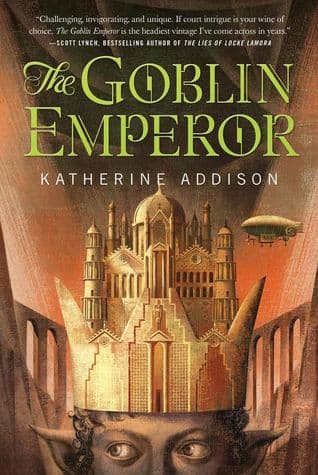
Katherine Addison (2014)
Genre
Fantasy / Science Fiction / Young Adult
Reading Time
9 hours
Key Themes
See below
Sign in to track this book
An exiled, half-goblin emperor, put on the throne by tragedy, navigates a dangerous court of assassins and schemers while looking for a friend amid the isolation of power.
Maia Drazhar, the youngest and half-goblin son of Emperor Varenechion, lives an isolated life in exile at the remote Drazharim estate, abused by his cousin, Setheris. His life changes abruptly when Captain Csevet arrives, informing him that the Emperor and his three elder sons have died in an airship accident. As the only surviving heir, Maia is immediately proclaimed Emperor of the Elflands and sent on a journey to the capital city of Untheileneise. Overwhelmed and unprepared for the responsibilities of the throne, Maia struggles to understand his new, terrifying position, leaving behind the only life he has known for a world of courtly intrigue he knows nothing about.
Upon arrival at Untheileneise, Maia faces the complex and rigid etiquette of the Imperial Court. He meets his new staff, including his secretary, Csevet, and his bodyguard, Beshelar. His half-goblin heritage and lack of formal education make him an outsider among the mainly elven nobility, who view him with disdain and open contempt. He struggles with the court's intricate language, the formal addresses, and the constant scrutiny. During his first audience, he is overwhelmed by the number of petitions and the expectation to make immediate decisions, showing his inexperience and vulnerability. The weight of the crown and the loneliness of his position immediately affect him.
Despite his initial struggles, Maia slowly finds his footing. He appoints Archon Thara Celehar, a former investigator, to lead the inquiry into the airship disaster, showing his intent to uncover the truth behind his family's death. He also tries to learn the formal language and customs of the court, seeking help from Csevet. Maia shows compassion by addressing a petition from a textile worker, concerning exploitative labor practices, and starts an investigation into the matter. These early actions, though small, show his desire for justice and his willingness to use his power for his subjects' betterment, often clashing with established court traditions.
Maia faces pressure to secure his lineage and the empire's stability through marriage. Various noble families present their daughters, and Maia endures a series of awkward and formal meetings with potential brides, none of whom truly appeal to him or offer genuine connection. His advisors pressure him to choose a bride who will strengthen his position politically, rather than someone he could genuinely love. This process emphasizes his isolation, as he seeks a companion while being constantly reminded that his personal desires must be secondary to imperial duty. He also continues to deal with the court's prejudices against his goblin heritage.
Archon Celehar's investigation into the airship accident progresses, uncovering evidence that suggests sabotage rather than a mere accident. He discovers inconsistencies in the wreckage and witness testimonies, pointing towards a deliberate act. Celehar reports his findings to Maia, confirming Maia's suspicions that his father and brothers were murdered. This revelation increases Maia's sense of vulnerability and isolation, as he realizes he is surrounded by potential enemies. The search for the conspirators becomes a main concern, adding danger to his already overwhelming duties as emperor.
Maia's attempts at reform and his unconventional approach to governance are met with resistance and hostility from certain court factions, particularly the conservative Elves. He endures public slights, veiled insults, and constant undermining of his authority. One incident involves a deliberate mis-translation of his words during a public address, designed to make him appear foolish. He also faces the actions of the Sethelis, a powerful elven noble family, who openly disrespect him. These challenges force Maia to learn quickly, relying on his few trusted advisors, Csevet and Beshelar, to interpret the complex social cues and political traps laid for him.
Despite the pervasive loneliness, Maia begins to form genuine connections. He develops a close working relationship with Csevet, his secretary, who is loyal and invaluable in navigating court protocols. Beshelar, his captain of the Guard, becomes a steadfast protector and a source of quiet reassurance. Maia also forms an unexpected bond with Cala, the Empress-Dowager, who, despite her initial coldness, offers him advice and support, recognizing his genuine nature. These new relationships provide Maia with needed emotional anchors and practical guidance, helping him to feel less isolated and more confident in his decisions.
After much thought, Maia chooses Idra, a minor noblewoman, as his Empress. While not a love match, Idra is kind, intelligent, and supportive, offering Maia a partnership rather than a political burden. Their wedding is a significant event, symbolizing Maia's commitment to his role and his growing confidence. He continues to push for his reforms, including improvements in working conditions and greater inclusion of goblins in imperial service. He starts to understand the power of his position and how to use it, no longer just reacting to events but proactively shaping his reign, even as the conspiracy against his family remains unsolved.
Archon Celehar's investigation finally succeeds, revealing the full scope of the conspiracy. He discovers that the airship was sabotaged by members of the conservative Sethelis family, specifically the Duke of Sethelis and his accomplices, who sought to prevent Maia's father, Emperor Varenechion, from enacting reforms that would have diminished their power. The plot was elaborate, involving compromised airship engineers and careful planning. The revelation of the Sethelis family's involvement sends shockwaves through the court, exposing the political corruption and the danger Maia has been in since his ascension. Celehar presents his findings to Maia, who faces the difficult decision of how to dispense justice.
Armed with Celehar's evidence, Maia confronts the conspirators. He handles the situation with justice and pragmatism, avoiding widespread purges that would destabilize the empire, but ensuring that those directly responsible for the murders face consequences. The Duke of Sethelis and his co-conspirators are arrested and tried, their power broken. Maia's decisive action, tempered with a desire for stability, earns him respect from many nobles. With the immediate threat neutralized and his position more secure, Maia can begin to truly implement his vision for the empire, encouraging greater equality and justice, marking the end of his tumultuous first year as the Goblin Emperor and the beginning of a more hopeful reign.
The Protagonist
Maia transforms from an abused, isolated, and naive exile into a compassionate, capable, and respected emperor, learning to navigate court politics and assert his own vision for the empire.
The Supporting
Csevet remains a steadfast and loyal advisor, growing in importance and trust within Maia's inner circle.
The Supporting
Beshelar's loyalty and protective role remain constant, solidifying his position as Maia's most trusted guardian.
The Supporting
Celehar diligently pursues the truth, successfully uncovering the conspiracy and solidifying his reputation as a man of integrity and competence.
The Supporting
Idra transitions from a potential bride to a supportive and respected Empress, forming a strong partnership with Maia.
The Supporting
Cala evolves from a seemingly disapproving matriarch to a wise and supportive mentor for Maia.
The Supporting
Setheris remains a figure of past abuse and present antagonism, eventually losing his power and influence.
The Antagonist
The Duke of Sethelis is exposed as the primary antagonist and conspirator, ultimately facing justice for his crimes.
The Supporting
Melihar's initial resentment of Maia transforms into respect and loyalty as he witnesses Maia's reign.
Maia's journey is about discovering who he is, both as a person and as an emperor. Exiled and abused for his half-goblin heritage, he initially lacks self-worth. Put into the most powerful position, he must reconcile his compassionate nature with leadership demands, navigate prejudices against his identity, and forge his own path. His struggle with his goblin features, his comfort with goblin language (Nedumi), and his eventual embrace of both his elven and goblin heritage are central to his character arc. He learns to define himself not by others' expectations but by his own actions and values.
“"He was the Emperor. He was Edrehasivar, and his word was law. He was Edrehasivar, and he was alone."”
The novel shows the immense weight of imperial responsibility. Maia, unprepared and untrained, is overwhelmed by the volume of work, the complex protocols, the constant scrutiny, and the life-and-death decisions he must make. He struggles with loneliness, the lack of trusted advisors, and the constant threat of assassination. The theme explores how leadership requires not just power, but also wisdom, compassion, and the courage to make difficult choices, often at personal cost. His commitment to his duties, even when he feels inadequate, defines his reign.
“"The crown was a heavy thing, not only for its weight of gold and jewels, but for the weight of the empire it signified."”
Maia's half-goblin heritage is a constant source of prejudice and discrimination from the mainly elven court. He is often subjected to subtle slights, open disdain, and assumptions of inferiority. The novel explores how prejudice can be deeply ingrained in society and how it affects those targeted. Maia's struggle for acceptance, his efforts to bridge the divide between elves and goblins, and his eventual success in earning respect (even from his detractors) show the importance of judging individuals by their character and actions rather than their lineage or appearance. His compassionate approach slowly chips away at the entrenched bigotry.
“"His ears were too long, his nose too broad, his skin too dark. He was a goblin, and he was the Emperor."”
After discovering that his father and brothers were murdered, Maia faces the challenge of seeking justice without vengeance. The temptation to take harsh retribution on the conspirators is present, but Maia consistently chooses a path of measured justice, focusing on upholding the law and ensuring stability for the empire rather than personal revenge. His decision to pursue a fair trial for the Duke of Sethelis, despite his personal grief and anger, shows his commitment to a just rule. This theme explores the moral complexities of power and a ruler's responsibility to act for the greater good.
“"He was the Emperor. He would not allow vengeance to rule him, but justice must be served."”
In a court defined by rigid formality, cunning, and often cruelty, Maia's kindness and empathy stand out. He treats his servants with respect, genuinely listens to commoners' petitions, and seeks to understand others' perspectives, even his adversaries. This approach, initially seen as weakness by some, gradually earns him loyalty and respect from unexpected quarters, such as Csevet, Beshelar, and even the Empress-Dowager. His compassionate governance, focused on improving his subjects' lives, proves to be a strength that distinguishes his reign and creates genuine connection.
“"He did not want to rule by fear, but by justice, and by kindness, if he could."”
Highlights Maia's outsider status and the complexities of imperial communication.
The elaborate and rigid court etiquette, including formal addresses (e.g., 'Your Serenity,' 'Your Imperial Majesty') and the specific, highly formal elven language (Edrehasivar), serves as a constant barrier for Maia. He grew up speaking Nedumi, the goblin tongue, and struggles immensely with the nuances of court speech, leading to misunderstandings and social faux pas. This device emphasizes his isolation and lack of preparation, while also showing his dedication as he painstakingly learns. The contrast between the two languages also underscores the cultural divide and prejudice within the empire.
The inciting incident and central mystery driving the plot.
The 'accident' that kills Emperor Varenechion and his three elder sons is the catalyst for the entire story, instantly elevating Maia to the throne. It functions as a central mystery, prompting Archon Celehar's investigation and creating a pervasive sense of danger for Maia. The unraveling of this mystery, revealing it to be an assassination, provides the primary external conflict and forces Maia to confront the treacherous underbelly of his court, ultimately leading to the exposure and downfall of the conspirators.
A potent symbol of both power and immense burden.
The physical crown itself, often described as heavy and ornate, symbolizes the immense weight of responsibility that Maia inherits. It is not just a piece of jewelry but the embodiment of the empire's history, traditions, and the lives of its millions of subjects. For Maia, wearing it is a constant reminder of his lonely position, the expectations placed upon him, and the constant threat to his life. Its weight is both literal and metaphorical, representing the profound shift in his existence and the pressures of leadership.
A source of prejudice, internal conflict, and unique perspective.
Maia's half-goblin ancestry is a defining plot device. It immediately sets him apart, making him an outsider in the elven court and the target of widespread prejudice. This heritage fuels much of the external conflict Maia faces and contributes to his initial feelings of inadequacy. However, it also gives him a unique perspective, fostering empathy for the marginalized and driving his desire for reform and equality. His 'otherness' ultimately becomes a source of strength, allowing him to challenge outdated traditions and bring a fresh, compassionate approach to governance.
“We are none of us perfect, but we can try to be better.”
— Maia reflects on his own imperfections and the importance of striving for improvement.
“It is not the emperor's place to be loved, but to be just.”
— Maia considers the responsibilities of rulership versus personal desires.
“Hope is the thing with feathers that perches in the soul.”
— Maia recalls a poem from his childhood, finding solace in difficult times.
“One cannot build a bridge with only one hand.”
— Maia learns about the necessity of cooperation and trust in governance.
“The past is a country from which we have all emigrated.”
— Reflecting on how personal histories shape but do not define the present.
“Kindness is a language which the deaf can hear and the blind can see.”
— Maia emphasizes the universal impact of simple acts of kindness.
“To rule is to serve, and to serve is to rule.”
— Maia's philosophy on leadership as a form of service to his people.
“A single candle can light a thousand others without diminishing its own flame.”
— Illustrating how generosity and guidance can multiply without loss.
“The heart has its reasons which reason knows nothing of.”
— Maia contemplates the conflict between emotional intuition and logical reasoning.
“In the end, we will remember not the words of our enemies, but the silence of our friends.”
— Reflecting on the importance of loyalty and speaking out against injustice.
“To be yourself in a world that is constantly trying to make you something else is the greatest accomplishment.”
— Maia's struggle to maintain his identity amid political pressures.
“The only way to deal with an unfree world is to become so absolutely free that your very existence is an act of rebellion.”
— Maia's defiance against the constraints of his royal upbringing and expectations.
“Do not go where the path may lead, go instead where there is no path and leave a trail.”
— Encouraging innovation and courage in the face of tradition and convention.
Ready to see how well you understood this book? Take our interactive quiz with 10 questions.

Biography coming soon.







