“The past is not a foreign country; it is a country that we carry within us, in our memories, in our blood, in the very air we breathe.”
— A reflection on the enduring presence of history and personal memory.

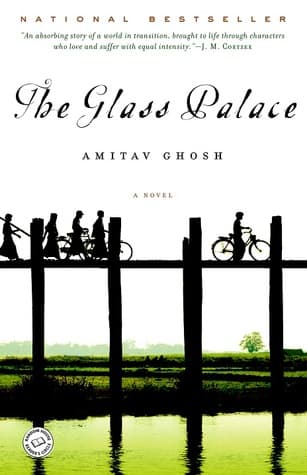
Amitav Ghosh (2000)
Genre
Literary Fiction / Lifestyle / Historical Fiction
Reading Time
10-12 hours
Key Themes
See below
Sign in to track this book
During the British invasion of Burma, a poor boy, Rajkumar, builds a teak empire and spends his life trying to reunite with Dolly, a woman exiled from the Glass Palace, as their lives reflect the making of nations.
In 1885, Rajkumar, an eleven-year-old orphan from Ratnagiri, works for Ma Cho, a food stall owner in Mandalay, Burma. He is there when British forces, led by General Prendergast, invade and capture King Theebaw and Queen Supayalat. During the occupation of the Glass Palace, Rajkumar sees the royal family forced into exile. He notices Dolly, a young attendant to the Queen, and is immediately drawn to her. This brief meeting leaves a lasting impression. As the British take control, Rajkumar, clever and ambitious, takes a job with Saya John, a successful Indian merchant in the teak trade. This starts his rise from poverty, driven by the political changes.
The deposed King Theebaw, Queen Supayalat, and their daughters, along with their attendants, including Dolly, travel by ship to Ratnagiri, a small coastal town in British India. Their new home is a simple bungalow, very different from the Glass Palace. The royal family struggles to adjust to their limited life, cut off from their former power. Dolly, though a servant, feels the weight of their loss and the boredom of their isolation. She serves the royal family, especially the Queen, while quietly watching their relationships change and despair grow. This time is marked by a strong sense of displacement and cultural difference.
Working for Saya John, Rajkumar becomes a sharp businessman. He learns the teak trade, mastering logging, transport, and market sales. He soon surpasses his mentor, starting his own logging operations deep in the Burmese forests. Rajkumar's ambition is vast; he expands his business, gaining wealth and influence. Despite his success, he often thinks of the young woman he saw during Mandalay's fall. Dolly remains a powerful image in his memory, a symbol of a past he wants to reconnect with. His success is driven by profit, but also by a deeper, unspoken wish to be worthy of her.
Years later, after building his teak empire, Rajkumar decides to find Dolly. He travels to India, to Ratnagiri, the rumored place of exile for the Burmese royal family. His search is hard; the royal family lives quietly, and information is scarce. He eventually finds their home and, with persistence and luck, makes contact. When he finally sees Dolly again, she is no longer the girl he remembered but a woman changed by hardship and service. Despite the years, his feelings for her are strong, and he is determined to win her affection and offer her a new life.
Rajkumar proposes to Dolly, and after some thought, she accepts, leaving her service to the exiled Queen. They marry, and Dolly moves to Burma, into Rajkumar's grand home. Their first years together have both joy and challenges in blending two different lives. Dolly, used to court life and then Ratnagiri's quiet routine, finds herself the mistress of a large household and part of a busy business. Rajkumar, though deeply in love, sometimes struggles to understand Dolly's quiet nature and her lingering connection to her past. They start a family, their children bridging their different origins.
Rajkumar and Dolly have two children: a daughter, Uma, and a son, Neel. Uma grows up independent, eventually studying in India. Neel, initially closer to his father's business, becomes interested in the nationalist movements in British India and Burma. The children represent a new generation, living between multiple cultures and identities. Their lives are shaped by their parents' experiences and the changing politics of the early 20th century. Uma's schooling in India exposes her to new ideas, while Neel's political awakening marks a shift from his father's business goals.
The story then focuses on Arjun, a young Indian man from a military family, who joins the British Indian Army. He is stationed in Burma during World War II, fighting the Japanese invasion. Arjun's experiences show the complex loyalties and sacrifices of the war and the British Empire. He meets members of the Azad Hind Fauj (Indian National Army), led by Subhas Chandra Bose, who want to free India with Japanese help. This meeting makes Arjun question his identity and service. His story connects with the larger fight for Indian independence, reflecting the difficult era and the moral choices many faced.
Neel, Rajkumar and Dolly's son, gets more involved in the nationalist movement. Inspired by Subhas Chandra Bose's words and the promise of Indian independence, he decides to join the Indian National Army (INA). This decision deeply worries his parents, especially Rajkumar, who values stability and his business. Neel's commitment leads him to fight alongside the Japanese against the British, a choice that puts him against the British Raj and endangers his family. His journey reflects the strong desire for self-rule that spread across the subcontinent, forcing people to choose sides in a global conflict.
World War II devastates Burma and India. Rajkumar's teak business suffers greatly, and the family faces hardship and displacement. The war also brings personal tragedy. Neel's involvement with the INA leads to his capture and imprisonment by the British. The family faces constant violence and uncertainty about their loved ones. Dolly, always strong, works to keep her family together amid the chaos. The war changes their lives, destroying their security and making them face the brutal realities of imperial conflict and the fight for national identity. The loss and suffering from this time leave deep, lasting scars.
After the war, with India and Burma nearing independence, the surviving members of Rajkumar and Dolly's family face new challenges. Neel is eventually freed from prison, but the experience has changed him. Uma, back from India, actively helps rebuild their lives. The family deals with the loss of their wealth and the need to adjust to a rapidly changing political and social world. The end of colonial rule brings both hope and uncertainty, as new nations are formed. The family's story continues, reflecting the wider story of post-colonial rebuilding and the search for identity in a fragmented world.
In their later years, Rajkumar and Dolly reflect on their long lives. Rajkumar's empire is mostly gone, but their family endures. The story often returns to memory and how the past shapes the present. Dolly, especially, carries the weight of the Glass Palace's fall and her connection to the exiled royal family. The children and grandchildren, spread across Burma, India, and beyond, embody their ancestors' diverse legacies. The novel ends with a sense of history's repeating nature, the strength of human connection, and the quiet dignity in surviving and adapting amid historical changes, leaving a strong impression of how lives are connected across generations and nations.
The Protagonist
Rajkumar transforms from a penniless boy into a wealthy patriarch, driven by ambition and love, but ultimately experiences the decline of his empire and the shift in his children's values.
The Protagonist
Dolly evolves from a royal attendant to an exiled servant, then a devoted wife and mother, always retaining her quiet strength and connection to her past.
The Supporting
Uma grows from a curious child into an educated, independent woman who navigates changing social landscapes and contributes to her family's resilience.
The Supporting
Neel transforms from a potential heir to his father's business into a fervent nationalist, willing to fight for independence, facing imprisonment and disillusionment.
The Supporting
Saya John serves as a crucial mentor figure, enabling Rajkumar's initial success before fading as Rajkumar's own empire grows.
The Supporting
Queen Supayalat endures a long, bitter exile, never fully reconciling with her loss of power and kingdom, serving as a poignant symbol of colonial impact.
The Supporting
Arjun experiences the brutal realities of war and the moral complexities of serving a colonial power while his homeland seeks independence, leading to a profound re-evaluation of his loyalties.
The Supporting
Alison navigates the horrors of war and the complexities of an interracial relationship, embodying a challenge to colonial norms and personal growth through adversity.
The novel deeply explores the effects of British colonialism on Burma, India, and Malaya. It shows the invasion of Burma, the forced exile of its royal family, and the economic exploitation, such as Rajkumar's teak trade. The theme also covers the cultural displacement felt by the Burmese royals in India and the political awakening of characters like Neel and Arjun, who struggle with serving or fighting the colonial power. The story highlights the lasting impact of imperial rule, shaping national identities and individual lives across generations, seen in the fragmented loyalties and varied paths of the family members.
“History, as they say, is written by the victors. But the vanquished too have a story to tell.”
At its core, 'The Glass Palace' is a story of lasting love and longing. Rajkumar's lifelong devotion to Dolly, sparked by a quick glimpse in Mandalay, drives much of his ambition and search. Their love story crosses social barriers and the vast distances created by colonialism. This theme also appears in the quieter, more complex family relationships, such as Dolly's connection to the exiled Queen or the forbidden love between Arjun and Alison. It explores how love can both support and complicate lives during political turmoil, acting as a strong force for connection in a fragmented world.
“He knew then that his life would never be complete until he found her again.”
The characters in 'The Glass Palace' constantly deal with identity and belonging, often caught between multiple cultures and nations. Rajkumar, an Indian in Burma, builds his life there but keeps parts of his Indian heritage. Dolly, a Burmese woman, is exiled to India and then returns to Burma as an Indian's wife, always remembering her royal past. Their children, Uma and Neel, navigate their mixed heritage and the conflicting demands of Burmese, Indian, and British influences. The theme is especially clear in the context of the Indian diaspora and the formation of new national identities after colonialism, showing how fluid and complex belonging is in a globalized world.
“We are all exiles, even in our own homes, if the heart is not there.”
The novel spans generations and historical events, emphasizing history's repeating nature and memory's power. The fall of the Glass Palace is a foundational memory that shapes Dolly's life and the family's story. The rise and fall of empires, fights for independence, and war's destruction are shown as recurring patterns. Characters often think about the past, using memory to understand their present and connect with their heritage. The story suggests that while circumstances change, certain human experiences and historical forces repeat, leaving marks on generations and influencing their choices.
“The past is not dead. It is not even past.”
Rajkumar's story shows the power of ambition and entrepreneurship. From a poor orphan, he builds a large teak empire, showing sharp business sense and drive. His success comes from his ability to use opportunities from the colonial economy, through hard work and risk. This theme explores the moral questions of getting rich within a colonial system and contrasts Rajkumar's material goals with his children's political and idealistic aims, especially Neel. It highlights the tension between individual success and wider societal changes.
“He knew that opportunities were like trees, they grew tall for those who knew how to plant them.”
A symbol of lost grandeur, colonial conquest, and the fragility of power.
The Glass Palace initially represents the opulent power of the Burmese monarchy. Its fall symbolizes the violent end of an era and the onset of British colonial rule. Throughout the novel, it serves as a recurring motif, a memory of a lost world that haunts Dolly and influences her family. It also functions as a metaphor for any fragile structure of power or happiness that can be shattered by external forces, connecting the personal lives of the characters to grand historical events and reminding them of what was lost.
A narrative structure that follows a family across multiple generations, connecting personal lives to historical events.
The novel's plot unfolds across several generations of Rajkumar and Dolly's family, spanning from the late 19th century to the mid-20th century. This allows Ghosh to explore the long-term impacts of colonialism, war, and social change on individual lives and family dynamics. By tracing the lives of children and grandchildren, the device illustrates how historical forces shape identity, loyalty, and destiny, showing both continuity and rupture within the family's experiences and perspectives across different eras and nations.
Shifting narrative viewpoints to offer a comprehensive understanding of historical events and personal experiences.
Ghosh employs a shifting narrative perspective, allowing the reader to experience events through the eyes of various characters—Rajkumar, Dolly, Uma, Neel, Arjun, and Alison. This device enriches the story by presenting diverse viewpoints on colonialism, war, and national identity. It prevents a singular, biased interpretation of events, instead offering a nuanced, multifaceted understanding of the complex historical period and the personal dilemmas faced by individuals caught in its sweep, highlighting the subjective nature of truth and experience.
A central economic activity that drives Rajkumar's ambition and symbolizes colonial exploitation.
The teak trade is not merely a backdrop but a crucial plot device. It forms the foundation of Rajkumar's immense wealth and symbolizes the economic exploitation inherent in colonialism, where natural resources of the colonized land are extracted for the benefit of imperial powers and ambitious individuals like Rajkumar. It connects Burma's natural landscape to global markets and underscores the entrepreneurial spirit, as well as the environmental impact, of the era. The rise and fall of Rajkumar's teak empire mirrors the broader economic and political shifts in the region.
“The past is not a foreign country; it is a country that we carry within us, in our memories, in our blood, in the very air we breathe.”
— A reflection on the enduring presence of history and personal memory.
“Change, when it comes, comes not in a single sweep but in a series of small, almost imperceptible shifts.”
— Observing the gradual nature of societal and personal transformations.
“There are some things that even time cannot erase, some scars that remain etched on the soul forever.”
— Reflecting on trauma and enduring emotional impact.
“For what is a kingdom, if not the people who live within its borders, their stories, their dreams, their sorrows?”
— A philosophical take on the true essence of a nation or empire.
“To live is to remember, and to forget is to die.”
— Emphasizing the importance of memory for existence and identity.
“The greatest empires are not built on land, but on the shifting sands of human desire.”
— A commentary on the ephemeral nature of power and ambition.
“Sometimes the greatest journeys are the ones we undertake within ourselves.”
— Highlighting introspection and self-discovery.
“History is not just a sequence of events; it is a living, breathing entity that shapes us all.”
— Describing history as an active force in human lives.
“The world is a tapestry woven from countless threads, each one a life, a story, a dream.”
— A poetic description of the interconnectedness of lives.
“Love, like a river, finds its way through the most impossible terrains.”
— Metaphor for the resilient and pervasive nature of love.
“Even in exile, there is a kind of freedom – the freedom to reimagine oneself, to rebuild a life from the fragments of the past.”
— Finding agency and possibility amidst displacement.
“The true measure of a man is not in his possessions, but in the kindness he shows to others.”
— A moral reflection on true wealth and character.
“Every border is an imaginary line, drawn by humans, often with blood.”
— Critique of political divisions and their violent origins.
“The silence between words is often more eloquent than the words themselves.”
— Highlighting the power of unspoken communication and pauses.
Ready to see how well you understood this book? Take our interactive quiz with 10 questions.
Biography coming soon.







