“They were good men, most of them, and they had died for nothing. And the world went on, indifferent to their sacrifice.”
— A character reflects on the futility of war and loss.

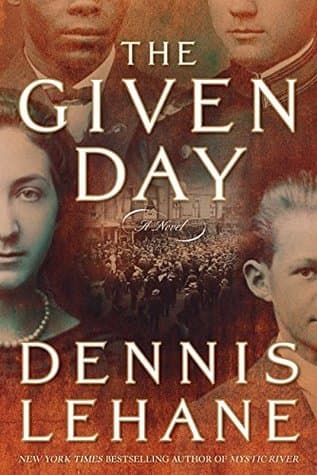
Dennis Lehane (2008)
Genre
Thriller / Historical Fiction / Mystery
Reading Time
14-16 hours
Key Themes
See below
Sign in to track this book
In post-World War I Boston, a white police officer and a Black man on the run find their lives connected to historical figures and social movements, fighting for survival and family in a nation facing major change.
In 1918, Luther Laurence, a Black man in Tulsa, Oklahoma, is in a deadly fight with the crime boss Deacon Pruitt. Luther, a good baseball player, must run away after a conflict leads to Pruitt's brother's death and Luther himself is badly hurt. He leaves his pregnant wife, Lila, promising to return. This escape begins his journey north, seeking safety and anonymity, and sets the stage for his arrival in Boston, where he hopes to earn enough money to bring Lila.
Danny Coughlin, a young Irish-American police officer in Boston, feels distant from his powerful and politically connected father, Captain Thomas Coughlin. Danny is troubled by the widespread corruption in the police force and the city's political system, controlled by figures like Mayor Andrew J. Peters. He deals with his hidden sexuality and finds comfort in reading and watching the societal changes around him, feeling more and more uneasy with how things are.
After a difficult journey, Luther Laurence arrives in Boston, needing work and a place to hide. Through various contacts, he finds a job as a houseman and chauffeur for the influential Coughlin family. He quickly sees the clear class and racial divisions in the city, managing the expectations of the white household while staying quiet and observant. His main goal remains saving money to reunite with Lila, whom he constantly worries about.
As World War I ends, the United States is gripped by the 'Red Scare,' a strong fear of communist and anarchist plots. Attorney General A. Mitchell Palmer, with help from a young J. Edgar Hoover, starts a wide campaign to find and deport suspected radicals. In Boston, the police department, including Captain Coughlin, investigates a series of bombings and alleged conspiracies. Danny, as a beat cop, is somewhat involved but grows more skeptical of the government's harsh methods and the created panic.
The Spanish Influenza pandemic hits Boston hard, killing many people across all social groups. The city's hospitals are overwhelmed, and public life nearly stops. The Coughlin family, like many others, experiences the fear and sadness of the epidemic. This shared vulnerability briefly crosses class and racial lines, showing how fragile life is and the great suffering of the time. Luther also sees the terrible impact, strengthening his wish for his family's safety.
Unhappy with the police department's working conditions, low pay, and political interference, Danny Coughlin secretly joins the growing Boston Police Union. He attends secret meetings, drawn to the idea of working together for better treatment for officers. This decision puts him directly against his father, Captain Coughlin, who, along with Governor Calvin Coolidge, sees unionization as defiance and a threat to public order and police authority. Danny struggles with this rebellion, but his beliefs push him forward.
During the Red Scare, Danny is assigned to a special team to track down Arnie Meserve, a dangerous anarchist and radical linked to recent bombings. Meserve is a complex character, a former soldier turned disappointed revolutionary. Danny's pursuit of Meserve mixes with his own moral questions, as he starts to question what justice truly is and who society's real enemies are. This investigation brings Danny into contact with the city's criminal side and the hidden networks of political disagreement.
While working for the Coughlins, Luther meets people from Boston's criminal underworld, including members of the Italian mafia. His past in Tulsa, especially his conflict with Deacon Pruitt, still affects him. Pruitt's influence proves to be far-reaching, and Luther fears his new life in Boston is not as safe as he hoped. He must carefully handle these dangerous new connections while trying to protect his identity and ensure his eventual reunion with Lila.
The disagreement between Boston police officers and the city's leaders reaches a critical point. Governor Calvin Coolidge and Police Commissioner Edwin Upton Curtis refuse to recognize the police union, leading to a final demand. The officers, including Danny, vote to strike, asking for better pay and the right to unionize. The city prepares for a possible breakdown of law and order, with Captain Coughlin caught between his loyalty to the force and his duty to the city, while Danny deals with the serious effects of his actions.
On September 9, 1919, the Boston Police go on strike, leaving the city largely unprotected. Looting, violence, and disorder break out, showing how easily civil order can fall apart. Danny is on the picket line, seeing the immediate results of the strike, while Luther watches the chaos from the Coughlin household. Governor Coolidge calls in the state militia to restore order, calling the strike a threat to public safety. The strike fails, leading to the firing of all striking officers, including Danny, and a lasting impact on labor relations in America.
After the failed strike, Danny Coughlin is fired from the police force, his career forever changed. He faces an uncertain future, but also feels free from the corrupt system he hated. Luther, having survived his encounters with criminals and the strike's chaos, finally arranges for Lila to join him in Boston. The two men, despite their different backgrounds, find a shared understanding and a new hope for a better future, having seen the difficult start of a new American era.
The Protagonist
Danny evolves from a disillusioned, closeted officer to a principled individual willing to sacrifice his career for his beliefs, finding a measure of self-acceptance and a new path forward.
The Protagonist
Luther transforms from a man solely focused on escape and survival to one who finds a new sense of belonging and hope for his family in an unexpected place.
The Supporting
Captain Coughlin remains largely steadfast in his beliefs, representing the entrenched power structure that ultimately clashes with the changing world, leading to a personal and professional reckoning.
The Supporting
Nora maintains her role as a steadying presence, witnessing the upheaval around her and adapting to the changing family dynamics without undergoing a radical personal transformation.
The Antagonist/Supporting
Arnie's arc is one of escalating radicalization and eventual tragic downfall, representing the destructive potential of unchecked disillusionment and political extremism.
The Antagonist
Pruitt remains a static but omnipresent force, symbolizing the past that Luther cannot fully escape, his influence serving as a continuous source of tension.
The Supporting/Mentioned
Lila's arc is one of separation and eventual reunification, symbolizing the hope for a new beginning for Luther.
The Mentioned/Supporting
Coolidge's actions solidify his political identity and propel him towards national prominence, serving as a historical antagonist to the union movement.
The Mentioned/Supporting
Palmer's arc is one of rising political power through fear-mongering, eventually leading to public criticism and the waning of the Red Scare.
The novel explores how the American Dream is broken and changed for different people after WWI. For Luther Laurence, it's the hard-to-reach hope of safety, stability, and family, always threatened by racism and his past. For Danny Coughlin, it's the disappointment with corrupt power systems and the realization that traditional paths to success are wrong. The 'dream' is shown as impossible for many, especially minorities and the working class, leading to anger and radicalization, as seen in Arnie Meserve. The war, the flu, and economic hardship show how fragile this dream is.
“America was a land of promise, a land of freedom, a land where a man could build a life. But some promises were only whispered, some freedoms were only for the few, and some lives were built on sand.”
The novel is set in a time of strong social and political unrest, showing the worries of a nation at a turning point. The Red Scare, the rise of labor movements, the Spanish Flu pandemic, and racial tensions all create instability. The Boston Police Strike of 1919 is the main event, showing the conflict between old power (Governor Coolidge, Captain Coughlin) and the desire for change (Danny, the striking officers). The book clearly shows the fear of revolution, the fight for workers' rights, and the deep divisions in society, reflecting a country trying to find its identity.
“The world was changing, rushing forward, and those who clung to the past would be swept away.”
Both main characters struggle with who they are and where they belong. Danny deals with his hidden sexuality and his moral conflict with his family's past and the police force, feeling like an outsider in his own world. Luther, a Black man escaping violence, constantly searches for a safe place to belong, wanting to create a home for his family away from the widespread racism of the time. The novel explores how outside forces—race, class, political beliefs, and societal expectations—shape a person's identity and the often-painful search for a true self and community.
“He was a man without a country, a man without a past, a man who had to invent himself anew every day.”
The idea of family, both by birth and by choice, and the complex demands of loyalty are key to the story. Danny's loyalty to his family (his father, sister) clashes with his loyalty to his beliefs and the new police union. Captain Coughlin's loyalty to the system and his idea of order creates a split with his son. Luther's strong loyalty to his wife, Lila, drives all his actions, making him endure great hardship. The novel also shows how loyalty can be misused or misplaced, and how new forms of 'family' can be created during crises, as seen in the unexpected bond between Danny and Luther.
“Family was a bond, a burden, a blessing, all at once. And sometimes, it was the thing that broke you.”
A common theme is the struggle between true justice and systemic corruption. Danny Coughlin daily faces the widespread bribery in the Boston Police Department and the political system, making him question the very institutions meant to uphold justice. The Red Scare shows how justice can be twisted by fear and political ambition, leading to the persecution of innocent people. Luther's flight from Deacon Pruitt shows the failure of justice in a world where power often wins over fairness. The novel examines who defines justice and for whom it truly works.
“Justice was a word people threw around, but it rarely meant the same thing to the rich as it did to the poor, or to the white as it did to the colored.”
Alternating perspectives of Danny Coughlin and Luther Laurence.
The novel utilizes a dual protagonist structure, alternating between the perspectives of Danny Coughlin, a white Boston police officer, and Luther Laurence, a Black man fleeing Tulsa. This device allows Lehane to present a panoramic view of early 20th-century America, contrasting the experiences of different races and social classes. It highlights the vast disparities in opportunity and safety, while also revealing shared human experiences of struggle and hope. The eventual intersection of their lives creates a rich tapestry of the era's complexities.
Weaving real historical figures and events into the fictional narrative.
Lehane masterfully integrates real historical figures like Babe Ruth, Eugene O'Neill, W.E.B. DuBois, A. Mitchell Palmer, J. Edgar Hoover, and Calvin Coolidge, as well as pivotal events like the Spanish Flu pandemic and the Boston Police Strike of 1919, into the fictional plot. This device grounds the story in a vivid, authentic historical context, giving depth and weight to the characters' struggles. It allows the reader to experience the era's major forces through the personal lens of the protagonists, blurring the lines between fact and fiction.
Hints of future events and recurring thematic echoes.
The novel employs foreshadowing through ominous descriptions of the political climate, the growing unrest, and the lurking threat of Luther's past. Parallelism is evident in the similar struggles for dignity and survival faced by both Danny and Luther, despite their vastly different circumstances. For instance, both men are outsiders in their respective worlds, seeking a form of justice or escape. This device deepens the thematic resonance, connecting their individual journeys to the larger historical forces at play and building suspense towards key events.
Boston as a microcosm of early 20th-century America.
Boston itself functions as a powerful symbol in the novel, representing a microcosm of early 20th-century America. It is a city of stark contrasts: old money and immigrant poverty, intellectualism and political corruption, racial divisions and burgeoning social change. The city's neighborhoods, its police force, and its political machinery all reflect the larger national struggles. Lehane uses Boston as a stage where the forces of tradition and modernity, order and chaos, clash, embodying the 'given day' of a nation at a pivotal turning point.
“They were good men, most of them, and they had died for nothing. And the world went on, indifferent to their sacrifice.”
— A character reflects on the futility of war and loss.
“History is a wheel, and it always turns back to where it started. Always.”
— A character muses on the cyclical nature of historical events.
“”
— A variation of a famous quote, emphasizing the lasting impact of history.
“Justice ain't about what's right. It's about what you can prove.”
— A cynical observation about the legal system.
“Sometimes you gotta break a few rules to do the right thing.”
— A character grapples with moral ambiguities in pursuit of a greater good.
“Fear is a powerful thing. It can make you do things you never thought you were capable of.”
— An insight into the motivating power of fear.
“There's no such thing as an innocent bystander, not when the world's on fire.”
— A commentary on complicity and responsibility during turbulent times.
“Every man has his price, and every woman her weakness.”
— A jaded perspective on human vulnerability and corruption.
“The truth is a luxury few can afford.”
— A character reflects on the compromises people make in difficult circumstances.
“Hope is a dangerous thing. It can keep you alive, or it can kill you.”
— An observation on the dual nature of hope.
“Some scars never heal, no matter how much time passes.”
— A poignant reflection on lasting trauma and emotional wounds.
“The world don't care about your good intentions. It cares about what you do.”
— A pragmatic view on actions versus intentions.
“Even in the darkest of times, there are always those who fight for the light.”
— A hopeful note amidst despair, highlighting resistance and resilience.
“”
— A ruthless perspective on the acquisition and maintenance of power.
“The city has a way of swallowing people whole, if you let it.”
— A metaphorical description of the overwhelming nature of urban life.
Ready to see how well you understood this book? Take our interactive quiz with 10 questions.

Dennis Lehane is a critically acclaimed author known for his gritty crime novels set in Boston. His notable works include "Mystic River," "Shutter Island," and the award-winning "Live by Night." Lehane's powerful storytelling and complex characters have earned him a dedicated readership and numerous accolades.







