“It was a dark and stormy night. No, it wasn't. It was a bright and sunny morning.”
— Opening of the story, humorously subverting a common literary trope.

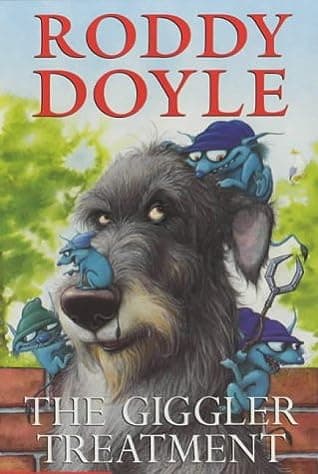
Roddy Doyle (2000)
Genre
Fantasy / Children's / Young Adult
Reading Time
60 min
Key Themes
See below
Sign in to track this book
When a father of four eats his son's chocolate biscuit, a secret society of magical pranksters called the Gigglers starts a funny, rude, five-stage 'Giggler Treatment' to teach him a lesson.
The story begins with Mr. Mack, a grumpy adult, kicking a small dog named Barnaby in a park. The Gigglers, tiny, invisible creatures living in trees who punish adults mean to children (or their dogs), see this. The Chief Giggler sends her team to give Mr. Mack 'The Giggler Treatment.' It starts subtly, with Mr. Mack's shoe falling off into a puddle, annoying him and amusing the Gigglers. This is just the first in a series of pranks to make his day worse.
As Mr. Mack continues his walk, the Gigglers ensure his day gets worse. His wet shoe squelches, drawing attention. He tries to avoid one puddle but steps into another, deeper one. At a bus stop, a child's ice cream 'accidentally' lands on his trousers, thanks to the Gigglers. He then gets stuck to a lamppost with chewing gum, delaying him more and increasing his frustration. Each event is met with the Gigglers' delighted giggles, which only Mr. Mack cannot hear. He blames his bad luck on chance, unaware of the tiny pranksters.
At a coffee shop, Mr. Mack hopes for peace. He orders coffee, but the Gigglers have other plans. As he reaches for his cup, a Giggler nudges it, making him spill hot coffee on his already stained trousers. This public embarrassment makes Mr. Mack even angrier. He is now visibly upset and attracting stares. The Gigglers watch from their hiding spots, their goal to make him suffer for his earlier unkindness in full effect. He tries to clean himself, but the situation only worsens, making him feel foolish and out of control.
Mr. Mack sits on a park bench, seeking refuge, unaware that the Gigglers have covered it with a super-sticky substance. When he tries to leave, he is stuck. His struggles to free himself draw the attention of people passing by, including children who find his situation funny. The Gigglers are laughing, their plan working perfectly. Mr. Mack's attempts to keep his dignity fail as he struggles with the bench, making him the object of public amusement and the Gigglers' target.
While Mr. Mack is still stuck, the child he had been mean to earlier, Rover, appears with his dog, Barnaby. Rover recognizes Mr. Mack and points him out. Barnaby, the dog Mr. Mack kicked, sniffs at his stuck leg. This encounter is the final humiliation for Mr. Mack, making him face those he wronged, though he does not understand the supernatural cause of his current suffering. The Gigglers watch, satisfied that their treatment is working, both physically and by bringing his unkindness back to him.
During Mr. Mack's ordeal, the Gigglers often discuss their rules for 'treatments.' They explain that the treatment's severity depends on how bad the adult's misdeed was. Kicking a dog, they agree, deserves a particularly nasty treatment. The Chief Giggler makes sure all steps are followed, from the first pranks to the final, most embarrassing ones. They stress that their actions are not random but planned acts of justice, meant to teach adults a lesson and bring joy to wronged children. They also discuss different types of 'treatments' and how well they work.
Eventually, a kind passerby helps free Mr. Mack from the park bench, though he still suffers indignity as he peels off. Disheveled and miserable, Mr. Mack limps away. He starts thinking about the day's strange and constant misfortunes. While he does not understand the Gigglers' part, the sheer amount of bad luck makes him question his own behavior. He remembers kicking Barnaby that morning, and a hint of guilt, or at least self-awareness, appears. The day's events leave a lasting impression, making him consider the results of his actions.
Throughout Mr. Mack's 'treatment,' the children who watch his troubles are full of joy and laughter. They find his struggles funny, especially when he is stuck to the bench or covered in coffee. Rover and Barnaby, the direct victims of Mr. Mack's initial unkindness, also seem to enjoy his suffering. This collective childish glee is a main part of the Gigglers' mission; their treatments are not just about punishing adults but also about bringing happiness and a sense of justice to children. The children's reactions confirm the Gigglers' work, strengthening their belief in their pranks.
After Mr. Mack has limped away, the Gigglers gather to review their operation's success. They carefully list each prank, from the wet shoe to the sticky bench, and rate how well it worked. The Chief Giggler is pleased with the outcome, calling Mr. Mack's treatment a clear success. They discuss how his misery and public embarrassment were a perfect punishment for his cruelty. They also wonder if Mr. Mack has truly learned his lesson, concluding that the experience will likely make him think twice before being unkind to children or their pets again. They then start looking for their next target, always watching for bad adult behavior.
The story ends with the Gigglers, satisfied with their work on Mr. Mack, preparing for a new mission. They spot another adult making a small mistake, suggesting their work is endless. Meanwhile, Mr. Mack is left to process his awful day. While the story does not explicitly say he becomes perfectly kind, the misery and public embarrassment he went through suggest he will be more careful and less likely to be casually cruel in the future. The Gigglers' treatment, though fantastical, acts as a strong deterrent, ensuring adults think twice about their actions towards children and animals.
The Antagonist/Recipient of Treatment
Mr. Mack transforms from an oblivious, unkind man to a thoroughly humiliated and self-reflective individual, potentially learning a lesson about the consequences of his actions.
The Protagonist/Leader
The Chief Giggler remains steadfast in her mission, demonstrating consistent leadership and a strong moral compass throughout the story.
The Supporting/Protagonists
The Gigglers collectively demonstrate their effectiveness and unwavering commitment to their mission, successfully executing a major 'treatment'.
The Supporting/Catalyst
Barnaby remains a constant, innocent presence, serving as a reminder of Mr. Mack's initial misdeed.
The Supporting/Witness
Rover remains a static character, serving as an important witness to the story's central conflict and resolution.
The Mentioned/Minor
Not applicable, a minor, transient character.
The main theme is justice, specifically punishment for unkindness. The Gigglers show this theme, acting as a magical force that ensures adults face consequences for being mean to children. Mr. Mack's 'treatment' is an example of this, as his growing misfortunes match the seriousness of his act of kicking Barnaby. The Gigglers' careful planning and satisfaction at Mr. Mack's suffering highlight the idea that wrongdoers should be held accountable, even if the method is fantastical. This theme reassures children that unfairness does not go unpunished.
“The Gigglers never forgot. They always knew. And if an adult was mean to a child, or a child's dog, then the Gigglers gave that adult The Giggler Treatment.”
This theme explores how every action, especially unkind ones, has results. Mr. Mack's day of misery is a direct result of his initial cruelty to Barnaby. Each prank, from the wet shoe to being stuck to a bench, comes from the Gigglers' response to his behavior. The story shows that even small acts of meanness can lead to big and embarrassing consequences. It teaches children that their behavior can start a chain reaction, emphasizing the importance of kindness and consideration.
“He'd kicked Barnaby. The dog. And now he was stuck to a bench. He didn't know how, but he knew why.”
Laughter and mischief are shown as strong forces, especially when used for a good reason. The Gigglers' main weapon is their ability to create embarrassing and funny situations, which they meet with their own giggles and the laughter of the children watching. This theme suggests that sometimes, humor and lighthearted pranks can be more effective than force in teaching a lesson. The joy children get from Mr. Mack's trouble shows that laughter can be a way to cope and feel validated when adults are unfair.
“The Gigglers giggled. It was the best giggle they'd had all morning.”
The book looks at the power difference between children and adults, and how the Gigglers balance this. Adults are often seen as powerful and intimidating, capable of random unkindness, while children have little power. The Gigglers exist to reverse this, giving children a sense of control and ensuring that adults who misuse their power are humbled. The story supports children's viewpoints, validating their feelings of unfairness and offering a fantastical solution to the problem of mean adults. It highlights the often-unseen struggles children have with adult authority.
“Adults sometimes forgot to be nice. They forgot that children were watching. The Gigglers never forgot.”
Tiny, invisible beings who intervene in the human world.
The Gigglers themselves are the primary magical realism device. They are fantastical creatures existing secretly within the ordinary world, capable of interacting with objects and influencing events without being seen by most adults. This device allows for the fantastical premise of justice being served through pranks, blending the mundane reality of a grumpy man's day with the extraordinary, unseen forces at play. It creates a sense of wonder and possibility, suggesting that there's more to the world than meets the eye, and provides a vehicle for the story's moral message.
A series of increasingly embarrassing and inconvenient events.
This device is central to the 'Giggler Treatment'. Mr. Mack's day is characterized by a continuous escalation of bad luck, starting with a wet shoe and culminating in him being stuck to a park bench. Each incident builds upon the last, increasing his frustration, public humiliation, and ultimately, his self-reflection. This progressive worsening of his situation keeps the reader engaged and highlights the thoroughness of the Gigglers' retribution, ensuring that the punishment truly fits the crime and leaves a lasting impact on the target.
The audience and Gigglers know the cause of events, but Mr. Mack does not.
Dramatic irony is a key comedic and thematic element. The reader is aware from the outset that the Gigglers are orchestrating Mr. Mack's misfortunes, while Mr. Mack himself attributes everything to random bad luck. This creates humor and allows the audience to revel in his cluelessness and increasing distress. It also underscores the Gigglers' secret power and the moral message, as the audience is privy to the 'why' behind the 'what', making Mr. Mack's eventual, vague realization more impactful.
Attributing human-like qualities to animals and magical creatures.
While the Gigglers are already fantastical, their human-like organization, discussions, and sense of justice give them relatable qualities. Additionally, Barnaby the dog, through his reaction to Mr. Mack's predicament, is subtly anthropomorphized, appearing to take satisfaction in his tormentor's comeuppance. This device helps readers connect with the non-human characters and understand their motivations and roles within the narrative, making the Gigglers' mission more understandable and the dog's suffering more poignant.
“It was a dark and stormy night. No, it wasn't. It was a bright and sunny morning.”
— Opening of the story, humorously subverting a common literary trope.
“The Giggler was a small, furry creature with very sharp teeth and a terrible temper.”
— Introduction of the main antagonist, the Giggler.
“If a grown-up is mean to a child, a Giggler will treat them to a big dollop of dog poo.”
— Explaining the Giggler Treatment and its purpose.
“Mr. Mack was a very important man. He was important because he was a dad.”
— Describing the protagonist, Mr. Mack, and his primary role.
“The dog poo was fresh. Very fresh. And green. Very green.”
— Describing the unpleasant nature of the Giggler Treatment in detail.
“You can't just go around giving people the Giggler Treatment without a good reason.”
— A character discussing the rules and ethics of the Giggler's actions.
“Children are the most important people in the world. They just don't know it yet.”
— A wise observation about the significance of children.
“The poo was on his head. And in his hair. And on his tie. And in his mouth. Almost.”
— Detailed description of Mr. Mack receiving the Giggler Treatment.
“It's not easy being a grown-up. You have to remember so many things.”
— A reflection on the challenges and responsibilities of adulthood.
“Sometimes, a little bit of trouble is good for you. It makes you think.”
— A character's philosophical take on facing difficulties.
“The Gigglers were a team. A very stinky team, sometimes, but a team nonetheless.”
— Highlighting the camaraderie and collective nature of the Gigglers.
“He knew he had been wrong. And that was a good start. A very good start.”
— Mr. Mack's realization of his mistake, leading to personal growth.
“All children deserve to be happy. Even the grumpy ones.”
— A universal message about the right to happiness for all children.
“The world is full of amazing things, if you just stop and look.”
— A concluding thought encouraging observation and appreciation.
Ready to see how well you understood this book? Take our interactive quiz with 10 questions.

Roddy Doyle is an Irish novelist, dramatist and screenwriter. He is the author of eleven novels for adults, eight books for children, seven plays and screenplays, and dozens of short stories. Several of his books have been made into films, beginning with The Commitments in 1991. Doyle's work is set primarily in Ireland, especially working-class Dublin, and is notable for its heavy use of dialogue written in slang and Irish English dialect. Doyle was awarded the Booker Prize in 1993 for his novel Paddy Clarke Ha Ha Ha.







