“Everyone wants to be a hero, but no one wants to do the work.”
— Rosie talking about the reality of espionage to Kazakov.

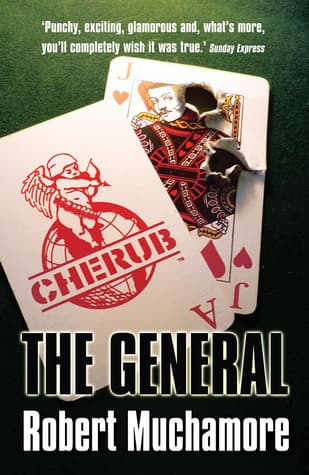
Robert Muchamore (2008)
Genre
Thriller / Children's / Mystery / Young Adult
Reading Time
274 min
Key Themes
See below
Sign in to track this book
Forty British commandos, outmatched by an American battalion in the Nevada desert, secretly deploy a squad of ten elite CHERUB agents to win the world's largest urban warfare simulation.
James Adams, now a CHERUB chairman, meets with General Sir Charles 'Chas' King and other military officials. He suggests an urban warfare training exercise at the Fort Reagan facility in Nevada, USA. This exercise will pit forty British commandos, led by Captain Jeremy 'Jezza' Banks, against an entire American battalion. Ten CHERUB agents will be secretly added to Banks's team as intelligence and special operations assets. James argues this will challenge both forces, testing the commandos' adaptability and the CHERUB agents' skills in a realistic, high-pressure setting. General King, initially doubtful, agrees to the plan, seeing the potential for valuable insights into modern urban combat. The massive war game is approved.
At CHERUB Campus, James Adams and Zara Asker choose ten agents for the Fort Reagan exercise. The selected agents include Lauren Adams, Jake Parker, Gabrielle O'Brien, and new recruits, all eager for the challenge. They receive a highly classified briefing, stressing the secrecy of their involvement and their important role. Their mission is to act as advanced reconnaissance, sabotage, and intelligence operatives, joining Captain Banks's 'Red Team' without the American 'Blue Team' knowing. The agents undergo intense physical and mental training, focusing on urban survival, espionage, and operating under extreme pressure, preparing them for the demands of the desert training facility.
The CHERUB agents are secretly taken to Fort Reagan, a large urban warfare training compound near Las Vegas. Their insertion is carefully planned to avoid detection by American forces. Dressed as civilian contractors or support staff, they are smuggled into the sprawling facility, which looks like a large, war-torn city. Inside, they meet Captain Banks and his forty British commandos. Banks, an experienced officer, is at first cautious about working with children but quickly sees their skills and the strategic advantage they offer. The agents join his team, receive their specific roles, and begin to learn the complex urban environment, getting ready for the exercise.
The urban warfare exercise begins. Captain Banks's Red Team, including the hidden CHERUB agents, immediately faces pressure from the larger and better-equipped American Blue Team. The Blue Team, unaware of the CHERUB presence, uses strong force and advanced surveillance to hunt the British commandos. The CHERUB agents quickly prove their worth, using stealth, hacking, and intelligence gathering to give Red Team important information, helping them avoid capture and plan counter-attacks. Lauren Adams, Jake Parker, and Gabrielle O'Brien excel, navigating the urban terrain and using their abilities to disrupt Blue Team's operations, showing how effective their secret inclusion is.
As the exercise continues, the CHERUB agents complete several daring and successful missions. Lauren Adams and Jake Parker infiltrate Blue Team's communications hub, planting bugs and disrupting their network, causing confusion. Gabrielle O'Brien uses her observation skills to map Blue Team's patrol routes and find weak spots. Another agent, Ryan Sharma, 'sabotages' a simulated supply depot, a major setback for the American forces. These actions, done with stealth, repeatedly surprise Blue Team commanders, who are puzzled by Red Team's ability to anticipate their moves and strike unexpected targets. Captain Banks relies heavily on the CHERUBs' intelligence, allowing his smaller force to perform well above its size.
During the exercise, a large riot simulation begins, designed to test both teams' ability to keep order in chaotic environments. Thousands of actors, playing civilians and rioters, fill the streets of Fort Reagan, creating a realistic and dangerous scenario. This adds a new layer of difficulty, making both Red and Blue Teams change their tactics. The CHERUB agents, trained in blending in and working undercover, are well-suited for this challenge. They navigate the riot-torn streets, gathering intelligence and helping Red Team control the situation and meet their goals amid the disorder, showing their versatility beyond traditional combat roles.
The American Blue Team commanders, especially Colonel Blake, become frustrated and confused by Red Team's ability to avoid capture and launch effective counter-attacks despite being outnumbered. They begin to suspect an unseen factor, unable to explain how Captain Banks's small force consistently outmaneuvers them. Their surveillance and intelligence reports fail to explain Red Team's insights, leading to internal disagreements and low morale within the Blue Team command. The CHERUB agents' secret operations are so effective that the American forces are left scrambling, unable to find the source of their opponent's intelligence, further showing the success of James Adams's experimental strategy.
During an intense phase of the exercise, one CHERUB agent, Alfie, is nearly exposed when a Blue Team patrol corners him. He escapes by using his training to blend into the civilian population during the riot simulation, but it is a close call that highlights the constant danger of their secret mission. The incident alerts CHERUB handlers and Captain Banks, reminding everyone of the high stakes. The near-exposure forces the agents to be even more careful, doubling their efforts to remain undetected while continuing their intelligence and sabotage operations, adding suspense to the already intense war game.
In the final phase of the exercise, Captain Banks, using intelligence from the CHERUB agents, plans a daring, high-risk assault on Blue Team's main command center. The CHERUBs are key to planning the infiltration, finding blind spots and security weaknesses. Lauren Adams and Jake Parker lead a secret team, using their stealth to move through heavily guarded areas. Their goal is to 'neutralize' the command center, ending the exercise by showing Red Team's ability to cripple the enemy's leadership. This final push is the result of weeks of planning and execution, designed to prove the effectiveness of the combined force.
Red Team successfully 'neutralizes' Blue Team's command center, winning the exercise. The American commanders are stunned and defeated, unable to understand how a smaller, outmatched force achieved such a decisive victory. After the exercise, a debriefing reveals the secret involvement of the ten CHERUB agents. The American military officials, including Colonel Blake, are at first disbelieving, then amazed by the young operatives' abilities. The revelation creates a mix of admiration and professional jealousy, but ultimately deep respect for the innovative strategy. General King praises the experiment's success, confirming James's vision and showing the important role CHERUB agents can play in modern warfare.
The Protagonist/CHERUB Chairman
James solidifies his role as a strategic leader, proving the effectiveness of his vision and the CHERUB program on a global stage.
The Supporting/CHERUB Agent
Lauren further develops her operational skills and proves her worth as a top-tier CHERUB agent in a complex military exercise.
The Supporting/CHERUB Agent
Jake continues to grow in his operational confidence and technical expertise, contributing significantly to the mission's success.
The Supporting/British Commando Leader
Captain Banks learns to trust and effectively utilize unconventional assets, expanding his understanding of modern warfare.
The Supporting/Military Official
General King moves from skepticism to firm belief in the potential of CHERUB operations.
The Supporting/CHERUB Executive
Zara reinforces her position as a crucial administrative and strategic partner to James Adams.
The Supporting/CHERUB Agent
Gabrielle hones her intelligence gathering and analytical skills, demonstrating her quiet but profound impact on missions.
The Antagonist/American Battalion Commander
Colonel Blake experiences professional frustration and ultimately gains a grudging respect for the unconventional tactics employed against him.
The novel explores the conflict between traditional military strategies and new, unconventional approaches. James Adams's idea to use child agents in a high-stakes military exercise challenges established warfare norms. General King's initial doubt versus James's belief, and Colonel Blake's frustration with Red Team's unusual successes, show this theme. The CHERUB agents' victory ultimately supports the idea that adaptability and creative thinking can lead to better results, even against a larger force, as seen in Red Team's win over the larger Blue Team.
““Sometimes the smallest, most unexpected piece on the chessboard can be the most powerful.””
A main theme is the importance of intelligence gathering, stealth, and secret operations in modern combat. The CHERUB agents, despite being young and lacking traditional military gear, are essential because they can infiltrate, gather information, and perform sabotage without being caught. Their successes, like disrupting Blue Team's communications or finding weaknesses, show that good intelligence can overcome numerical and technological disadvantages. This contrasts sharply with Blue Team's reliance on brute force, proving that information can be a more powerful weapon than firepower.
““In this game, knowing where the enemy is, and where they're going, is half the battle won.””
For the CHERUB agents, the Fort Reagan exercise is a major test of their skills and maturity. It is a high-stakes environment where they must use all their training in a realistic, intense situation. Agents like Lauren, Jake, and Gabrielle are pushed to their limits, showing their ability to work under pressure, make important decisions, and contribute to a larger military operation. Their success confirms their training and builds their confidence, marking an important step in their growth as elite operatives.
““This isn't just a game for them. It's real, and they're proving they're ready for it.””
The entire exercise relies on deception; the American forces do not know about the CHERUB agents. This theme examines how perception can be controlled and how hidden factors can change the outcome of a conflict. Colonel Blake's inability to understand Red Team's successes comes from his limited view of the forces involved. The revelation of the CHERUBs at the end shows how what one believes to be true can be a carefully made illusion, highlighting the strategic benefit of keeping a secret advantage.
““The greatest trick is to make your enemy believe you are something you are not, or that you are not there at all.””
The covert involvement of CHERUB agents as a hidden factor.
The 'unseen hand' is the primary plot device, referring to the secret insertion of CHERUB agents into Captain Banks's Red Team. The American Blue Team is completely unaware of their presence, which creates a significant tactical imbalance and drives much of the narrative tension. This device allows the smaller Red Team to consistently outmaneuver and outthink their numerically superior opponents, providing crucial intelligence and performing stealth operations that baffle the American commanders. It highlights the power of covert operations and intelligence in modern warfare, as the Blue Team struggles to comprehend the source of their adversary's seemingly supernatural insights.
Fort Reagan as a hyper-realistic urban warfare training ground.
Fort Reagan itself acts as a crucial plot device. Its hyper-realistic simulation of a war-torn city, complete with actors playing civilians and rioters, provides an immersive and challenging environment for the exercise. This setting allows for complex urban combat scenarios, testing the agents' ability to navigate diverse environments, blend in with crowds, and operate amidst chaos. The detailed and dynamic nature of Fort Reagan ensures that the challenges faced by both teams, and especially the CHERUB agents, feel authentic and high-stakes, pushing them to their limits in a controlled yet unpredictable setting.
The smaller, outmatched Red Team's unexpected success.
The 'underdog advantage' is a narrative device where Captain Banks's Red Team, significantly outnumbered and outgunned by the American Blue Team, consistently manages to hold its own and eventually 'win' the exercise. This device is made possible by the covert CHERUB agents, who act as a force multiplier. It creates suspense and allows for moments of unexpected triumph against seemingly insurmountable odds. This device reinforces the theme that intelligence, strategy, and unconventional tactics can overcome raw power, making the Red Team's victory all the more satisfying and impactful.
“Everyone wants to be a hero, but no one wants to do the work.”
— Rosie talking about the reality of espionage to Kazakov.
“The greatest weapon isn't a gun, it's information.”
— Kazakov reflecting on the power of intelligence.
“Sometimes the best way to hide something is in plain sight.”
— Kazakov's strategy for concealing sensitive data.
“Trust is a luxury few can afford in our line of work.”
— Rosie warning Kazakov about the dangers of trusting others.
“Fear is a powerful motivator, but it can also blind you.”
— Kazakov observing the effects of fear on an adversary.
“You can't change the past, but you can learn from it.”
— Rosie giving advice to Kazakov after a failed mission.
“The line between right and wrong often blurs when lives are on the line.”
— Kazakov grappling with a difficult moral decision.
“Every secret has a shelf life. Eventually, it will expire.”
— Rosie discussing the impermanence of classified information.
“A good spy is like a ghost: seen but never truly there.”
— Kazakov's internal monologue about the nature of his role.
“Even the most secure systems have a weakness, if you know where to look.”
— Kazakov planning an infiltration.
“The hardest part isn't getting in, it's getting out clean.”
— Rosie outlining the challenges of an extraction.
“Sometimes the smallest detail can unravel the biggest conspiracy.”
— Kazakov noticing a seemingly insignificant clue.
“Never underestimate your opponent, no matter how insignificant they seem.”
— Rosie's constant reminder to Kazakov.
“The world isn't black and white, Kazakov. It's a thousand shades of grey.”
— Rosie explaining the complexities of their moral landscape.
Ready to see how well you understood this book? Take our interactive quiz with 10 questions.

Biography coming soon.







