BookBrief
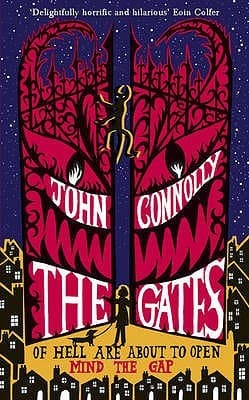
The Gates cover
Archivist's Choice

The Gates

John Connolly (2009)

Genre

Fantasy / Science Fiction / Young Adult

Reading Time

260 min

Key Themes

See below

Track Your Reading

Sign in to track this book

When a premature trick-or-treating adventure leads young Samuel Johnson and his dachshund Boswell to witness the accidental summoning of Satan, they race to prevent the gates of Hell from unleashing evil upon the world.

Synopsis

Young Samuel Johnson, a scientifically-minded boy, and his dachshund, Boswell, go trick-or-treating early and find strange events at 666 Crowley Road. The Abernathys, who live there, accidentally open a portal to Hell during an occult ritual. This lets minor demons into the world and reveals the massive Gates of Hell, where a Great Malevolence prepares to emerge. Samuel uses his scientific mind to understand the supernatural invasion. As demonic activity increases, he gathers an unlikely group of allies, including Nurd, a clumsy demon, and other eccentric characters. Together, they plan to close the Gates. Samuel confronts the Great Malevolence, combining his scientific understanding with unexpected faith and love to seal the breach, restore balance, and save the world from destruction.
Reading time
260 min
Difficulty
Easy
Pacing
Moderate
Mood
Whimsical, Suspenseful, Humorous, Adventurous
✓ Read this if...
You enjoy quirky, imaginative stories where science and the supernatural collide, featuring a clever young protagonist and a unique blend of humor and suspense.
✗ Skip this if...
You prefer hard science fiction without fantasy elements, or if you dislike stories featuring young protagonists facing large-scale supernatural threats.

Plot Summary

An Early Trick-or-Treat and a Peculiar House

Ten-year-old Samuel Johnson, a brilliant and eccentric boy with an advanced understanding of physics, decides to go trick-or-treating three days early with his dachshund, Boswell. Their search for candy leads them to 666 Crowley Road, the home of the Abernathys. Samuel sees strange lights and sounds from the house, and through a window, he watches the Abernathys, a well-meaning but naive couple, try a séance. Without knowing it, their amateur occult dabbling accidentally opens a small portal, showing a glimpse of monstrous, red-skinned figures and the faint outline of gigantic gates. This first encounter immediately sparks Samuel's scientific curiosity and his unease.

The First Glimpse of Hell's Gates

During their failed séance, the Abernathys, trying to contact dead relatives, instead open a rift in reality at 666 Crowley Road. This rift is not just spiritual; it appears as a swirling vortex in their living room. Samuel and Boswell later see terrifying creatures through it and, most importantly, the colossal, ancient, and impossibly huge Gates of Hell. These gates are made of an unknown, dark material, stretching beyond human understanding. Seeing them confirms Samuel's growing suspicion that something truly extraordinary and dangerous has been unleashed, mixing his scientific understanding with a terrifying new reality.

The Arrival of Nurd, the Lesser Demon

After the Abernathys' ritual, a small, clumsy demon named Nurd is accidentally pulled through the portal. Nurd, a 'Lesser Demon of the Eighteenth Order of the Former Empire,' cares more about paperwork and small complaints than grand evil. He is first annoyed by his unplanned arrival on Earth but soon finds himself trapped. Samuel, watching Nurd's comical attempts to go home, realizes the demon is more of a bother than a threat. Nurd, unable to return to Hell without Samuel's help, becomes an unwilling informant and, eventually, a reluctant ally to Samuel, giving important, though often sarcastic, information about the infernal hierarchy.

The Expanding Breach and the Rise of the Great Malevolence

The small breach at 666 Crowley Road begins to grow, not just in size but in its ability to let more significant entities pass through. Samuel notices a change in the atmosphere around the house, and Nurd confirms that the initial summoning was a serious mistake, attracting the attention of much more powerful beings. The 'Great Malevolence,' or Satan himself, now knows about the opening and is actively working to widen it for his full entry into the human world. This escalation makes Samuel understand the true seriousness of the situation and the immediate threat to Earth, moving beyond simple curiosity to a sense of responsibility.

Samuel's Scientific Approach to the Supernatural

With his great intelligence and deep understanding of theoretical physics, Samuel approaches the demonic invasion with an almost academic curiosity, not fear. He tries to measure the 'dark energy' coming from the gates, researches scientific theories that might explain interdimensional travel, and even tries to calculate the path of hellfire. His scientific method, while unusual for fighting demons, gives him unique insights and a sense of control over a seemingly uncontrollable situation. He believes the gates work on principles like quantum mechanics, making his scientific knowledge his main weapon.

The Gathering of Unusual Allies

As the threat grows, Samuel's allies expand beyond Boswell and Nurd. He is joined by Mrs. Abernathy, who, despite her initial naivety, has a hidden strength and a surprising talent for organization; her husband, who helps in his own clumsy way; and eventually, the local vicar, Reverend O'Connell, who offers spiritual guidance and common sense. Even some of the lesser demons, like Nurd's rival, unintentionally help Samuel due to their own bureaucratic disagreements. This diverse group, each with their quirks and strengths, forms an effective resistance against the growing infernal forces.

The Escalation of Demonic Activity

As the Gates of Hell get closer to fully opening, the demonic activity around Crowley Road increases sharply. Lesser demons, imps, and other infernal creatures begin to spill into the human world more often and with more evil, causing chaos and fear in the local community. These appearances are no longer only in the Abernathys' house but start affecting the surrounding area, creating a sense of coming doom. Samuel and his allies must confront these creatures directly, using a mix of scientific skill, divine help, and bravery to protect the innocent and contain the spreading evil.

The Plan to Close the Gates

Using his advanced understanding of physics, combined with Nurd's reluctant insights into infernal mechanics, Samuel plans to close the Gates of Hell. His strategy involves using a theoretical weakness in the fabric of reality that the gates are exploiting, essentially creating a 'reverse' effect to seal them. This plan requires precise timing, the manipulation of ambient energy, and the cooperation of his diverse group of allies. It is a complex, multi-faceted operation that blends scientific principles with elements of faith and human will, showing Samuel's unique genius.

The Confrontation with the Great Malevolence

The story's climax sees Samuel and his allies directly confronting the Great Malevolence, Satan himself, as he makes his final push to fully appear on Earth. This is not a direct physical battle, but a clash of wills, intellect, and spiritual power. Satan tries to overwhelm Samuel with fear and doubt, tempting him with knowledge and power. Samuel, however, remains firm, using his scientific understanding and the strength from his friends and his own spirit to resist the infernal lord's influence and carry out his plan to close the gates, preventing the complete invasion.

Closing the Gates and Restoring Balance

Through Samuel's scientific brilliance, the coordinated efforts of his allies, and perhaps some unexpected divine help, the Gates of Hell are successfully sealed. The massive portal at 666 Crowley Road collapses, the demonic appearances recede, and reality is restored. The world is saved from infernal invasion, and the Abernathys' house returns to normal, though with a few lingering oddities. Samuel, though tired, feels a deep sense of accomplishment, having used his unique gifts to protect humanity. The experience changes him, but his scientific curiosity remains strong.

Principal Figures

Samuel Johnson

The Protagonist

Samuel evolves from a detached observer into a courageous leader, learning to embrace the unknown and value human connection alongside his scientific pursuits.

Boswell

The Supporting

Boswell remains steadfast throughout, his loyalty serving as a consistent emotional anchor for Samuel.

Nurd

The Supporting

Nurd, initially self-serving, grudgingly develops a sense of camaraderie with Samuel and experiences a minor shift in his demonic priorities.

Mrs. Abernathy

The Supporting

Mrs. Abernathy transforms from a ditzy spiritual dabbler into a brave and resourceful participant in saving the world.

Mr. Abernathy

The Supporting

Mr. Abernathy, initially passive, grows to accept and aid in the extraordinary circumstances, finding quiet resolve.

Reverend O'Connell

The Supporting

Reverend O'Connell's faith is tested and reaffirmed as he confronts actual demonic forces, becoming a spiritual anchor for the group.

The Great Malevolence (Satan)

The Antagonist

The Great Malevolence's relentless pursuit of Earth's invasion culminates in a direct, albeit non-physical, confrontation with Samuel.

The Elder Demons

The Mentioned

These characters serve as a constant, underlying threat, their power reinforcing the stakes of the conflict.

Themes & Insights

Science vs. Faith

The novel explores science and spiritual belief when facing the unknown. Samuel, with his advanced physics knowledge, tries to rationalize and quantify the demonic invasion, treating it as a scientific problem. In contrast, Reverend O'Connell represents traditional faith, offering prayers and spiritual guidance. The story suggests that neither approach alone is enough; a blend of both — Samuel's ingenuity and his allies' collective belief and courage — is needed to overcome the infernal threat. This is clear when Samuel uses physics to understand the gates, while O'Connell's prayers offer protection.

For every action, there is an equal and opposite reaction. Even in the case of Hell, Samuel suspected, the laws of physics applied.

Narrator about Samuel Johnson

The Nature of Good and Evil

The book looks at the complex nature of good and evil, often surprising the reader. The Abernathys, despite good intentions, accidentally unleash evil. Conversely, Nurd, a demon, is more of a clumsy bureaucrat than an evil force, and his self-interest ironically helps Samuel. This theme shows that evil is not always grand and terrifying, and good can come from unexpected places. It shows that intentions matter, but actions have consequences, and that even 'good' people can make big mistakes, while 'evil' beings can have human-like flaws.

Evil, Samuel had learned, was often less about grand pronouncements and more about simple, thoughtless acts.

Narrator

Childhood Innocence and Wisdom

The novel suggests that children, especially those with unique views like Samuel, have a wisdom and resilience often underestimated by adults. Samuel's innocence allows him to approach the terrifying reality of Hell's Gates with a detached, analytical curiosity rather than paralyzing fear. His ability to see beyond normal boundaries and apply his scientific knowledge to the supernatural shows the creative power of a child's mind. This theme is strengthened by the fact that a ten-year-old ultimately plans to save the world, while adults initially dismiss or misunderstand the threat.

Sometimes, Samuel thought, the things adults believed were far more fantastical than anything he could imagine.

Samuel Johnson

The Power of Unexpected Alliances

A central theme is the strength found when different people come together for a shared goal. Samuel, a solitary and intellectual boy, must learn to rely on a diverse group of allies: his loyal dog, a clumsy demon, a ditzy couple, and a skeptical vicar. Each character brings unique skills and perspectives, showing that the group is stronger together. This theme highlights the importance of community and cooperation, suggesting that even the biggest threats can be overcome when diverse individuals put aside their differences and work together, as seen in the final plan to close the gates.

He learned that sometimes, the most unlikely people were the ones who truly understood.

Narrator about Samuel Johnson

Plot Devices & Literary Techniques

The Gates of Hell

A physical manifestation of the boundary between Earth and Hell.

The Gates of Hell serve as the central plot device, a literal and metaphorical barrier between worlds. Initially glimpsed as a terrifying vision, they become increasingly solid and present as the portal widens. They represent the ultimate threat and the direct conduit for the infernal invasion. Their physical nature allows Samuel to apply his scientific theories to their operation, making them a tangible problem to solve, rather than just an abstract evil. The gates are the focal point of the entire conflict, dictating the urgency and scale of the threat.

Nurd's Bureaucratic Nature

A demon's obsession with rules and paperwork provides crucial exposition and comic relief.

Nurd's bureaucratic personality is a significant plot device. His constant complaints about infernal regulations, paperwork, and hierarchical structures provide Samuel and the reader with invaluable information about the inner workings of Hell, its inhabitants, and the specific mechanics of the Gates. This not only serves to humanize (or demonize) the infernal realm but also provides much-needed comic relief amidst the escalating tension, preventing the story from becoming overly dark. His detailed, albeit grudging, explanations are key to Samuel's understanding of the problem.

Samuel's Scientific Genius

The protagonist's advanced understanding of physics as a tool for problem-solving.

Samuel's extraordinary scientific intellect is the primary plot device driving the resolution of the conflict. His ability to apply complex theories of particle physics, quantum mechanics, and dark energy to the supernatural phenomenon of the Gates of Hell allows him to understand their function and devise a method for their closure. This device elevates the story beyond a simple good-versus-evil narrative, grounding the fantastical elements in a pseudo-scientific framework and providing a unique, intellectual approach to combating demonic forces. It's his mind, not brute strength, that saves the day.

The Abernathys' Séance

The catalyst for the entire plot, an act of naive occult dabbling.

The Abernathys' ill-advised séance is the inciting incident and a crucial plot device. Their well-meaning but ignorant attempt to contact the deceased inadvertently creates the breach between worlds, setting the entire story in motion. This device highlights the dangers of dabbling in the unknown without proper understanding and serves as a cautionary tale. It also establishes the core conflict and provides the initial reason for Samuel's involvement, as he is an accidental witness to their catastrophic mistake, leading him to investigate the peculiar house at 666 Crowley Road.

Critical analysis

Notable Quotes

The universe is a big place, and it gets bigger every day. There are things out there that would make your hair stand on end, and things that would make you weep with joy. And sometimes, just sometimes, the two are the same.

Narrator musing on the vastness and wonder/terror of existence.

It's a good thing to be afraid, sometimes. It means you're still alive.

Mr. Abernathy offering wisdom to Samuel.

Evil isn't born. It's made. It's the choices people make, the things they do, the way they treat each other.

Mr. Abernathy explaining the nature of evil to Samuel.

The problem with the universe is that it's full of people, and people are always doing stupid things.

A somewhat cynical observation about humanity's role in cosmic events.

Sometimes, the smallest things can make the biggest difference. A kind word, a helping hand, a little bit of courage.

Samuel reflecting on the impact of seemingly minor actions.

There are more things in heaven and earth, Horatio, than are dreamt of in your philosophy.

A direct quote from Hamlet, used to emphasize the strangeness of the unfolding events.

The end of the world is always happening somewhere, to someone. We just don't always notice.

A poignant reflection on the cyclical nature of destruction and personal apocalypses.

Don't underestimate the power of a good cup of tea. It can solve almost anything, or at least make you feel better while you're trying to solve it.

Mrs. Abernathy offering practical comfort and wisdom.

Even in the darkest times, there is always hope. You just have to look for it, sometimes with a torch.

A hopeful message amidst the chaos.

The universe doesn't care about your plans. It has its own.

A reminder of the insignificance of individual will against cosmic forces.

What is the point of being a demon if you can't have a little fun?

Nurd, one of the demons, expressing a mischievous outlook.

Sometimes, the best way to fight a monster is to become one yourself. Just for a little while.

A morally ambiguous piece of advice on dealing with overwhelming threats.

Laughter is a powerful thing. It can scare away the dark, even if only for a moment.

Samuel finding solace and strength in humor during a difficult situation.

The world is full of wonders, Samuel. You just have to be brave enough to see them, even the scary ones.

A recurring theme about embracing the full spectrum of existence.

Quiz

Test Your Knowledge

Ready to see how well you understood this book? Take our interactive quiz with 10 questions.

10
Questions
~5
Minutes
?
Best Score

Key Questions (FAQ)

The central premise revolves around young Samuel Johnson and his dachshund Boswell inadvertently stumbling upon an occult ritual at 666 Crowley Road. This ritual, performed by the well-meaning but misguided Abernathys, accidentally summons Satan and creates a rift in reality, revealing the Gates of Hell and threatening to unleash demonic entities upon the world.

About the author