“The Fourth Monkey is always listening.”
— A recurring motif about the antagonist's surveillance and control.

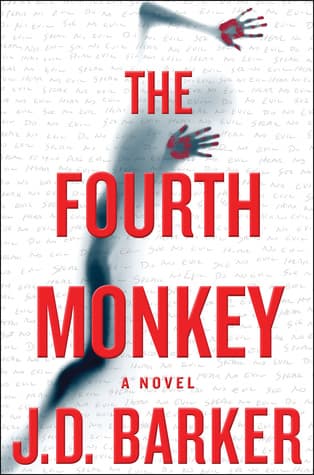
J.D. Barker (2017)
Genre
Thriller / Mystery
Reading Time
800 min
Key Themes
See below
Sign in to track this book
A detective races against time to decipher a dead serial killer's final, elaborate puzzle, navigating the psychopath's chilling diary and his own fractured past to save a kidnapped victim who may still be alive.
The story opens with Detective Sam Porter, head of the 4MK task force, being called to the scene of a fatality. A man has been hit by a bus and killed. What looks like an accident quickly becomes more sinister when the victim is identified as the notorious Four Monkey Killer (4MK), a serial killer who has terrorized Chicago for five years, leaving behind 'see no evil, hear no evil, speak no evil' tokens with his victims. In the victim's pocket, a white box contains an ear, confirming his identity as 4MK. This discovery immediately tells Porter that even in death, the killer's game is not over, and a new victim, Emery Reed, is likely still alive and in danger.
Along with the ear, a leather-bound journal is found on the 4MK's body, filled with handwritten entries. Porter and his team, including Detectives Nash and Clair, realize this diary holds the key to understanding the killer and, more importantly, finding Emery Reed. The diary entries, written from the killer's perspective as a child, detail a horrifying upbringing with an abusive, fanatically religious mother and a distant, complicit father. The entries show the boy's interest in the 'three wise monkeys' and his early, disturbing experiments with cruelty, particularly towards animals, hinting at the start of his later terror. Porter reads the diary himself, getting inside the mind of the man he hunted for years.
Following the 4MK's established pattern, the team expects the first 'see no evil' package. It arrives at Emery Reed's parents' house, containing a small, white box. Inside is a miniature coffin and a glass eye. This clue leads Porter and his team to a woman named Amy, who was abducted and blinded by the 4MK five years prior, but managed to escape. Amy, still traumatized, gives important, though fragmented, details about her captivity, including the killer's distinctive voice and a few sensory memories. Her survival shows the 4MK's twisted nature, as he allowed her to live as a 'witness' to his cruelty, further complicating the psychological profile of their deceased suspect.
The investigation continues with the arrival of the 'hear no evil' package, containing a severed ear. This leads the task force to a deaf man named David, who was abducted by the 4MK years ago and had his eardrums punctured, making him completely deaf. David, like Amy, survived the ordeal and has been living in fear. Through an interpreter, the team learns more about the killer's methods and the specific locations he used, particularly a soundproofed room where David was held. These details, combined with the diary entries, begin to paint a clearer picture of the killer's careful planning and the deep psychological damage he inflicted on his victims.
During the intense investigation, Detective Porter battles his own personal problems. The 4MK case, especially the abduction of children, brings back painful memories of his younger sister, Maggie, who disappeared years ago and was never found. The anniversary of her disappearance approaches, causing Porter to lose sleep, experience vivid nightmares, and self-medicate with alcohol. His colleagues, particularly Nash, notice his increasing instability and worry about him. Porter's personal connection to lost children fuels his relentless pursuit of Emery Reed, but also clouds his judgment and makes him vulnerable to the killer's psychological traps, blurring the lines between professional duty and personal vendetta.
As Porter reads deeper into the diary, the narrative shifts, showing a more complex and disturbing family dynamic. The killer's childhood entries initially portray his father as a victim, silently enduring the mother's abuse. However, later entries expose the father's involvement and active participation in the boy's psychological torment and 'education' in cruelty. He is revealed to be a manipulative figure who encouraged his son's dark tendencies, providing him with tools and opportunities for his disturbing experiments. This twist complicates the understanding of the 4MK's origins, suggesting that his pathology was not just from his mother's abuse but a collaborative effort by both parents, turning his childhood home into a breeding ground for a serial killer.
The third 'speak no evil' package arrives, containing a small wooden box with Emery Reed's tongue inside, with a cryptic note. This gruesome discovery confirms Emery is still alive but has been brutally maimed, making the search more urgent. The note includes a riddle or a series of numbers that the team struggles to decipher, leading them on a wild goose chase across Chicago. Porter, driven by a desperate hope to save Emery and haunted by his sister's disappearance, pushes his team to their limits, analyzing every detail of the packages, the diary, and the previous victims' testimonies, convinced that the killer, even in death, has left a precise path to his final victim.
The climax of the diary entries reveals the killer's identity as a young boy named Anson Bishop. The entries detail his careful planning, his escape from his abusive parents, and his transformation into the 4MK. However, the biggest twist comes when Porter realizes the man hit by the bus was not Anson Bishop, but a decoy. The man was a homeless individual, carefully groomed and prepared to look like Bishop, including specific clothing and personal effects, and a fake diary. The real Anson Bishop is still alive, orchestrating the entire post-mortem game, using his 'death' as a final, elaborate taunt and a way to continue his terror from the shadows, making the hunt for Emery Reed even more desperate.
With the knowledge that Anson Bishop is alive, Porter re-evaluates all the evidence. He realizes that the clues left behind were not meant to be found by the task force but by Bishop’s father, who was also involved in the previous abductions. He re-examines the 'speak no evil' package and the diary, putting together the final pieces of the puzzle. The fragmented clues, including a specific address mentioned in a diary entry about a childhood 'hideout' and the patterns of Bishop's previous victims, lead Porter to a run-down warehouse on the outskirts of Chicago. Time is running out, and Porter knows this is his last chance to save Emery Reed from the cunning and still-active Four Monkey Killer.
Porter, acting on instinct and a desperate hunch, arrives at the abandoned warehouse. He finds Emery Reed chained and traumatized, but alive. A tense confrontation occurs with Anson Bishop, who has been watching the police's movements and waiting for Porter. Bishop reveals his motive: he wanted to 'educate' Porter, just as his parents had 'educated' him, and to make Porter understand his twisted philosophy. A struggle ensues, during which Porter is injured. Bishop manages to escape, leaving Porter with Emery. While Emery is saved, the killer's ultimate fate remains ambiguous, leaving the door open for his return. Porter realizes that the 4MK case is far from over, and Bishop is still out there.
The Protagonist
Porter confronts his personal demons and uses his trauma to fuel his pursuit of justice, ultimately saving Emery Reed but failing to capture Anson Bishop.
The Antagonist
Bishop maintains his identity as a master manipulator, even faking his own death to continue his psychological games with Detective Porter.
The Supporting
Nash remains a steadfast partner, providing support and a grounding presence for Porter throughout the intense investigation.
The Supporting
Clair remains a competent and dedicated investigator, contributing to the team's efforts to track the 4MK.
The Supporting
Emery is abducted and subjected to the 4MK's ritual, but is ultimately rescued by Detective Porter.
The Supporting
Amy provides a survivor's perspective on the 4MK's methods, offering vital clues for the investigation.
The Supporting
David provides a survivor's perspective on the 4MK's methods, offering vital clues for the investigation.
The Mentioned
Her past disappearance serves as a constant motivation and emotional burden for Detective Porter.
The Supporting
Her abusive parenting is revealed as a key factor in the development of Anson Bishop's psychopathy.
The Supporting
His complicity and active manipulation are revealed as crucial in fostering Anson Bishop's psychopathy.
The book explores how a serial killer is made, not born. Through Anson Bishop's diary, the story details his horrific childhood, including physical and psychological abuse from his fanatically religious mother and the manipulative involvement of his father. This theme questions if evil is inherent or a product of environment, suggesting that Bishop's acts are a direct, though twisted, response to his upbringing. The diary entries show the psychological breaking that leads to his adult psychopathy, showing how a child's innocence can be systematically replaced with calculated cruelty.
“My mother taught me about the three wise monkeys. My father taught me how to put them into practice.”
Both the victims and the protagonist are affected by trauma. Detective Porter is haunted by the unresolved disappearance of his sister, Maggie, which causes nightmares, alcoholism, and an almost obsessive drive to save other children. The 4MK's survivors, Amy and David, have physical scars and deep psychological damage, living in constant fear. Even Anson Bishop's actions, while evil, come from the trauma of his own childhood abuse. The book shows how past traumas, whether as a victim or a perpetrator, continuously shape present actions and perceptions, leaving lasting marks on individuals.
“Some wounds never heal. They just change shape.”
Deception is central to the plot, especially through Anson Bishop. His 'death' at the beginning of the book is the ultimate manipulation, designed to mislead the police and continue his game from the shadows. The diary itself is a carefully curated story, initially presenting a sympathetic view of his father before revealing his true involvement. Bishop consistently uses misdirection, riddles, and false trails to toy with Detective Porter, showing his intelligence and enjoyment of psychological warfare. The entire investigation is a battle against Bishop's masterful lies and deceptions, forcing the police to question everything they think they know.
“The greatest trick the devil ever pulled was convincing the world he didn't exist.”
The novel explores the line between seeking justice and giving in to personal vengeance. Detective Porter's pursuit of the 4MK is driven not only by his duty as an officer but also by his deep grief and guilt over his sister's disappearance. He becomes personally invested, often making reckless decisions, driven by a desire for retribution against the kind of evil that took Maggie. This theme questions if true justice can be achieved when personal motives are intertwined with professional responsibilities, and how close one can come to becoming the monster they hunt in the name of righting wrongs.
“I didn't want justice. I wanted him to suffer.”
The killer's diary is a powerful story device, giving a first-person account of his childhood that shapes the reader's and Porter's understanding of his motives. The reliability of this narrative is questioned as new information is revealed, showing how perspective can be manipulated. The contrast between the diary's 'confession' and the unfolding reality of Bishop's ongoing game highlights how stories, even seemingly personal ones, can be crafted to deceive. This theme emphasizes the subjective nature of truth and how narratives, whether from a killer or a detective, can be used to control perception and influence outcomes.
“A story is only as true as the one telling it.”
A handwritten journal offering a first-person account of the killer's childhood.
The leather-bound diary found on the supposedly deceased 4MK's body is the central plot device. It serves as a primary source of information, guiding the police through the killer's twisted past and providing clues to his methods and motives. The diary is presented as a narrative within a narrative, offering a first-person account of Anson Bishop's traumatic childhood. It also functions as a psychological weapon, allowing Bishop to manipulate Porter and the investigation from beyond his 'grave,' revealing a carefully constructed and evolving perspective that ultimately leads to the shocking twist of his survival and continued machinations.
'See no evil, hear no evil, speak no evil' as the killer's signature.
The 'three wise monkeys' proverb (Mizaru, Kikazaru, Iwazaru) is the central motif and signature of the Four Monkey Killer. Each of his victims is associated with one of these 'evils,' with the corresponding body part or symbolic token left for the police. This motif provides the killer's identity and ritualistic structure, creating a predictable pattern that the task force must decipher. It also reflects Anson Bishop's traumatic childhood, where his abusive mother used this proverb in a twisted, literal way to punish and 'educate' him, highlighting the deep psychological roots of his crimes and his desire to recreate his own trauma on others.
The killer fakes his own death to orchestrate a post-mortem game.
The initial discovery of the 4MK's body, seemingly hit by a bus, is a major plot twist and a sophisticated act of deception. The 'dead' killer is revealed to be a carefully chosen decoy, meticulously prepared to resemble Anson Bishop. This device allows Bishop to continue his reign of terror from the shadows, manipulating the investigation and taunting Detective Porter with a false sense of closure. It elevates Bishop's intelligence and sadism, making him an even more formidable antagonist who can orchestrate events even when presumed dead, challenging the traditional detective-killer dynamic and raising the stakes significantly.
The detective's unresolved personal loss fuels his obsession with the case.
Detective Sam Porter's personal trauma—the unsolved disappearance of his younger sister, Maggie—serves as a powerful emotional plot device. This past event directly connects him to the victims of the 4MK, particularly the abducted children, making his pursuit of the killer deeply personal. His unresolved grief, guilt, and desire for closure fuel his relentless dedication, sometimes to the detriment of his own well-being. This device adds emotional depth to Porter's character, explaining his obsessive drive and making the stakes of the investigation higher than just professional duty, blurring the lines between justice and personal vengeance.
“The Fourth Monkey is always listening.”
— A recurring motif about the antagonist's surveillance and control.
“Evil doesn't just happen; it's cultivated.”
— Reflection on the origins of malevolence in the story.
“In the silence, the truth screams the loudest.”
— Observation during an investigation scene.
“Monkeys see, monkeys do, monkeys hear, monkeys speak... but the fourth monkey? The fourth monkey plans.”
— Explanation of the book's title and the antagonist's methodology.
“Fear is a weapon sharper than any blade.”
— Comment on psychological manipulation in crimes.
“The past is a ghost that never stops haunting.”
— Character reflecting on unresolved history affecting the present.
“Justice isn't always found in a courtroom.”
— Musing on alternative forms of retribution in the plot.
“Some puzzles are meant to be solved, others to trap.”
— Describing the antagonist's intricate schemes.
“The line between hunter and prey is thinner than you think.”
— During a tense chase or confrontation scene.
“Darkness isn't the absence of light; it's the presence of something else.”
— Atmospheric description in a sinister setting.
“Every killer has a signature, but the smart ones leave no fingerprints.”
— Discussion on criminal profiling and evasion.
“Trust is the first casualty in a game of lies.”
— Reflecting on deceit among characters.
“The mind is the most dangerous crime scene of all.”
— Analyzing the psychological aspects of the mystery.
“Sometimes the only way out is through the darkness.”
— Character's resolve in facing perilous situations.
Ready to see how well you understood this book? Take our interactive quiz with 10 questions.







