“The past is a place, and you have to go there to find it.”
— Dylan's internal reflection on his father's past and his own.

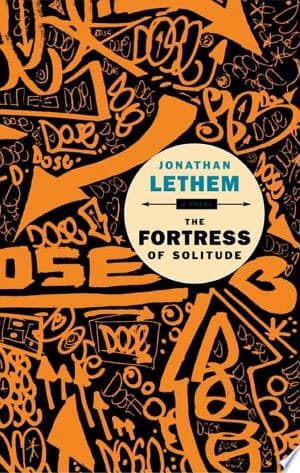
Jonathan Lethem (2014)
Genre
Literary Fiction / Fantasy / Historical Fiction
Reading Time
12-15 hours
Key Themes
See below
Sign in to track this book
In 1970s Brooklyn, a white boy and a Black boy form a friendship amidst racial tension and urban change, their lives shaped by music, identity, and a mysterious ring that grants flight.
In 1970s Brooklyn, young Dylan Ebdus and his mother, Rachel, a former experimental filmmaker, move into a brownstone on Dean Street. They are white in a mostly Black and Puerto Rican neighborhood, which had seen many white families leave. Dylan's father, Abraham, a painter, stays in their old apartment, splitting the family. The brownstone needs repairs, and Rachel's bohemian lifestyle and lack of interest in upkeep make Dylan's adjustment hard. He feels alone and struggles to connect with other kids, often getting bullied. His only comfort is his growing interest in comic books and the idea of superpowers, which helps him cope with feeling powerless and isolated.
Dylan's closest neighbor is Mingus Rude, a Black boy his age, who lives next door. Mingus is the son of Arthur Rude, a former doo-wop singer, and is more confident and street-smart than Dylan. Despite their racial and social differences, a friendship forms, based on shared interests in music, comic books, and the city, but with underlying tensions. Mingus often protects Dylan, but sometimes takes advantage of him. Their bond is a main part of Dylan's life, offering both companionship and a constant reminder of his outsider status as they navigate the often-difficult environment of Dean Street.
One day, while exploring an empty lot, Mingus Rude finds a tarnished brass ring. When he puts it on, he discovers he can fly. This discovery excites both boys, fulfilling their comic book dreams. Mingus, with his new power, begins to fly over Brooklyn rooftops, a secret he shares only with Dylan. This power at first strengthens their bond, as Dylan becomes Mingus's confidant. However, the ring also creates new power dynamics and envy in their friendship, as Dylan wants similar abilities and Mingus deals with the responsibility of his gift. The ring becomes a symbol of their shared secret and individual hopes.
As Dylan and Mingus become teenagers, their lives begin to separate. Dylan, still figuring out his identity, finds comfort in punk rock and a growing interest in art, often feeling like an outsider in both white and Black social groups. Mingus, meanwhile, becomes more involved in local street culture, influenced by his father's past and his environment. The racial and class differences that were subtle in childhood become more obvious. While they remain friends, their interactions are increasingly strained by unspoken resentments, misunderstandings, and the different pressures they face. The shared secret of the ring becomes less a bond and more a source of unspoken tension as their lives take different directions.
Mingus Rude's involvement in the drug trade increases during his teenage years. Under pressure and seeking power and belonging, he starts dealing crack cocaine. This decision changes his life, leading him away from his earlier goals and deeper into the criminal world of Dean Street. His once-innocent use of the flight ring for fun changes to using it for illegal activities, like quick escapes. Dylan watches from a distance, helpless and increasingly distant from his friend's choices. Eventually, police catch Mingus, leading to his arrest and imprisonment. This event shatters Dylan's remaining illusions about their childhood and forces him to face the harsh realities of their different lives and the larger societal issues.
After high school, Dylan Ebdus leaves Brooklyn for college, trying to escape the complexities and difficulties of his adolescence on Dean Street. He pursues his artistic interests, studying film and music, and tries to redefine himself away from his past. While he finds some success and forms new relationships, his youth, especially his friendship with Mingus and the racial tensions of his neighborhood, continues to affect him. He carries a deep sense of guilt and unresolved feelings about Mingus's fate. His college years involve a struggle to connect his past identity with his current goals, always feeling the pull of his Brooklyn roots and the people he left behind.
Years later, as an adult, Dylan Ebdus returns to Brooklyn, drawn back by nostalgia, unresolved guilt, and practical reasons. He finds Dean Street changed by gentrification, with many familiar faces and places replaced by new businesses and residents. This return forces him to confront his past, particularly his strained relationship with his father, Abraham, and the lasting impact of his friendship with Mingus. He tries to reconnect with parts of his old life, seeking closure and understanding. His return is a painful journey of self-discovery, as he deals with the person he became and the person he left behind in his changing childhood neighborhood.
After Mingus Rude is released from prison, Dylan Ebdus tries to reconnect with his old friend. Their reunion is awkward and full of unspoken history. Mingus is changed, marked by his time in prison and carrying the weight of his past. He is less forgiving and more cynical than Dylan remembers, and their power dynamic has shifted. Dylan tries to offer support and perhaps make amends for his perceived abandonment, but their shared history and different paths create a gap between them. Their conversations often return to the mysterious ring, which Mingus still has, serving as a tangible link to their shared, but now distant, past and the dreams they once held.
After his release, Mingus Rude tries to start a music career, using his experiences and his father's legacy in his art. He records an album, a raw expression of his life and struggles. Dylan, at first excited, tries to help promote Mingus's music, seeing it as a possible path to redemption for his friend. However, Mingus's criminal record and his own inner struggles prove to be significant obstacles. He struggles with the music industry and his personal relationships, often self-sabotaging. The flight ring, still with him, becomes less a symbol of power and more a burden, a reminder of lost potential and the choices that led him astray. His music, though good, struggles to find an audience.
As the story progresses, the true nature and fate of the magic ring become a central focus. It is revealed that the ring's power is not limitless or purely good; it seems connected to the wearer's emotional state and perhaps their moral compass. Mingus, burdened by his past and increasingly disillusioned, finds his ability to fly lessening and becoming more unpredictable. The ring, once a symbol of endless possibility, becomes a metaphor for the fleeting nature of youthful dreams and the high cost of choices. Its ultimate fate, whether lost, discarded, or simply no longer working, highlights the novel's exploration of how fantasy and the harsh realities of life intersect, and how power can both uplift and destroy.
Throughout his adult life, Dylan Ebdus continues to grapple with his artistic identity, eventually finding his voice by directly using his experiences on Dean Street. He writes songs and stories that explore race, class, friendship, and the elusive nature of memory. His art helps him process his guilt, his love for Mingus, and his complex relationship with his childhood neighborhood. This artistic journey intertwines with a journey of self-acceptance, as he comes to terms with his own privilege, his vulnerabilities, and the lasting mark his past has left on him. He learns to embrace the complexities of his identity, no longer trying to escape his history but integrating it into who he is.
The novel ends with Dylan Ebdus, now an adult, reflecting on the lasting impact of Dean Street and his friendship with Mingus Rude. He recognizes that his childhood experiences, though often painful, helped shape him into the person he became. The neighborhood's racial and social dynamics, the magic of the ring, and the tragedy of Mingus's life are all part of his memory and identity. While their lives went in different directions, the bond between Dylan and Mingus, however flawed, remains a powerful force. The story concludes with a sense of sad acceptance, acknowledging how much place and people affect one's life, and how the past continues to influence the present.
The Protagonist
Dylan evolves from a naive, alienated child to a reflective adult artist who confronts his past, accepts his complex identity, and finds his voice by integrating his experiences.
The Supporting/Co-Protagonist
Mingus transforms from a powerful, aspirational child with a magical gift to a man broken by the penal system and the harsh realities of his environment, losing his way despite his inherent talent.
The Supporting
Rachel remains largely static in her bohemian, self-focused worldview, serving more as a catalyst for Dylan's isolation than undergoing significant personal transformation.
The Supporting
Abraham remains largely fixed in his artistic pursuits and emotional distance, his arc primarily serving to highlight the intergenerational struggles and the impact of parental neglect on Dylan.
The Supporting
Arthur's arc primarily involves his attempts to reignite his musical career and find justice for past wrongs, reflecting the ongoing struggle for recognition and fair treatment in the music industry.
The Supporting
Lacy remains a steadfast and supportive matriarch, her arc demonstrating resilience and enduring maternal love in the face of adversity.
The Supporting
Robert's role is primarily confined to Dylan's childhood, representing the initial hostile environment Dylan faces, and his impact diminishes as the boys grow up.
The Mentioned
Isabel's role is to provide a romantic relationship for Dylan during his college years, symbolizing his attempt at a new beginning, but her personal arc is not central to the narrative.
The novel explores race and identity in 1970s and 1990s Brooklyn. Dylan, a white boy in a mostly Black neighborhood, deals with feeling like an outsider, his privilege, and unspoken racial rules. Mingus, a Black boy, faces systemic barriers, stereotypes, and economic pressures that shape his life. The story shows the racial divide through their friendship, illustrating how their experiences are affected by their skin color, from bullying to the justice system. Gentrification of Dean Street later on further complicates this theme, examining how racial demographics and class structures change a community.
““The white boy, Dylan, felt like a tourist in his own life, perpetually observing, never quite belonging.””
At its heart, the book is about the lasting, yet difficult, friendship between Dylan and Mingus. Their bond forms from shared childhood fantasies and secrets, but it is constantly tested by racial differences, class disparities, and personal choices. Dylan's guilt over Mingus's downfall and his perceived abandonment highlights the theme of betrayal, both intentional and accidental. Their adult attempts to reconcile show the lasting impact of childhood connections and the difficulty of overcoming gaps created by very different life paths. It ultimately questions the strength of their bond.
““Their friendship was a fortress of solitude, built brick by brick from shared secrets and unspoken understandings, yet always vulnerable to the siege of the outside world.””
The novel shows the shift from childhood innocence, with comic book fantasies and the magic flight ring, to the harsh realities and disillusionment of adulthood. Dylan and Mingus's dreams of superpowers and escape are slowly worn away by economic pressures, racial injustices, and personal failures. Mingus's tragic path into crime and prison is a clear example of this loss, while Dylan's struggle to reconcile his idealized past with his complex present also shows deep disillusionment. The magic ring, once a symbol of hope, becomes a metaphor for fleeting power and lost potential.
““The city, once a canvas for their superhero dreams, revealed itself to be a labyrinth of unyielding realities.””
Art and music act as important escapes, expressions, and forms of identity for several characters. Dylan finds comfort and eventually his voice through punk rock, film, and songwriting, using creativity to process his difficult past. Mingus, influenced by his father Arthur Rude's doo-wop legacy, tries to put his experiences into his own music, seeing it as a way to redemption and self-expression. Arthur's story shows music's power to both uplift and exploit. This theme explores how art can offer solace, resistance, and a way to express the inexpressible, even when facing significant hardship and systemic injustice.
““Music, for Mingus, was the only language left that could translate the unspeakable truths of his life.””
The story is filled with a strong sense of memory and nostalgia, seen through Dylan's adult reflections on his childhood. He constantly revisits Dean Street, both physically and mentally, trying to understand his past and its lasting effects. The changing landscape of Brooklyn due to gentrification physically shows lost time and altered realities. Dylan's memories are often tinged with sadness, guilt, and a longing for a simpler, though complicated, past. This theme explores how personal and shared memories shape identity and how people deal with idealized versions of their youth versus often harsher truths.
““Dean Street, for Dylan, was less a place than a palimpsest, each layer of memory written over the last, yet none ever fully erased.””
A magical brass ring that grants the wearer the power of flight.
The flight ring is the central magical realism element in the novel. Discovered by Mingus Rude, it allows him to fly, fulfilling the boys' comic book fantasies. Initially, it symbolizes boundless possibility, escape from their mundane and challenging lives, and the shared secret that binds their friendship. As the story progresses, its power becomes more ambiguous, seemingly tied to the wearer's emotional state and moral choices. It transforms from a symbol of freedom to one of burden and lost potential, ultimately representing the fleeting nature of childhood dreams and the harsh realities that ground them. It serves as a powerful metaphor for aspirations and the consequences of their pursuit.
The story is told primarily from Dylan Ebdus's adult perspective, looking back on his childhood.
The novel employs a first-person retrospective narration, with an adult Dylan Ebdus recounting his childhood and adolescence on Dean Street. This allows for a reflective, often melancholic, tone as Dylan processes his past experiences, guilt, and the complex racial dynamics of his youth. The hindsight perspective provides a layer of interpretation and self-analysis, allowing the narrator to comment on the significance of events and character motivations that he might not have understood at the time. This device emphasizes themes of memory, the shaping of identity, and the enduring impact of childhood friendships and traumas on adult life, often blurring the lines between objective memory and subjective interpretation.
The transformation of the Brooklyn neighborhood from predominantly Black to increasingly white and affluent.
The gentrification of Dean Street serves as a significant backdrop and plot device, highlighting the socio-economic and racial shifts in Brooklyn over several decades. As Dylan returns to his childhood neighborhood as an adult, he finds it drastically altered, with his old brownstone now a symbol of upward mobility for new white residents. This transformation underscores the themes of loss, change, and the displacement of original communities. It acts as a concrete manifestation of the passage of time and the complex interplay of race, class, and urban development, forcing Dylan to confront how his own privilege implicitly contributed to these changes and the erasure of his past.
Frequent references to superheroes and comic book tropes.
The novel is rich with allusions to comic books and superhero narratives, which serve as a recurring motif and metaphor. Dylan and Mingus's shared obsession with superheroes like Superman and the Fantastic Four provides a framework for their childhood fantasies and their understanding of power and responsibility. The flight ring directly embodies this fantasy. These allusions contrast sharply with the grim realities of their lives, highlighting the gap between idealized heroism and the messy, often tragic, struggles of real people. The comic book lens allows the author to explore themes of identity, escape, and the search for meaning in a world that rarely offers clear-cut heroes or villains.
“The past is a place, and you have to go there to find it.”
— Dylan's internal reflection on his father's past and his own.
“It was the music, always the music, that made the world make sense.”
— Dylan's deep connection to music as a source of understanding and solace.
“There are things you can't outrun, no matter how fast you are.”
— A reflection on the inescapable nature of certain truths or consequences.
“Friendship was a kind of magic, too, a way of making the world less lonely.”
— Dylan's appreciation for his bond with Mingus and others.
“Brooklyn was a map of all his past selves, each street a different version of him.”
— Dylan's strong identification with his neighborhood and its role in his development.
“The trick was to keep moving, even when you didn't know where you were going.”
— A philosophical outlook on navigating uncertainty in life.
“Every secret was a kind of weight, pressing down on you.”
— Dylan's experience with keeping secrets and their burden.
“Sometimes the greatest power was the power to disappear.”
— A thought on the allure of anonymity or escape.
“The city had a way of swallowing people whole, and spitting them out changed.”
— The transformative and often harsh nature of New York City.
“Memory was a river, and you could drown in it if you weren't careful.”
— A cautionary thought on the overwhelming nature of past recollections.
“You couldn't save anyone who didn't want to be saved, not really.”
— A realization about the limits of helping others.
“Superheroes were just regular people, trying to do something extraordinary.”
— Dylan's understanding of the hero archetype beyond the fantastic.
“The future was just a story you hadn't read yet.”
— A perspective on the unknown and unfolding nature of what's to come.
“Graffiti was a conversation, a way of talking back to the walls of the world.”
— Dylan's observation on the rebellious and expressive nature of street art.
“Home wasn't a place, it was a feeling, a certain kind of belonging.”
— Dylan's evolving understanding of what 'home' truly means.
Ready to see how well you understood this book? Take our interactive quiz with 10 questions.

Jonathan Allen Lethem is an American novelist, essayist, and short story writer. His first novel, Gun, with Occasional Music, a genre work that mixed elements of science fiction and detective fiction, was published in 1994. In 1999, Lethem published Motherless Brooklyn, a National Book Critics Circle Award-winning novel that achieved mainstream success. In 2003, he published The Fortress of Solitude, which became a New York Times Best Seller. In 2005, he received a MacArthur Fellowship. Since 2011, he has taught creative writing at Pomona College.







