“A garden is a grand teacher. It teaches patience and careful watchfulness; it teaches industry and thrift; above all it teaches entire trust.”
— Nell's grandmother shares wisdom about gardening and life.

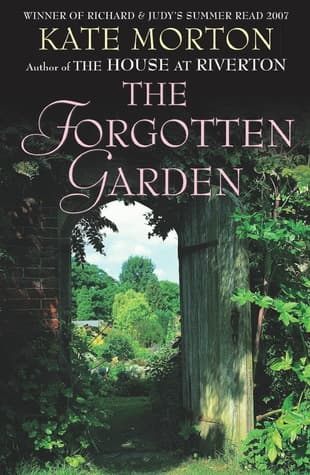
Kate Morton (2008)
Genre
Historical Fiction / Mystery / Romance
Reading Time
10-12 hours
Key Themes
See below
Sign in to track this book
A mysterious inheritance, a lost Victorian author, and a book of dark fairy tales propel a grieving woman into uncovering the century-old secrets of a secret garden and her own forgotten family history.
In 2000, Cassandra, a young woman still coping with the car accident a decade earlier that killed her parents, is saddened by the death of her grandmother, Nell. Nell, who raised Cassandra, leaves her a cottage in Cornwall, England, called Blackhurst Manor, and an old book of dark fairy tales named 'The True History of the Kindred' by Eliza Makepeace. This gift is confusing, as Nell had always said she was an orphan from Australia, arriving there by boat as a child. Cassandra, feeling lost after Nell's death and her recent separation from her partner, Drew, decides to go to Cornwall to look into the cottage and the hints Nell left about her true origins, hoping to find answers about her grandmother's past and her own identity.
The story moves to 1913, following a young girl, also named Nell, found abandoned on a ship going to Australia. She holds a small suitcase with the same book of fairy tales, 'The True History of the Kindred,' and a white lace dress. She is adopted by the Kindred family, who run the port. Despite her new family's love, Nell has fragmented memories of a garden, a woman, and a frightening event involving a man with a tattoo. She tries to put her past together but finds her memories hard to grasp and often scary, leaving her with a feeling of being lost and a deep fear of being left alone.
Cassandra arrives in Cornwall and finds Blackhurst Manor, a run-down but beautiful cottage with an overgrown garden. She meets the local vicar, Reverend Aubrey, who knew Nell when she stayed there in the 1970s. Aubrey tells Cassandra some local history and connects Nell to the Mountrachet family, the former owners of the nearby estate, Ashton Park. Cassandra starts to explore the cottage and finds more clues: old letters, photographs, and drawings, all suggesting a link between Nell, Eliza Makepeace, and the Mountrachet family. The fairy tale book becomes a guide, as its stories seem to match events and characters from Nell's lost past.
The story goes to 1899, introducing Eliza Makepeace, an author of dark fairy tales. Eliza, an orphan herself, was adopted by the wealthy Mountrachet family and grew up at Ashton Park, where she became close with her adopted brother, Nathaniel. She is a sensitive woman, bothered by vague, unsettling memories of her early childhood and a recurring dream of a threatening figure. Her stories, especially 'The True History of the Kindred,' are personal, showing her understanding of her own hidden past and the secrets within the Mountrachet family. Eliza's life at Ashton Park has creativity and a growing sense of unease about the family's head, the manipulative Linus Mountrachet.
Cassandra continues to solve the puzzle, learning more about the Mountrachet family. She learns that Eliza Makepeace was an author and a key person in the family's history, having disappeared in 1913. Cassandra learns about Linus Mountrachet's controlling nature and his wife Adeline's fragile mental state. She also finds signs of a secret room or hidden passage within Ashton Park, suggesting more concealment. The local historical society and Reverend Aubrey’s memories are helpful, giving details that link Eliza’s life and disappearance to Nell’s abandonment.
Flashbacks show Eliza's growing discomfort at Ashton Park. She discovers her adopted father, Linus, has been manipulating her. Through memories and clues, Eliza realizes she is not Adeline's daughter, but the daughter of Linus and a servant girl, Rose. Linus, afraid of scandal, had Rose sent to an asylum and forced Eliza into being his adopted daughter. When Eliza tries to expose his cruelty and her true parents, Linus, with Adeline's help, locks her in the secret room at Ashton Park, keeping her quiet and stopping her from telling the truth.
The story returns to Nell's adult life. After marrying and raising her family in Australia, Nell is haunted by her childhood memories. In the 1970s, after her husband's death, she travels back to England, drawn to Cornwall. She finds Blackhurst Manor, a cottage linked to the Mountrachet family, and starts to learn about her past. During this time, she meets Reverend Aubrey and begins her own investigation into Eliza Makepeace's disappearance and the secrets of Ashton Park, gathering the clues that Cassandra would later inherit. She realizes that the fairy tales in her book hold the key to understanding who she is.
Cassandra, guided by Nell’s notes and the symbols in Eliza’s book, makes a discovery. She learns that Eliza Makepeace had a daughter, born while she was imprisoned at Ashton Park. This daughter, taken away by Nathaniel Mountrachet and the housekeeper, was the young girl abandoned on the ship to Australia – Nell. The white lace dress, the fairy tale book, and the memories all belonged to Eliza’s daughter, Nell. Eliza had put clues about her life and her child’s identity in her stories, hoping they would be found one day.
Cassandra, now understanding Nell's true identity as Eliza's daughter, focuses on Eliza's fate. She realizes that the 'forgotten garden' is a real place at Ashton Park. With Drew's help, who has joined her in Cornwall, Cassandra explores the overgrown garden. They find a hidden gate and a secluded area. There, under a stone bench, they find a hidden compartment containing Eliza Makepeace's last journal entries. These entries confirm Eliza's imprisonment, her despair, and her hope for her daughter. It is revealed that Eliza died in the hidden garden, released from her confinement by Nathaniel shortly before her death, allowing her to spend her last moments outside.
With the full truth revealed, Cassandra understands the legacy of resilience and love passed down through her family. She learns that Nell, her grandmother, was Eliza's daughter, making Cassandra Eliza Makepeace's great-granddaughter. This discovery brings a sense of belonging and peace, healing the grief and uncertainty that had bothered her since her parents' deaths. Cassandra decides to stay in Cornwall, to restore Blackhurst Manor and its garden, and to write about her family's story. She and Drew fully reconcile, and Cassandra accepts her future, connected to a rich past.
The Protagonist
Cassandra transforms from a grieving, uncertain woman into a confident individual who embraces her family legacy and finds a new sense of belonging and purpose.
The Central Figure/Protagonist of Past Timeline
Nell lives a life burdened by a forgotten past, but her adult quest for truth lays the groundwork for her granddaughter Cassandra to ultimately complete the puzzle.
The Central Figure/Protagonist of Past Timeline
Eliza transforms from a naive, adopted daughter into a woman who uncovers her true parentage and sacrifices her freedom to protect her child's future.
The Antagonist
Linus remains a static character, a villain whose actions lead to generations of suffering and secrets.
The Supporting
Nathaniel evolves from a somewhat passive observer of his father's cruelty to an active participant in protecting Eliza's child, fulfilling his promise to her.
The Supporting
Adeline remains a largely static character, trapped by her circumstances and fear, unable to break free from Linus's influence.
The Supporting
Reverend Aubrey serves as a consistent source of information and comfort for Cassandra, helping her connect to the local history.
The Supporting
Drew's arc involves reconciling with Cassandra and becoming a supportive partner in her journey of self-discovery.
The novel explores how personal identity comes from one's origins, family history, and the stories we tell ourselves. Cassandra's search for Nell's past is a search for her own identity, understanding who she is by knowing her background. Nell's struggle with fragmented memories shows how a lost past affects one's sense of self, while Eliza's use of fairy tales to deal with her trauma shows a way to self-discovery and truth. The characters' understanding of themselves changes as family secrets are revealed.
“Perhaps all of life was a kind of dreaming, and it was only when you awoke that you remembered the truth.”
Memory, both individual and shared, is a main theme. Nell's childhood amnesia and her fragmented recollections drive much of the plot. Forgetting, whether forced (like Eliza's imprisonment) or psychological (Nell's memory loss), creates the main mystery. Remembering, through clues, stories, and places like the forgotten garden, leads to resolution and healing. The novel suggests that even forgotten memories can leave a mark, subtly influencing lives across generations.
“Memory was a beautiful thing, but it was also a cruel mistress. It could bring you joy, but it could also bring you pain.”
Eliza Makepeace's fairy tales are not just stories but a plot device and a theme. They are a coded history, a way for Eliza to record her experiences and her daughter's identity when direct communication was not possible. The stories become a legacy, passed down, holding truths that go beyond official records. Cassandra's reading of these tales is key to solving the mystery, showing how stories can preserve truth, offer hope, and connect people through time.
“Stories were not just things to be read. They were things to be lived.”
The novel has a theme of hidden family secrets and their lasting impact across generations. The Mountrachet family's image hides dark truths of infidelity, illegitimacy, and cruelty, especially Linus's actions against Eliza and Rose. These secrets do not disappear; they appear as unexplained absences, fragmented memories, and a general unease that affects Nell and Cassandra. Learning these secrets is both painful and freeing, showing the complex, often sad, legacy that connects families.
“Secrets were like roots, growing deeper and more entangled with every passing year.”
Grief is present throughout the novel. Cassandra is deeply affected by the loss of her parents and then her grandmother, Nell. Nell herself carries an unspoken grief for her lost past and the mother she never knew. Eliza experiences great loss – her true identity, her freedom, and her child. The characters' journeys are often driven by a need to process and understand these losses, finding comfort not in forgetting, but in facing and accepting their grief into their understanding of themselves and their family.
“Grief was a strange thing; it never really went away, it just changed its shape.”
A crucial artifact serving as a coded autobiography and map to the past.
Eliza Makepeace's book of dark fairy tales is more than just literature; it's a meticulously crafted allegory of her own life, her imprisonment, and the fate of her daughter, Nell. Each story, with its specific characters and settings, symbolically mirrors actual events and people, acting as a coded message across time. It is the primary clue passed from Nell to Cassandra, guiding Cassandra's investigation and providing the emotional and factual keys to unlock the family's secrets. The book embodies Eliza's enduring hope and her genius in preserving truth.
Interweaving narratives from different eras to gradually reveal the complete story.
The novel masterfully employs a multi-timeline structure, shifting between Cassandra's present-day investigation (2000s), Nell's childhood and adult life (1913, 1970s), and Eliza Makepeace's life (late 1800s-early 1900s). This allows Morton to build suspense, gradually unveil pieces of the puzzle, and demonstrate the generational impact of the secrets. The timelines converge as Cassandra's discoveries in the present illuminate the events of the past, creating a rich tapestry of interconnected lives and destinies.
A powerful symbol of hidden truths, forgotten lives, and the potential for renewal.
The forgotten garden at Blackhurst Manor is a literal and symbolic plot device. Literally, it is the place where Eliza spent her last days and where her final journal entries are hidden, holding the ultimate truth of her fate. Symbolically, it represents the buried memories, the neglected truths, and the lost lives within the Mountrachet family history. Its eventual rediscovery and restoration by Cassandra signify the healing of generational wounds and the blossoming of new life and understanding.
A tangible link across generations, symbolizing innocence, loss, and connection.
The beautiful white lace dress is found in Nell's suitcase when she is abandoned as a child, and it is later revealed to have belonged to Eliza. This garment serves as a poignant physical link between Eliza and her daughter, Nell, and subsequently to Cassandra. It symbolizes the innocence lost, the secrets carried, and the enduring connection between mother and child, even across decades of separation and mystery. Its presence is a recurring motif, hinting at the true lineage long before it is fully understood.
“A garden is a grand teacher. It teaches patience and careful watchfulness; it teaches industry and thrift; above all it teaches entire trust.”
— Nell's grandmother shares wisdom about gardening and life.
“The past is not dead. It is not even past.”
— Reflection on how family secrets and history continue to affect the present.
“We are all the authors of our own stories, and sometimes we don't get to choose the chapters.”
— Cassandra contemplates her journey to uncover her family's past.
“A secret's worth depends on the people from whom it must be kept.”
— Observation about the nature of secrets in the family mystery.
“Home is where the heart is, and the heart can be a treacherous place.”
— Nell reflects on her search for belonging and roots.
“The truth is rarely pure and never simple.”
— Comment on the complex layers of the family mystery uncovered.
“In every end, there is also a beginning.”
— Cassandra finds hope in resolving the family secrets.
“Love is not a thing to be understood, but to be felt.”
— Reflection on the romantic elements in the story.
“A story is a letter that the author writes to himself, to tell himself things that he would be unable to discover otherwise.”
— Discussion about the power of storytelling and self-discovery.
“The garden was a place of solace, where the past and present could meet without conflict.”
— Description of the garden as a central, peaceful setting.
“Sometimes the smallest key opens the biggest doors.”
— Cassandra discovers a crucial clue in her investigation.
“Memory is a cruel mistress, for she gives and takes away at will.”
— Nell struggles with fragmented memories of her past.
“To be forgotten is a fate worse than death, for it is to be erased from the story of the world.”
— Reflection on the theme of being forgotten and seeking identity.
“The heart has its reasons, which reason knows nothing of.”
— Observation on the irrational nature of love and emotion in the story.
Ready to see how well you understood this book? Take our interactive quiz with 10 questions.

Biography coming soon.







