“The door was there, and then it was gone.”
— The opening line describing the mysterious disappearance of the portal.

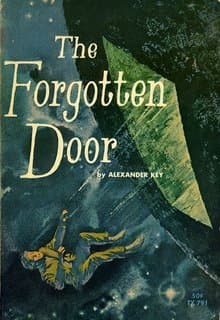
Alexander Key (1965)
Genre
Fantasy / Children's / Science Fiction / Young Adult
Reading Time
120 min
Key Themes
See below
Sign in to track this book
A telepathic boy, fallen through a forgotten door from another world, must outwit the suspicious adults of rural Earth and find his way home before the army captures him and endangers the only family who ever cared.
The story begins with a boy, later called Jon, falling through a shimmering 'door' onto a strange planet he later learns is Earth. Injured and confused, he hides in a cave near the McAllister farm in the mountains of North Carolina. Jon has no memory of his past, only a vague sense of urgency and the ability to read minds. Sally, the youngest McAllister daughter, finds him. She brings him food and tries to talk to him. Eventually, Mr. and Mrs. McAllister, with their older children, Frank and Polly, take Jon in. They do this despite his quietness and unusual appearance. They are a kind, simple farming family who see a child in need, unaware of his true origins.
As Jon recovers at the McAllister farm, his abilities appear. He cannot speak English at first, but he understands everything through his telepathy. He uses it to tell the family, especially Sally, his thoughts and feelings. He shows unusual strength, agility, and a connection to nature, calming animals and understanding their thoughts. The McAllisters, though puzzled by his strangeness, grow to love him. Sally forms a bond with Jon, sensing his kindness and innocence. Mr. McAllister, a man of quiet wisdom, believes Jon is a lost, traumatized child and defends him against local suspicion.
Jon's presence on the remote farm does not go unnoticed. Local gossip, started by his unusual appearance and behavior, spreads. Mrs. Letty, a nosy neighbor, becomes suspicious. She often visits the farm, pretending to be neighborly but actually looking for information. She tells her suspicions to Mr. Henderson, a local businessman with influence. He wants to use Jon's abilities more than help him. The McAllisters try to protect Jon, but the growing attention makes them uneasy. They realize their secret cannot be kept forever in their small community.
Mr. Henderson, interested by Mrs. Letty's reports of a strange boy with unusual powers, investigates. He shows a materialistic and exploitative side of humanity, seeing Jon as a scientific curiosity or a weapon. He visits the McAllister farm, trying to question Jon and the family. But Mr. McAllister refuses to give him up. Henderson's methods become more aggressive. He tries to bribe the family and sends others to spy on them. The McAllisters realize they are in danger. Henderson's persistence means he will stop at nothing to get Jon.
Henderson's influence reaches the authorities. The army, led by Colonel Blake, arrives at the McAllister farm. They are interested in Jon's abilities for national security, seeing him as a threat or an asset. The McAllisters realize the serious danger to Jon and their family. They decide to flee. Under cover of darkness, guided by Jon's senses and knowledge of the wilderness, they escape into the mountains. This forces the family to leave their home and livelihood, showing the sacrifice they make for Jon.
Hiding in the rugged mountains, the McAllisters use their resourcefulness and Jon's abilities to survive. Jon uses his telepathy to find food, avoid detection, and understand his past. While in a cave, Jon remembers things, especially the feeling of falling through the 'door' and a vague memory of his home world. He realizes he must find a way back, not just for himself, but to protect the McAllisters, who are now fugitives because of him. The family's bond strengthens during this time, confirming their commitment to Jon.
Jon's memories become clearer. He realizes the 'door' he fell through must still be nearby. He leads the McAllisters back towards the area where he first appeared, hoping to find the portal. But the army, with Henderson's help, still searches for them. Colonel Blake and his men, with tracking dogs and local knowledge, get closer. The family, tired and hungry, races against time to find the forgotten door before they are caught. Their journey has many near misses and constant fear of being found.
As they get closer to the site, Jon remembers everything. He remembers his home world, a place of advanced civilization, peace, and universal telepathic communication. His people are gentle, evolved beings who do not understand violence. He remembers falling through a broken 'door' during an exploratory mission, an accident that separated him from his family. He understands that his people would never harm anyone and that his telepathy is a natural part of their existence. This explains his initial confusion and his dislike of Earth's conflicts and misunderstandings.
The army finally corners Jon and the McAllisters near the forgotten door. Colonel Blake and his men surround them, demanding Jon's surrender. In a moment of tension, Jon uses his telepathy to project his thoughts and feelings directly into the minds of the soldiers, especially Colonel Blake. He conveys his peaceful intentions, his desire to return home, and the innocence of the McAllisters. He shows them visions of his own world, a place without conflict, hoping to appeal to their better nature and prevent violence.
Jon's telepathic plea affects Colonel Blake. Despite his military duty, he is moved by the boy's sincerity and the visions of peace. Just as the standoff reaches its peak, the shimmering 'door' reappears. It is Jon's chance to go home. With a heavy heart, Jon says a telepathic goodbye to the McAllisters, especially Sally, expressing his gratitude and love. He steps through the portal, disappearing from Earth. The McAllisters are left with a sense of loss but also an understanding of love and the wonders beyond their world, changed by their encounter with Jon.
The Protagonist
Jon begins as a lost, amnesiac alien and gradually reclaims his memories, understanding his identity and purpose, ultimately returning to his home world.
The Supporting
Sally grows in empathy and courage, becoming Jon's staunchest ally and demonstrating profound maturity.
The Supporting
Mr. McAllister's resolve is tested, but his moral compass remains steadfast, reinforcing his role as a protector.
The Supporting
Mrs. McAllister's initial apprehension gives way to fierce maternal love and protection for Jon.
The Supporting
Frank evolves from cautious skepticism to a committed and protective member of Jon's adopted family.
The Supporting
Polly consistently provides a supportive and caring presence for Jon.
The Antagonist
Henderson remains consistently driven by self-interest and exploitation, serving as the primary human antagonist.
The Supporting
Mrs. Letty remains a static character, representing societal suspicion and the danger of unchecked gossip.
The Supporting
Colonel Blake undergoes a significant shift from an antagonist driven by duty to a sympathetic figure swayed by Jon's telepathic communication of peace.
This theme is important to the story. It contrasts the McAllisters' acceptance of Jon with the fear and suspicion of other characters like Mrs. Letty and Mr. Henderson. The McAllisters, despite Jon's strange appearance and silence, see a child in need and offer him unconditional love and protection. In contrast, the community and Mr. Henderson react with fear, greed, and a desire to control what they don't understand, leading to persecution. Jon's telepathy highlights this theme, as he can perceive people's true intentions.
“''We can't send him off for folks to poke at, not when he's just a child and can't speak for himself.''”
The book explores human nature through its characters. The McAllisters show compassion, kindness, and self-sacrifice, risking everything to protect an innocent being. Mr. Henderson shows greed, suspicion, and a desire for power. The military, at first a symbol of strict authority and threat, eventually shows empathy through Colonel Blake. Jon, with his telepathy, reflects these different parts of humanity. He makes characters confront their own biases and beliefs.
“''He's no monster, he's just a boy who's lost and afraid.''”
A main theme is that true understanding goes beyond spoken language. Jon, unable to speak English, communicates through telepathy and actions. He forms deep bonds with the McAllisters, especially Sally. This contrasts with the misunderstandings of those who cannot access his thoughts, leading to fear and conflict. In the climax, Jon uses telepathy to show his peaceful intentions to Colonel Blake. This shows the power of direct, empathetic communication to bridge divides and overcome prejudice. It suggests that shared understanding is possible even between different beings.
“''He doesn't need words. You can feel what he means.''”
Jon's journey is a quest for home. He is an alien, 'forgotten' by his door, and longs for his peaceful, telepathic world. He finds a temporary home and a loving family with the McAllisters. But there is always a tension of his 'otherness' and the knowledge that he does not truly belong on Earth. The McAllisters, by taking him in, create a sense of belonging for him. This shows that 'home' can be found in the love and acceptance of others, even when one is far from their origin. His return through the door means he is reunited with his true home.
“''He's going home, Sally. He has to.''”
A shimmering, ephemeral portal between worlds.
The 'forgotten door' is the central plot device, serving as the means by which Jon travels from his home world to Earth and, eventually, back again. It is described as a shimmering, unstable portal that appears and disappears, making Jon's return journey uncertain. Symbolically, it represents the boundary between the known and unknown, the familiar and the alien. Its mysterious nature fuels the initial conflict and the urgency of Jon's quest, as its reappearance is not guaranteed, adding a layer of suspense to his efforts to return home.
Jon's primary means of communication and a source of conflict/understanding.
Jon's telepathy is a crucial plot device, enabling him to understand English despite not speaking it, and to communicate his thoughts and emotions to others, particularly the McAllisters. It serves as both a source of his 'otherness' that frightens outsiders like Mr. Henderson, and the key to deep, empathetic connection with those who accept him, like Sally. Ultimately, it becomes the tool for conflict resolution when Jon uses it to convey his peaceful nature to Colonel Blake, highlighting the theme of communication beyond words.
A sanctuary and a challenging refuge from persecution.
The McAllister farm initially functions as a safe haven and a symbol of simple, honest living, contrasting with the complexity and suspicion of the outside world. When the family is forced to flee, the surrounding wilderness (the mountains and caves) becomes a challenging refuge. It tests their resilience but also highlights Jon's innate connection to nature and his survival skills. This setting emphasizes the isolation and self-sufficiency of the family, making their stand against the outside world more poignant.
A narrative technique to gradually reveal Jon's origins.
Jon's initial amnesia serves as a key narrative device. It allows the reader to discover Jon's identity and his home world alongside him, building suspense and mystery. His gradual recovery of memories, triggered by specific events or sensations, provides exposition about his alien background, his people's peaceful nature, and the purpose of the 'door.' This device makes Jon's journey of self-discovery a central part of the plot and enhances the eventual revelation of his true origins.
“The door was there, and then it was gone.”
— The opening line describing the mysterious disappearance of the portal.
“We are all brothers under the skin.”
— Jon expresses a universal truth about humanity.
“Fear is the only darkness.”
— A reflection on the nature of fear and ignorance.
“Sometimes the simplest things are the hardest to understand.”
— Jon observes human behavior with puzzlement.
“A door forgotten is a world lost.”
— Highlighting the significance of the forgotten portal.
“Truth needs no defense, only understanding.”
— A philosophical insight shared by Jon.
“In every ending, there is a beginning.”
— A hopeful note about change and new opportunities.
“The stars are not so far away when you know the way.”
— Jon's perspective on travel and connection.
“Kindness is a language everyone understands.”
— Emphasizing the universal power of compassion.
“Memory is the key that unlocks the door.”
— Referring to the importance of remembering the past.
“To see with the heart is to truly see.”
— A lesson about empathy and deeper perception.
“The world is full of wonders, if only we look.”
— An encouragement to appreciate the marvels around us.
“Home is not a place, but a feeling.”
— Jon's realization about the essence of belonging.
“Courage is not the absence of fear, but the will to go on.”
— A definition of bravery in the face of challenges.
Ready to see how well you understood this book? Take our interactive quiz with 10 questions.

Alexander Key was an American author known for his science fiction and fantasy novels for young adults. His most famous work, 'The Forgotten Door,' published in 1965, explored themes of alienation and discovery. Key's writing often featured compelling characters navigating imaginative worlds, earning him a dedicated readership within the children's literature and speculative fiction communities.







