“To say that I am not a man of action is to say that I am a man of contemplation, or at least of reflection.”
— Early reflection on Todd Andrews's personality and life philosophy.

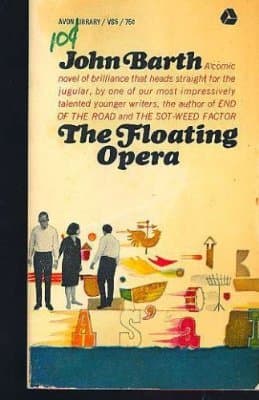
John Barth (1956)
Genre
Literary Fiction
Reading Time
240 min
Key Themes
See below
Sign in to track this book
On a single day, a lawyer considers suicide, weighing the absurdities of life and past events aboard a showboat.
The novel opens with Todd Andrews, a 50-year-old lawyer, thinking about a day in June 1937 when he decided to commit suicide but then changed his mind. He first explains his philosophy, especially his rejection of absolute values and his embrace of ethical relativism. This comes from his experiences in World War I and a heart condition. This condition, called 'Dull's disease,' means he could die at any moment. This paradoxically makes him feel immortal and free from normal moral rules. He describes his morning routine, including a visit to the barber, where he observes everyday interactions while preparing for his planned suicide later that day.
Todd continues his account of the morning, focusing on his long affair with Jane Mack, the wife of his best friend, Harrison Mack. He describes their unusual arrangement: Harrison knows about the affair and seems to accept it. Todd visits Jane at her home, where their interactions involve intellectual talk and a distant closeness. He thinks about how absurd and convenient their relationship is, giving him company without the emotional demands of a normal bond. This relationship further shows his ethical relativism, as traditional moral lines are blurred.
Todd meets Harrison Mack for lunch at their usual place. Their conversation covers details of their legal work and local news, carefully avoiding any mention of Todd's affair with Jane. Todd watches Harrison with affection and detached curiosity, thinking about their friendship and Harrison's calm acceptance of his situation. The meal shows the normal surface that hides complex emotions. Todd's thoughts often turn to philosophical ideas, considering the meaninglessness of existence and the arbitrary nature of human constructs, even as he participates in social rituals.
After lunch, Todd runs errands and thinks. He visits the grave of his infant daughter, Mireille, who died shortly after birth. This event deeply affected his worldview and contributed to his nihilistic leanings. He remembers the circumstances of her death and his emotional numbness afterward. Later, he meets Mireille, a young woman who works at the local bank. He has a strange, almost fatherly relationship with her. Their interaction is brief but important, as Mireille represents a different kind of innocence and vulnerability that Todd observes from a distance, reinforcing his detached view of human connection.
As the afternoon passes, 'The Floating Opera,' a showboat that travels the Chesapeake Bay, arrives in town. This theatrical boat, offering entertainment and escape, serves as a symbolic background for Todd's day. He thinks about performance and illusion, seeing similarities between the acts on the showboat and the roles people play in daily life. The anticipation of the evening's entertainment adds a surreal layer to his already detached view of reality, as he continues to prepare for his planned suicide, seeing his life as a performance nearing its end.
Todd joins Jane and Harrison Mack for dinner, along with Colonel Morton, an elderly and somewhat confused family friend. The dinner conversation is a mix of polite small talk and the Colonel's increasingly rambling stories. Todd uses this chance to explore his philosophical ideas, engaging in subtle intellectual debates with Jane and Harrison, who often challenge his relativistic arguments. The Colonel's presence adds a touch of the absurd and sad, reminding Todd of the inevitable decline of mind and body, reinforcing his belief in life's ultimate meaninglessness and existence's arbitrary nature.
After dinner, Todd, Jane, and Harrison attend the performance on 'The Floating Opera.' The show is a mix of vaudeville acts, melodramas, and musical numbers, presented with amateur charm. Todd watches the audience and performers with his usual analytical detachment, seeing the show as a small example of human striving and illusion. The chaotic and often absurd nature of the performance mirrors his own inner world and his view of the world. During the show, the planned moment for his suicide, the explosion of the ship's engine, nears, adding ironic tension to the entertainment.
Todd has carefully planned to commit suicide by inhaling carbon monoxide from the showboat's faulty engine during the performance. He slips away from Jane and Harrison, heading toward the engine room. As he approaches, he notices signs of mechanical trouble with the engine, which is sputtering and smoking. This unexpected malfunction disrupts his plans. He observes the crew's frantic efforts to fix the engine and the growing panic among some audience members. This unforeseen event introduces chance into his predetermined act, forcing him to reconsider his intentions.
As the engine sputters and dies, filling the air with smoke and a sense of danger, Todd faces the practical realities of his suicide plan. The chaos and unplanned nature of the engine's failure make his detailed act seem less profound and more arbitrary. He realizes that if all values are relative, and if life itself has no inherent meaning, then ending it is no more significant than continuing to live. The lack of a logical reason for either action leads him to a shift in perspective. He understands that if nothing matters, then choosing to live is as valid as choosing to die.
In a sudden insight, Todd Andrews gives up his plan to commit suicide. He realizes that if there is no absolute value, then there is no absolute reason *not* to live. The arbitrary nature of the universe, which had led him to nihilism, now provides a basis for choosing life. He concludes that since there is no logical reason for death, the only logical conclusion is to continue living. He emerges from the engine room, rejoining Jane and Harrison, having made a decision that, while simple, shows a shift from his earlier philosophical stance. He chooses life, not from a new belief in its goodness, but from recognizing its arbitrary neutrality.
The Protagonist
Todd begins the day determined to commit suicide based on his nihilistic philosophy but ultimately decides to live, realizing that if nothing matters, then living is as valid a choice as dying.
The Supporting
Jane's character remains largely consistent throughout the novel, serving as a stable, if complex, presence in Todd's life.
The Supporting
Harrison's character remains consistent, embodying conventionality and providing a stable counterpoint to Todd's philosophical journey.
The Supporting
The Colonel's character remains static, serving as a symbolic figure of aging and the past.
The Mentioned
Mireille's character is static, serving as a symbolic reminder for Todd.
Todd Andrews believes all values are arbitrary and life has no inherent meaning. This comes from his experiences in World War I and his heart condition. He often examines moral dilemmas, concluding that 'nothing matters' absolutely. This theme appears in his detached approach to his affair with Jane Mack, his philosophical discussions, and his initial decision to commit suicide. His eventual choice to live, however, reinterprets this nihilism: if nothing matters, then living is as valid as dying, making the choice itself an arbitrary but ultimately life-affirming act.
“I discovered that there was no why. My moral philosophy, then, is a description of the condition of having no moral philosophy.”
The novel consistently highlights the absurdity and randomness of human life and social constructs. From Todd's unusual affair to the chaotic performance on the Floating Opera, events often defy logic. Todd's thoughts frequently focus on the arbitrary nature of laws, customs, and even personal relationships. The showboat's malfunctioning engine, which stops Todd's planned suicide, is a clear example of this theme, as a random mechanical failure affects a philosophical decision, showing life's unpredictable nature.
“For me, the world was a stage, and I was merely a player, but the play was without a script, and the audience was either asleep or non-existent.”
Todd's heart condition, 'Dull's disease,' means he could die at any moment. This paradoxically makes him feel immortal and free from the usual fear of death. This constant awareness of his own mortality shapes his worldview, leading him to observe life detachably and to be fascinated by suicide. His infant daughter, Mireille, also died, which deeply affects his understanding of life's fragility. His planned suicide is a rational, though extreme, response to his philosophical ideas about mortality, and his eventual choice to live is an engagement with the arbitrary nature of his own finite existence.
“The fact that I could die at any moment meant that I was, in a sense, already dead, and thus free from the fear of death.”
Performance is a recurring idea in the novel, from the literal show on 'The Floating Opera' to the metaphorical 'acts' people put on daily. Todd sees himself and others constantly playing roles, whether as a lawyer, best friend, or detached lover. The showboat itself, with its staged dramas and illusions, symbolizes this theme. Todd questions the authenticity of human interaction, seeing social rituals as carefully constructed performances. This theme reinforces his detachment, as he often feels like an observer rather than a full participant in life's 'play.'
“Life, I concluded, was a kind of floating opera, a medley of acts and illusions, none of them truly substantial.”
Todd Andrews recounts a past day, allowing for extensive philosophical digressions.
The entire novel is narrated by Todd Andrews, looking back at a specific day in June 1937. This retrospective viewpoint allows him to interweave his detailed account of events with extensive philosophical reflections, analyses, and digressions. The narrative jumps between the past events of the day and Todd's present-day interpretations and elaborations of his ethical and existential theories. This device provides intimate access to Todd's complex mind, making his internal journey the primary focus of the story, often overshadowing the external plot.
A literal and symbolic setting for the climax, representing performance and the arbitrary nature of life.
The showboat, 'The Floating Opera,' is both a physical setting for the climax of the story and a powerful symbol. It represents the idea of life as a performance, a series of acts and illusions. Its transient nature, constantly moving along the river, mirrors Todd's own philosophical fluidity and his sense of being unmoored from fixed values. The chaotic and somewhat absurd performance on the boat, culminating in the engine's malfunction, underscores the theme of life's inherent absurdity and the unpredictable role of chance in human affairs, directly impacting Todd's decision.
A fictional, life-threatening heart condition that fuels Todd's nihilistic philosophy.
Todd Andrews' 'Dull's disease' is a fictional heart condition that could cause his death at any moment. This looming threat of arbitrary death is a central catalyst for his development of ethical relativism and nihilism. It frees him from conventional moral constraints, as he perceives his life as already compromised and thus less valuable in a traditional sense. The condition creates a constant awareness of mortality, leading him to question the purpose of life and the significance of his actions, directly informing his initial decision to commit suicide.
“To say that I am not a man of action is to say that I am a man of contemplation, or at least of reflection.”
— Early reflection on Todd Andrews's personality and life philosophy.
“The only way to get through life is to treat it as a joke.”
— Todd Andrews's cynical and detached approach to existence.
“I am a man of reason, and I love reason even when it leads me to the brink of unreason.”
— Todd Andrews grappling with the limits and implications of his logical framework.
“What is the difference, after all, between committing suicide and dying of natural causes? Both are terminal.”
— Todd Andrews's detached consideration of his suicide plan.
“It is not that I have no feelings, but that my feelings are of a kind that I cannot easily translate into action.”
— Explaining his emotional detachment and inaction.
“The story of my life, if I were to write it, would be a story about the failure of stories.”
— A meta-commentary on narrative and the inability to fully capture reality.
“I was alive, I was dying, I was living, I was dead. All at the same time.”
— Reflecting on the paradoxes of existence and his own state of being.
“The world is a stage, and all the men and women merely players; but what a shabby, ill-lit stage, and what unconvincing actors!”
— A cynical twist on Shakespeare's famous line, applied to his view of humanity.
“Truth, it seemed to me, was a matter of perspective, and perspective was a matter of where you happened to be standing.”
— Discussing the subjective nature of truth and reality.
“To live is to choose, but what if all choices are equally meaningless?”
— Contemplating the burden of choice in a seemingly meaningless world.
“The Floating Opera, in other words, was not a place but a state of mind.”
— Explaining the symbolic meaning of the novel's title.
“One does not commit suicide to escape life, but to escape the impossibility of life.”
— A nuanced take on the motivations behind suicide.
“My life, I decided, had been a kind of experiment, and now it was time to draw conclusions.”
— Todd Andrews reflecting on his life as a detached observer, prior to his decision.
“The important thing, I learned, was not to judge, but to observe, to record, to understand.”
— His detached, analytical approach to the world and human behavior.
Ready to see how well you understood this book? Take our interactive quiz with 10 questions.

John Simmons Barth is an American writer who is best known for his postmodern and metafictional fiction. His most highly regarded and influential works were published in the 1960s, and include The Sot-Weed Factor, a satirical retelling of Maryland's colonial history, and Lost in the Funhouse, a self-referential and experimental collection of short stories. Though Barth's work has been controversial among critics and readers, he was co-recipient of the National Book Award in 1973 for his novel Chimera with John Williams for Augustus. Despite Barth's influence on postmodern literature in America, his influence and publicity have decreased since his novels were published.







