“He seems perfect, doesn’t he? Always the perfect husband, the perfect father, the perfect friend. Almost too perfect.”
— Early on, the narrator considers the seemingly ideal nature of her husband.

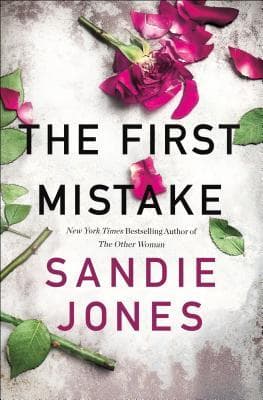
Sandie Jones (2019)
Genre
Thriller / Mystery
Reading Time
360 min
Key Themes
See below
Sign in to track this book
A wife's perfect world unravels when her husband's suspicious behavior forces her to question if her closest confidante is actually her biggest betrayer.
Alice lives a comfortable life with her second husband, Nathan, their two children, Florence and George, and her successful interior design business. Her best friend, Beth, is always there, having supported her through the death of Alice's first husband, Tom, years ago. Alice values her bond with Nathan, especially after her grief. However, Alice starts to notice Nathan becoming more distant and secretive. He is often on his phone, making quiet calls, and spending more time away from home, saying he has business trips. Alice first ignores her unease, thinking it is stress, but his frequent and vague excuses begin to bother her.
Worried by Nathan's increasingly strange behavior, Alice talks to Beth. Beth, always supportive, offers advice and tries to comfort Alice. However, Alice starts to notice small changes in Beth's manner and actions. Beth seems to know more about Nathan's activities than she lets on, and her reactions to Alice's worries sometimes feel forced or too dismissive. A series of coincidences, like Beth being where Nathan claimed to be for a business meeting, makes Alice question if Beth is truly on her side, or if she is somehow involved in Nathan's secrecy. Alice's trust in both Nathan and Beth slowly fades.
Determined to find the truth, Alice starts to quietly investigate Nathan's activities. She checks his phone records, follows him on one of his supposed business trips, and eventually finds out he is having an affair. The other woman is a younger colleague named Chloe. Heartbroken and angry, Alice confronts Nathan, who first denies everything before admitting to the affair. However, the revelation is not as simple as she expected. Nathan confesses that he has been blackmailed by the real person behind the affair, who has threatened to expose a secret from his past if he does not comply. This adds a layer of complexity to the betrayal, moving Alice's focus from infidelity to a deeper, more dangerous plot.
Nathan finally tells Alice the full extent of the blackmail: he is being forced to continue the affair with Chloe because someone knows he was responsible for the accident that killed Alice's first husband, Tom. Nathan explains that he was driving the car that night, not Tom, and that he was drunk. He swapped places with Tom after the crash to avoid prosecution, leaving Tom to die. This confession shatters Alice, not only because of the deception but because it changes the most traumatic event of her life. She deals with the huge betrayal, realizing her entire relationship with Nathan was built on a lie and that the man she loved caused her deepest pain.
As Alice processes Nathan's confession, she realizes something horrifying: the only person who knew the specific details of Tom's death, besides Nathan, was Beth. She connects Beth's suspicious behavior, her subtle manipulations, and her seemingly coincidental presence at key moments. Alice confronts Beth, who, after initial denials, happily admits to planning everything. Beth reveals her motive: a deep resentment and jealousy towards Alice, fueled by a twisted sense of justice for Tom's death. Beth confesses she found evidence of Nathan's involvement and saw an opportunity to destroy Alice's life, making her pay for supposedly taking everything from Beth.
Beth, now fully exposed, talks about her long-standing envy and obsession with Alice. She confesses that she had always secretly loved Tom, even before Alice met him. She believed Alice stole Tom from her and that Tom would have eventually chosen her. Tom's death, for which she blamed Nathan, became the reason for her elaborate revenge plan. Beth carefully planned to expose Nathan's secret, ruin his marriage, and ultimately destroy Alice's happiness, believing it was fair punishment for the life she felt Alice had unfairly taken from her. Her actions were driven by years of suppressed anger, jealousy, and a distorted sense of loyalty to a deceased man.
United by the shared enemy, Alice and Nathan, despite their broken relationship, decide they must expose Beth. They gather evidence, trying to prove her blackmail and manipulation. However, Beth is always one step ahead, having carefully hidden her tracks. The situation becomes a tense standoff where Beth threatens to go public with Nathan's secret, destroying both his life and Alice's family. Alice realizes the only way to protect her children and her reputation is to silence Beth. The confrontation becomes increasingly dangerous, as Beth is not only cunning but also emotionally unstable and unpredictable.
The final confrontation happens at Alice's home, where Beth, in a fit of rage, attacks Alice. A violent struggle occurs, during which Alice, in self-defense, pushes Beth. Beth falls, hitting her head, and dies. Nathan, arriving at the scene, helps Alice make the scene look like an accidental fall, protecting Alice from murder charges and keeping their secret buried. They carefully clean up, making up a story about Beth visiting and an unfortunate accident. The incident ties Alice and Nathan together in a new, darker complicity, forever changing their dynamic and forcing them to live with another devastating secret.
Afterward, Alice and Nathan must live with what they have done. They maintain the story of Beth's accidental death, convincing the authorities and their community. Their marriage, though permanently damaged, finds a new, uneasy balance built on shared guilt and the need for mutual protection. Alice struggles with the moral consequences of her actions, constantly looking over her shoulder. The once-perfect life she knew is shattered, replaced by a reality full of deceit and fear. The children remain unaware, but the parents carry the heavy burden of their secrets, knowing their 'first mistake' led to a series of increasingly bad choices.
The Protagonist
Alice evolves from a trusting wife to a suspicious investigator, then a betrayed woman, and finally, a complicit partner in a new secret.
The Husband/Antagonist (initially)/Victim
Nathan goes from a seemingly perfect husband to a revealed deceiver, a blackmailed victim, and finally, Alice's accomplice in a new crime.
The Antagonist
Beth transforms from a supportive best friend to a revealed, calculating blackmailer and murderer, driven by psychotic jealousy and resentment.
The Mentioned/Catalyst
Tom's character doesn't have an arc, but the truth surrounding his death is progressively revealed, changing the perception of past events.
The Supporting
Chloe's role shifts from a perceived threat to a victim of manipulation, highlighting the extent of Beth's control.
The Supporting
Florence's character remains consistent as a child, her primary role being a motivator for Alice's actions.
The Supporting
George's character remains consistent as a child, his primary role being a motivator for Alice's actions.
The novel is full of betrayal. Alice is first betrayed by Nathan, who has an affair and, more importantly, hid his role in Tom's death. This is made worse by the betrayal from her best friend, Beth, who carefully plans the entire scheme out of jealousy and revenge. Each layer of deception reveals the weak foundations of Alice's relationships and trust. The theme ends with Alice and Nathan's joint deception to cover up Beth's death, showing how betrayal can lead to more deceit.
“"The first mistake could be her last." (Narrator, referring to Alice's initial trust)”
Beth's character shows extreme obsession and jealousy. Her long-standing unrequited love for Tom causes deep resentment towards Alice, whom she believes 'stole' Tom and then had a perfect life. This jealousy turns into a carefully planned revenge plot, where Beth obsesses over destroying Alice's happiness. Her actions show how unchecked envy can grow and lead to destructive and manipulative behavior, blurring the lines between friendship and enmity. Beth's obsession with Tom's memory is so strong that it controls years of her life and ends in violence.
“"She'd wanted Tom, always, and Alice had taken him from her. This was just repayment." (Beth, revealing her motive)”
Alice's life first seems perfect: a successful business, a loving husband, beautiful children, and a supportive best friend. However, this perfect image is systematically broken down throughout the novel. Nathan's affair and his hidden past, along with Beth's manipulation, reveal the problems beneath the surface. The theme looks at how appearances can be very misleading, and how people often create a flawless exterior to hide internal problems, secrets, and resentments. The 'perfect' life is a fragile thing, easily shattered by hidden truths.
“"Alice had built her life on solid ground, or so she thought. Now, it was quicksand." (Narrator, reflecting on Alice's crumbling reality)”
The entire plot is a direct result of Nathan's actions years earlier — his drunk driving and subsequent cover-up of Tom's death. This 'first mistake' starts a chain reaction that ultimately destroys his marriage, exposes him to blackmail, and leads to Beth's death. The novel shows how past secrets, no matter how deeply buried, can reappear with devastating effects, impacting not only the original person but also innocent lives caught in the web of deceit. It highlights the long-term consequences and the unavoidable nature of one's past.
“"Some secrets, once buried, refuse to stay down." (Narrator, hinting at the resurfacing truth)”
As the story goes on, the characters are forced into morally difficult situations. Alice, at first a victim, eventually helps cover up Beth's death to protect herself and her family. Nathan, despite his initial fault, becomes a victim of blackmail and then an accomplice. The novel explores how far people will go to protect themselves and their loved ones, even if it means breaking ethical rules and committing more crimes. It questions good and evil, suggesting that circumstances can force ordinary people into extraordinary, morally unclear actions.
“"There was no right choice, only the least wrong one." (Alice, grappling with her decisions)”
The story is primarily told from Alice's perspective, whose perceptions are flawed and manipulated.
The narrative is largely filtered through Alice's point of view, making her initial interpretations of events and characters (especially Nathan and Beth) seem credible to the reader. However, as the plot unfolds, Alice's trust and understanding are repeatedly shattered, revealing how easily she (and by extension, the reader) can be deceived. This device keeps the reader guessing and mirrors Alice's confusion, creating suspense as the true motives and identities of those around her are slowly unmasked. The reader's understanding evolves alongside Alice's, highlighting the deceptive nature of appearances.
Nathan's affair initially distracts from the true, deeper conspiracy.
The initial focus on Nathan's secretive behavior and the eventual discovery of his affair with Chloe serves as a significant red herring. This infidelity leads Alice (and the reader) to believe the central conflict is a marital one, a classic 'other woman' scenario. This misdirection diverts attention from Beth's deeper, more sinister plot and the true secret of Tom's death, making the eventual revelations more shocking and impactful. It cleverly uses a common thriller trope to mask the unique twist of the story.
The reader is often unaware of the full truth until Alice discovers it, creating suspense.
While dramatic irony typically involves the audience knowing more than the characters, 'The First Mistake' often employs a reversed form, where the reader is just as in the dark as Alice, or even behind her. We experience Alice's confusion and dawning realization in real-time. For example, when Alice suspects Nathan, the reader suspects Nathan. When Beth's true nature is hinted at, the reader only gets glimpses. This technique builds intense suspense and allows the reveals to be genuinely surprising, as the reader directly shares Alice's journey of discovery and shock, rather than observing it with foreknowledge.
Brief mentions of Tom's death and past events provide context and foreshadowing.
Throughout the narrative, Alice has brief recollections or refers to the past, particularly the tragic death of her first husband, Tom. These moments initially serve as background, establishing Alice's past grief and her current happiness with Nathan. However, as the plot progresses, these seemingly innocuous memories gain new significance, hinting at hidden truths and foreshadowing the revelations about Nathan's involvement and Beth's long-held grudge. They add layers to the characters' motivations and the central mystery, showing how past events continue to exert influence on the present.
“He seems perfect, doesn’t he? Always the perfect husband, the perfect father, the perfect friend. Almost too perfect.”
— Early on, the narrator considers the seemingly ideal nature of her husband.
“You think you know someone, every inch of them, every secret, every thought. And then you realize you’ve been looking at a stranger all along.”
— The narrator's growing unease about her husband's true character.
“The first mistake is always the hardest to admit, because it opens the door to all the others.”
— A reflection on the snowball effect of initial misjudgments or wrong turns.
“Every lie we tell creates a debt, and eventually, that debt has to be paid.”
— Consideration of the inevitable repercussions of dishonesty.
“Sometimes, the most dangerous people are the ones who appear the most harmless.”
— A recurring theme as the true nature of characters is revealed.
“Love can blind you, can’t it? Make you see what you want to see, not what’s really there.”
— The narrator reflects on how her feelings might have clouded her judgment.
“The past isn't always behind us. Sometimes it walks right beside us, waiting for its moment.”
— Hints at unresolved issues from the characters' histories impacting the present.
“It’s amazing how quickly a perfect life can unravel with just one thread pulled.”
— As cracks begin to show in the seemingly idyllic life of the main characters.
“Fear has a way of making you question everything, even your own sanity.”
— The narrator's increasing paranoia and distrust of those around her.
“The truth is rarely simple. It’s usually messy and complicated and hurts everyone involved.”
— The painful revelations that emerge as the mystery unfolds.
“We all have secrets, don't we? Some we keep to protect ourselves, others to protect the ones we love.”
— A general observation about human nature and the motivations behind secrecy.
“Sometimes the only way to move forward is to acknowledge the past, no matter how much it hurts.”
— A character grappling with confronting difficult memories or events.
“Trust is a fragile thing. Once broken, it’s almost impossible to put back together exactly the same way.”
— The aftermath of betrayals and the struggle to rebuild relationships.
“The greatest trick the devil ever pulled was convincing the world he didn't exist, or in this case, that he was utterly charming.”
— A thought about how evil can masquerade behind an appealing facade.
Ready to see how well you understood this book? Take our interactive quiz with 10 questions.

Biography coming soon.







