“You have to be realistic about these things.”
— Logen Ninefingers' pragmatic mantra, often used to justify harsh actions or accept grim realities.

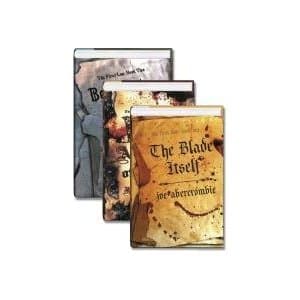
Joe Abercrombie (2008)
Genre
Fantasy
Reading Time
2600 min
Key Themes
See below
Sign in to track this book
A crippled torturer, a narcissistic nobleman, and a barbarian trying to outrun his past meet in a brutal story of power, betrayal, and dark humor. No one is truly good, and redemption is a bloody, elusive idea.
Logen Ninefingers, a known Northman warrior, is on the run after his group is ambushed and seemingly killed by Shanka. He barely survives a fall down a waterfall and begins a long, hard trip south. He is haunted by his violent past and the 'Bloody-Nine' part of him. Meanwhile, in Adua, the Union capital, the mysterious First of the Magi, Bayaz, makes a dramatic entrance. He disrupts the comfortable life of the pampered Inquisitor Glokta and the self-absorbed Captain Jezal dan Luthar. Bayaz, a powerful and old sorcerer, immediately takes charge and starts to manipulate events. He senses a coming war with the Gurkish Empire and an older threat.
Bayaz, with his apprentice Malacus Quai and the former mercenary Dogman, makes Jezal train hard with a sword under the famous Master Swordsman, Varuz. Jezal, at first angry and focused on winning the upcoming Contest, slowly gets better, though he stays self-centered. At the same time, Sand dan Glokta, a crippled former war hero who became a torturer for the Inquisition, must investigate a plot in the Union's banking system. His brutal interrogations of bankers and nobles show deep corruption and a network of traitors. He also deals with constant pain from his shattered body and bitter memories of being captured and tortured by the Gurkish.
Bayaz says his real goal is to find the legendary Seed, a powerful object from the 'Old Time' that he believes is needed to beat the Prophet Khalul and the Gurkish Empire. He puts together a reluctant group: Logen Ninefingers, who he found after Logen escaped; Jezal dan Luthar, who he forces; Ferro Maljinn, a vengeful former slave who wants to kill Khalul; and Malacus Quai. Their journey is full of danger. They go through desolate lands, old ruins, and meet monstrous creatures and hostile locals. This tests their endurance and makes them face their biases and fears.
While Bayaz's group travels, the Union gets ready for war in the North against Bethod, the King of the Northmen. Colonel Collem West, an officer from a common family, is put in command. He struggles to earn the respect of the noble officers and manage the volatile Prince Ladisla. He becomes close with Ardee West, Jezal's sister, who is stuck in Adua's strict social circles. West's leadership is tested in brutal battles against the Northmen, leading to heavy losses and hard choices. He sees the horrors of war and the political tricks that hurt the Union's efforts. He also deals with his own ambition and temper.
Bayaz's group continues their hard journey. They reach the old city of Shab-wish, where they find clues about the Seed's real location. During their travels, tensions grow, especially between Ferro and Jezal. Logen struggles to control his violent side. They face attacks from shadowy figures loyal to Khalul and a devastating betrayal by Malacus Quai, who is a servant of Khalul. Quai steals the map to the Seed and escapes, forcing Bayaz to change his plan. The group keeps going, determined to reach the 'Edge of the World' where the Seed is said to be hidden.
After a difficult trip to the ruins of an old city at the 'Edge of the World,' Bayaz, Logen, Jezal, and Ferro find the Seed. It is not one object but a group of powerful magical objects. Bayaz tells more about the 'Old Time's' history and the real nature of his fight with Khalul, both apprentices of the first Magi, Juvens. They get some of the Seed, but their success does not last long. When they return, they find the Union in chaos. The Gurkish Empire, led by the fanatical Prophet Khalul, has started a huge invasion, overwhelming the Union's defenses and going deep into their land.
Sand dan Glokta, now promoted and in command, is sent to defend Dagoska, a city important for its location, against the many Gurkish soldiers. He uses his usual ruthlessness and practical cynicism, doing whatever is needed to hold the city. He manipulates local groups, executes suspected traitors, and makes impossible tactical decisions. All this happens while he fights his own physical pain and despair. The siege is brutal and bloody, with many deaths on both sides. Glokta's defense works, but at a terrible cost, leaving him tougher and more disillusioned, yet strangely effective.
In the North, the Union army, now under the more capable command of Field Marshal Burr and Colonel West, fights Bethod's Northmen in a series of brutal battles. The climax is at the Battle of the High Places, where West shows his strategic skill and courage. He leads the Union to a hard-won victory. During the battle, Logen Ninefingers, who returned to the North with Bayaz, confronts his old rival, the Fenris Wolf. He then faces Bethod himself. Logen's 'Bloody-Nine' side comes out again, leading to a violent and decisive end to Bethod's rule. But it also reminds Logen of his own destructive nature.
Despite Glokta's success in Dagoska and West's victory in the North, the Gurkish invasion continues to threaten the Union's center. The Union army loses many soldiers and must retreat, leaving much land. Meanwhile, Bayaz, back in Adua, starts his long-term plan for the Union's leadership. He manipulates the dying King Guslav and the Open Council to make sure Jezal dan Luthar, now a war hero despite little combat experience, is named the new king. Jezal, still naive and largely a puppet, is put on the throne, unprepared for being king.
With Jezal as king, Bayaz shows how powerful and influential he truly is. He reveals the Seed's real purpose: not as a direct weapon against Khalul's magic, but as a way to control the Union and gather his own power. He manipulates the economy and politics, ruling through Jezal. Bayaz then goes to the Gurkish capital with Ferro for a final, magical fight with Khalul. Using the Seed, Bayaz unleashes devastating magical power, destroying Khalul's stronghold and showing his terrifying abilities. The fight between the two old Magi is not fully resolved, but Bayaz shows he is in charge.
The war officially ends. The Union is very weak but still whole, and the Gurkish forces retreat. However, the victory feels empty. Jezal is king in name only, a prisoner of Bayaz's influence and trapped in a loveless marriage for political reasons. Glokta, now a Lord Inquisitor, continues his work, forever scarred and accepting his role as Bayaz's enforcer. Logen, unable to escape his violent nature, eventually returns to the North; his future is unclear. Ferro, disappointed by Bayaz's real nature, leaves to continue her personal fight against Khalul. West, despite his military success, is left with a broken spirit and a troubled future. This shows the grim and often unheroic results of the war and the powerful people's manipulations.
The Protagonist
Logen tries to escape his violent past but ultimately succumbs to the 'Bloody-Nine' persona, realizing he cannot change his fundamental nature.
The Protagonist
Jezal transforms from a shallow fop to a reluctant, manipulated king, gaining some maturity but losing his freedom.
The Protagonist
Glokta's arc is one of deepening cynicism and resignation, accepting his role as an instrument of power while never finding peace.
The Antagonist/Supporting
Bayaz's arc reveals his true nature as a powerful, amoral manipulator, consolidating his power over the Union and defeating his rival.
The Supporting
Ferro's arc is defined by her relentless pursuit of revenge, which ultimately leaves her isolated and still consumed by hatred, even after facing Khalul.
The Supporting
West rises through military ranks, but the moral compromises and violence of war break his spirit, leaving him scarred and disillusioned.
The Supporting
Ardee's arc sees her struggling against societal constraints and personal desires, ultimately resigning herself to a bleak, politically motivated marriage.
The Supporting
Dogman evolves from Logen's loyal companion to a reluctant but effective leader, trying to maintain order and humanity in the chaos of war.
The Antagonist
Khalul serves as the primary external antagonist, a force of religious zealotry and ancient magic challenging Bayaz's dominion.
The Supporting
Black Dow remains consistently brutal and self-serving, a constant threat and moral foil to Logen among the Northmen.
Abercrombie shows war as horrific, messy, and often pointless. Characters like Collem West and Logen Ninefingers experience the physical and mental toll of battle. They see terrible acts, get bad injuries, and make hard moral choices. The big strategic conflicts often become desperate, bloody fights, showing the human cost over any perceived glory. The outcome often feels empty, with no real winners, only survivors scarred by the experience.
“War is a wound, and it can be healed. But a scar remains.”
The trilogy explores how power corrupts, whether held by old Magi, clever Inquisitors, or ambitious generals. Bayaz manipulates everyone around him, from kings to commoners, for his own goals. This shows that power often costs morality. Glokta's role as an Inquisitor shows the cruelty and corruption built into the Union system. Even those who try to do good, like Collem West, make morally compromising decisions to survive and get ahead. This suggests that real power is rarely kind.
“You can never have too much power. If you are weak, you will be eaten. Just as you are eating the weak.”
Many characters struggle with who they are and the choices that define them. Logen Ninefingers constantly fights his 'Bloody-Nine' side, wondering if he can ever escape his violent nature. Jezal tries to find meaning beyond his superficial life. Glokta is defined by his past torture and his current role as an Inquisitor, always thinking about who he has become. The story suggests that while people may try to change, basic parts of their character often stay the same. Real growth comes from accepting, not denying, one's true self, no matter how dark.
“Once you've been a monster, you are always a monster.”
Abercrombie intentionally blurs the lines between good and evil. Characters usually seen as 'heroes' often do terrible things, while 'villains' sometimes show unexpected humanity or serve a needed purpose. Bayaz, the supposed protector of the Union, is a ruthless manipulator. Glokta, a torturer, can be surprisingly effective and even sympathetic. Logen, a 'good' person, is also a mass murderer. This theme challenges common fantasy ideas. It makes readers face the messy, complex reality of human nature, where few are purely good or evil.
“There are no good men. There are only good decisions.”
The past greatly affects the present for almost every character and the world itself. Bayaz and Khalul's old feud drives much of the plot. Logen is always haunted by his past actions and the reputation of 'The Bloody-Nine.' Glokta's past torture defines his current life and worldview. The remains of the 'Old Time' and its magic dictate the present conflicts. This theme shows that history is not easily escaped or forgotten. Its echoes last through generations, shaping destinies and conflicts.
“The past is a wound, and the future is a scar.”
Alternating viewpoints to provide a broad, nuanced understanding of events
The trilogy employs a rotating third-person limited perspective, shifting between the viewpoints of several main characters (Logen, Jezal, Glokta, West, Ferro, and occasionally others). This device allows Abercrombie to present a multi-faceted view of the unfolding events, revealing character motivations, internal struggles, and the often contradictory nature of truth. It prevents any single character from being a sole 'hero' and immerses the reader in the distinct voice and worldview of each individual, often highlighting the disconnect between their perceptions and objective reality.
Logen's berserker alter ego, representing his violent past
The 'Bloody-Nine' is Logen Ninefingers' terrifying, uncontrollable berserker persona. It manifests during moments of extreme stress or combat, transforming Logen into a brutal, almost inhuman killing machine. This device serves as a physical manifestation of Logen's violent past and his internal struggle with his own nature. It highlights the theme of identity and the inescapable pull of one's darker self, as Logen desperately tries to suppress it but ultimately cannot. The Bloody-Nine is both a curse and a terrifyingly effective weapon, blurring the lines of Logen's morality.
Ancient magical artifacts, a MacGuffin driving Bayaz's quest
The Seed refers to a collection of powerful magical artifacts from the 'Old Time,' created by the ancient Magi. It functions primarily as a MacGuffin, driving Bayaz's quest throughout the second book. Its true nature and purpose are gradually revealed, not as a single weapon to defeat Khalul's magic, but as a source of immense power that Bayaz ultimately uses to solidify his control over the Union and confront his rival. The quest for the Seed brings together the disparate protagonists and serves as a catalyst for their individual journeys and the larger geopolitical conflict.
A state-sanctioned organization for torture and political control
The Inquisition is a powerful and feared institution within the Union, responsible for rooting out traitors, dissidents, and anyone deemed a threat to the closed council. Headed by the Arch Lector Sult and featuring figures like Sand dan Glokta, it uses torture, surveillance, and political manipulation as its primary tools. This device serves to highlight the darker, more authoritarian aspects of the Union government and the pervasive corruption within its highest echelons. It provides a stark contrast to the idealized notions of justice and showcases the cynical reality of power.
“You have to be realistic about these things.”
— Logen Ninefingers' pragmatic mantra, often used to justify harsh actions or accept grim realities.
“Better to do it than live with the fear of it.”
— Logen Ninefingers advising on facing dangers head-on, reflecting his warrior philosophy.
“Once you've got a task to do, it's better to do it than to live with the fear of it.”
— A variation of Logen's advice, emphasizing the burden of anticipation in difficult situations.
“A man lost in the desert must take such water as he is offered, no matter who it comes from.”
— Jezal dan Luthar reflecting on compromises and alliances in desperate circumstances.
“The blade itself incites to deeds of violence.”
— A proverb quoted by characters, highlighting how weapons and power can corrupt or provoke conflict.
“You can never have too many knives.”
— Logen Ninefingers' practical advice, underscoring the brutal and unpredictable world they inhabit.
“It's better to be a coward for a minute than dead for the rest of your life.”
— A cynical view on bravery, often echoed by characters facing mortal danger.
“The only thing worse than a battle lost is a battle won.”
— Reflecting on the pyrrhic nature of victory and the costs of war in the series.
“Life is a series of disappointments, as far as I can tell.”
— A grim observation by characters like Glokta or Logen, capturing the trilogy's bleak tone.
“Evil turned out not to be a grand thing. Not sneering emperors with their world-conquering designs. Not cackling demons plotting in the darkness beyond the world. It was small men with their small acts and their small reasons. It was selfishness and carelessness and waste.”
— A philosophical insight on the nature of evil, often reflected in the characters' petty cruelties.
“You have to learn to love the small things in life, like a hot bath or a glass of good wine.”
— Sand dan Glokta's bitter appreciation for simple pleasures amidst his suffering and cynicism.
“It's not about being the best. It's about being the one left standing.”
— A survivalist ethos common among warriors like Logen, emphasizing endurance over glory.
“The world is built on violence. Every throne is a bloody one.”
— A commentary on power and history in the brutal world of the series.
“Sometimes men change for the better. Sometimes men change for the worse. And often, very often, given time and opportunity, they change back.”
— A reflection on the fluid and often cyclical nature of character and morality in the trilogy.
Ready to see how well you understood this book? Take our interactive quiz with 10 questions.

Biography coming soon.







