“The Earth is our mother, and we are her children. We must care for her, for she cares for us.”
— A fundamental teaching of the Free State, emphasizing ecological responsibility.

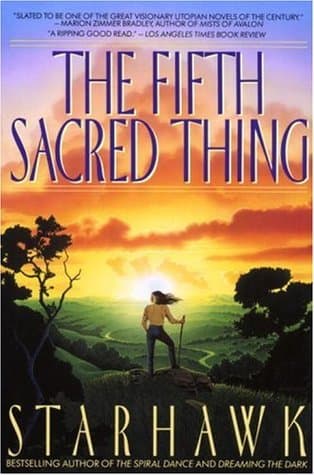
Starhawk (1993)
Genre
Fantasy / Spirituality / Science Fiction
Reading Time
12-16 hours (approx. 486 pages)
Key Themes
See below
Sign in to track this book
In a post-apocalyptic California, a peaceful, nature-revering San Francisco faces an existential threat from the militant, technocratic Hand of the new order, forcing a young woman to choose between ancient magic and modern warfare to protect her city's soul.
The story begins with Madrona, a young healer and gardener, living in the Free State of San Francisco. This city is peaceful and sustainable, built on principles of ecological harmony and the four sacred things: Earth, Air, Fire, and Water. It contrasts sharply with the technologically advanced, repressive Stewards of the South, who control the rest of California with strict social order and resource exploitation. Madrona, despite the city's peace, feels a coming threat. Her grandmother, Maya, a respected elder and seer, often speaks of the 'Fifth Sacred Thing' – the Spirit – and warns against complacency. Madrona prepares for a trip into the wild to gather herbs, a journey that shows their precarious existence.
The Free State's peaceful life ends when Steward scouts, heavily armed, appear on their borders. Their presence violates a long-standing truce, causing fear and determination in the city. Bird, a young warrior and Madrona's lover, is among the first to see the Stewards. The Free State, having removed most of its weapons and focused on defense, faces a moral problem: how to protect their way of life without betraying their non-violence. Debates happen in city councils, with some wanting defensive preparations and others a full commitment to peace, even with an invasion.
Jehanne, a skilled spy, goes on a dangerous mission into Steward territory to get information. She navigates the sterile, hierarchical society of the South, seeing the brutal enforcement of their laws, the genetic engineering of their elite, and the oppression of workers. Jehanne finds out the Stewards' plan: to destroy the Free State, which they see as a threat. She also uncovers a growing resistance among some disillusioned Stewards and enslaved workers, offering a bit of hope for an internal uprising. Her reports to San Francisco confirm their dire situation.
The Stewards launch their full invasion, their advanced weapons overwhelming the Free State's initial defenses. The city, unprepared for such an assault, suffers many losses. The Stewards use sonic weapons, chemical agents, and engineered soldiers, creating a terrifying battleground. Madrona, Maya, Bird, and others adapt quickly, using their knowledge of the land, healing skills, and collective spirit to resist. The invasion tests their peaceful society, forcing them to face war and its difficult choices. San Francisco's streets become a war zone, with every building and alley a potential battleground.
Despite the Stewards' technology, the Free State puts up a strong and unusual resistance. They use their knowledge of the city's layout, their tunnel network, and their connection to the land to create traps and diversions. Healers like Madrona work constantly, tending to the wounded and keeping morale high. The city's spiritual practices become a source of strength, with rituals reinforcing their collective will and belief in the Fifth Sacred Thing. Defenders, including warriors like Bird, use creative tactics, often avoiding direct fights for subtle resistance, such as disabling Steward technology or disrupting supply lines. Their love for home fuels their resilience.
The long siege brings internal conflicts to the surface. Some, like the more practical warriors, argue for aggressive tactics to repel invaders, challenging the city's pacifist ideals. Others, led by elders like Maya, insist on non-violence and compassion, even for enemies. Madrona is caught between these extremes, struggling with her desire for revenge and her commitment to healing. The debates are passionate, forcing the community to re-examine their society's core beliefs and how far they will go to protect it. The line between defense and aggression blurs.
As the war grows, the concept of the Fifth Sacred Thing – the Spirit, or collective will – becomes more powerful. San Francisco's people engage in communal rituals, meditations, and acts of compassion, even for captured Steward soldiers. This collective spiritual energy, with their commitment, shifts the atmosphere. Stories of healings and kindness spread, inspiring defenders and some Steward soldiers, who question their mission. This spiritual awakening becomes a potent, unseen weapon against the Stewards' cold, rational ideology.
Meanwhile, Jehanne, back in Steward territories, works to start a rebellion. She connects with disillusioned scientists, engineers, and enslaved workers, sharing information about the Free State's resilience and the Stewards' cruelties. Her efforts, combined with growing unease among some Steward officers who see the siege's futility, begin to succeed. Small acts of sabotage and defiance grow into a coordinated uprising within Steward ranks and cities. This internal disruption weakens the Stewards' war effort and diverts resources, creating a turning point.
The combination of the Free State's spiritual resistance and the growing rebellion within Steward territories begins to break the Stewards' will. Key Steward leaders are killed or defect, and their supply lines are cut. The Steward army's morale drops as they see the San Franciscans' spirit and dissent in their own ranks. The siege, once daunting, starts to fail. The Free State, though hurt, finds new strength in its unity and the power of the Fifth Sacred Thing, pushing back against the invaders.
The Stewards are forced to retreat, their invasion a failure. San Francisco is victorious but at a great cost. The city is damaged, and many lives are lost. The aftermath involves intense healing and rebuilding. Madrona and other healers work to mend physical and spiritual wounds. The war transforms survivors, deepening their commitment to principles while making them face darker human nature. The novel ends with the Free State beginning to rebuild, offering reconciliation to disillusioned people of the South, and facing the challenge of creating a sustainable and peaceful future.
The Protagonist
Madrona transforms from a gentle healer into a resilient leader, capable of both nurturing and defending her community.
The Supporting
Maya remains a steadfast beacon of spiritual wisdom, her teachings proving crucial to the Free State's survival.
The Supporting
Bird learns to integrate his warrior spirit with the Free State's spiritual principles, finding strength in both.
The Supporting
Jehanne successfully instigates a rebellion within the Steward territories, proving instrumental in their defeat.
The Antagonist
Jaguar's unwavering belief in Steward superiority is ultimately shattered by the Free State's resilience and internal dissent.
The Antagonist
General Hawk's military strategies are ultimately undermined by the Free State's unconventional tactics and the growing internal unrest within the Steward ranks.
The Supporting
River steadfastly upholds the Free State's principles, guiding her community through the moral and practical challenges of war.
The Supporting
Star grows from an eager young warrior into a seasoned defender, deeply committed to the Free State's future.
The novel explores the strength of a community that values cooperation, shared resources, and collective well-being over individual gain. The Free State of San Francisco, built on these ideas, faces a technologically stronger enemy but wins through unity, resilience, and non-violent resistance. Scenes of communal healing, shared meals, and democratic councils (like those Madrona attends) highlight this. The 'Fifth Sacred Thing' – the Spirit – shows that collective consciousness and compassion can be a strong force against oppression, as the city's unified spiritual energy affects Steward soldiers.
“What is the Fifth Sacred Thing? It is Spirit, it is life, it is the web of connection between all living things. It is the power that makes us human, and it is the power that will save us.”
A main theme is the contrast between two ways of living with Earth. The Free State of San Francisco practices radical ecological sustainability, living in harmony with nature, growing permaculture gardens, and reusing resources. Madrona's role as gardener and healer shows this connection. The Stewards of the South represent unchecked industrial exploitation, genetic manipulation, and a hierarchical society that sees nature as something to control for profit. Their sterile cities and disregard for the environment (e.g., destructive weapons) show the bad results of such an approach. The war itself becomes a battle for the planet's soul, between those who value it and those who want to control it.
“We are the Earth, and the Earth is us. When we hurt the Earth, we hurt ourselves. When we heal the Earth, we heal ourselves.”
The entire story centers on the conflict between radical freedom and absolute control. The Free State of San Francisco champions individual autonomy, diverse spiritual practices, and democratic self-governance, allowing citizens to live authentically. This freedom is clear in the city's art, music, and social structures. The Stewards, in contrast, impose a rigid, totalitarian regime, controlling every part of citizens' lives, from genetics to thoughts. Their society is built on fear, conformity, and surveillance, with harsh penalties for dissent. The war is not just for land but for the definition of human existence – whether it will be defined by liberation or by enforced order. Jehanne's infiltration into the South clearly shows the suffocating nature of Steward control.
“Freedom is not given; it is taken. And once taken, it must be defended with all your heart.”
The novel examines different forms of spirituality and how they become power. The Free State's spirituality is deeply connected to Earth, Air, Fire, Water, and the 'Fifth Sacred Thing' (Spirit/collective consciousness). Their rituals, healing practices, and communal bond are sources of inner and collective strength, allowing them to resist a powerful enemy. Maya's prophecies and Madrona's healing abilities are spiritual powers. The Stewards, while not religious, have a devotion to their scientific and genetic 'purity' and their hierarchical order, seeing themselves as chosen to rule. Their power is external, technological, and forceful. The conflict explores which form of power lasts longer and changes more.
“The greatest power is not the power to destroy, but the power to create, to heal, to love.”
A core spiritual and philosophical framework guiding the Free State.
These concepts are the ideological backbone of the Free State. The Four Sacred Things (Earth, Air, Fire, Water) represent the fundamental elements of life and ecological balance, informing their sustainable practices and respect for nature. The Fifth Sacred Thing (Spirit, or the web of interconnectedness, love, and collective will) emerges as the ultimate source of their power and resilience, especially during the war. It's a device that provides both moral guidance and, ultimately, a form of spiritual 'weaponry' against the Stewards' material and technological might, manifesting as collective consciousness and compassion that can disarm and even convert enemies.
A character with prophetic abilities who guides the community.
Maya, Madrona's grandmother, serves as the community's oracle or seer. Her prophetic visions and deep spiritual insights provide crucial warnings and guidance to the Free State. This device allows for foreshadowing of impending threats and reinforces the spiritual dimension of the story. Maya's pronouncements often frame the moral and existential dilemmas faced by the characters, reminding them of their core values and the deeper implications of their actions. Her wisdom is a non-material resource that the Free State possesses, contrasting with the Stewards' reliance on data and technology.
A clear geographical and ideological split that defines the conflict.
The physical division of California into the Free State of San Francisco and the Steward-controlled South is a crucial plot device. It visually and ideologically separates the two opposing worldviews, making their conflict tangible and immediate. This division creates a clear 'us vs. them' dynamic, heightening the stakes of the war. It also allows for distinct narrative arcs in each territory (e.g., Madrona's story in the Free State, Jehanne's infiltration of the South), showcasing the contrasting realities of life under each system and demonstrating that the conflict is not just external but also deeply internal for the people living within or between these zones.
The presence of dissent and rebellion within the antagonist's ranks.
The existence of a nascent resistance movement and the potential for defection among the Steward population and even within their military is a vital plot device. This prevents the Stewards from being a monolithic, unbeatable evil, adding complexity to the conflict. Jehanne's mission specifically aims to exploit and amplify this dissent. It suggests that even in the most repressive regimes, the human spirit for freedom can endure, and it provides a crucial strategic advantage for the Free State by weakening the Stewards from within. This device underscores the theme that true change often comes from within, not just from external force.
“The Earth is our mother, and we are her children. We must care for her, for she cares for us.”
— A fundamental teaching of the Free State, emphasizing ecological responsibility.
“There are four sacred things: the Earth, Air, Fire, and Water. The Fifth Sacred Thing is the spirit that moves among them, and binds them together.”
— A central tenet of the Free State's spiritual philosophy, explaining the title.
“We are the ones we have been waiting for.”
— A rallying cry within the Free State, empowering individuals to take action.
“Power is not domination. Power is the ability to create, to transform, to make things happen.”
— Reimagining the concept of power from a hierarchical to a generative perspective.
“The greatest magic is the magic of community, of people working together for a common good.”
— Highlighting the strength and efficacy of collective action in the Free State.
“Fear is a powerful weapon, but love is more powerful still.”
— Contrasting the oppressive tactics of the Stewards with the resilience of the Free State.
“Justice is not about punishment, but about healing and restoration.”
— Reflecting the Free State's approach to conflict resolution and societal harmony.
“Every act of kindness, every gesture of compassion, sends ripples through the universe.”
— Emphasizing the impact of individual actions on the larger world.
“To be truly free is to be connected to all things, to feel the pulse of life within and around you.”
— Defining freedom not as independence, but as deep interconnectedness.
“The past is not a prison, but a wellspring of wisdom if we choose to drink from it.”
— Encouraging learning from history without being bound by its limitations.
“There is no 'other.' We are all part of the same great web of life.”
— A core belief promoting inclusivity and dismantling divisions.
“The seeds of the future are always present in the now. What we plant today determines tomorrow's harvest.”
— A call to mindful action and responsibility for creating the future.
“Even in the darkest times, the light of hope can always be found, if you know where to look.”
— A message of resilience and optimism in the face of adversity.
“The greatest revolution begins within, in the transformation of our own hearts and minds.”
— Suggesting that societal change is rooted in personal growth and inner work.
Ready to see how well you understood this book? Take our interactive quiz with 10 questions.
Biography coming soon.







