“Sure never any Mortal was so persecuted, so torn, so mangled, so disfigured as I am, since I had the Misfortune to be born.”
— Araminta reflecting on her perceived misfortunes and the constant threats she imagines.

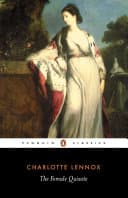
Charlotte Lennox (2020)
Genre
Historical Fiction / Romance
Reading Time
9-10 hours
Key Themes
See below
Sign in to track this book
An 18th-century heiress, raised on chivalric romances, creates comical chaos as she tries to live a knightly life in Georgian England.
Lady Arabella, the beautiful and smart daughter of a rich Marquis, lives a quiet life on her father's country estate. Her main companions are her governess and a large collection of 17th-century French heroic romances, which she reads with great passion. These books, full of tales of perfect heroines, brave knights, and elaborate courtly love, twist her view of reality. She starts to believe the world works by these romantic rules, expecting men to act like chivalrous suitors and women like besieged beauties. Her imagination is so taken over that she sees everyday events and talks through this warped lens, leading to many misunderstandings and funny problems.
Sir George Bellmour, Arabella's cousin and intended suitor, arrives at the Marquis's estate. He is a sensible and kind young man, truly drawn to Arabella. However, Arabella immediately labels him a 'lover' from her romances, expecting him to pass elaborate tests of loyalty and courage. She sees his direct attempts at conversation and affection as part of a complex romantic plot. She demands he perform silly feats and express his love in the exaggerated language of her books. As a man of reason, he finds this confusing. Their interactions are a constant source of humor, as Sir George tries to understand her expectations while Arabella believes he is just following a suitor's script.
The Marquis, Arabella's father, wants his daughter married and settled, especially to Sir George, whose character he approves of. But Arabella's romantic ideas are a big problem. She believes marriage can only happen after a long, hard courtship, full of trials, abductions, and heroic rescues, like in her favorite books. She rejects a simple, arranged marriage, insisting her suitor must prove his worth as a romantic hero. Her father's attempts to discuss practical matters are met with fantastical explanations and demands, leading to his frustration and the indefinite delay of any marriage plans.
One of Arabella's funniest delusions involves a young gardener's son. Seeing him near the estate, Arabella immediately decides he is a disguised prince, madly in love with her and planning an abduction. This is a common theme in her romances. She sees his innocent actions as secret signals and preparations for her 'capture.' This leads to a dramatic scene where Arabella, convinced of his evil yet romantic plans, 'escapes' or 'resists' him in a very theatrical way. This confuses the boy and amuses the servants who watch. This event further shows her complete separation from reality.
When Miss Glanville, a stylish and lively young woman, visits Arabella, she also becomes a victim of Arabella's romantic imagination. Arabella, seeing Miss Glanville's beauty and wit, immediately casts her as a 'rival' for Sir George's affection. She believes Miss Glanville is secretly in love with him and plotting against her. This makes Arabella treat Miss Glanville with suspicion and disdain, interpreting every polite interaction between Miss Glanville and Sir George as proof of a secret affair. Miss Glanville, completely confused by Arabella's accusations, is deeply offended. This creates awkward social situations and shows how Arabella's delusions isolate her.
Arabella's delusions become dangerous during a visit to Bath. Believing Sir George is trying to prove his love by staging a dramatic 'abduction' or 'rescue' (as in her romances), she misinterprets a gentleman's genuine attempt to help her with a minor accident near the water. Convinced he is a villain trying to carry her off, she dramatically throws herself into the river to escape. This public scene not only risks her life but also greatly embarrasses her family and friends, especially Sir George. He is forced to rescue her and see her complete loss of touch with reality in front of society.
After the humiliating incident at Bath, Arabella's father and Sir George realize her romantic obsession has become a serious problem for her well-being and future. They decide to ask Sir Charles Glanville for help. He is a wise and respected clergyman, known for his intelligence and persuasive arguments. Sir Charles learns about Arabella's unique condition and agrees to try and free her from her romantic delusions. His method is not ridicule, but gentle, logical argument. He aims to show her the impracticality and absurdity of applying fictional stories to real life.
Sir Charles Glanville talks with Arabella in a thoughtful way. Instead of confronting her directly or mocking her beliefs, he patiently and logically examines heroic romances. He points out their historical mistakes, moral flaws, and impractical plots and characters. He explains how such stories, while entertaining, offer a dangerous and unrealistic model for real-world behavior and relationships. He gently guides her to understand the difference between literary rules and actual human nature, slowly but surely breaking down her fantastical worldview through reason and eloquent discussion.
Through Sir Charles's patient and reasoned arguments, Arabella slowly begins to see her mistakes. She starts to question the absolute truth of her cherished romances and recognizes the absurdity of her past actions. The logical problems and impracticalities Sir Charles pointed out resonate with her intelligence. She has a big change in how she sees things, realizing the world is not a grand stage for heroic deeds but a place of ordinary human interactions and real, though less dramatic, emotions. This awakening is gradual but significant, leading her to regret her past behavior and embrace a more rational understanding of life.
With her romantic delusions gone, Arabella can see Sir George Bellmour for who he really is: a kind, sensible, and truly loving man. She understands his sincere affection, free from the need for dramatic displays or elaborate tests. Her acceptance of reality allows her to appreciate his steady devotion and good character. The novel ends with Arabella, now a balanced and rational young woman, agreeing to marry Sir George. Their future will be based on mutual respect and understanding, not the fantastical ideas of her past imagination. Her journey from delusion to enlightenment is complete.
The Protagonist
Arabella transforms from a delusional young woman, trapped in a fictional world, to a rational and sensible individual who embraces reality and genuine affection.
The Supporting
Sir George maintains his steadfast love and patience, eventually being rewarded when Arabella returns to her senses and accepts his genuine affection.
The Supporting
The Marquis moves from exasperation and mild attempts at intervention to seeking professional, intellectual help for his daughter's condition.
The Supporting
Sir Charles's arc is primarily one of intervention and resolution, successfully guiding Arabella back to reality through intellectual discourse.
The Supporting
Miss Glanville remains a consistent voice of reason and conventional society, serving as a foil to Arabella's delusions.
The Supporting
The Governess remains largely static, a witness to Arabella's delusions rather than an active agent in her cure.
The Mentioned
The gardener's son has no character arc; he merely serves as a catalyst for one of Arabella's delusions.
The Supporting
Mr. Hervey's arc is brief, serving to demonstrate Arabella's consistent adherence to her romantic delusions.
The novel mainly explores the dangers of letting fictional stories control how one sees reality. Arabella's full immersion in French heroic romances makes her misunderstand social interactions, romantic intentions, and even simple events, causing embarrassment, danger, and isolation. Her story is a warning against confusing art with life, especially for young, easily influenced minds without enough real-world experience. The Bath incident, where Arabella throws herself into the river, clearly shows the physical danger of her delusions, while her social mistakes highlight the problems it causes with others.
“She was not born to lead a common life; her mind was formed to nobler views, and she was determined to act in every scene of life, as the heroines of romance had acted before her.”
The novel also supports the power of reason and good education in forming a balanced mind. Sir Charles Glanville's careful and logical arguments, which gently break down Arabella's romantic worldview, show the importance of critical thinking and rational discussion. His approach, based on Enlightenment ideas, demonstrates that intellectual persuasion, not ridicule or force, is the best way to correct wrong perceptions. Arabella's eventual recovery shows how reasoned argument can change someone and the value of basing one's understanding of the world on facts and logic.
“Reason, when it can once gain an audience, seldom fails of success.”
The novel subtly examines the limited roles available to women in 18th-century society, especially those in the upper classes. Arabella's isolation and her reliance on books for companionship may be a result of societal limits on women's power and education. Her romantic delusions, though extreme, also show a desire for a life of passion and importance beyond the home, a desire her society largely denied. The expectation for her to marry and settle, compared to her fantastical ideals, shows the conflict between personal dreams and societal norms for women.
“A young lady, bred in the country, and who has no other employment than reading, is very apt to contract a romantic turn of mind.”
The novel compares two different views of love and courtship: the exaggerated, theatrical, and often absurd depictions in heroic romances versus the more realistic, quiet, and genuine affection shown by characters like Sir George Bellmour. Arabella's demands for elaborate trials and poetic declarations highlight how impractical it is to apply fictional romantic ideals to real relationships. The ending, with Arabella accepting Sir George's sincere but undramatic love, argues for a type of affection based on mutual respect, understanding, and shared reality, rather than grand gestures and impossible feats.
“True love, Madam, is not a fever of the mind, but a calm, steady, and rational preference.”
A character whose mind is warped by reading too much fiction.
This is the central plot device, directly referencing Cervantes' *Don Quixote*. Lady Arabella is a 'female Quixote,' whose mind is so thoroughly saturated with 17th-century French heroic romances that she perceives the real world through their lens. This device drives all of her actions, misunderstandings, and the comedic elements of the novel. It allows for the exploration of the dangers of unchecked imagination and the contrast between fiction and reality, as Arabella continually misinterprets everyday events as grand romantic adventures.
Humorous ridicule of a literary genre and societal norms.
Lennox uses satire and parody to critique the excesses of the heroic romance genre, which was popular in her time. Arabella's absurd interpretations and actions are a direct parody of the improbable plots, exaggerated sentiments, and unrealistic characters found in these romances. Beyond literary critique, the satire also extends to societal expectations, particularly concerning women's education and courtship rituals, highlighting their potential for fostering delusion or limiting rational thought.
Letters and stories within the main narrative.
While not a purely epistolary novel, 'The Female Quixote' incorporates letters and embedded narratives, particularly when Arabella recounts 'her story' or 'her lover's story' in the convoluted, anachronistic style of her romances. These moments serve to reinforce her delusional state and allow the author to directly showcase the style she is critiquing. Sir Charles Glanville also employs narratives and logical arguments within their discussions, acting as a counterpoint to Arabella's fictional tales.
Characters who highlight the protagonist's traits through contrast.
Several characters serve as foils to Arabella. Sir George Bellmour, with his sensible and genuine affection, highlights the absurdity of Arabella's demands for theatrical courtship. Miss Glanville, a conventional and rational young woman, contrasts sharply with Arabella's romanticized view of female relationships. Most significantly, Sir Charles Glanville, representing Enlightenment reason and logical discourse, acts as the ultimate foil, providing the intellectual antidote to Arabella's unchecked imagination and emotional excess.
“Sure never any Mortal was so persecuted, so torn, so mangled, so disfigured as I am, since I had the Misfortune to be born.”
— Araminta reflecting on her perceived misfortunes and the constant threats she imagines.
“For my part, I am very well satisfied, that I have done my Duty, and have not suffered a Spot to fix upon my Honour.”
— Araminta, after a dramatic encounter, believing she has preserved her reputation, despite causing a scene.
“I am not to be imposed upon, I know the World, and am not to be deceived by appearances.”
— Araminta confidently asserting her worldly knowledge, ironically, while being completely deluded.
“What! shall I suffer myself to be treated with such Indignity? No, I will die a thousand Deaths first.”
— Araminta reacting with extreme indignation to a perceived slight, often a misunderstanding.
“A Lady, who has any regard for her Honour, ought to be prepared for all Accidents.”
— Araminta expressing her belief in constant vigilance and preparation for imagined dangers to her honor.
“My Life is one continued Series of Adventures, and I am perpetually meeting with new ones.”
— Araminta describing her life, which she views through the lens of romance novels, as a constant adventure.
“It is not for a Lady of my Quality to be seen without her Attendants.”
— Araminta insisting on maintaining proper decorum and status, even in inconvenient situations.
“I am not to be governed by the arbitrary Will of another, but by my own Reason.”
— Araminta asserting her independence, though her 'reason' is often skewed by her romantic fancies.
“You are a very impertinent Fellow, to talk to a Lady of my Rank in such a Manner.”
— Araminta rebuking a man for what she perceives as disrespectful or overly familiar address.
“I perceive you are one of those who imagine that a Woman has no Business but to love, and be beloved.”
— Araminta, surprisingly, articulating a more nuanced view of women's roles, though often contradicting it.
“I will never suffer myself to be confined, or to have my Liberty infringed upon.”
— Araminta's strong desire for freedom, often leading her into precarious situations.
“This is a most cruel and barbarous Treatment! I am used worse than any Slave.”
— Araminta's dramatic overreaction to a minor inconvenience or perceived mistreatment.
“I am not to be bought and sold like a common Commodity.”
— Araminta asserting her worth and refusing to be treated as an object in marriage negotiations.
“There are some Men, who, for the sake of an Estate, would marry a Woman with a wooden Leg.”
— Araminta, with a rare moment of cynical realism, observing the mercenary aspects of marriage.
“My Honour is dearer to me than my Life.”
— Araminta's steadfast belief in the paramount importance of her reputation and virtue.
Ready to see how well you understood this book? Take our interactive quiz with 10 questions.

Charlotte Lennox, née Ramsay, was a Scottish novelist, playwright, poet, translator, essayist, and magazine editor, who has primarily been remembered as the author of The Female Quixote, and for her association with Samuel Johnson, Joshua Reynolds and Samuel Richardson. However, she had a long, productive career in her own right.







